Loan modification software, in the sense a mortgage servicer buys it, takes a delinquent borrower's complete application and the loan's servicing data and works out which of the investor's home retention options the borrower gets, with the payment, rate, term and partial claim, and the reasons for every option not offered. The way to judge any of it is not a demonstration on the vendor's sample loan but a replay on yours: take a quarter of files your team has already decided, run them through the software under the rule version in force on each decision date, and make the vendor explain every case where the two disagree. That test finds the three faults that matter in this work (a rule applied on the wrong date, an earlier partial claim not counted, and a stale market rate) and it shows how the product behaves where your own decisions were wrong. Botminds' Loss Mitigation Waterfall Decisioning was built to pass that test: agents read the file and run the investor's waterfall with the arithmetic shown, and the workout underwriter signs.
The pressure to buy comes from rule change, not volume alone. The rulebooks move faster than any procedure manual.
Why loss mitigation rules outrun the spreadsheet
25
archived versions of HUD Handbook 4000.1 between September 2014 and August 2025
HUD handbook archive
11
mortgagee letters HUD issued in 2026 by early October, one of them on loss mitigation
HUD mortgagee letter index
21,175
permanent modifications completed by Fannie Mae and Freddie Mac in Q2 2026 alone
FHFA foreclosure prevention report
What is loan modification software, and what should it decide?
It should decide nothing; it should prepare a decision a person can defend. The work it takes over has four parts: identify the loan's owner and the rule version in force on the evaluation date; establish the inputs (balance, arrears, escrow, earlier workouts, the week's survey rate); run the owner's options in the owner's order with the owner's targets and caps; and draft the notice. The CFPB's own assessment of the 2013 servicing rules records what servicers found hardest: the loss mitigation provisions "were the most burdensome to implement, largely due to the requirement to evaluate borrowers for all available options and provide a comprehensive decision letter", and large servicers said building the process "to insert the appropriate denial reason language into loss mitigation determination letters was a major challenge and required significant labor hours" (CFPB, 2013 RESPA Servicing Rule Assessment Report, 2019).
What stays with people is the judgement Regulation X and the investors assign to them: the signature on the decision, the second signature where the servicer's policy requires one, the appeal heard by different personnel, and the files the investor reserves for itself. Software that blurs those lines creates the exam findings described below.
What kinds of loan modification software are there?
Four kinds of product are sold for this work, and they differ in where the investor's rules live and who can see them working.
Four kinds of loan modification software, and what each leaves to the underwriter
| Kind | Where the investor rules live | What the underwriter sees | What a replay tests |
|---|---|---|---|
| Default management module in the servicing system | Workflow steps and form letters; the waterfall arithmetic often sits outside | Tasks, dates and documents | Clocks and notices, rarely the arithmetic |
| Calculators and spreadsheets | In the formulas, maintained by whoever last edited them | Inputs and a result | Whether the formulas match the rule in force on the date |
| Rules or decision engine | Coded rule tables, versioned by IT release | A result and a reason code | Rule versions by date; inputs still keyed by people |
| Agents that read the file and run the rules | Dated rule sets the compliance analyst approves, with tests | Each step with its rule, inputs and arithmetic, and the documents behind each input | Rule versions, inputs read from documents, and the notice |
How to test loan modification decisioning: replay last quarter
A replay answers the buyer's real question, which is not "can it compute a 40-year payment" but "what would it have done differently on our files, and who was right". Run it in five steps.
Choose the files. Take every decided complete application from one recent quarter, or a few hundred if volume is high, across every investor you service for. Include denials and files that ended in a disposition option, not only approvals, and include the files that went to appeal.
Load the rules as they were. The replay is only fair if each file runs under the version in force on its own evaluation date. A quarter that spans 1 October 2025 has two FHA rulebooks in it; one that spans 1 May 2025 has two VA ones, because VA rescinded its home retention waterfall that day (VA Circular 26-25-2). A vendor that cannot run a file under last year's rule cannot help with an appeal, an investor review or an exam.
Give it the file, not the answers. Provide the documents and servicing data your underwriters had, and hold back their decisions. If the product reads the documents itself, you learn whether it finds the inputs; if it needs keyed inputs, you are testing your keying as much as the product.
Compare four things. The option offered, the terms (payment, rate, term, claim amount), the reasons for each option not offered, and the dates (decision within 30 days, acceptance window, trial plan).
Explain every difference. Each disagreement goes into one of the cells below, and someone signs which side was right.
Every disagreement between a decision and its replay falls into one of four cells
Agreement. Check a sample by hand anyway: two tools can share one mistake.
A payment, rate or claim amount moved. Usually a stale survey rate, escrow treatment or an arrears figure.
The original used a rule not in force on its date, such as an 18-month limit after 1 October 2025.
An earlier partial claim not counted, a wrong default date, a misread hardship. The file, not the rule, was wrong.
What did the CFPB find about automatic denials?
It found servicers whose process denied an option the investor wanted to see. In its spring 2024 servicing edition the CFPB reported that "the servicers did not follow investor guidelines for evaluating loss mitigation applications when they automatically denied certain consumers a payment deferral option rather than submitting the consumers' applications to the investor for review", in breach of the policy requirement in 12 CFR 1024.38(b)(2)(v); the servicers "refunded or waived late charges and corrected negative credit reporting" (CFPB Supervisory Highlights, Issue 33).
That finding is the one to look for in a replay, because automation makes it easy to commit at scale. A rule table that ends a waterfall at "not eligible" when the investor's guide says "refer to investor" will deny every such file the same way, quickly and consistently. Ask the vendor to show, on your files, which outcomes the product sends to a person or to the investor rather than deciding, and how the rule set marks them. The same issue found notices sent late and one servicer's notices that gave no deadline to accept or reject an offer; both are easy replay checks.
Regulation X's commentary sets a second test for any system that stops at the first failed criterion. A servicer may disclose only the reasons on which the borrower was actually evaluated, but must then add a "notification that the borrower was not evaluated on other criteria" (comment 41(d)-4). Software that short-circuits must say so in the notice.
How to QC loss mitigation decisions: five causes worth sorting by
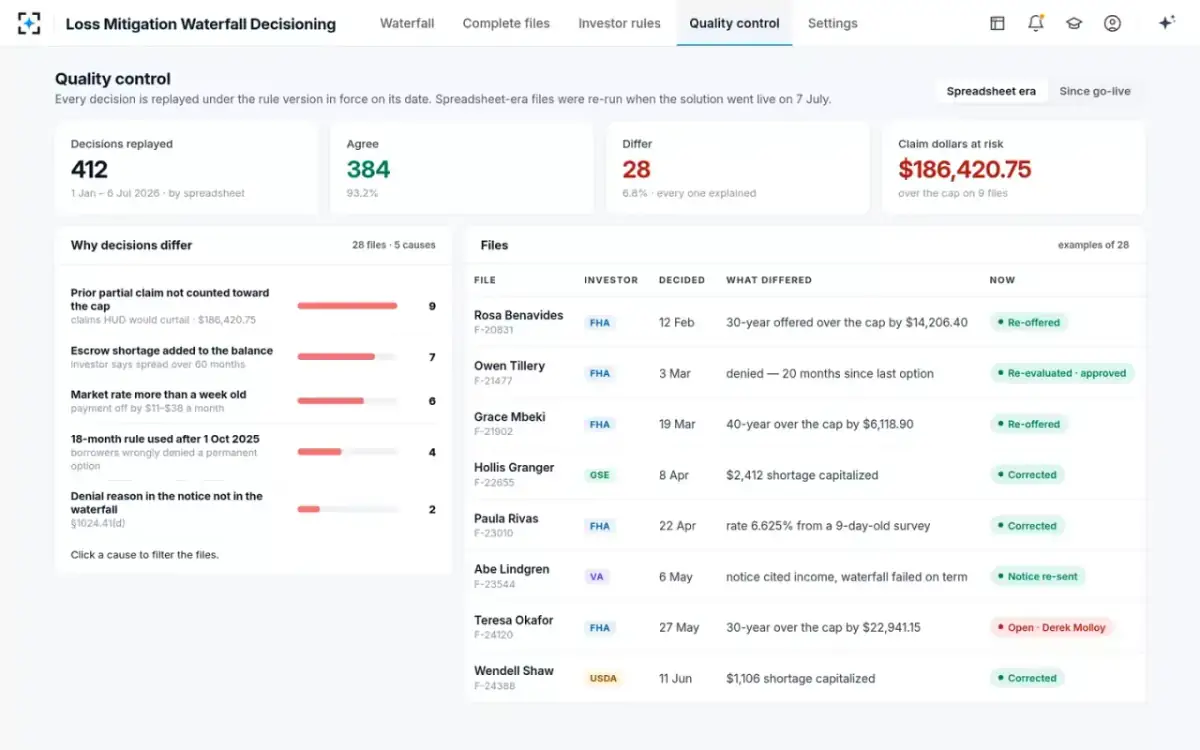
Sort the differences by cause, not by investor, because causes point to the fix. Five recur in this work, and the solution's own sample replay shows them in a plausible mix. Take the fictional servicer's 412 decisions from the first half of 2026, made by spreadsheet before go-live and replayed under the rule in force on each date: 384 agree (93.2%) and 28 differ.
Why 28 of 412 spreadsheet decisions changed on replay, by cause
The four rule-driven causes are exactly the ones a spreadsheet cannot keep up with. An earlier claim is a fact about the loan's history that someone must look up; FHA requires the servicer to verify every earlier partial claim and supplement in HUD's portal and to add any it knows of that are not reported there (ML 2025-12). The survey rate changes every Thursday. And the 24-month rule is a single number in a 251-page letter that replaced another 251-page letter. FHA partial claim requirements sets out the cap arithmetic the first cause gets wrong.
A replay that explains each difference by its cause
How accurate are loss mitigation decisions? What a replay can and cannot tell you
No regulator publishes an error rate for workout decisions, so the only accuracy figure you can trust is your own. A replay gives you two: how often your past decisions differ from the rule (the sample servicer's 6.8%) and, once you have checked the differences by hand, how often the product was the side that was wrong. Ask for both, and ask the vendor to commit to the second before the replay starts.
Be careful with what a replay cannot show. It checks a decision against the rule and the documents; it cannot tell you whether the documents were complete, whether the borrower's hardship was real, or whether a borrower who was never evaluated should have been. Those belong to intake and QC sampling. And a disagreement is not automatically the old decision's fault: a product that miscounts the cap will "find" errors that are its own.
What to ask a loan modification software vendor
Ask questions the vendor can only answer on screen, on your files. The eight below map to the replay and to the exam findings above.
Eight questions to put to loan modification software before you buy
- Which rule version decided this file, and can you rerun it under last year’s?
Every decision should carry its version and effective date, and replay under it later.
- Where did each input come from?
The page of the pay stub, the servicing field, the HUD portal for earlier claims, the survey week for the rate.
- Show the arithmetic for every step, including the steps that failed
A denial reason is only as good as the computation behind it.
- Which outcomes go to a person or the investor instead of being decided?
The CFPB found automatic denials of options the investor wanted to review.
- How does a new mortgagee letter or circular become a rule?
Who drafts it, who approves it, what is tested before it goes live.
- Does the notice say when the borrower was not evaluated on other criteria?
Comment 41(d)-4 requires it for systems that stop at the first failure.
- Can the appeal reviewer see the first decision without redoing it?
Regulation X requires different personnel; they need the same trace.
- What does it never do?
It should never approve, deny, send a notice or change the loan in your servicing system.
Where Loss Mitigation Waterfall Decisioning fits, and where it does not
Botminds' Loss Mitigation Waterfall Decisioning sits between a complete application and a signed decision. Six agents read the package and the servicing history, pick the investor rule set in force on the evaluation date (FHA, VA, USDA, GSE, your portfolio policy and private-label trusts by their servicing agreements), run every step with the arithmetic shown, and draft the evaluation notice. The workout underwriter decides and signs; a team lead co-signs above your threshold; QC replays any decision under its own date's rules. In the sample servicer, the six agents read a 23-document file and ran its waterfall in 44 seconds.
The notice is checked against Regulation X before anyone signs
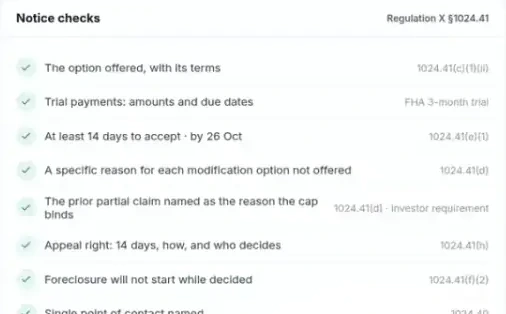
Be clear about the edges. It is not a servicing system: it reads balances, escrow and earlier workouts and never writes to them. It does not collect or chase the application; that is intake work, done before the file is complete. It does not decide what the investor has kept for itself; those files go to the investor with the evaluation attached. It needs your rule sets in the form you hold them (for GSE loans, the servicing guide your team works from) and your notice templates. And it is only as current as the compliance analyst who approves each new version, which is why every version is tested against past decisions before it goes live.
What does loan modification software cost, against the work it replaces?
List prices are rarely published, so price the work. Our estimate for a complete file decided by spreadsheet puts the elapsed time from complete to signed at about eleven working days: five waiting in the queue, a day reading the package and reconciling it, a day on the loan history and earlier claims, a day and a half on rule version, rate and arithmetic, a day drafting the notice and a day and a half for review and co-signature. The reading, arithmetic and drafting days are the term software can change; multiply the hours inside them by your volume and your underwriters' loaded cost, and measure your own before you trust ours.
The larger term is the cost of a wrong decision: an offer over the partial claim cap that must be re-offered, a denial that should have gone to the investor, a borrower re-evaluated after an appeal. Your replay prices those directly, because it tells you how many of last quarter's files would have needed rework. Four things move any vendor's price: the number of investor rule sets, the number of document types read, the connection to your servicing system, and whether notices are drafted. Budget separately for the analyst time to approve rule versions, and for your second line to validate a tool that shapes decisions.
How those numbers turn into value for the borrower, the payment cut each option delivers, is the subject of the mortgage loan modification calculator. The Loss Mitigation Waterfall Decisioning page lists the agents and what each is never allowed to do.
Questions people ask
Is loss mitigation software the same as loan modification software?
Loss mitigation software is the wider category: it covers early intervention, application intake, forbearance, repayment plans and disposition options as well as modifications. Loan modification software usually means the decisioning part, where the investor's waterfall is run and terms are computed.
How many files does a fair replay need?
Enough to include every investor and every outcome you see, including denials and appeals: a full quarter is the simplest rule. The sample servicer replayed 412 decisions from six months; 28 differences were enough to show five distinct causes.
Does Regulation X require servicers to test their decisioning software?
Not in those words. It requires policies and procedures "reasonably designed" to identify "all loss mitigation options for which borrowers may be eligible" under the owner's requirements (12 CFR 1024.38(b)(2)), and the responsibility stays with the servicer whatever tool it uses. Testing is how a servicer shows the design is reasonable.
Can the software handle GSE Flex Modifications?
It should, as one rule set among several: FHFA's Flex Modification aims for a 20% cut to principal and interest through rate, term and principal forbearance. Ask to see a GSE file and an FHA file replayed side by side, since the two use different targets, rates and caps.
How long does a replay take?
With agents reading the files, the run itself is minutes per hundred files; the time goes on explaining the differences. Plan a few days for an underwriter and a QC reviewer to sign each one, and agree beforehand who decides which side was right.