The loan modification underwriting process starts when a delinquent borrower's application is complete and ends when a workout underwriter signs a decision: identify the loan's owner and the rule version in force, fix the inputs, test the owner's options in order, set the terms, and send a written notice within 30 days, after which the borrower has a window to accept or appeal and, if accepted, three months of trial payments before the modification becomes permanent. Most servicers run the middle of that process in spreadsheets that trail the latest mortgagee letter, and the underwriters who run them are rightly wary of any tool that asks them to sign numbers they cannot see being made. Botminds' Loss Mitigation Waterfall Decisioning gives the reading and the arithmetic to agents and shows every step with its rule, so underwriters keep the decision. This guide is for the manager who has to change the process without losing the people who make it work.
The process is long, rule-bound and heavily documented
30days
from a complete application to a written decision, when it arrives more than 37 days before a sale
12 CFR 1024.41(c)(1)
3months
of trial payments before an FHA permanent modification can be signed
HUD ML 2025-12
0.69hours
HUD’s average for each of 3.4 million FHA default servicing responses a year
HUD, 2026
What is the loan modification underwriting process, step by step?
Six steps, each with its own owner and clock. Regulation X sets the outer frame; the investor sets the substance; the servicer's policy sets the signatures.
Complete. The application is complete when the servicer has everything it requires to evaluate the borrower for all options. Regulation X requires an acknowledgement within five business days saying whether it is complete; FHA defines a complete request as one with everything needed for all its home retention and disposition options, at minimum the hardship reason and occupancy.
Evaluate. Within 30 days the servicer must "evaluate the borrower for all loss mitigation options available to the borrower" (12 CFR 1024.41(c)(1)). This is the underwriting proper: the owner's rule set, the inputs, the waterfall, the terms.
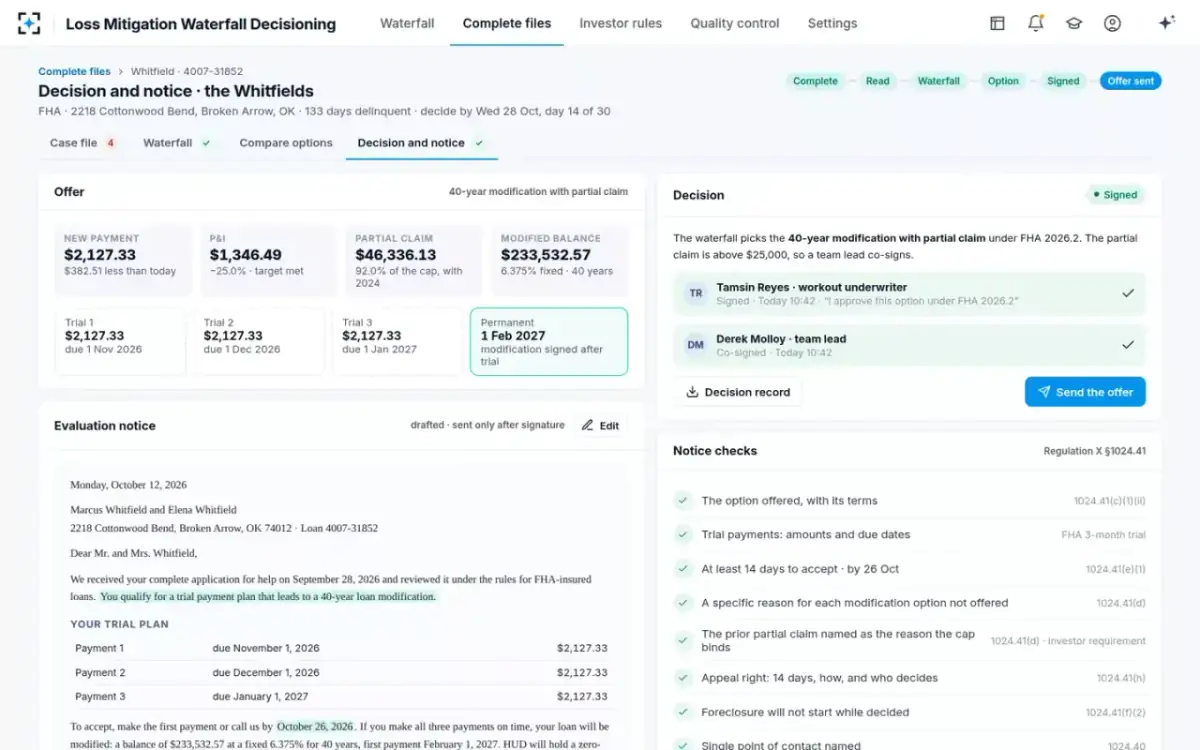
Decide and sign. The underwriter signs; a second signer joins where policy requires it, typically above a partial claim threshold or where no home retention option fits.
Notify. The notice states the option offered, the time to accept (at least 14 days when the application was complete 90 or more days before a sale, at least 7 when it was between 90 and 37), the specific reason for each modification denied, and the appeal right where it applies.
Trial. For FHA, three trial payments at the projected permanent payment, with the agreement in the borrower's hands at least 15 days before the first one is due.
Permanent. After a successful trial, FHA requires the modification documents to be effective "no later than the first Day of the second month following the final TPP month", and sent to all parties at least 15 days before that date (ML 2025-12).
How long does loan modification underwriting take?
The underwriting itself may take up to 30 days from a complete application; the whole path to a permanent modification takes four to five months, and most of that is fixed by rule. The figure below draws one FHA file both ways: decided on the last permitted day, and decided on day 4, the median the solution's sample servicer reached after go-live.
Only the first stretch of a loan modification is the underwriter's to shorten
- Evaluation30 d
- Time to accept14 d
- Before first trial payment15 d
- Evaluation4 d
- Time to accept14 d
- Before first trial payment15 d
Twenty-six days sound modest against five months, but they fall at the worst point. Until the decision goes out, the borrower is still delinquent, still accruing arrears and still uncertain; and on an FHA loan the servicer may be working against HUD's separate deadline to evaluate a default "before four monthly installments are due and unpaid" (ML 2025-12).
Where the underwriter's hours go today
Most of the elapsed time is waiting, and most of the working time is reading and arithmetic. The solution's own estimate splits a complete file's working days, from complete to signed, like this.
Where a complete file's working days go, by spreadsheet and with agents (estimate)
By spreadsheet · about 11 working days
- Waiting for an underwriter · 45%
- Reading the package · 9%
- History, earlier claims, escrow · 9%
- Rule version, rate, arithmetic · 14%
- Drafting the notice · 9%
- Review and co-signature · 14%
With agents preparing · about 4 working days
- Waiting for an underwriter · 77%
- Reading, history, arithmetic, notice · 10%
- Review and co-signature · 13%
The second bar has a lesson for managers: once the reading and arithmetic shrink, the queue is most of what is left, and the queue is a staffing and prioritization question. Ordering files by their Regulation X deadline rather than by arrival date is the cheapest change a team can make, with or without software.
Will automation replace loss mitigation underwriters?
No, and the rules are written so that it cannot. Regulation X assigns the evaluation, the notice and the independent appeal to the servicer's personnel; FHA requires the servicer to obtain the borrower's affordability attestation; investors reserve some decisions for themselves. What changes is the job's content. The underwriter stops rebuilding the waterfall and starts checking it: are the inputs right, is the rule version right, does the arithmetic hold, should this file go to the investor.
Regulators have not endorsed AI for loss mitigation, and a manager should not imply they have. The nearest statement is FHFA's guidance to Fannie Mae and Freddie Mac, revised in May 2025, which "encourages the responsible innovation and use of AI/ML that is consistent with the safe and sound operations of the Enterprises" and treats uses that affect compliance with laws as high risk (FHFA Advisory Bulletin 2022-02). The practical reading for a servicer: agents may prepare, people decide, and every step is reviewable.
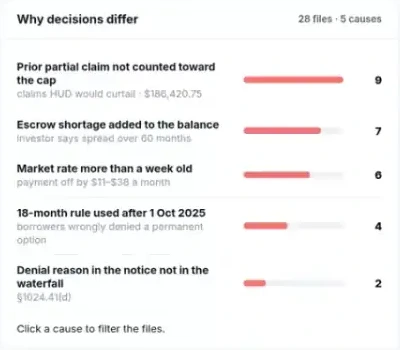
What the second line sees: every disagreement with its cause
How often are loss mitigation appeals successful?
Not often, and the CFPB's own data show the appeal right did not change that. Comparing 2015 with 2012, its assessment of the servicing rules found that "a larger share of borrowers who completed loss mitigation applications appealed", that "the proportion of appeals that were successful was lower post-Rule", and that "the net effect was that there was no increase in the likelihood that a borrower whose application was denied successfully appealed that denial". Large servicers told the CFPB it is "uncommon for a loan modification denial to be reversed as a result of an appeal", and that reversals typically come when "the borrower provided new income documentation" (CFPB assessment, 2019).
Read that as a design brief for the process, not as comfort. If appeals rarely reverse, an appeal is a weak check on the first decision, so the first decision must carry its own evidence. And when an appeal does turn on new information, the reviewer, who must be different personnel under 12 CFR 1024.41(h)(3), needs to rerun the same steps with one input changed, not start over.
The net effect was that there was no increase in the likelihood that a borrower whose application was denied successfully appealed that denial.
CFPB, 2013 RESPA Servicing Rule Assessment Report
How to roll out a new waterfall without losing the team: four stages
Roll out in stages that each give underwriters a reason to trust the next one, and treat every disagreement as material for training rather than as a vote on the tool. The sequence below is the one the solution is designed for.
Four stages from spreadsheet to signed decisions with agents preparing
- Stage 1 · Replay a closed quarter
Run decided files under the rule version in force on each date. Underwriters and QC explain every difference and agree which side was right.
- Stage 2 · Run alongside
For a few weeks underwriters decide as usual; the agents prepare the same files. Compare before signing, discuss each mismatch at the daily huddle.
- Stage 3 · Agents prepare, underwriters sign
Underwriters work from the prepared file, with what-if inputs for anything they doubt. QC re-tests every decision for the first month.
- Stage 4 · Steady state
QC falls back to a sample (in the sample servicer, every 40-year modification and 5% of the rest). New rule versions are replayed before they go live.
- Throughout · Keep the appeal seat apart
The appeal reviewer is never the first underwriter or the co-signer, and reads the same trace.
- Throughout · Write down every rule question
Questions underwriters raise become test cases for the next rule version, approved by the compliance analyst.
The stage people skip is the first, and it is the one that wins the team. A replay turns an abstract claim ("the agents are accurate") into a list of files the underwriters know, with a reason against each one. In the sample servicer, nine of the 28 differences were earlier partial claims nobody had counted against the cap. An underwriter who sees her own team's miss explained step by step is far more likely to trust the next file than one shown a demonstration.
How to train loss mitigation underwriters on a rule that changes every year
Train on changes, not on manuals. FHA's January 2025 letter, ML 2025-06, ran to 251 pages and was to take effect in February 2026; three months later ML 2025-12 "updates and replaces ML 2025-06" and brought the date forward to 1 October 2025 (ML 2025-12; ML 2025-06). The CFPB's own proposal to replace the complete-application framework, published in July 2024, sits on the federal agenda at the final rule stage with a target of August 2026 and has not been finalized (Unified Agenda, RIN 3170-AB04). An underwriter who learned the 2024 rules from a binder is out of date twice.
Three habits work better. Teach each new letter as a list of differences, each with a test file that changes outcome under it (the 18-to-24-month change needs only one file, a borrower whose last option was 20 months ago). Teach the arithmetic once, with the appendix open, so underwriters can check any step the agents show. And make the rule version visible on every file, so "which rules did we use?" never needs an answer from memory.
Every signature carries its meaning and its rule version
What the first ninety days should measure
Measure what the borrower and the examiner would notice, not what the tool reports about itself. Six numbers cover it: the share of complete files decided inside 30 days and the median day of decision; the replay disagreement rate on QC's sample, with each difference's cause; notices re-sent or corrected; offers withdrawn and re-made; appeals filed and reversed; and the time a co-signature waits. The CFPB's spring 2024 findings name the failures these catch: notices that "did not provide timely notices", and notices that "did not provide a deadline for accepting or rejecting loss mitigation offers" (Supervisory Highlights, Issue 33).
The sample servicer reports every file decided inside its clock since go-live, at a median of day 4. Your own first-quarter figures, measured the same way, are what the team should see. Who signs a loss mitigation decision describes each seat in the chain, and testing on decisions you already made describes the stage 1 replay in full. The Loss Mitigation Waterfall Decisioning page lists what each agent is never allowed to do.
Questions people ask
How long does a loan modification take?
From a complete application, about four to five months to a permanent FHA modification: up to 30 days for the decision, a window to accept, three trial payments and the documents. The time before the application is complete, gathering documents, comes on top and varies most by borrower.
What happens during loan modification underwriting?
The underwriter confirms the loan's owner and rule version, establishes the balance, arrears, escrow and earlier workouts, tests each option in the owner's order with its target and cap, sets the terms of the first option that fits, and drafts the notice with the reason for every option not offered.
Do borrowers have to send pay stubs for a loan modification?
It depends on the investor. FHA does not require financial documentation and forbids using it to disqualify a borrower, apart from hardship documentation for some hardship types. GSE and USDA evaluations use income, USDA explicitly targeting a payment near 31% of gross monthly income.
Can the underwriter change the decision after the notice is sent?
A corrected decision means a new notice, and it should be logged as a correction with its cause. If the borrower appeals, a different reviewer decides within 30 days, and that decision is not open to further appeal.
How many underwriters does a servicer need?
Enough to decide every complete file inside 30 days with time for a second signature. Count complete files a week, multiply by hands-on hours per file, and add the co-signer's time; the hours per file are the number software can change, and the queue is the number staffing changes.