FHA partial claim requirements in 2026 come from HUD Handbook 4000.1 as revised by Mortgagee Letter 2025-12. A partial claim is HUD's reimbursement of money a servicer advances to reinstate a defaulted FHA loan, and where needed to defer principal, secured by a zero-interest note and subordinate mortgage to HUD that is not repaid until the loan is paid off, sold, assumed or matures. A standalone partial claim requires that the borrower attest they can resume the current payment, that the claim fit within the room left under FHA's cap, and that the borrower complete a three-month trial plan; it must be at least $1,000. The rule that decides most files, though, is the cap: all partial claims and payment supplements on the loan together "must not exceed 30 percent of the Mortgage's unpaid principal balance, as of the date of Default at the time of payment of the initial Partial Claim and will remain constant for the life of the Mortgage". The base is fixed at the first claim, and every claim since counts against it. Botminds' Loss Mitigation Waterfall Decisioning reads every earlier claim from the loan's history and computes the room before it tests a single option.
The FHA partial claim in four rules
30%
of the balance at the first claim’s default: the ceiling on all claims and supplements
Statutory Maximum for Partial Claims
Life
of the loan: the ceiling stays constant, and a same-borrower refinance does not reset it
$1,000
the minimum partial claim, and the minimum room needed to review a combination
disaster options excepted
0%
interest: the claim is a zero-interest subordinate note to HUD
What are the FHA partial claim requirements in 2026?
They split into rules for every partial claim and extra rules for a standalone one. For every claim: it "must be secured by a zero interest subordinate promissory Note and Mortgage executed by the Borrower in favor of HUD"; it must fully reinstate the loan; the servicer must run an escrow analysis so the claim covers the real escrow due; only arrears may go in, with one extra monthly payment allowed to cover the time it takes to return the documents; and the minimum is $1,000 except for disaster options (ML 2025-12).
FHA standalone partial claim requirements add three tests. The borrower must have "sufficient Partial Claim funds to reinstate the Mortgage", must attest "they can resume Mortgage Payments", and must successfully complete a trial plan. And the servicer must first check whether a 30-year modification at the market rate would lower principal and interest by at least $1.00; if it would, it offers the modification instead, "to preserve Partial Claim funds". A borrower who received any permanent option in the last 24 months is not eligible for another, and that includes a standalone partial claim.
What is the FHA partial claim limit?
Thirty percent, measured once. The Statutory Maximum for Partial Claims "refers to the total outstanding balance of all Partial Claims and Payment Supplements and must not exceed 30 percent of the Mortgage's unpaid principal balance, as of the date of Default at the time of payment of the initial Partial Claim and will remain constant for the life of the Mortgage" (ML 2025-12). Two consequences follow. The ceiling does not grow or shrink as the loan amortizes; it is a dollar figure set the first time HUD paid a claim. And it survives a refinance: "a refinanced Mortgage on the same Property and by the same Borrower is not considered a new Mortgage for determining the statutory maximum value".
… must not exceed 30 percent of the Mortgage's unpaid principal balance, as of the date of Default at the time of payment of the initial Partial Claim and will remain constant for the life of the Mortgage.
HUD Handbook 4000.1, as revised by ML 2025-12
How is the partial claim cap calculated?
Appendix 4.0, Part B, does it in four steps. Step 1: check HUD's portal for an earlier claim and enter the unpaid balance at the time of the initial partial claim, or, if there was none, the balance at the date of default for this episode. Step 2: multiply by 30%. Step 3: if there was no earlier claim, that is the room. Step 4: if there was, "subtract the total amount of all Partial Claim(s) paid on the Mortgage, as reported in SIP, from the 30% statutory maximum funds available". For this calculation "any Payment Supplement is treated the same as a Partial Claim" (ML 2025-12, Appendix 4.0).
The room then governs the rest of the waterfall. A standalone partial claim needs room at least equal to the arrears. A combination modification needs at least $1,000 of room to be reviewed at all, and the claim may be no more than what is needed to reach the 25% target. The Payment Supplement needs room for reinstatement plus the monthly reductions. Get the room wrong and each of those answers is wrong.
Do prior partial claims count toward the 30% cap?
Yes, every one, including payment supplements and claims HUD's records do not show. The servicer "must verify if the Borrower previously received one or more Partial Claim(s) or Payment Supplements", check HUD's Single Family Mortgage Asset Recovery Technology Integrated Portal, "including reviewing prior case number loan information", and verify both "the unpaid principal balance at the time of payment of the initial Partial Claim" and "the aggregate total of all Partial Claim(s) paid on the Mortgage". And: "If the Mortgagee is aware of other Partial Claims or Payment Supplements that are not reported in SIP, the Mortgagee must include those amounts in the calculation" (ML 2025-12).
The rule assumes a lot of history. Many FHA loans in default in 2026 already carry a claim from the COVID-19 years, and some carry two. A claim taken through a prior servicer, or before a same-borrower refinance, still counts. The letter's own wording also defines the maximum as the "total outstanding balance" of claims while Appendix 4.0 subtracts all claims "paid on the Mortgage"; where an earlier claim was partly repaid, read your servicing agreement and HUD's guidance on the point before relying on either reading.
Three ways the cap is miscounted, worked on one loan
Take the Ruiz loan, a fictional 2019 FHA purchase of $230,000 at 4.25%. It defaulted in 2020; when HUD paid the first partial claim in 2021, the balance at that default was $225,460.11, so the ceiling is $67,638.03 for life. Claims since: $14,218.40 in 2021 and $9,765.12 in 2024, $23,983.52 in all. The room for the 2026 default is $43,654.51. Today's balance is $197,347.57.
The Ruiz loan's partial claim room, counted right and two ways wrong
Right · 30% of $225,460.11 = $67,638.03
- 2021 claim · 21%
- 2024 claim · 14.4%
- Room $43,654.51 · 64.6%
Wrong base · 30% of today’s $197,347.57 = $59,204.27
- 2021 claim · 24%
- 2024 claim · 16.5%
- Room $35,220.75 · 59.5%
Claim missed · right base, 2024 claim not counted
- 2021 claim · 21%
- Room $53,419.63 · 79%
Using today's balance. The natural mistake, because today's balance is on every screen. On the Ruiz loan it shrinks the room to $35,220.75. A borrower who needs, say, $40,000 of claim to reach the 25% target on a 40-year modification is wrongly sent on to the 15% floor or the Payment Supplement.
Missing an earlier claim. The expensive mistake. With the 2024 claim missed, the room looks like $53,419.63, and the servicer may offer a modification with a claim that, added to the real history, breaks the 30% ceiling. The offer must then be withdrawn and the waterfall run again, after the borrower has been told one answer.
Forgetting the supplement. A payment supplement is a partial claim for this purpose. A file with a supplement from 2025 and no other claim has a cap already partly used, even though the borrower may think of it as "monthly help" rather than a claim.
What each input should be, and where it comes from
Counted wrong: Today’s unpaid balance, or the balance at this default
Counted right: The balance at the default when HUD paid the first claim, from HUD’s portal
Counted wrong: Those in this servicer’s system
Counted right: All claims and supplements in HUD’s portal, plus any known but unreported
Counted wrong: A fresh 30% on the new loan
Counted right: The old ceiling and claims carry over for the same borrower and property
Counted wrong: Treated as a separate program
Counted right: Counted as partial claims
Counted wrong: At the step that uses a claim
Counted right: Before any option is tested, so every step uses the same room
Is the FHA partial claim forgiven, and when is it repaid?
ML 2025-12 contains no forgiveness: the claim is a zero-interest note to HUD that falls due at a later event. "HUD will not require payment on the Partial Claim until the first of the following events occurs: the maturity of the Mortgage; the sale or transfer of the Property; the assumption of the Mortgage; the Payoff of the Mortgage, except that HUD will agree to subordinate the Partial Claim Note to a Streamline Refinance; or, if provided for under the Partial Claim Note, the termination of FHA insurance." And "HUD does not prohibit partial or total payment on the Partial Claim at any time prior to the due date" (ML 2025-12).
That has a practical edge for borrowers who search for "partial claim payoff": selling or refinancing the home, other than through an FHA Streamline Refinance, triggers repayment of the claim to HUD alongside the first mortgage. A borrower comparing options should know the claim is deferred, not cancelled.
VA partial claim cap vs FHA, and USDA's 30%
VA's new claim and USDA's recovery advance look like FHA's and count differently. VA caps a claim at 25% of the unpaid balance "on the date on which the partial claim is made", 30% for borrowers who missed a payment between March 2020 and May 2025, and allows one claim per loan (38 U.S.C. 3737). USDA allows multiple recovery advances "up to a cumulative amount that is less than or equal to 30 percent of the unpaid principal balance as of the date of the initial default" (USDA final rule, 2024), which is the nearest match to FHA's rule.
Where each program's cap is measured
| Program | Cap | Balance it is measured on | Claims allowed |
|---|---|---|---|
| FHA partial claim and Payment Supplement | 30% | At default when the first claim was paid; constant for life | As many as fit, one permanent option per 24 months |
| VA partial claim | 25%, or 30% for 2020–2025 misses | When the claim is made | One per loan, plus disaster exceptions |
| USDA mortgage recovery advance | 30% | At the initial default | Multiple, cumulative |
The VA side has its own dates and history; the VA partial claim program in 2026 sets them out.
How Loss Mitigation Waterfall Decisioning checks the cap before any option
Botminds' Loss Mitigation Waterfall Decisioning makes the cap the first calculation, not a check at the end. Its loan history reader is configured so that earlier partial claims are always reported, each with its date and amount and the document it came from; the calculator then fixes the room and uses the same figure at every step that draws on it.
The earlier claim, found in the servicing history
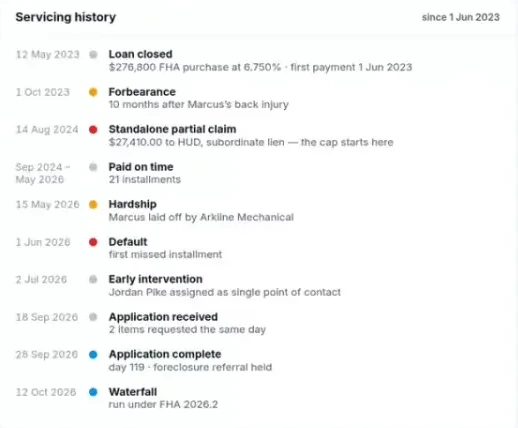
The sample servicer learned why when it replayed its spreadsheet-era decisions. Of 412 files decided in the first half of 2026, 28 came out differently under the rule in force, and the largest single cause, nine files, was an earlier partial claim not counted toward the cap. Those were offers that could not stand, made to borrowers who had been told an answer.
Uncounted earlier claims: the largest cause of changed decisions
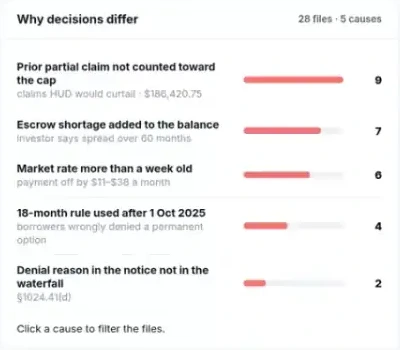
When the cap is what stops an option, the notice says so in terms the borrower can check: which earlier claim, how much room was left, and how much the option needed. Regulation X requires a specific reason for each modification denied, naming the investor requirement behind it (12 CFR 1024.41(d)). The payment supplement calculator shows how much an earlier claim can change what is left for a borrower, and the Loss Mitigation Waterfall Decisioning page shows the agents that read it.
Questions people ask
Is there a limit on how many FHA partial claims a borrower can get?
No fixed number: as many as fit under the 30% ceiling. The practical limit is time, since a borrower may receive only one permanent home retention option every 24 months, and a standalone partial claim counts as one.
Does an FHA partial claim change my monthly payment?
A standalone partial claim leaves the monthly payment unchanged; it only cures the arrears. It creates a second lien in HUD's favor, which shows up when the home is sold or refinanced.
Can a partial claim be combined with a loan modification?
Yes: that is FHA's combination option, used when a modification alone cannot reach the 25% target. The claim may cover arrears and principal deferment, but no more than is needed to reach the target.
What is the minimum FHA partial claim?
$1,000, except for options tied to a presidentially declared major disaster area. A borrower with less than $1,000 of room is not reviewed for a combination modification; FHA offers the 40-year standalone modification instead.
Who verifies earlier FHA partial claims?
The servicer, in HUD's Single Family Mortgage Asset Recovery Technology Integrated Portal, including prior case numbers, and it must add any claims or supplements it knows of that the portal does not show.