The FHA loss mitigation waterfall in 2026 is the order HUD's Mortgagee Letter 2025-12 imposes on every FHA-insured loan in default since 1 October 2025: a repayment plan, then forbearance, then a check on whether the borrower had a permanent option in the last 24 months, then a standalone partial claim, a standalone loan modification, a modification combined with a partial claim, the Payment Supplement, and finally a pre-foreclosure sale or deed in lieu. The servicer stops at the first option the borrower qualifies for. That is simple to state and easy to get wrong, because each question reads a different input (days in default, the date of the last permanent option, the borrower's attestation, the weekly survey rate, the 30% partial claim cap) and because the order itself was rewritten twice in 2025. Botminds' Loss Mitigation Waterfall Decisioning runs the order on each complete file and shows the rule and the arithmetic at every step, so the workout underwriter checks a trace instead of rebuilding one. This guide walks one fictional loan through all eight questions.
Four numbers that set the FHA waterfall in 2026
25%
target cut to principal and interest for a modification
ML 2025-12
15%
the floor: a 40-year combination must reach at least this, or the file moves on
30%
of the unpaid balance at default: all partial claims and supplements together, for life
24months
between permanent options, up from 18 in the January 2025 letter
What is the FHA loss mitigation waterfall after October 1, 2025?
It is a table of eight questions in HUD Handbook 4000.1, and the servicer "must evaluate Borrowers using the Loss Mitigation Option Waterfall below and the requirements for the specific Loss Mitigation Options" (ML 2025-12). Each question has a yes and a no. A yes sends the servicer to review the option named; if that option cannot be offered, it goes to the next question. Question 3 is the odd one: a yes there skips every home retention option and jumps to question 8.
The table replaces the patchwork that FHA servicers ran from 2020 to 2025: the COVID-19 Recovery options, FHA-HAMP and the older standalone partial claim rules. HUD's letter let FHA-HAMP and the standard pre-foreclosure sale and deed-in-lieu stay suspended through 30 September 2025, ended the COVID-19 Recovery options on the same day, and made the new permanent options effective on 1 October 2025. Searches for "FHA waterfall October 2025" are looking for exactly this switch.
One fictional loan, eight questions: where the Ferreira file stops
What changed in ML 2025-12, and what happened to the COVID-19 Recovery Modification?
ML 2025-12 rewrote a rewrite. HUD published a new permanent set of options in ML 2025-06 on 16 January 2025, due to take effect on 2 February 2026. Three months later ML 2025-12 "updates and replaces ML 2025-06", tightened it and pulled it forward four months (ML 2025-12). HUD gave its reason plainly: it "continues to see increased default rates on the COVID-19 Recovery Options, as well as the use of the COVID-19 Recovery Options in a manner inconsistent with prudent management of the MMIF". The January letter had credited those options with letting "more than 2.3 million families" avoid foreclosure (ML 2025-06).
The letter that never took effect, and the one that did
ML 2025-06 (January 2025): 2 February 2026
ML 2025-12 (April 2025, in force): 1 October 2025: the new options start four months earlier
ML 2025-06 (January 2025): One every 18 months
ML 2025-12 (April 2025, in force): One every 24 months, other than disaster options
ML 2025-06 (January 2025): To give way to the new set
ML 2025-12 (April 2025, in force): Extended to and expired on 30 September 2025
ML 2025-06 (January 2025): New provisions included
ML 2025-12 (April 2025, in force): Removed as "unnecessarily burdensome"
ML 2025-06 (January 2025): Higher borrower payments
ML 2025-12 (April 2025, in force): Kept at existing amounts
ML 2025-06 (January 2025): Part of the new set
ML 2025-12 (April 2025, in force): Kept, under an "overall evaluation" of whether it stays
The CFPB moved the same way on the federal side: it rescinded its 2021 COVID-19 protections in Regulation X by an interim final rule effective 15 July 2025 (Federal Register, 16 May 2025). And the rulebook has not stopped moving. HUD's Mortgagee Letter 2026-08, "Updates to Loss Mitigation Requirements", dated 23 June 2026, could be adopted at once and had to be implemented "no later than September 21, 2026", so it is now in force (HUD ML 2026-08). It changes three things around the waterfall, not the waterfall itself: its summary of changes lists only the trial payment plan sections and when to initiate foreclosure, so the order of the questions below is unchanged. First, a borrower now fails a trial plan when they "fail to accept a TPP Agreement for a third time during the Default episode". Second, it limits "multiple re-reviews for loss mitigation that prevent the Mortgagee from initiating foreclosure": foreclosure may start once the servicer has reviewed the initial complete request and any later complete request made "after a change in the Borrower's circumstances that impacts their eligibility", notified the borrower and rejected any available appeal. Third, borrowers may make trial payments "in advance of the month they are due", and the monthly payment may change between the trial and the permanent option when escrow for taxes and insurance rises. This guide follows the text of ML 2025-12 for each step, with those three changes applied.
Questions 1 and 2: the early tools a seriously delinquent loan has already passed
The first two questions screen for borrowers who need time, not a new loan. Question 1 asks whether the borrower is "no more than 120 Days in Default and able to repay Arrearages over a set period of no more than 24 months"; the letter allows longer defaults "for specific Borrowers". Question 2 asks whether the borrower needs "a period of reduced or suspended payments before they are able to resume payments".
Take the Ferreira loan, a fictional 2021 FHA purchase of $280,000 at 3.25% with principal and interest of $1,218.58. The first missed installment was 1 June 2026; one owner was laid off in May and has since found work at lower pay. On 20 October the file is complete and 141 days in default, so question 1 is a no. The household's income is back, so forbearance would only defer the problem: question 2 is a no.
How often can an FHA borrower get a permanent option? Question 3 and the 24 months
Once every 24 months. Question 3 asks whether the borrower "received a Permanent Home Retention Option in the past 24 months (other than for a PDMDA)", and a yes sends the file straight to the home disposition options. The eligibility text measures from "the first payment due date on a previous Permanent Home Retention Option", at the time the new option is approved, and a borrower who received a COVID-19 or disaster option in that window stays eligible (ML 2025-12). Every borrower who takes a new option also signs an affordability attestation acknowledging they will not get another one for 24 months.
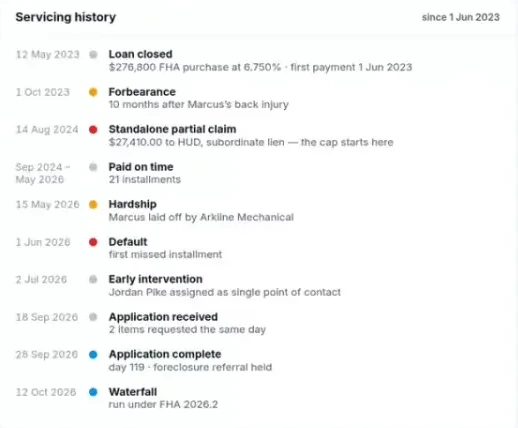
The date matters more than the option. A standalone partial claim is a permanent option too, so a borrower who took one 23 months ago is out, and one who took it 25 months ago is in. The Ferreira loan has had no workout since it was made, so question 3 is a no and the review continues. In the solution's own sample file, by contrast, the Whitfields took a standalone partial claim in August 2024; 26 months later they pass question 3, but that claim still counts against their cap, which is the 30% that never resets.
The servicing history that answers question 3
What is a standalone partial claim? Question 4
A standalone partial claim is HUD paying the arrears as a zero-interest subordinate lien, with no change to the first mortgage. It is offered when the borrower attests they can resume the current payment and has enough room under the 30% cap to cover the arrears. FHA also asks the servicer to protect that room: if a 30-year modification at the market rate would lower the payment by at least $1.00, the servicer must offer the modification instead "to preserve Partial Claim funds" (ML 2025-12, Appendix 4.0 Part C).
Question 4 reads the borrower's word, not a budget. FHA's rule says the borrower "is not required to provide financial documentation to be evaluated", and the servicer must not use financial documents to disqualify anyone, other than the required hardship documentation. The Ferreira household says it cannot carry $1,218.58 plus escrow on the new income, so question 4 is a no.
When does FHA allow a 40-year modification? Questions 5 and 6 on the Ferreira loan
FHA allows 40 years whenever 30 years cannot reach the 25% target, first as a standalone modification and then in combination with a partial claim. The test is mechanical. Multiply current principal and interest by 0.75: for the Ferreira loan the target is $913.93. Add the arrears that a modification may capitalize (past-due interest, escrow advances and the projected escrow shortage, but not past-due principal, which is still in the balance) to the unpaid balance of $250,058.92: $256,720.43 to resolve. Re-amortize it at the market rate, which in the week of the offer was the 22 October survey rate of 7.32%, rounded to 7.375%, plus 25 basis points for 30 years or 50 for 40.
Question 5 fails badly. At 7.625% for 30 years the payment is $1,817.05, and at 7.875% for 40 years $1,760.97: both higher than today's. Question 6 then asks how much partial claim would bring the modified loan down to the target. For 30 years the answer is $127,596.20, and for 40 years $123,483.99, against a cap of $75,017.68 (30% of the balance at default, with no earlier claim). The last test in question 6 is the 15% floor: put the whole cap into the claim, modify the rest over 40 years, and see if principal and interest fall at least 15%. It comes to $1,246.39, up 2.3%. The combination is denied.
The Ferreira loan's principal and interest under each option
The same questions give a different answer to a loan made at a higher rate. In the solution's sample file, the Whitfields' 2023 loan carries a 6.750% note, so re-amortizing over 40 years with a partial claim reaches the 25% target, and the waterfall stops at question 6 with principal and interest cut from $1,795.32 to $1,346.49. The order is the same; the note rate decides how far down it a file travels.
What is the FHA payment supplement, and why 2026 rates send loans there? Question 7
The Payment Supplement uses partial claim funds to bring the loan current and then pays part of the principal each month for 36 months, "to provide payment relief without modification of the Mortgage" (ML 2025-12). It exists for loans like the Ferreiras': a low note rate that no modification at today's rates can beat. The monthly principal reduction is the lesser of 25% of principal and interest and the principal portion of the payment, it must be at least 5% and at least $20, and the money must fit under the cap.
For the Ferreira loan, reinstatement takes $9,382.89 of the $75,017.68 cap (here past-due principal does count), leaving $65,634.79 for monthly reductions. Twenty-five percent of principal and interest is $304.64, less than the $548.71 principal portion, so the reduction is $304.64 a month; 36 months of it is $10,967.04, well inside the funds. The borrower pays $913.93 of principal and interest for three years, exactly the 25% target, and the last step compares it with the best 40-year combination ($1,246.39). The supplement is lower, so it is the offer: a total claim of about $20,349.93 and a three-month trial plan. The payment supplement calculator works through what happens when an earlier claim leaves too little room.
Question 8, the pre-foreclosure sale or deed in lieu, is not reached. Had the supplement failed (no room under the cap, a reduction under 5%, or an adjustable-rate loan), Appendix 4.0 sends the file back: the 40-year combination if it lowers the payment at all, otherwise a standalone partial claim if the cap covers the arrears, and otherwise the 40-year combination "even if the payment increases".
What the notice must say about every step not offered
A waterfall decision denies every modification above the one offered, and Regulation X treats each as a denial. The evaluation notice must state "the specific reason or reasons" for each trial or permanent modification denied (12 CFR 1024.41(d)), and FHA's own notice rules add "the actual reason or reasons they have been denied for any HUD Loss Mitigation Option". For the Ferreiras that means four sentences a borrower can check: the standalone modification raised the payment; the combination needed more partial claim than the cap allows; the full cap reached only a 2.3% increase, short of the 15% floor; and the supplement is offered at $913.93.
A decision with the reason for each option not offered
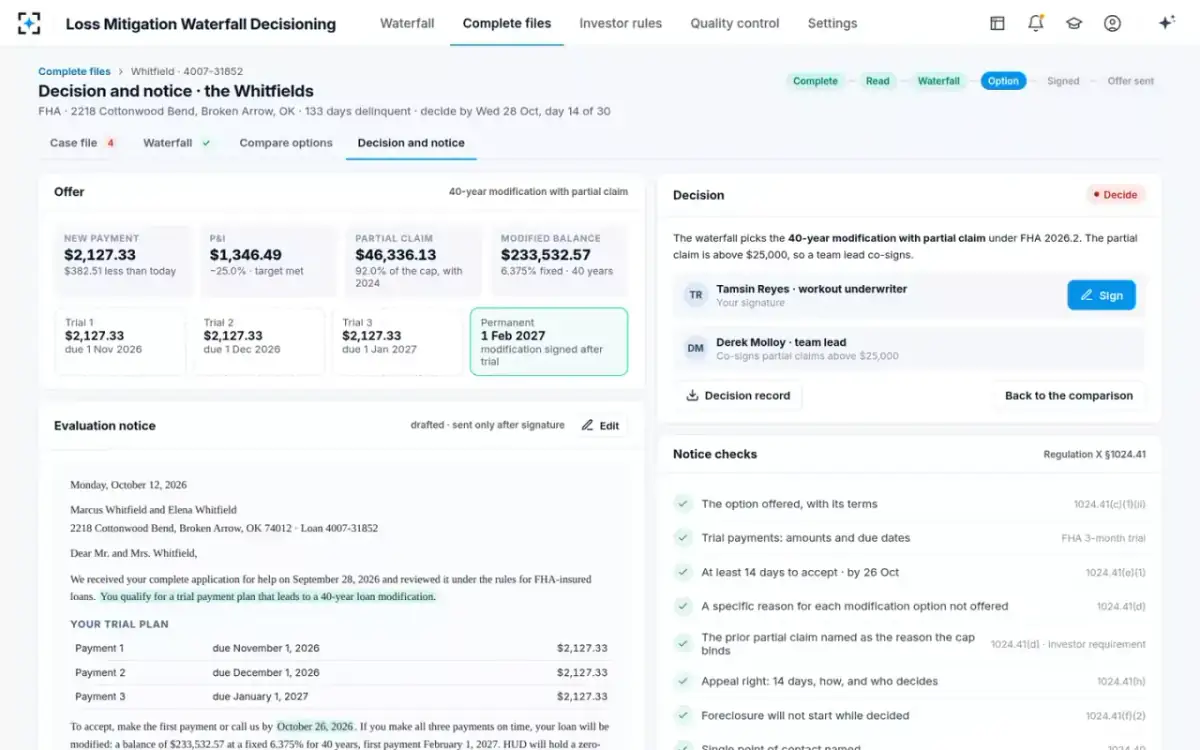
How Loss Mitigation Waterfall Decisioning traces each step
Every input in the trace above comes from somewhere a person can check, and that is the design of Botminds' Loss Mitigation Waterfall Decisioning. One agent reads the package and the servicing history and reports every earlier workout with its date, which answers question 3 and fixes the cap. Another reads the FHA case number and the pool and picks the rule set version in force on the evaluation date, so a file evaluated on 30 September 2025 and one evaluated on 1 October 2025 are run under different tables. The calculator then asks the questions in order and shows the arithmetic under each one, and the notice drafter turns the steps that failed into reasons.
The workout underwriter reads the trace, changes an input as a what-if if she doubts it, and signs. When HUD issues the next letter, the compliance analyst loads it as a new dated version and replays past decisions against it before it goes live. The FHA modification interest rate explains why the week of the offer, not the week of the evaluation, sets the rate in question 5. The Loss Mitigation Waterfall Decisioning page shows the full set of agents and the rule sets for VA, USDA and GSE loans.
Questions people ask
Is the FHA waterfall mandatory?
Yes. ML 2025-12 says the mortgagee "must evaluate Borrowers using the Loss Mitigation Option Waterfall". A servicer may set a rate below the market rate at its own cost, but it may not reorder the questions or skip one.
Does FHA still have a 40-year modification on its own?
Yes, as the second half of question 5. If a 40-year standalone modification cannot reach 25% and the borrower has less than $1,000 of partial claim room, FHA tells the servicer to offer the 40-year standalone modification "even if the payment increases".
How long is the FHA trial payment plan?
Three months for borrowers (six for non-borrowers who acquired title through an exempted transfer). The payment is the projected payment under the permanent option after an escrow analysis, and the agreement must reach the borrower at least 15 days before the first trial payment is due.
What happens if the borrower fails the trial plan?
A missed trial payment by the end of the month it was due is a failure, and since ML 2026-08 so is a third failure to accept a trial plan agreement in the same default episode. Borrowers who failed a standalone partial claim trial or an Outside of the Waterfall modification trial can be re-evaluated once, starting at question 5; for the rest, the servicer moves to the home disposition options.
Is there a FHA loss mitigation waterfall PDF?
The waterfall table is in Handbook 4000.1, section III.A.2, as revised by ML 2025-12, which HUD publishes as a 251-page PDF. The calculations behind questions 4 to 7 are in Appendix 4.0, "FHA Home Retention Options Calculations", Parts A to F.