The VA partial claim program in 2026 is VA's new tool for veterans whose VA-guaranteed loans are in default: VA pays the holder part of the debt, applied first to the arrears, and takes a lien behind the first mortgage, so the veteran can bring the loan current without paying the missed installments now. Congress created it in the VA Home Loan Program Reform Act, signed on 30 July 2025, at 38 U.S.C. 3737. A claim may not exceed 25% of the unpaid balance, or 30% for a borrower who missed a payment between 1 March 2020 and 1 May 2025; VA may make one per loan, with an exception after declared disasters; and it may make none after July 2030. VA opened the program on 15 June 2026, but servicers were not required to offer it until late November 2026. For a workout team the hard part is the gap year and the overlap: VA ended its previous last-resort program, VASP, in May 2025, and the rules changed twice in eighteen months. Botminds' Loss Mitigation Waterfall Decisioning loads each VA version with its effective date and applies the one in force on each file.
The VA partial claim program in four numbers
25%
of the unpaid balance: the cap on a partial claim
38 U.S.C. 3737(c)(1)(A)
30%
for borrowers who missed a payment from 1 Mar 2020 to 1 May 2025
38 U.S.C. 3737(c)(1)(B)
1
claim per loan, except after a presidentially declared major disaster
38 U.S.C. 3737(c)(2)
4.89%
of VA loans delinquent at the end of the second quarter of 2026
MBA National Delinquency Survey
What is the VA partial claim program in 2026?
It is a purchase by VA of part of a defaulted loan's debt. The statute describes "the purchase by the Secretary of a portion of indebtedness under the loan", in which VA pays the holder what it "determines necessary to help prevent or resolve a default" and "receives a secured interest in the property ... which is subordinate to the first lien guaranteed loan" (Pub. L. 119-31, 38 U.S.C. 3737(b)). The holder must apply the payment "first to arrearages", which may include taxes, insurance premiums or homeowner's dues VA considers necessary. The loan must be guaranteed by VA, on the borrower's primary residence, and in default or at imminent risk of it.
In practice, as the National Consumer Law Center summarized it on launch day, the program "will allow some Veterans struggling to pay their mortgages to defer past-due payments to the end of their loans" (NCLC, 15 June 2026): the arrears stop being due now and become a balance owed to VA. VA confirmed the timing in its own circular: it "launched the new section 3737 Partial Claim Program in summer 2026" (VA Circular 26-26-2), and trained servicers through June 2026 in a webinar series titled "The VA Partial Claim and Loss Mitigation Waterfall" (VA Home Loans), which tells servicers the claim sits inside a new VA order of options rather than standing alone.
What is the VA partial claim cap? 25%, or 30% for pandemic-era misses
The cap is 25% of the unpaid principal balance "on the date on which the partial claim is made". For "an individual who failed to make a payment" on a VA loan between 1 March 2020 and 1 May 2025, the cap is 30% of the balance "as of the date that the initial partial claim is made" (38 U.S.C. 3737(c)(1)). The 30% tier reaches a large group: any VA borrower who missed even one payment in those five years.
The base date is the detail to watch. VA measures the cap on the balance when the claim is made; FHA measures its 30% on the balance at the default in which its first partial claim was paid, and holds that number for the life of the loan (HUD ML 2025-12). The two programs use the same word for different arithmetic. FHA partial claim requirements works through the FHA version on one loan.
Can a VA borrower get more than one partial claim?
Generally no. "The Secretary may make only one partial claim per loan." The exception is a borrower who missed a payment during a major disaster declared by the President under the Stafford Act, or in the 120 days after one; VA may then make an additional claim (38 U.S.C. 3737(c)(2)). NCLC has asked VA to go further and let disaster-affected borrowers move payments to the end of the loan "for a second time" (NCLC).
One claim per loan makes the claim's timing a judgement with long consequences. A veteran who uses it for a short hardship has nothing left for a later, deeper one, except through the other options in VA's order. That is a reason to document, on every VA file, which options were considered before the claim and why each did not fit.
What replaced VASP?
Nothing, for about thirteen months, and then the partial claim program. VA launched the Veterans Affairs Servicing Purchase program on 31 May 2024 as "the final option in the VA Home Retention Waterfall", designed "to assist borrowers in finding an affordable loss mitigation option in a high-interest rate environment". On 23 April 2025 it announced the wind-down: as of 1 May 2025 VA "rescinds the VA Home Retention Waterfall and will stop accepting VASP submissions"; trial plans already accepted could run to 31 August 2025, and no VASP payments would issue after 30 September 2025 (VA Circular 26-25-2).
The same circular loosened modification rules for the interim. Servicers were told to review veterans "for all options outlined in Chapter 5" of the VA Servicer Handbook and "offer the best loss mitigation option available", keeping "VA's preferred order of consideration in mind" without following the rescinded waterfall, and VA removed the requirement that 30-year and 40-year modifications cut principal and interest by at least 10%. In January 2026 VA also withdrew its 2022 advance notice on expanding incentivized loss mitigation options (Federal Register, 21 January 2026).
Two last-resort tools for VA loans, and how they differ
VASP (May 2024 to 2025): An administrative program under VA’s existing powers
Partial Claim Program (from June 2026): A new statute, 38 U.S.C. 3737, enacted 30 July 2025
VASP (May 2024 to 2025): Purchases the whole loan after a successful trial plan
Partial Claim Program (from June 2026): Pays part of the debt and takes a subordinate lien; the holder keeps the loan
VASP (May 2024 to 2025): The final option in the VA Home Retention Waterfall
Partial Claim Program (from June 2026): A step in a new VA loss mitigation order, taught to servicers in June 2026
VASP (May 2024 to 2025): Ended for new submissions on 1 May 2025; no payments after 30 Sep 2025
Partial Claim Program (from June 2026): 25% or 30% of the balance, one per loan, no claims after July 2030
VASP (May 2024 to 2025): VA owns the loan and deals with the default itself
Partial Claim Program (from June 2026): Borrower liable to VA for its loss; VA may reduce remaining entitlement
What is the VA partial claim program 2026 implementation date for servicers?
VA opened the program on 15 June 2026; servicers had until late November 2026 to offer it. NCLC's launch statement put the gap plainly: "Mortgage servicers, however, are not required to offer the new partial claim program until late November of this year. As a result, until November, Veterans may face foreclosure and payment increases rather than receiving the promised relief" (NCLC, 15 June 2026). NCLC asked VA to direct servicers to hold foreclosures and not to offer "payment increase modifications to borrowers who will be eligible for partial claims" until their systems were ready.
For a servicer that means three populations of VA files in 2026: those evaluated before VA's new guidance, those evaluated after it while the servicer's own systems were catching up, and those evaluated once the claim is fully in place. A decision is only defensible against the rule in force on its date, and the most likely QC finding of 2027 is a VA file evaluated in the overlap as if the claim did not exist.
VA loss mitigation from VASP to the partial claim, month by month
- VASP, the last option11 mo
- No last-resort program; best option, 10% floor removed13.5 mo
- Program open; servicers adopting5.5 mo
When does the VA partial claim program end?
Five years after enactment: "The Secretary may not make a partial claim under this section after the date that is five years after the date of the enactment of this section" (38 U.S.C. 3737(j)). The Act was approved on 30 July 2025, so new claims stop after 30 July 2030 unless Congress extends the program. Claims already made stay in place; the sunset ends the making of new ones.
A five-year window matters for rule design. It means the VA rule set a servicer runs in 2030 will have a hard stop date on one of its steps, and a file evaluated on 31 July 2030 must not reach it. Effective dates are the only reliable way to handle that.
What else Pub. L. 119-31 changed: the order, the audits and the borrower's liability
The Act did more than create a claim. It requires VA to prescribe "a mandatory sequence in which the holder of a loan guaranteed under this chapter shall offer loss mitigation options (including an option to enter into a partial claim agreement ...)", and bars VA from buying an entire loan "until the veteran has completed such sequence" (38 U.S.C. 3732(d)). VA may pay claims on the holder's certification that it complied with VA's requirements, and must run "on a random-sampling basis, post-payment audits". Decisions on claims are "final and conclusive and ... not subject to judicial review".
It also changed what a later default costs the veteran. A borrower "who defaults on a loan for which the Secretary makes a partial claim ... shall be liable to the Secretary for any loss", and VA may reduce the borrower's remaining entitlement. VA's August 2026 circular added the foreclosure side: a non-judicial sale under state law now discharges VA's partial claim interest, and servicers should no longer start a judicial foreclosure solely because of it, because "a judicial foreclosure can cost up to 12 times more and take months or even years longer" (VA Circular 26-26-2).
VA, FHA and USDA partial claims compared
Three government programs now let a servicer move arrears into a deferred, subordinate balance, and each counts the cap its own way. The table is the shortest route to the differences.
Three partial claims, three caps
| VA partial claim | FHA partial claim | USDA mortgage recovery advance | |
|---|---|---|---|
| Cap | 25% of the balance (30% for 2020–2025 misses) | 30% of the balance, for all claims and supplements together | 30% of the balance, cumulative |
| Balance used | On the date the claim is made (initial claim, for the 30% tier) | At default, when the first claim was paid; fixed for life | At the date of the initial default |
| How many | One per loan, plus disaster exceptions | As many as fit under the cap, one permanent option per 24 months | Multiple, up to the cumulative cap |
| Ends | No new claims after July 2030 | Permanent; HUD is reviewing its waterfall | Permanent since 11 February 2025 |
VA partial claim program requirements a servicer should check on every file
The statute names the floor of every VA file, and VA's handbook adds the detail. From the statute alone: a VA-guaranteed loan; the borrower's primary residence; default or imminent default as VA determines it; no earlier claim on the loan unless the disaster exception applies; the cap, at 25% or 30% depending on whether the borrower missed a payment between March 2020 and May 2025; the arrears paid first; and VA's documents executed and recorded so VA's interest is secured. Each of those is a test with a date and a source document.
The 30% tier deserves its own check, because the evidence is old. Whether the borrower missed a payment in a five-year window ending May 2025 is a question for the servicing history, including any period serviced by a prior servicer. A VA claim capped at 25% for a borrower entitled to 30% is a smaller cure than the law allows.
How servicers can run the VA program beside the others
Most servicers run VA loans beside FHA, USDA and GSE loans in one workout team, which is how the rules collide. Botminds' Loss Mitigation Waterfall Decisioning keeps them apart by rule set and by date: the investor rule selector identifies the loan's guarantor from its identifiers and picks the version in force on the evaluation date, and the compliance analyst publishes each new VA version only after it passes its test cases and a replay of past decisions. In the sample servicer, the next VA version was scheduled to go live on 2 November after passing 38 of 38 tests.
VA files in the same queue, each run under its own investor's rules
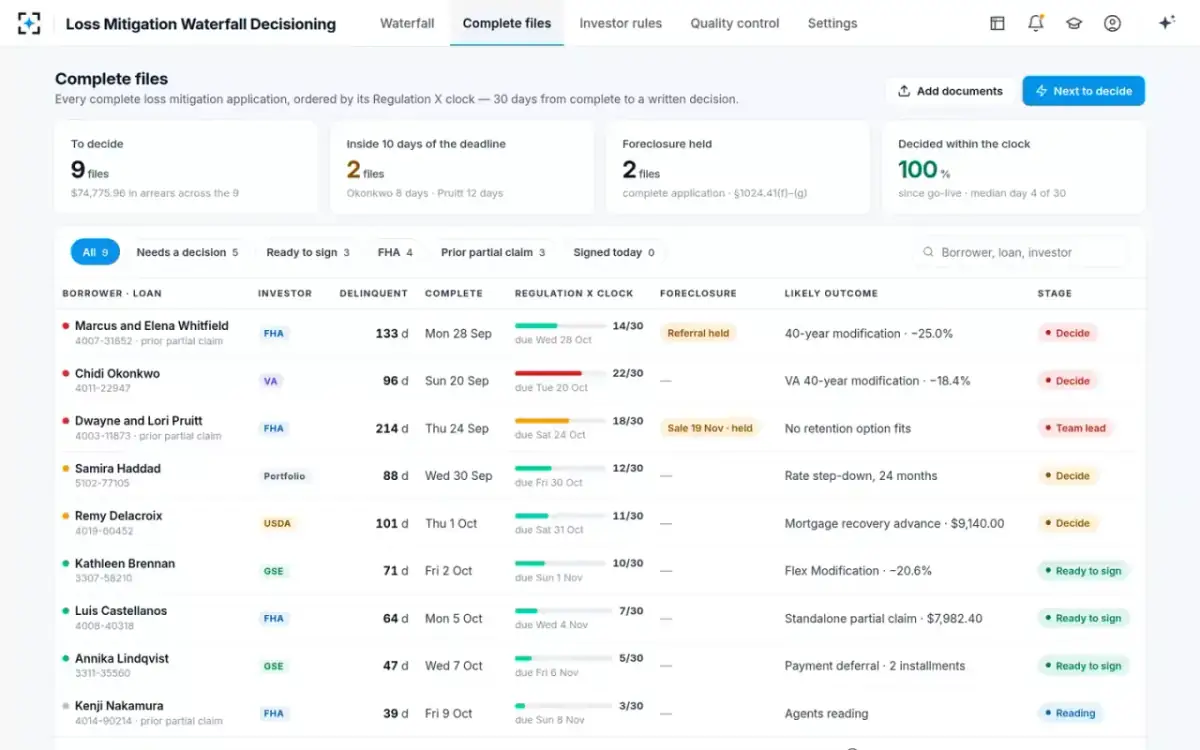
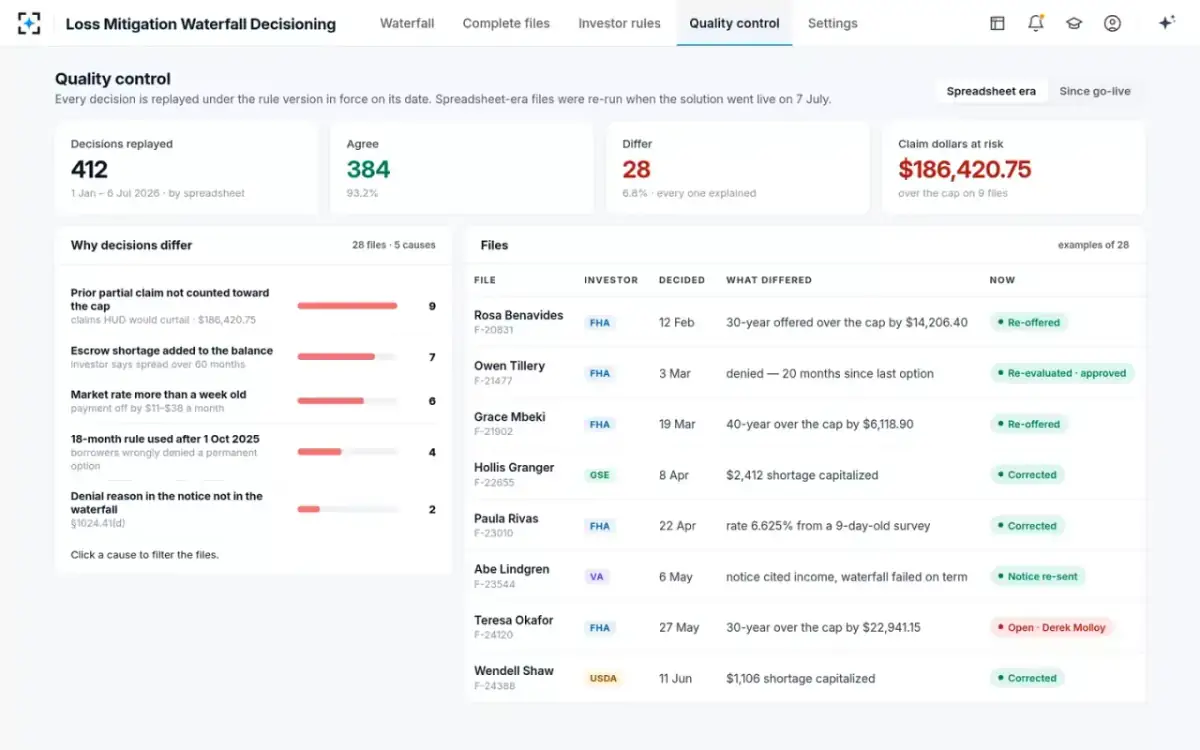
The agents read the loan's history for the two facts the VA cap turns on, an earlier claim and any missed payment between March 2020 and May 2025, and the notice drafter writes VA's reasons, not FHA's, for each option not offered. Replays catch the files decided under the wrong version; in the sample servicer's quality control review, one VA notice had cited income when the waterfall had in fact failed on term, and the notice was re-sent.
A VA notice corrected after replay
How VA's order compares with FHA's, the GSEs' and USDA's is set out in what a loss mitigation waterfall is, and the Loss Mitigation Waterfall Decisioning page shows the six rule sets the solution runs.
Questions people ask
Is the VA partial claim a loan the veteran must repay?
Yes. VA takes a secured interest subordinate to the first mortgage, so the amount is owed to VA rather than due monthly; a borrower who later defaults is liable to VA for any loss, and VA may reduce the borrower's remaining loan entitlement.
Does the VA partial claim charge interest?
The statute does not set an interest rate on the claim; it leaves terms and conditions to VA. NCLC describes the program as letting veterans "defer past-due payments to the end of their loans". Check VA's handbook chapter for the current terms before quoting them to a borrower.
Can a veteran apply directly to VA for a partial claim?
No. The claim is made through the loan's holder and servicer, who evaluate the veteran under VA's order of options and submit the claim; VA pays on the servicer's certification and audits a random sample afterwards.
What happened to the COVID-era VA partial claim?
The earlier COVID-19 Veterans Assistance Partial Claim Payment program was a separate, pandemic-era tool. VA's August 2026 circular treats its liens, partial purchases made with COVID-19 refund modifications and new section 3737 claims alike for foreclosure discharge.
Is a VA partial claim available on a rental or second home?
No. The statute limits the program to a VA-guaranteed loan "regarding the primary residence of the borrower".