In the loss mitigation underwriting process, the underwriter takes a delinquent borrower's complete application, works out which home retention options the owner of the loan allows, tests them in the order that owner sets, computes the payment, rate, term and any partial claim for the first option that fits, and puts a written decision in front of the borrower within the 30 days Regulation X allows. The work is hard because the rules belong to someone else: FHA, VA, USDA and the GSEs each set their own order and targets, and FHA rewrote its order twice in 2025. And the underwriter is one link in a chain: a team lead co-signs large claims, a different person hears any appeal, the investor keeps some calls for itself, and quality control re-tests the result. Botminds' Loss Mitigation Waterfall Decisioning exists for that chain: agents read the file and run the investor's rules with the arithmetic shown, and each person in the chain decides and signs.
The seat matters more each quarter. Delinquency is rising, it is concentrated in government-insured loans, and a loan in default costs about nine times as much to service as one that pays.
Why the workout desk is busier, and why its decisions cost so much
11.79%
of FHA loans were delinquent at the end of the second quarter of 2026
MBA National Delinquency Survey
$1,573
a year to service a non-performing loan, against $176 for a performing one (2024)
MBA servicing operations study
1.46Mhours
a year of paperwork in FHA loss mitigation alone, by HUD’s own estimate
HUD information collection notice, 2026
What does a loss mitigation underwriter do? Five jobs in every file
The underwriter's job is to turn a complete application into the one option the loan's owner says the borrower gets, with terms that can be defended line by line. In practice that is five jobs, done in the same order on every file, and the first is the one most often skipped.
1. Establish whose rules apply. The options a borrower can be offered are the owner's options, not the servicer's. Regulation X's commentary says so directly: options a servicer administers for a different owner "are not available to the borrower solely because such options are administered by the servicer" (12 CFR 1024.41, comment 41(c)(1)-2). An FHA case number, a Ginnie Mae pool, a GSE investor code or a private trust each points to a different rulebook, and to a different version of it depending on the date.
2. Fix the inputs. Unpaid balance, arrears, escrow after a fresh analysis, every prior partial claim, the date of the last permanent option, bankruptcy and occupancy. On an FHA loan, the borrower "is not required to provide financial documentation to be evaluated", and the servicer must not use financial documents to disqualify the borrower except for hardship documentation (HUD Mortgagee Letter 2025-12). On a GSE or USDA file, income is central. Knowing which inputs a rule set reads is half the job.
3. Run the owner's order. For FHA since 1 October 2025 that is eight questions, from a repayment plan to a pre-foreclosure sale; the FHA waterfall in 2026 traces them on one loan. Each step has its own target, rate and cap.
4. Set the terms. The payment, the modified balance, the rate as of the trial plan offer, the partial claim, and the trial plan itself: three payments on an FHA modification, with the agreement in the borrower's hands at least 15 days before the first one is due.
5. Write the decision down. Regulation X requires a written notice of which options the servicer will offer, how long the borrower has to accept, and, for each loan modification denied, "the specific reason or reasons" (12 CFR 1024.41(c)(1)(ii) and (d)).
Who approves a loan modification? Six seats around one file
A loan modification is approved by the servicer's workout underwriter under authority the loan's owner has delegated, and for larger or unusual decisions by a second signer the servicer's own policy names. Around those two seats sit four more: the appeal reviewer, quality control, the analyst who keeps the investor rules current, and the investor or insurer itself.
Six seats in a workout decision, and what each one keeps
Today
Rebuilds the investor’s order in a spreadsheet for each file, then spends most of the hour proving which rule she used.
With agents
Opens the file with the package read, the order run step by step and the notice drafted; checks and decides.
Still theirs: The decision and the signature on every option.
Today
Signs large partial claims from a summary, and owns the number if HUD later questions it.
With agents
Co-signs above the servicer’s threshold with the cap arithmetic and every prior claim in front of him.
Still theirs: The second signature where the money is, and every file where no home retention option fits.
Today
Reconstructs the first decision from notes before judging it.
With agents
Reads the first decision step by step, with the rule version and the inputs it used.
Still theirs: An independent decision; Regulation X bars the first evaluator from this seat.
Today
Re-tests a sample by redoing the arithmetic, often under today’s rules rather than the decision date’s.
With agents
Replays a decision under the rule version in force on its date and sees exactly where it differs.
Still theirs: The finding, and what happens to the borrower if the decision was wrong.
Today
Rewrites procedures each time HUD or VA issues a letter, and hopes the spreadsheet follows.
With agents
Publishes each investor rule set as a dated version, tested against past decisions before it goes live.
Still theirs: Approval of every rule change.
Today
Receives files the servicer was supposed to send, or does not.
With agents
Receives the files its guidelines reserve to it, with the evaluation attached.
Still theirs: The options it has not delegated, and its own audits after it pays.
What does Regulation X require of the people who decide?
Regulation X does not name a job title, but it builds the seat. It requires servicers to assign personnel to a delinquent borrower no later than the 45th day of delinquency, and those personnel must give accurate information about the "loss mitigation options available to the borrower from the owner or assignee" (12 CFR 1024.40). It requires policies under which servicer staff can "identify with specificity all loss mitigation options for which borrowers may be eligible", and the commentary adds that the owner's options and criteria must be "readily accessible to the servicer personnel involved with loss mitigation" (12 CFR 1024.38(b)(2)).
Then it sets the clock. A complete application received more than 37 days before a foreclosure sale must be evaluated "for all loss mitigation options available to the borrower" within 30 days, with a written notice of the result (12 CFR 1024.41(c)(1)). Note what the rule does not do: it does not prescribe the evaluation. The commentary leaves its conduct "in the sole discretion of a servicer", and the owner's rules decide the substance. Regulation X polices the process; the investor polices the answer.
FHA adds a clock of its own. A servicer must complete an evaluation "before four monthly installments are due and unpaid" and send the borrower the result, whether or not the borrower has applied (ML 2025-12, the 90-Day Review). For FHA files, then, the underwriter often works two deadlines at once.
Who reviews a loss mitigation appeal, and can the same person decide it?
No: the person who evaluated the application cannot decide the appeal. "An appeal shall be reviewed by different personnel than those responsible for evaluating the borrower's complete loss mitigation application" (12 CFR 1024.41(h)(3)). The commentary allows a supervisor to hear it, as long as that supervisor "were not directly involved in the initial evaluation" (comment 41(h)(3)-1). A team lead who co-signed the first decision is therefore the wrong person to hear the appeal of it.
The appeal right is narrower than many borrowers think. It applies to loan modification denials, and only when the complete application arrived 90 or more days before a foreclosure sale, or during the pre-referral period. The borrower has 14 days from the offer to appeal; the servicer has 30 days to decide; and the appeal decision "is not subject to any further appeal" (12 CFR 1024.41(h)). What makes an appeal workable is the first decision's paper: an appeal reviewer who must reconstruct the arithmetic is redoing the underwriting, not reviewing it.
An appeal shall be reviewed by different personnel than those responsible for evaluating the borrower's complete loss mitigation application.
12 CFR 1024.41(h)(3)
Does the investor approve modifications, or does the servicer?
For most government-insured and GSE loans, the servicer decides under authority the owner has delegated, inside the owner's rules; the owner approves only what it has kept for itself. FHA's letter lets the servicing mortgagee "with this delegated authority" sign loss mitigation agreements, and it makes its waterfall mandatory: the mortgagee "must evaluate Borrowers using the Loss Mitigation Option Waterfall" (ML 2025-12). VA's partial claims, by contrast, are made "in the sole discretion of the Secretary", paid on the servicer's certification and checked by random post-payment audits (Pub. L. 119-31, 38 U.S.C. 3737).
The line between delegated and reserved is where examiners have found trouble. In its spring 2024 servicing edition, the CFPB reported servicers that "did not follow investor guidelines for evaluating loss mitigation applications when they automatically denied certain consumers a payment deferral option rather than submitting the consumers' applications to the investor for review" (Supervisory Highlights, Issue 33). The commentary is explicit that this duty survives even where the Regulation X clock does not apply: a servicer must evaluate "consistent with any owner or assignee requirements, even where the requirements of § 1024.41 may be inapplicable" (comment 38(b)(2)(v)-1).
The underwriter's outputs, read from the rules
A servicer should define the seat by what it must produce and who checks it. Built from the rules rather than from habit, that definition looks like this.
The workout underwriter's outputs, the rule behind each, and who checks it
| Output | Rule behind it | Who checks or co-signs |
|---|---|---|
| The owner’s options, in the owner’s order | 12 CFR 1024.38(b)(2) and comment 41(c)(1)-2 | Compliance analyst keeps the rule set; QC re-tests |
| A decision within 30 days of a complete application | 12 CFR 1024.41(c)(1) | Team lead watches the clock |
| FHA evaluation before four installments are unpaid | HUD ML 2025-12, 90-Day Review | Team lead; HUD on review |
| Partial claim inside the 30% statutory maximum | HUD ML 2025-12, Statutory Maximum for Partial Claims | Team lead above the servicer’s threshold |
| A specific reason for each modification denied | 12 CFR 1024.41(d) | Notice check before sending; QC |
| Files the investor reserves, sent to the investor | 12 CFR 1024.38(b)(2)(v) | Team lead; investor |
| An appeal decided by someone else | 12 CFR 1024.41(h)(3) | A reviewer not involved in the first decision |
Where the chain breaks: staffing, notices and decisions taken too early
The chain fails most often for a dull reason: too few people for the volume. The Financial Stability Oversight Council notes that delinquent loans are "more labor-intensive than servicing performing loans and requires additional personnel with expertise", with processes that are "more complex, leading to additional operational risk" (FSOC, Report on Nonbank Mortgage Servicing, 2024). The CFPB's 2014 case against Flagstar Bank is the extreme version: in 2011 the bank "had 13,000 active loss mitigation applications but only assigned 25 full-time employees and a third-party vendor in India to review them", and "for a time, it took the staff up to nine months to review a single application" (CFPB, 29 September 2014). That is 520 applications per reviewer.
The 2024 exam findings show the subtler breaks. Servicers sent determination notices late; one sent notices that gave no deadline to accept or reject an offer; and some told borrowers they had been approved for an option before anyone had determined they were eligible, which examiners treated as deceptive (Supervisory Highlights, Issue 33). Each of those is a hand-off failure between the underwriter, the notice and the second signer, not a failure of judgement.
How Loss Mitigation Waterfall Decisioning divides the work between agents and signers
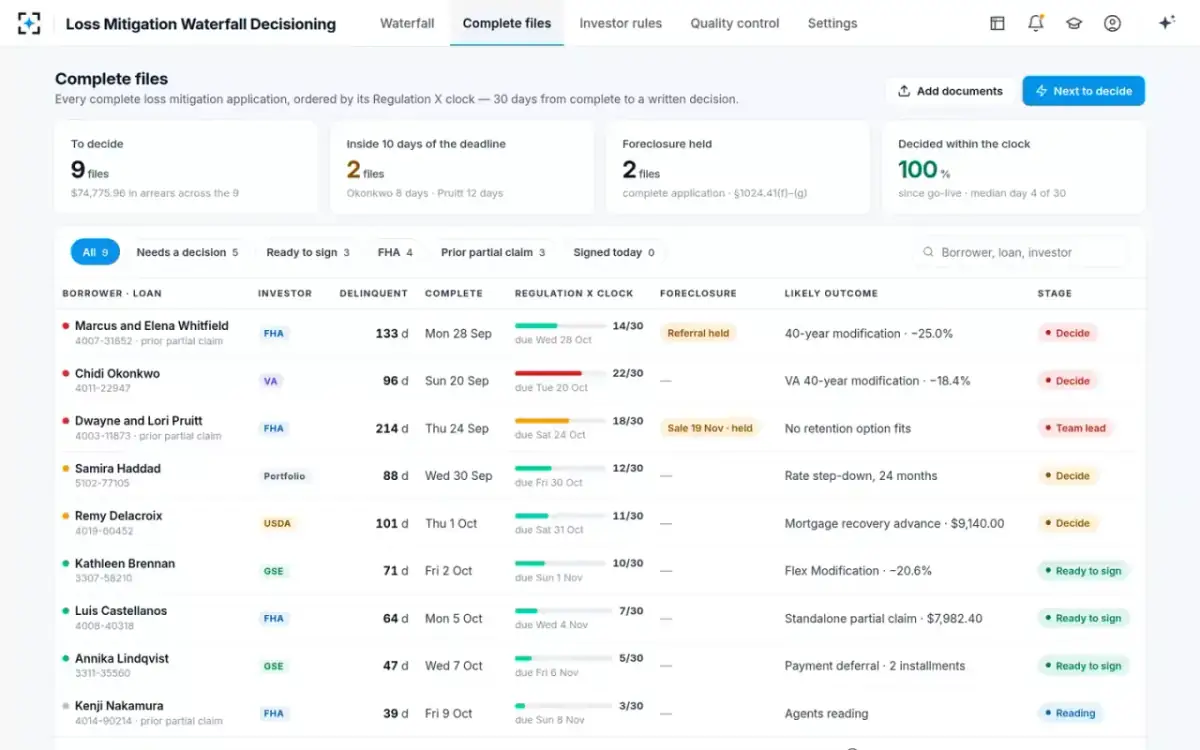
Botminds' Loss Mitigation Waterfall Decisioning gives the mechanical half of the seat to six agents and keeps every decision with a named person. Take a sample file from its fictional servicer: Marcus and Elena Whitfield, an FHA loan five installments behind, application complete on Monday 28 September 2026. The underwriter, Tamsin Reyes, opens it on day 14 of 30 from a queue of nine complete files ordered by their Regulation X deadline.
The underwriter's day starts from the Regulation X clock
Who does what on one file: six agents prepare, three people sign
Agent
Package and loan history readersRead the 23 documents and the servicing history; report every prior partial claim with its date and amount.
Never: counts a figure without the page it came from.
Agent
Investor rule selectorReads the case number and pool, and picks the rule set version in force on the evaluation date.
Never: applies a rule before its effective date.
Agent
Waterfall calculator and notice drafterRun every step in the owner’s order with the arithmetic shown; draft the trial offer and the reasons for each option not offered.
Never: approves, denies, sends or changes the loan.
A person decides
Workout underwriterChecks the inputs and each step, decides the option and signs, stating what the signature means.
A person decides
Team leadCo-signs partial claims above the servicer’s threshold and any file where no home retention option fits.
A person decides
QC reviewerReplays the decision later under the rule version in force on its date.
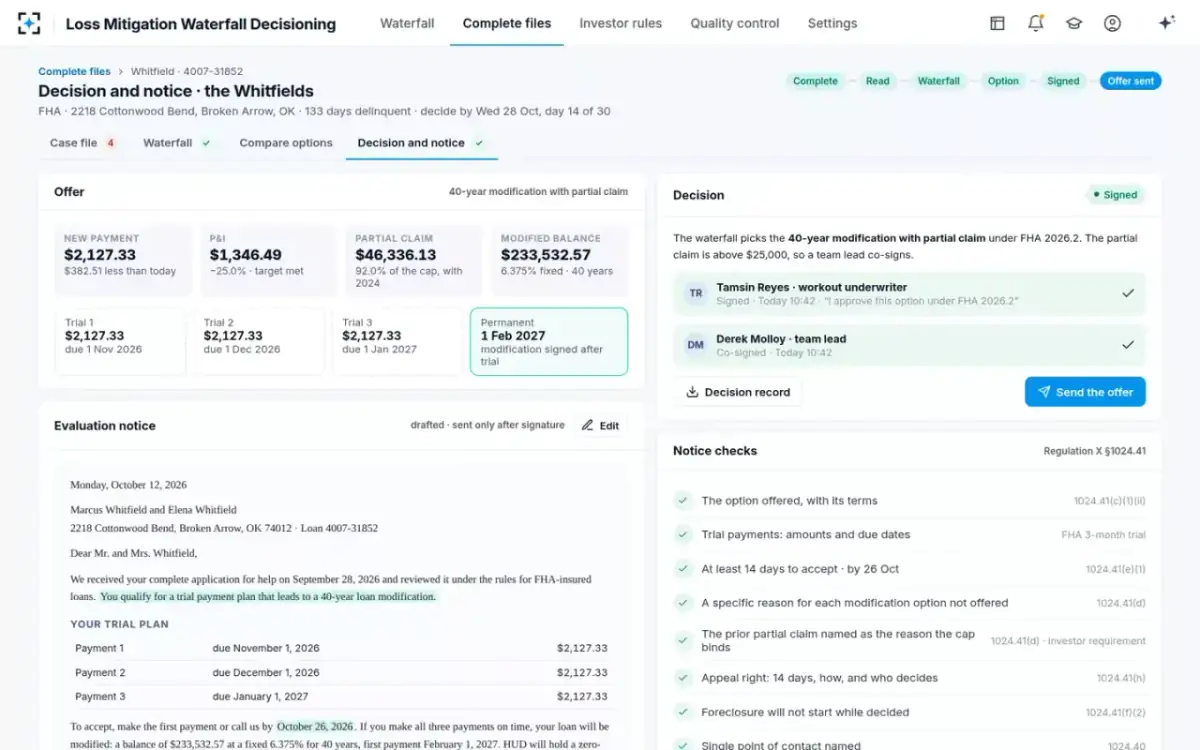
On the Whitfield file the agents read the package and the servicing history in 44 seconds and found what the team's old spreadsheet missed: a standalone partial claim paid in August 2024, which counts toward the loan's 30% statutory maximum. The waterfall stopped at a 40-year modification with a partial claim that cut principal and interest by 25.0%. Because that claim was above the servicer's $25,000 threshold, the decision needed two signatures before the offer could go.
Two signatures, each with what it means, before the offer goes out
The appeal seat stays outside that flow on purpose. If the Whitfields appeal, the reviewer must be someone other than the underwriter and the co-signer, and reads the same steps with the same rule version. Changing the loan modification underwriting process covers how a team brings the seats onto one file without losing trust, and the Loss Mitigation Waterfall Decisioning page shows each agent's limits.
Questions people ask
How many files does a loss mitigation underwriter handle?
No regulator publishes a standard. The CFPB's Flagstar case is the cautionary figure: 13,000 active applications for 25 full-time employees, about 520 each, and reviews that took up to nine months. A sustainable load is whatever keeps every complete file inside its 30-day clock with time left for a second signature.
Does a loss mitigation underwriter talk to the borrower?
Usually not directly. Regulation X assigns separate continuity-of-contact personnel by day 45 of delinquency to answer the borrower and explain options. The underwriter's voice reaches the borrower through the evaluation notice, which is why its reasons must be specific.
Can an underwriter offer an option outside the investor's waterfall?
Only where the owner allows it. FHA's own waterfall includes an "Outside of the Waterfall" modification, but it is defined narrowly: for borrowers who have not responded to outreach, at least 90 days delinquent, with a payment cut of at least $1.00. Anything else is an exception the owner must approve.
Who signs the loan modification agreement for FHA?
The borrower and any party needed to keep HUD's first lien and make the agreement enforceable under state law. Where a mortgagee signature is required, ML 2025-12 lets "the servicing Mortgagee with this delegated authority" provide it.
Is loss mitigation underwriting being automated?
The arithmetic and the reading are; the decision is not. The CFPB has noted that servicers already run "automated processes required by investors" to review borrowers, yet every Regulation X duty still falls on the servicer and its people, from the 30-day notice to the independent appeal.