An FHA payment supplement calculator works out whether a borrower qualifies for FHA's Payment Supplement and how large the monthly help is, using the seven steps of Appendix 4.0, Part F, in HUD Handbook 4000.1 as revised by Mortgagee Letter 2025-12. The supplement uses partial claim funds to bring the loan current, then pays a "Monthly Principal Reduction" toward the borrower's principal for 36 months, without modifying the loan. The calculator takes the partial claim room left under FHA's 30% cap, subtracts the reinstatement, sizes the monthly reduction at the lesser of 25% of principal and interest and the principal portion of the payment, checks that the money lasts 36 months, tests that the reduction is at least 5% of principal and interest and at least $20, and compares the result with the best 40-year modification. It is reached only late in FHA's waterfall, after a 40-year modification with a partial claim cannot cut the payment by 15%, which in 2026 is where loans with low note rates land. Botminds' Loss Mitigation Waterfall Decisioning runs every step on each file and shows the numbers a workout underwriter signs.
The Payment Supplement's limits, from HUD's letter
36months
of monthly principal reduction; the payment then returns to the note
ML 2025-12
25%
of principal and interest at most, and no more than the principal portion
5%+ $20
the minimum reduction: both tests must pass
30%
of the balance at default: the cap the supplement shares with every partial claim
What is the FHA payment supplement?
It is a partial claim that pays the arrears and then part of each month's principal for three years. HUD defines it as "a loss mitigation option that utilizes Partial Claim funds to bring the Mortgage current coupled with the subsequent provision of a Monthly Principal Reduction (MoPR) applied toward the Borrower's principal due each month for a period of 36 months to provide payment relief without modification of the Mortgage" (ML 2025-12). The borrower signs a non-interest-bearing note, a subordinate mortgage and a Payment Supplement Agreement in favor of HUD, for the total of the reinstatement and all 36 months of reductions.
The money sits with the servicer. HUD pays the whole amount in one claim, filed within 60 days of the borrower's signature; the servicer holds the reduction funds in "a separate, non-interest bearing, insured custodial account", and each month applies the reduction to principal only after receiving at least the borrower's share of the payment. The servicer "must not recalculate the MoPR during the Payment Supplement Period", and may not charge fees or interest for it.
When does the waterfall reach the payment supplement?
Only when every modification has failed. FHA's waterfall asks first whether a standalone modification reaches its 25% target, then whether a modification with a partial claim does, and, on a 40-year term, whether it reaches at least 15%. "If a minimum 15 percent reduction to the P&I portion of the Mortgage Payment cannot be achieved, the Mortgagee must review the Borrower for the Payment Supplement" (ML 2025-12). In the waterfall table it is question 7.
Rates decide how often that happens. A modification's rate is the weekly survey rate, rounded to the nearest eighth, plus 25 basis points for 30 years or 50 for 40, as of the trial plan offer, and the survey was at 7.32% on 22 October 2026 (Freddie Mac PMMS, via FRED). For a loan with a 3% to 5% note, re-amortizing at 7.875% raises the payment however long the term; only the partial claim can bring it down, and the cap limits how far. The FHA waterfall traced on one loan shows a 2021 loan reaching the supplement with the cap untouched.
When does FHA require a 40-year term, and how is the modification rate calculated?
FHA moves to 40 years whenever 30 cannot reach 25%: first as a standalone modification, then with a partial claim, and the last modification test before the supplement is always a 40-year one. If a 40-year standalone modification misses 25% and the borrower has less than $1,000 of partial claim room, the servicer must offer it anyway, "even if the payment increases". The rate for that step is the rounded survey rate plus 50 basis points: 7.375% plus 0.50, or 7.875%, for an offer in late October 2026. The FHA modification interest rate works through the rounding and the timing.
How is the FHA payment supplement calculated? Seven steps
Appendix 4.0, Part F, sets the calculation in seven steps. Here they are on one fictional loan, the Brandt file, a 2022 FHA purchase of $310,000 at 5.125% with principal and interest of $1,687.91. The borrowers took a standalone partial claim of $70,500.00 in 2024; the balance at that default was $303,205.55, so their cap is fixed at $90,961.67. The loan defaulted again on 1 June 2026, and by October it is five installments behind.
Appendix 4.0, Part F, on the Brandt loan
| Step | What HUD asks | Brandt loan |
|---|---|---|
| 1 · Availability | Partial claim room left under the 30% cap (Part B); must be above zero | $90,961.67 − $70,500.00 = $20,461.67 |
| 2 · Reinstatement | Arrears to bring the loan current, including past-due principal (Part A, Step 2) | $11,674.55 |
| 3 · Funds for MoPR | Step 1 less Step 2; must be above zero | $8,787.12 |
| 4 · Maximum MoPR | Lesser of 25% of P&I and the principal portion of the payment | Lesser of $421.98 and $450.39 = $421.98 |
| 5 · MoPR | Maximum if the funds cover 36 months; otherwise funds ÷ 36 | 36 × $421.98 = $15,191.19 > $8,787.12, so $8,787.12 ÷ 36 = $244.09 |
| 6 · Reduction test | MoPR ÷ P&I at least 5%, and MoPR at least $20 | $244.09 ÷ $1,687.91 = 14.46%: passes both |
| 7 · Compare | Offer whichever is lower: P&I under the supplement or under a 40-year modification with partial claim | $1,443.82 against $1,927.34: offer the supplement |
Before step 1, the Brandt file failed every modification. At 7.625% for 30 years and 7.875% for 40, a standalone modification would raise principal and interest to $2,133.54 or $2,067.70. To reach the $1,265.93 target, a 40-year modification needed $116,883.86 of partial claim against $20,461.67 of room. And with all of that room used, the 40-year payment was still $1,927.34, 14.2% higher than today, nowhere near the 15% cut the floor requires.
The Brandt loan's principal and interest at each step of the waterfall
What is a monthly principal reduction, and how big can it be?
The monthly principal reduction, or MoPR, is "the amount of principal reduction that the Mortgagee will disburse monthly from the Payment Supplement Account and apply to the payment of principal due" during the 36 months (ML 2025-12). Because it pays principal, it can never exceed the principal portion of the payment; because it is capped at a 25% cut, it can never give more relief than FHA's modification target. And it has a floor: the minimum is "5 percent of the P&I portion" and "no less than $20.00 per month", both measured when the supplement period begins.
The monthly principal reduction, as a formula
Room
30% × balance at the first claim’s default − all earlier partial claims and supplements
Brandt: $20,461.67. Zero room means no supplement.
HUD portal and the loan history
Funds for the reduction
room − arrears needed to reinstate (with past-due principal)
Brandt: $8,787.12. Below zero means no supplement.
Servicing data
Monthly principal reduction
lesser of (25% of P&I, principal portion, funds ÷ 36)
Brandt: $244.09, limited by the funds.
Calculator
Test
reduction ≥ 5% of P&I and ≥ $20, and principal portion ≥ the minimum
Brandt: 14.46% and $244.09 pass.
Workout underwriter
One trap hides in step 2. For a modification, Appendix 4.0 capitalizes only past-due interest, escrow and allowable costs, because unpaid principal is still in the balance. For a partial claim or a supplement, the reinstatement must include "the principal amounts that are past due", because the claim pays the missed installments in full. Using the modification arrears in Part F overstates the funds left for the reduction; on the Brandt loan by $2,223.37, enough to raise the monthly reduction by about $62.
FHA payment supplement requirements: who qualifies
The eligibility list is short and strict. Each item is a test the calculator or the underwriter must record a result for.
FHA payment supplement requirements under ML 2025-12
| Requirement | What it means in practice |
|---|---|
| A fixed-rate mortgage | Adjustable-rate loans cannot receive a supplement |
| Enough partial claim funds for reinstatement and the reduction | Parts B and F: room above zero after reinstatement |
| The principal portion of the first payment after reinstatement at least the minimum MoPR | Early-term loans with small principal portions may fail |
| Bankruptcy requirements met | As set out for loss mitigation during bankruptcy proceedings |
| Borrower Affordability Attestation | The borrower affirms they can pay their share of the payment |
| A trial payment plan completed | Three months, before the supplement documents are signed |
| No supplement signed in the past 36 months | A new supplement waits 36 months from the last one |
When the supplement fails: what the borrower is offered instead
If the reduction misses 5% or $20, the borrower is "not eligible for the Payment Supplement", and HUD tells the servicer to offer "the lowest monthly P&I payment achieved under either a 40-Year Combination Loan Modification and Partial Claim or a Standalone Partial Claim, if sufficient funds are available" (ML 2025-12, Appendix 4.0 Part F, Step 6).
Change one number on the Brandt file to see it. Suppose the 2024 claim had been $78,000.00 instead of $70,500.00. Room falls to $12,961.67; after the $11,674.55 reinstatement only $1,287.12 is left; the reduction is $1,287.12 ÷ 36 = $35.75, which is 2.12% of principal and interest. It passes the $20 test and fails the 5% test, so there is no supplement. The 40-year modification with the remaining room would cost $1,978.78, higher than today; a standalone partial claim of $11,674.55 fits inside the $12,961.67 of room and leaves the payment at $1,687.91. The lower of the two is the standalone partial claim, and that is the offer: the arrears cured, and no relief on the payment. A $7,500 difference in a claim paid two years earlier decides whether the household gets $244.09 a month of help or none.
That is the strongest argument for counting every earlier claim exactly, and the reason the FHA rule requires the servicer to verify earlier claims and supplements in HUD's portal and to include any it knows of that are not reported there. FHA partial claim requirements shows how the cap is fixed and three common ways it is miscounted.
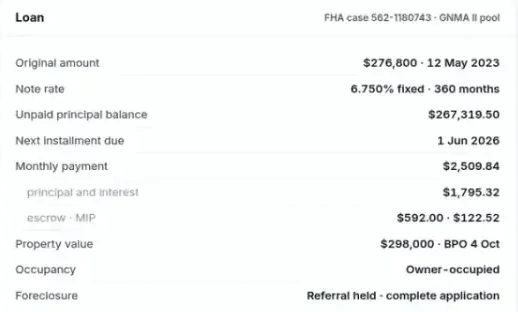
The loan terms the calculator starts from
What an FHA payment supplement calculator must check
A spreadsheet can multiply by 0.25 and divide by 36. What it usually cannot do is know which inputs are in force and where they came from. Eight checks separate a calculator you can sign from one you cannot.
Eight checks for an FHA payment supplement calculator
- Run only after the 40-year combination misses 15%
The supplement is question 7; reaching it early skips options HUD requires first.
- Cap base from the first claim’s default
Not today’s balance: the statutory maximum is fixed when the first partial claim is paid.
- Every earlier claim and supplement subtracted
Verified in HUD’s portal, plus any the servicer knows of that are not reported there.
- Reinstatement with past-due principal
Part A, Step 2, not the modification arrears of Step 3.
- Principal portion at the start of the supplement period
It caps the reduction and must itself exceed the minimum.
- Both minimum tests
At least 5% of principal and interest and at least $20, as of the start date.
- The comparison in Step 7
Against the 40-year combination at the market rate on the offer date.
- The fallback when it fails
The lower of the 40-year combination and a standalone partial claim, with the reason in the notice.
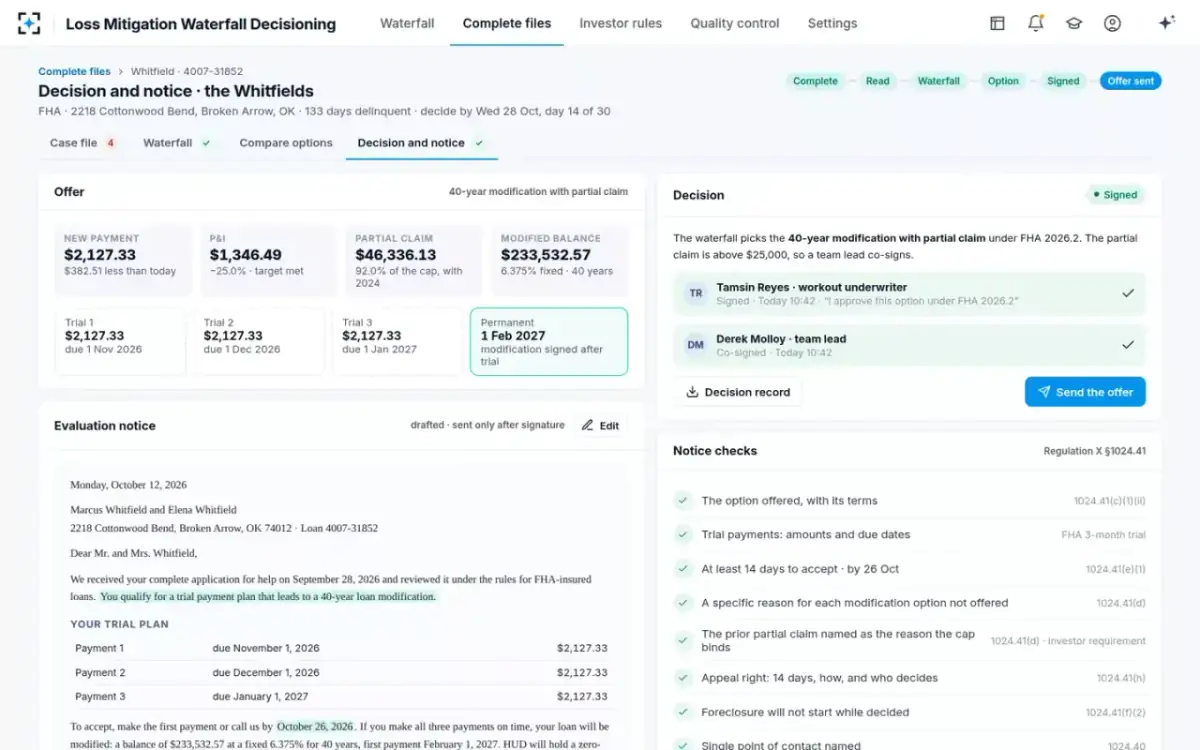
Botminds' Loss Mitigation Waterfall Decisioning runs those checks as steps, each with its rule citation and its arithmetic, and the notice drafter turns a failed test into the specific reason Regulation X requires for each modification not offered (12 CFR 1024.41(d)). The workout underwriter can change one input as a what-if (an earlier claim amount, the offer week) without touching the decision on file, and signs the result.
A signed decision, with the reasons the waterfall produced
Questions people ask
Is the FHA payment supplement the same as a partial claim?
It is funded the same way and counts against the same 30% cap, but it does more: it pays the arrears and then part of the principal each month for 36 months. A standalone partial claim pays only the arrears and leaves the payment unchanged.
What happens after the 36 months?
The reductions stop and the borrower pays the full principal and interest under the original note again. On the Brandt loan that is a step from $1,443.82 back to $1,687.91, before any change in escrow.
Does the borrower repay the payment supplement?
Yes, eventually. It is evidenced by a non-interest-bearing note and subordinate mortgage to HUD for the reinstatement and all reductions; like other FHA partial claims, it is not due monthly.
Can a borrower get a second payment supplement?
Not within 36 months of signing the first, and never beyond the 30% cap, which the first supplement has already used in part.
Is the payment supplement permanent?
It is part of the waterfall now, but HUD said in ML 2025-12 that it will "conduct an overall evaluation of the Payment Supplement tool, including an assessment of its performance and function, to determine if it should remain".