The FHA loan modification interest rate is a fixed rate no higher than FHA's "Market Rate": the most recent Freddie Mac Primary Mortgage Market Survey (PMMS) rate for 30-year fixed conforming loans, rounded to the nearest one-eighth of a percentage point, plus 25 basis points for a 30-year modification or 50 for a 40-year one, taken as of the date the borrower is offered the trial payment plan. The same rate carries into the permanent modification. Because the survey moves every week, a waterfall computed on one Thursday's rate and offered after the next can give the wrong term, the wrong partial claim, or the wrong option altogether; in the five weeks to 8 October 2026 the survey rose from 6.71% to 7.40%. Botminds' Loss Mitigation Waterfall Decisioning reads the survey week that will be in force at the offer and shows the rounding and the margin on every file, so the workout underwriter signs a rate she can trace.
The FHA modification rate, in four numbers
1/8pt
round the weekly survey rate to the nearest 0.125% first
ML 2025-12
+25bp
added for a 30-year modification
+50bp
added for a 40-year modification
7.32%
the survey rate on 22 October 2026: 7.625% and 7.875% caps after rounding
Freddie Mac PMMS via FRED
What interest rate does an FHA loan modification use?
A fixed rate at or below the Market Rate. HUD's rule is short enough to quote in full: "Market Rate is a rate that is no more than 25 bps for a 30-year loan modification or 50 bps for a 40-year loan modification greater than the most recent Freddie Mac Weekly Primary Mortgage Market Survey (PMMS) Rate for 30-year fixed rate conforming Mortgages (U.S. average), rounded to the nearest one-eighth of 1 percentage point (0.125 percent), as of the date the Borrower is offered the TPP. The Mortgagee must first round the PMMS Rate to the nearest one-eighth of 1 percentage point (0.125 percent) before calculating the rate at 25 bps or 50 bps greater than the PMMS Rate" (ML 2025-12).
Four other rules frame it. "The Mortgagee must ensure that any modified loan is a fixed rate Mortgage." The servicer may set a rate below the Market Rate, but "Discount Points associated with rate reductions are not reimbursable". When a modification raises the note rate, "the Mortgagee must calculate the maximum interest allowable as the Market Rate". And for any option that includes a modification, the trial plan's rate and the permanent rate may not exceed the Market Rate, which "must be established when the TPP is offered".
What is the PMMS rate, and how often does it change?
The PMMS is Freddie Mac's weekly average of 30-year fixed mortgage rates, published each Thursday. The Federal Reserve Bank of St. Louis carries the series as MORTGAGE30US, "Weekly, Ending Thursday", and notes that since a methodology change on 17 November 2022 "the weekly mortgage rate is now based on applications submitted to Freddie Mac from lenders across the country" (FRED, Federal Reserve Bank of St. Louis). HUD's letter tells servicers that the weekly results are published on Freddie Mac's website.
It changes every week, and in 2026 it changed a lot. Over the 52 weeks to October 2026 it ranged from 5.98% on 26 February to 7.40% on 8 and 15 October. The autumn rise is the one that matters for decisions made now.
The weekly survey rate, September and October 2026
How is the FHA modification rate calculated? Round first, then add 25 or 50 basis points
Take the most recent survey rate on the day the trial plan is offered, round it to the nearest 0.125%, then add 0.25 for a 30-year term or 0.50 for a 40-year term. The result is the ceiling for that term. On 22 October 2026: 7.32% rounds to 7.375% (7.32 is 0.055 from 7.375 and 0.07 from 7.25), so the 30-year ceiling is 7.625% and the 40-year ceiling 7.875%.
Eight weeks of FHA modification rate ceilings, from the survey to the cap
| Survey week | PMMS | Rounded to 1/8 | 30-year ceiling | 40-year ceiling |
|---|---|---|---|---|
| 3 Sep 2026 | 6.71% | 6.750% | 7.000% | 7.250% |
| 10 Sep 2026 | 6.76% | 6.750% | 7.000% | 7.250% |
| 17 Sep 2026 | 6.95% | 7.000% | 7.250% | 7.500% |
| 24 Sep 2026 | 7.03% | 7.000% | 7.250% | 7.500% |
| 1 Oct 2026 | 7.28% | 7.250% | 7.500% | 7.750% |
| 8 Oct 2026 | 7.40% | 7.375% | 7.625% | 7.875% |
| 15 Oct 2026 | 7.40% | 7.375% | 7.625% | 7.875% |
| 22 Oct 2026 | 7.32% | 7.375% | 7.625% | 7.875% |
Two practical notes. Because 25 and 50 basis points are whole multiples of an eighth, rounding before or after adding the margin gives the same answer except in a dead tie, but HUD prescribes the order, so a calculator should follow it and show it. The bigger risk is the direction of rounding: "nearest" means 6.95% becomes 7.000%, not 6.875%, and a spreadsheet that truncates to the eighth below sets a rate lower than the borrower will be offered, which can make a modification look like it meets the 25% target when it does not, or the reverse when a servicer rounds up.
When is the FHA modification rate locked?
On the date the borrower is offered the trial payment plan. The rule reads "as of the date the Borrower is offered the TPP", and the trial plan terms add that the Market Rate "must be established when the TPP is offered" and that the trial and permanent rates may not exceed it (ML 2025-12). It is not the date the application was complete, nor the date the file was evaluated. A servicer that fixes the rate at evaluation and offers a week later may be using a rate that is no longer the most recent.
The calendar makes that likely. Regulation X allows 30 days from a complete application to a written decision (12 CFR 1024.41(c)(1)), and the notice and trial offer go out after the underwriter, and sometimes a team lead, has signed. Every Thursday in between is a new survey.
Four Thursdays can pass between a complete file and its trial offer
- Queue and evaluation20 d
- Signatures6 d
- Notice and trial offer4 d
- Evaluation, signatures and trial offer6 d
What the September-to-October 2026 rise did to one loan
Take the Mercer loan, a fictional 2023 FHA purchase of $325,000 at 6.875% with principal and interest of $2,135.02. It defaulted on 1 June 2026. At the default the balance was $314,783.00, so the cap is $94,434.90 and, with no earlier claim, all of it is available. Adding the arrears a modification may capitalize gives $325,165.33 to resolve, and the 25% target is $1,601.26. Neither standalone modification reaches it, so the question is how much partial claim each term needs.
The same file, offered five weeks apart
Offered in the week of 3 September (PMMS 6.71%): 7.000% for 30 years, 7.250% for 40
Offered in the week of 8 October (PMMS 7.40%): 7.625% for 30 years, 7.875% for 40
Offered in the week of 3 September (PMMS 6.71%): Needs $84,483.24, within the $94,434.90 cap: offered
Offered in the week of 8 October (PMMS 7.40%): Needs $98,932.20, over the cap: not offered
Offered in the week of 3 September (PMMS 6.71%): Not reached
Offered in the week of 8 October (PMMS 7.40%): Needs $91,727.37, within the cap: offered
Offered in the week of 3 September (PMMS 6.71%): 30-year term, $84,483.24 owed to HUD
Offered in the week of 8 October (PMMS 7.40%): 40-year term, $91,727.37 owed to HUD, $2,707.53 of room left
The switch happened on the 1 October survey: at 7.25% rounded, the 30-year combination needed $96,156.36, over the cap, and the file moved to 40 years. A decision computed in September and offered in October on September's rate would therefore offer a 30-year term the October rule does not allow, at a rate below the ceiling that, if the servicer did not intend a discretionary reduction, it was not required to give. The reverse error, computed in a high week and offered after rates fall, denies a 30-year term the borrower would have qualified for, and puts ten more years of payments on the loan.
The same arithmetic explains why waiting matters for the cap. A claim of $91,727.37 leaves $2,707.53 of room for the life of the loan; the September offer would have left $9,951.66. For a borrower who defaults again, that difference is the gap between a standalone partial claim next time and none. FHA partial claim requirements explains why the room never resets.
Can the servicer offer a rate below the market rate?
Yes, for FHA, at its own cost: "At the Mortgagee's discretion, the Mortgagee may reduce Note interest rates below Market Rate; however, Discount Points associated with rate reductions are not reimbursable" (ML 2025-12). The Market Rate is a ceiling, so a lower rate is always permitted; what a servicer cannot do is charge more, or let a stale rate become an unintended reduction that shows up in QC as an error.
Other owners word it differently. USDA requires modifications to be "a fixed interest rate" that "cannot exceed the market interest rate at the time of modification" (USDA final rule, 2024). The GSEs' Flex Modification reduces the rate only "if eligible", as the first of its steps toward a 20% cut (FHFA, 2024), under rates set in each GSE's guide. A team that runs all three needs each owner's rate rule, not one.
Why 2026 rates push loans past modification to the payment supplement
Because a modification at 7.625% or 7.875% raises the payment on any loan whose note rate is well below that. Loans made in 2020 and 2021 carry note rates near 3%; re-amortizing their balance at today's ceiling cannot lower principal and interest without a very large partial claim, and the 30% cap limits the claim. Those files fall through the 15% floor to the Payment Supplement, which leaves the note rate alone and pays part of the principal for 36 months instead.
That is the most important practical effect of the rate rule in 2026: it sorts the default population by vintage. High-rate loans from 2023 and 2024 can often be modified; low-rate loans from 2020 and 2021 mostly cannot. The payment supplement calculator follows a loan through that last step.
How to keep the rate current from evaluation to offer
Treat the rate as an input with a date, and check the date at the offer. Botminds' Loss Mitigation Waterfall Decisioning's escrow and rate checker reads the survey week, applies the rounding and the margin for each term, and shows them on the file; if a new survey is released before the offer goes out, the waterfall runs again on the new rate, and the underwriter sees whether anything changed before she signs. In its sample servicer's replay of 412 spreadsheet-era decisions, six had used a market rate more than a week old.
Stale rates, counted among the reasons decisions change
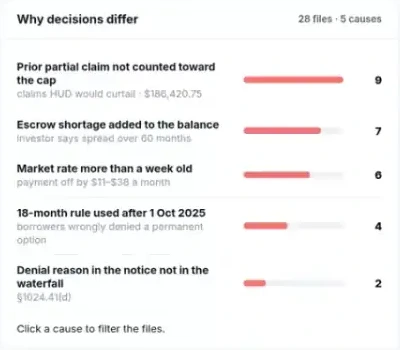
The offer itself states the rate, the term and the trial payments, and FHA requires the trial plan agreement to give "the Market Rate for the modified Mortgage, if applicable". The notice drafter writes those terms from the same step the calculator used, so the rate in the letter is the rate in the arithmetic.
The rate in the offer is the rate in the arithmetic
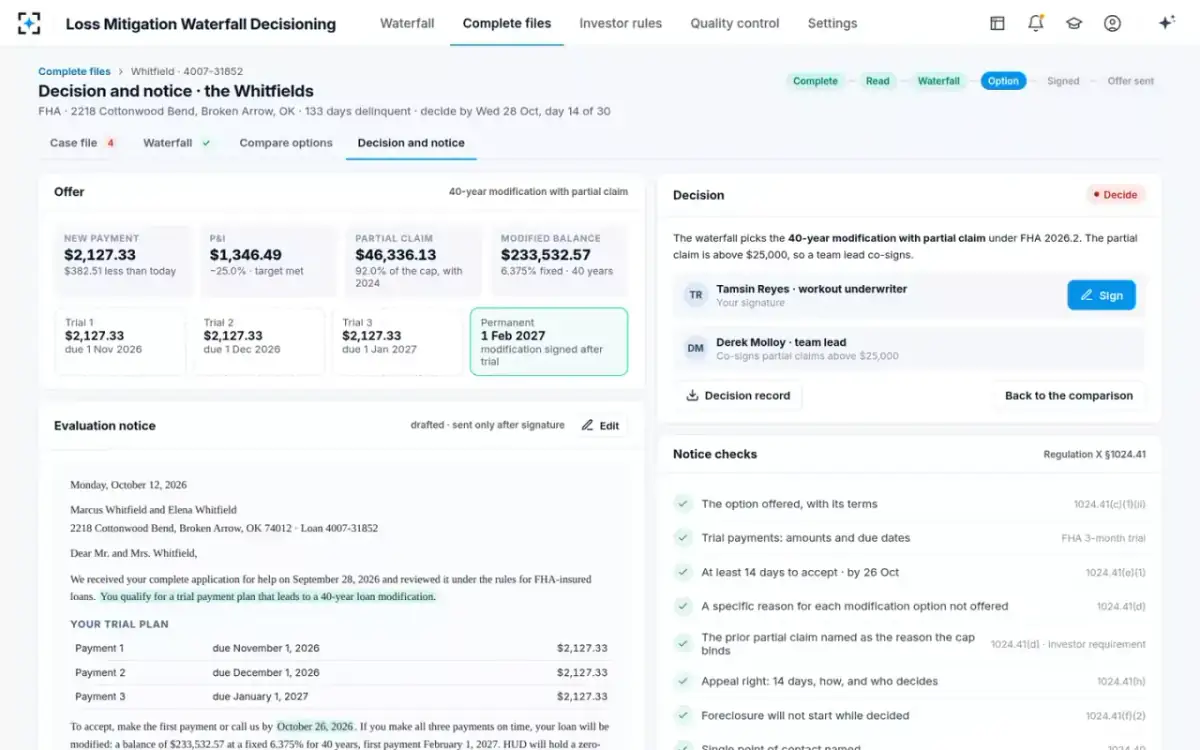
How the rate fits into the rest of FHA's order is traced in the FHA waterfall in 2026, and the Loss Mitigation Waterfall Decisioning page lists the agents behind each step.
Questions people ask
Is the FHA modification rate the same as the borrower's note rate?
Not usually. The modified rate is reset to no more than the Market Rate. If the note rate is lower, a modification raises it unless the servicer chooses a lower rate at its own cost; that is why low-rate loans often end at the Payment Supplement instead.
Where do I find the PMMS rate history?
Freddie Mac publishes the weekly survey, and the Federal Reserve Bank of St. Louis carries the full history as the FRED series MORTGAGE30US. Use the value in force on the day the trial plan is offered.
Why does a 40-year modification get a higher rate?
HUD allows 50 basis points over the rounded survey rate for 40 years against 25 for 30 years, reflecting the longer term. The longer term still usually lowers the payment more than the extra quarter point raises it.
Does the rate change during the trial plan?
No. It is set when the trial plan is offered, and the permanent modification may not exceed it, so a rise in the survey during the three trial months does not affect the borrower.
Can the borrower ask for a 30-year term at the 40-year rate?
The term is set by the waterfall, not by choice: FHA tries 30 years first and moves to 40 only when 30 cannot reach the target. A borrower may ask for a term shorter than 30 years on a standalone modification, if the payment stays within the target.