ULDD, in mortgage lending, is the Uniform Loan Delivery Dataset: the standard list of data points a lender sends Fannie Mae or Freddie Mac when it sells or pools a closed single-family loan. It covers the note terms, the property and its value, the borrower and credit, mortgage insurance and the parties, and it travels as a MISMO XML file exported from the loan origination system. The GSEs buy on that data: their edits run against it, their prices are set from it, and the lender warrants it accurate for as long as the loan exists. Getting it right is hard because the file is assembled from systems, not from the signed documents, and nothing in the delivery process compares the two field by field. Botminds' Loan Delivery Data Validation exists to do that comparison: its agents tie every delivered field to the page of the note, appraisal or findings it must agree with, before the loan is sold.
ULDD is the last of four datasets a loan passes through
1 · At application
ULAD
Uniform Loan Application Dataset
The redesigned 1003 as data: most of what the automated underwriting systems decide on.
2 · At appraisal
UAD
Uniform Appraisal Dataset
Standard fields and answers for the appraisal report, submitted through the collateral portal.
3 · At closing
UCD
Uniform Closing Dataset
The Closing Disclosure as data, sent before delivery with the signed PDF inside.
4 · At sale
ULDD
Uniform Loan Delivery Dataset
The common set of fields the GSEs require to buy or securitize a single-family loan.
What does ULDD stand for, and who created it?
ULDD stands for Uniform Loan Delivery Dataset. Fannie Mae and Freddie Mac built it together as one part of the Uniform Mortgage Data Program, the standardisation effort the two have run since May 2010 under the oversight of the Federal Housing Finance Agency, their regulator and conservator. FHFA's own description is short: the ULDD "defines the common data set required by the Enterprises for single-family loan deliveries" (FHFA Insights, 2017).
Before the program, each GSE defined its delivery data its own way, and a lender selling to both kept two mappings. The program put four datasets on one footing: the loan application (ULAD), the appraisal (UAD), the Closing Disclosure (UCD) and the delivery (ULDD). FHFA credits it with having "enhanced accuracy and overall quality of loan data". The datasets are common, not identical in use: each GSE still adds requirements of its own, so a delivery file prepared for one is checked against that GSE's rules.
ULDD is not a form a person fills in. It is the shape of an export. The loan origination system holds the values, a delivery module maps them to ULDD data points, and the result is uploaded to Fannie Mae's Loan Delivery application or Freddie Mac's selling system. That is the point where data stops being the lender's working record and becomes something the lender has sold.
What is a ULDD file, and what is in it?
A ULDD file is an XML document built on the MISMO reference model, carrying one loan or many, with one data point for each required or conditionally required field. MISMO, the mortgage industry's standards body and a subsidiary of the Mortgage Bankers Association, says "all exchanges included in the GSE UMDP program" are based on its standards (MISMO FAQs). The field list itself sits in Fannie Mae's Implementation Guide for Loan Delivery Data, Appendix D, which the Selling Guide describes as "a listing of the ULDD required and conditionally required data fields, as well as field definitions and implementation notes" (Selling Guide C1-2-02).
"Conditionally required" is where much of the work lives. A field such as mortgage insurance coverage is required only when the loan-to-value ratio calls for insurance; project type and dues only when the property is in a project. The data points fall into a handful of families, and each family has a document it should agree with. In the sample lender used on this page, the solution maps 286 delivered fields per loan, each to the page it must match or marked as set by the system.
The main ULDD field families, and the signed page each must agree with
| Field family | Examples | Source of truth in the closing file |
|---|---|---|
| Loan terms | Note amount, note rate, term, first payment date, maturity, principal and interest | The note, page 1, and any rider or modification |
| Property | Address, property type, project type and dues, number of units | The security instrument and the appraisal |
| Value and ratios | Sales price, appraised value, LTV, CLTV | The Closing Disclosure for price, the appraisal for value; ratios recomputed |
| Borrower and credit | Names, representative credit score, debt-to-income ratio, income | The note for names as signed; the final automated underwriting findings for score and DTI |
| Occupancy and purpose | Primary residence, second home or investment; purchase or refinance | The signed final loan application and the security instrument |
| Insurance | Mortgage insurance coverage percent and certificate number | The MI certificate |
| Parties and registry | MERS MIN, seller, servicer, document custodian | The security instrument and the note, which carries the MIN |
Is ULDD the same as UCD?
No. The Uniform Closing Dataset carries the Closing Disclosure: what the borrower was told the loan costs. The Uniform Loan Delivery Dataset carries the loan as the investor is buying it. Many values appear in both, such as the loan amount, rate and sales price, but they are submitted at different moments and checked by different systems. Fannie Mae requires a UCD file with "a 'Successful' status from the UCD collection solution prior to the delivery of the loan" (Selling Guide C1-2-02), and the ULDD file then goes through Loan Delivery's own edits.
The two also hold values that are meant to differ. The delivered LTV, for example, is computed from the lower of the sales price and the appraised value and delivered as a rounded whole percent, while the Closing Disclosure prints the price. A comparison that treats every shared label as a must-match pair will raise false errors. The UCD and ULDD crosswalk sets out which fields should agree and which should not.
What does the lender warrant about ULDD data?
The lender warrants all of it. The Selling Guide is unusually direct: "Regardless of the delivery option, the lender represents and warrants that all required mortgage loan delivery data is true, correct, and complete, even for such data elements that are not required to qualify a borrower or underwrite a loan" (Selling Guide A2-2-02). The last clause matters. A project type that never touched the credit decision still carries the same warranty as the note rate.
The warranty also outlives the usual relief. Fannie Mae offers enforcement relief on many underwriting representations once a loan has performed, but data inaccuracies are one of the six life-of-loan exclusions (Selling Guide A2-2-07). The Guide's test is specific: inaccuracies in the same delivery data element on five or more loans, where the delivered data differs from the lender's own loan files, and where the true data would have made the loan ineligible, or eligible only under different terms. A lender "remains responsible for representations and warranties for the life of the loan related to misstatements, misrepresentations, omissions, and data inaccuracies", and Fannie Mae "may require the lender to correct data as needed" (Selling Guide A3-4-02).
A loan's file proves what was signed. The ULDD file is what was sold. The warranty is that the two say the same thing, field by field, for as long as the loan exists.
What checks a ULDD file before the loan is bought?
Three checks run before purchase, and each looks at a different thing. The first is the GSE's own edits. Fannie Mae states that "loans may only be submitted and purchased in Loan Delivery if they are clear of all fatal edits" (C1-2-02). Edits test whether data is present, well formed, internally consistent and eligible: a missing project type, a MIN that fails its check digit, a payment that does not fit the rate and term.
The second is the document custodian, who holds the original note and certifies it against the delivered data. When the two disagree, Fannie Mae's process lets the lender "accept or decline data changes the custodian proposes as a result of the discrepancy on the note and the data they provided" (Selling Guide C2-2-02). Until that is resolved, the loan is not certified and not bought.
The third is a pair of match rules on the other datasets. The appraisal must have reached "Successful" in the collateral portal, and "the appraised value as indicated on the appraisal submitted to UCDP" must match "the appraised value as reported at sale of the loan" (Selling Guide B4-1.1-06). The UCD must also be Successful before delivery.
Where a ULDD file is checked, and by whom
Agent
Loan origination system exportMaps stored values to ULDD data points and writes the MISMO XML file.
Never: Reads the signed documents.
Agent
GSE delivery editsFatal edits and warnings on presence, format, consistency and eligibility. A fatal edit stops purchase.
Never: Compares a value with the note or appraisal.
A person decides
Document custodianCertifies the original note against the delivered data and proposes changes where they differ.
Never: Checks fields that are not on the note.
Agent
Collateral and closing portalsRequire Successful UCD and UCDP submissions; the delivered appraised value must match UCDP.
Never: Check score, DTI, occupancy or MI against their documents.
A person decides
Post-closing QC, after saleSamples loans monthly and reviews data integrity against the file.
Never: Reaches every loan, or reaches it before sale.
Where ULDD data goes wrong: one sample loan
Most wrong ULDD values are not malformed. They are a correct value from the wrong moment, or from the wrong document, and they pass every format check. Take a sample lender, Calder Point Mortgage (a fictional company with fictional borrowers), and a 48-loan batch it is about to sell, as it runs through Loan Delivery Data Validation. On one loan, the Brandt purchase, four fields break.
Closing moved from 1 October to 25 September, the note was redrawn, and the loan system kept the old dates: the file says first payment 12/01/2026 and maturity 11/01/2056, the note says 11/01/2026 and 10/01/2056. Both pairs fit a 360-month term. The property value field holds the $515,000 sales price instead of the $509,000 appraised value. Fannie Mae's rule computes LTV on "the lower of the sales price or the current appraised value", truncates it to two decimals and rounds up to the next whole percent (Selling Guide B2-1.2-01). On $412,000 that is 80.94%, delivered as 81%, not the tidy 80% the file implies. Above 80%, the loan needs mortgage insurance; the 12% certificate was on file but never linked. And the project type was blank where the appraisal says PUD.
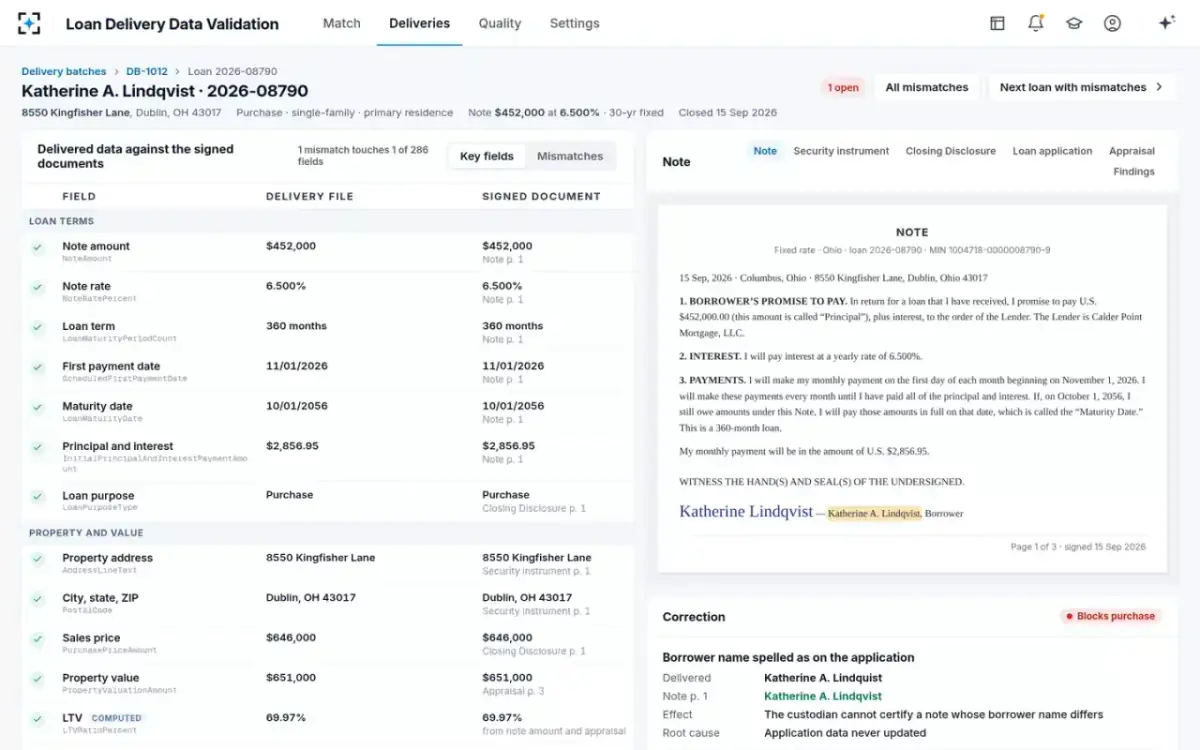
Every ULDD field next to the page it must agree with
How Loan Delivery Data Validation checks a ULDD file
The solution reads the ULDD export as it is and never edits it. Its delivery file reader maps every data point to the document and page it must agree with, using the investor's field map. Separate readers take the signed closing package (note, security instrument, riders, Closing Disclosure, title, MI certificate) and the appraisal and underwriting file (appraisal, final findings, transmittal summary, credit report). A field matcher compares each pair under the investor's rounding rules and recomputes what must be computed: LTV and CLTV from the lower of price and value, principal and interest from amount, rate and term, maturity from the first payment date.
On the sample batch that is 662 documents and 13,728 fields, read and compared in 1 minute 43 seconds. Eleven fields broke on eight loans. The investor's edits would have caught two of them.
One sample ULDD batch, checked field by field in Loan Delivery Data Validation
286
delivered fields per loan, each mapped to a page or marked system-set
13,728
fields compared against 662 signed documents
9of 11
mismatches that passed the investor’s edits
People decide what changes. The loan delivery analyst accepts each drafted correction, or keeps the delivered value with a reason and a second person; accepted corrections create a new version of the file, and the exported one is never overwritten. Where documents contradict each other, such as a file priced as a primary residence whose signed application says investment property, the agents do not choose: the loan goes to QC with both pages. Why the edits pass values like these is the subject of Fannie Mae loan delivery edits and what they cannot see.
How big is the delivery data problem?
Large enough that the regulator has measured it. Lenders originated 6.83 million mortgages in 2025 by the count of HMDA data (FFIEC HMDA data browser), and every one sold to a GSE carries a ULDD file of a few hundred fields. Neither GSE publishes how often those fields disagree with the closing file, and no public study puts a rate on it. What is public is how seriously the data is treated: a warranty on every field, a life-of-loan exclusion for patterns of data inaccuracy, and a post-purchase process to correct discrepancies the lender finds itself.
The ULDD has also been revised to carry more over time. FHFA noted in 2017 that an update adding HMDA fields would be mandatory from May 2019 (FHFA Insights). Each addition is another field the lender warrants and another mapping from the loan system that can go stale.
Questions people ask
What does ULDD mean in mortgage?
ULDD means Uniform Loan Delivery Dataset, the common data standard Fannie Mae and Freddie Mac use for single-family loan deliveries. It was developed under the Uniform Mortgage Data Program that the GSEs have run together since 2010, with FHFA as their regulator.
What is a ULDD file?
A ULDD file is the XML export, built on the MISMO reference model, that a lender uploads to sell or pool loans. It holds one data point for each required or conditionally required field listed in Fannie Mae's Appendix D, for every loan in the delivery.
What is the Uniform Mortgage Data Program?
It is the GSEs' joint program to standardise mortgage data, made up of four datasets: the loan application (ULAD), the appraisal (UAD), the Closing Disclosure (UCD) and the delivery (ULDD). FHFA describes it as improving "the quality of available data for the Enterprises and lenders".
Does the lender have to deliver fields that underwriting never used?
Yes, and it warrants them too. Fannie Mae's Guide says some delivery data elements "are not required to qualify a borrower or underwrite a loan but are still required to be delivered", and the warranty of "true, correct, and complete" covers them all.
Who checks a ULDD file against the note?
The document custodian certifies the original note against the delivered data before purchase, and proposes data changes where the two differ. The custodian sees only what is on the note; the appraisal, findings, occupancy and MI fields need their own comparison, which is what a pre-delivery data review adds.
Can a delivered ULDD field be corrected after the sale?
Yes, through Fannie Mae's post-purchase adjustment process, and lenders must report discrepancies they find. Corrections that change loan-level price adjustments are considered for repricing only within 18 months of acquisition, with a $100 minimum per loan; what a wrong field costs after sale covers the clocks.