Mortgage data integrity is the property that a loan's data, in every system it passes through, says what the signed documents say: the application, the underwriting findings, the Closing Disclosure, the delivery file sold to the investor and the records the regulator keeps. It fails quietly, because a wrong value is usually well formed and consistent with its neighbours, and it fails at the hand-offs between systems. The rules treat it as the lender's job: Fannie Mae requires "complete and accurate data", verifiable underwriting data and procedures to validate it, and it holds a pattern of delivery data errors against the lender for the life of the loan. Botminds' Loan Delivery Data Validation addresses the hand-off a lender owns outright, from the closing file to the data it delivers, by checking every field against its page before sale. This guide starts with what the regulator's own auditors found.
What FHFA’s inspector general found in the regulator’s loan data
647,820
Fannie Mae loans whose valuation method was recorded as “unknown”
>10%
of the Fannie Mae loans reviewed, acquired 2015 to 2017
>99%
of loans acquired Oct 2019 to Dec 2021 had a valuation type recorded, after the fix
What is mortgage data integrity?
It has two parts, and lenders tend to measure only one. Completeness and validity: every required field present, in the right format, consistent with the others. Accuracy: every value the same as the document it comes from. The first can be checked by rules, and the GSEs' edits do so on every loan. The second needs the documents, and it is the part Fannie Mae writes into its Guide: "Lenders must supply Fannie Mae with complete and accurate data. All data entered into DU must be verifiable. The lender must have adequate procedures in place to validate the integrity of specific data for each underwriting recommendation" (Selling Guide A3-4-02).
Integrity also has a direction. Data flows from the application to underwriting, to closing, to delivery, to the investor and on to the regulator's databases. Each hand-off can copy a value forward correctly, copy a stale one, or lose it. A field that is right in one system and wrong in the next is an integrity failure even if nobody typed anything wrong.
What did FHFA's inspector general find about loan data?
That the regulator's own loan-level database had holes large enough to matter. In a March 2019 audit of FHFA's oversight of Fannie Mae's single-family purchases from 2015 to 2017, the Office of Inspector General "found multiple instances in MLIS where selected data fields were either missing information entirely or listed the expected data as 'unknown.'" For the property valuation method present at delivery, MLIS recorded "unknown" for 647,820 mortgages, "more than 10% of the Fannie Mae loans reviewed" (FHFA-OIG, COM-2022-005).
The inspector general's reason for caring is the reason any lender should: "The absence of complete and accurate data from MLIS presents a significant problem, because FHFA relies on MLIS to support its research, policy analyses, and publications." FHFA and Fannie Mae found an alternative source for the field; by 2019 unknowns had fallen below 1%, and the follow-up review of loans acquired from October 2019 to December 2021 found a valuation type recorded for more than 99%. The lesson is not that the data was wrong at the lender. It is that a field can be lost between systems at scale, and that nobody notices until someone checks.
A field lost between two systems is not one lender's typo. At the scale of the mortgage market, it is a hole in the regulator's picture of the market.
How accurate is mortgage delivery data?
Nobody publishes the answer. Neither GSE reports how often delivered fields disagree with lenders' closing files, and no public study puts a rate on it. What can be said is how much data there is and how it is checked. Lenders originated 6.83 million mortgages in 2025 (FFIEC HMDA data browser); every one sold to a GSE carries a delivery file of a few hundred fields; and the checks that run on every loan, the edits, test form and consistency, not agreement with the signed documents.
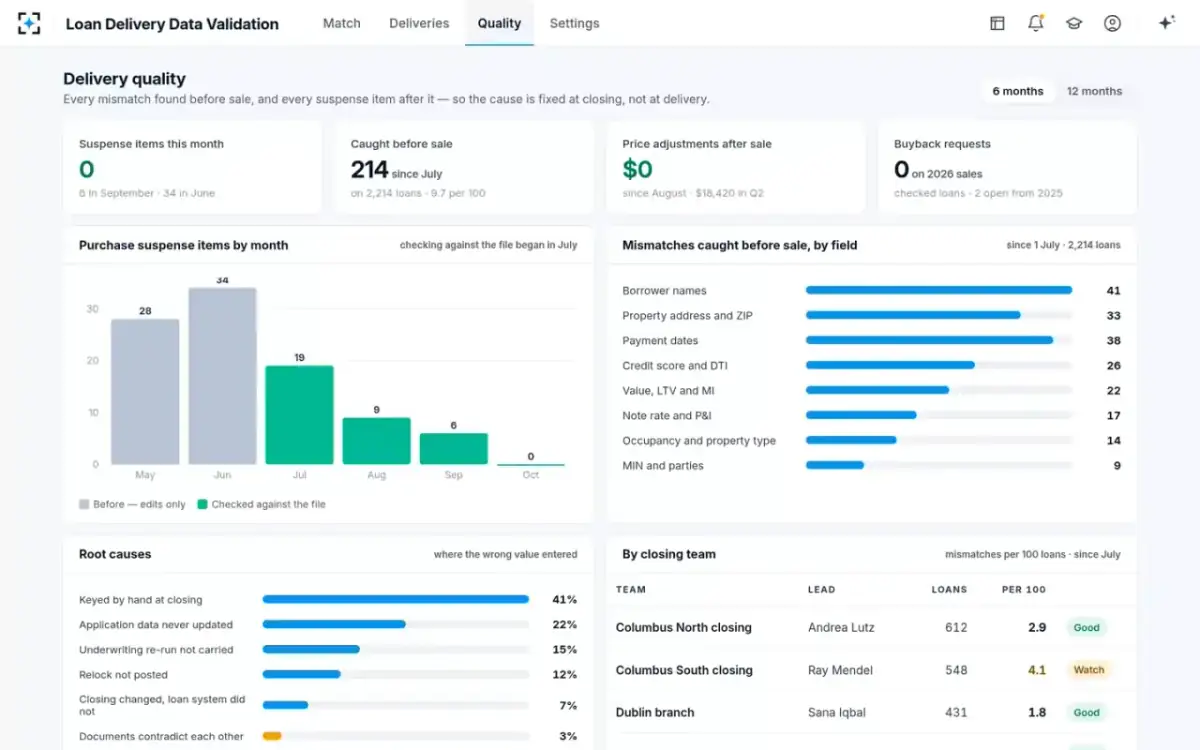
Lenders can measure their own rate, and should. Take a sample lender, Calder Point Mortgage (fictional, as are its borrowers and staff), which began checking every delivered field against its closing file in July. Over the next months its agents caught 214 mismatches before sale on 2,214 loans, 9.7 per 100 loans. That is sample data, built to show what a lender's own measurement looks like, and the shape of it is the useful part: where the errors come from.
Where wrong values entered, as Loan Delivery Data Validation records them
Where do mortgage data errors come from?
From the hand-offs, as the sample suggests. Three patterns account for most of them, and each has a fix that is not a data fix. Values keyed at closing, such as a borrower's name as said on the phone or a ZIP code from a prior address, are a closing-desk process. Values that are stale, such as the original lock rate after a relock or an early underwriting submission's DTI, are an integration gap: the loan system was not updated when the document was. And values from the wrong document, such as the contract price in the appraised value field, are usually a mapping or training problem.
Fannie Mae's Guide names the moment the stale-value problem must be caught: the data submitted to DU "must reflect the loan as it was closed, including occupancy type, product type, amortization, loan term, property type, loan purpose, sales price, and appraised value" (Selling Guide B3-2-10). The few errors that are not hand-off problems, where two signed documents disagree, need a person, not a correction.
Where a delivered value can go wrong, and who should catch it
| Hand-off | Typical failure | Caught today by | Caught before sale by a field check? |
|---|---|---|---|
| Application to underwriting | Income or debts not updated after the first run | The underwriter, if resubmitted | Yes: DTI and score read from the final findings |
| Underwriting to closing | Relock, new run or redrawn documents not carried to the loan system | Sometimes the closer | Yes: note and findings against the data |
| Closing to the loan system | Names, dates, ZIP and project type keyed by hand | The custodian, for note fields only | Yes |
| Loan system to delivery file | A field mapped from the wrong source, on every loan | Nobody, until a pattern is found | Yes, and the pattern shows by field |
| Delivery to the investor’s records | A value lost or set to unknown | The investor or the regulator | Partly: the delivered value is right, its downstream use is not the lender’s |
Why does loan data quality matter to the lender?
Because the lender carries it for the life of the loan. Fannie Mae's data warranty survives the enforcement relief that protects performing loans from most underwriting defects. The test is a pattern: inaccuracies in "the same delivery data element(s)" on five or more loans, where "such delivery data differ from the information documented in the lender's mortgage loan files", and where the true data would have made the loan ineligible or eligible only under different terms (Selling Guide A2-2-07). A mapping error is a pattern by construction.
Data quality also shapes credit. FHFA's account of the representation and warranty framework says that uncertainty about repurchase "can contribute to increased credit overlays that affect lending costs and may reduce access to credit" (FHFA). In 2012, banks told the Federal Reserve that "the higher risk of putbacks of delinquent mortgages by the GSEs" was the factor cited as most important by the largest number of banks for being less likely to make GSE-eligible loans to borrowers with lower scores (Federal Reserve, Senior Loan Officer Survey, April 2012). Clean data is how a lender keeps that risk priced into a field, not into a credit box.
What is MISMO, and does a standard fix integrity?
MISMO is the mortgage industry's standards body, a subsidiary of the Mortgage Bankers Association, and its standards underlie "all exchanges included in the GSE UMDP program as well as exchanges required by FHA, Ginnie Mae, VA and the USDA" (MISMO FAQs). The GSEs' Uniform Mortgage Data Program, which FHFA credits with having "enhanced accuracy and overall quality of loan data" (FHFA Insights), gave the industry one vocabulary for applications, appraisals, closings and deliveries.
A standard fixes the shape of the data, not its truth. It guarantees that a first payment date is a date in the right place; it cannot know that the note was redrawn. Integrity needs the standard and a comparison with the documents. What ULDD is explains the delivery standard in detail.
What should mortgage data integrity software do?
It should compare data with documents, not data with data, on every loan, and leave the decisions to people. QC already has to do this on a sample: the post-closing review must include "a data integrity review", must "review the final terms of the loan to ensure they align with the data used to support the underwriting decisions", and when the data and the source documents disagree, the lender must check the tolerances, resubmit to DU if outside them, and decide whether the loan remains eligible (Selling Guide D1-3-02). Software earns its place by doing the comparison before sale, on every loan, so QC finds less.
What to look for in mortgage data integrity software
- It reads the signed documents
A tool that reconciles the loan system with the delivery file confirms stale values that both share.
- It picks the version that counts
Signed and redrawn notes, the final underwriting run, the appraisal sent to the collateral portal.
- It recomputes the investor’s way
LTV on the lower of price and value with the Guide’s rounding; MI coverage from the result.
- It reports by field and cause
Errors per 100 loans by field, closing team and root cause, so the fix lands upstream.
- It never changes data on its own
Drafted corrections a person accepts, written as a new version, with page and signer.
- It routes contradictions
Two signed documents that disagree go to QC with both pages.
- It shows its coverage
Which fields it tied to a page, and which it could not.
Where Botminds' Loan Delivery Data Validation fits on that list, and where it does not: it reads the signed closing package, appraisal and final findings for every loan in a delivery batch, ties each of the delivered fields to its page, recomputes the investor's ratios and reports mismatches by field and cause. It does not reverify income or employment with third parties, examine the original note in hand, or fix what happens to data after it reaches the investor. How to test it, or any alternative, on one of your own delivered batches is in mortgage audit software: a one-batch pilot.
Loan Delivery Data Validation: delivery quality by field, cause and team
Measuring your own rate: three numbers to track
Because no public rate exists, a lender's own measurement is the only benchmark it has, and three numbers cover most of what matters. The first is mismatches per 100 loans by field, found before sale against the signed documents. It shows where to look, and a single field that dominates is usually one mapping or one habit. The second is the share of data errors found before sale against those found after: custodial exceptions, purchase suspense, Purchase Advice corrections, post-purchase adjustments and QC data findings. A healthy process moves errors from the second column to the first.
The third is repeat causes. Count each mismatch by where it entered, and track whether the same cause recurs after a fix. In the sample lender's data, hand keying at closing was 41% of causes; a closing team at 4.1 mismatches per 100 loans against 1.8 at another is a training gap with a name. These numbers also feed what QC must already report: Fannie Mae's post-closing review expects lenders to find discrepancies between the data used and the documents, and to decide whether each loan "remains eligible as delivered" (Selling Guide D1-3-02).
Fixing integrity at the source, not at the sale
A field corrected before sale saves one loan. A cause fixed at the closing desk saves every loan after it. The sample lender's numbers show the order of priorities: names and dates keyed by hand, application data never refreshed, underwriting re-runs and relocks that never reached the loan system. Each is a process step with an owner, and each shows up in a field-level check as a cluster, not a scatter.
The other reason to work at the source is the clock. Lenders must report discrepancies they find between delivered data and their own records, and corrections are repriced only within 18 months of acquisition (Selling Guide C1-2-02). What a wrong field costs after sale prices that path. Integrity checked before the sale never needs it.
Questions people ask
What is the difference between data quality and data integrity in mortgage lending?
The terms overlap. Data quality usually means fields are complete, valid and consistent; data integrity adds that values stay true to their source documents as they move between systems. Fannie Mae's Guide uses both, under the heading "Data Quality and Integrity", and requires complete, accurate and verifiable data.
What is MLIS?
FHFA's Mortgage Loan Integrated System, a database of loan-level data the GSEs provide, which FHFA uses for oversight, research and policy analysis. Its inspector general's 2019 audit found the valuation method recorded as "unknown" for more than 10% of the Fannie Mae loans reviewed.
Who is responsible for mortgage data integrity at a lender?
Everyone who touches a value, but the warranty sits with the seller. In practice the post-closing and loan delivery teams own the delivered data, QC independently tests a sample, and secondary marketing owns the consequences in price and repurchase risk.
How often should delivery data be checked against the file?
On every loan before sale, if the tools allow it. Post-closing QC samples loans at least monthly after sale, which measures the error rate but cannot correct the loans already delivered.
Does data integrity matter for loans a lender keeps in portfolio?
Yes, for different reasons: regulatory reporting, servicing, loss estimates and any later sale all rely on the same fields. A loan sold years later carries the same warranty on its data as one sold the week it closed.