Mortgage audit software is a broad label: it covers quality control platforms that sample closed loans after sale, compliance testing engines, pre-delivery edit checkers, and tools that compare each delivered field with the signed documents before the loan is sold. They answer different questions, and the only reliable way to compare them is on your own loans. For delivery data, that means one batch you have already sold: give the software the delivery file and the closing packages, hold back what you learned afterwards (custodial exceptions, purchase suspense, post-purchase adjustments, QC findings) and score what it finds. Botminds' Loan Delivery Data Validation is built to be tested that way, and the pass marks below apply to any product, including ours. The work it targets is a lender's warranty on a few hundred fields a loan, checked today by hand in the days before a commitment expires.
Pass marks for a one-batch delivery data pilot
- It finds what you found after sale
Every custodial exception, suspense item, post-purchase adjustment and QC data finding on the batch, before you show it the answers.
- It finds what you did not
Mismatches nobody caught. Each one confirmed by a person against the cited page counts; each one that is wrong counts against it.
- False flags stay low enough to read
Count flags a reviewer rejects. A tool that flags everything has moved the stare-and-compare, not removed it.
- Every flag cites a page
Delivered value, signed value, document and page, one click from the passage.
- Fields with no source are named
The share of delivered fields the tool could not tie to a document, listed, not hidden.
- Contradictions go to a person
Two signed documents that disagree, such as occupancy, are referred, never “corrected”.
- Your data is never overwritten
Corrections are drafts; accepted ones make a new file version; the export stays as it was.
- Review time per loan falls
Measured on the analyst’s clock for the batch, from export to sign-off.
What is mortgage audit software?
It is software that checks loans against a standard, and the standard is what distinguishes one kind from another. Post-closing QC software manages the sample Fannie Mae requires lenders to select "on at least a monthly basis" and review within 90 days of the disbursement month (Selling Guide D1-3-01): reverifications, defect ratings, rebuttals and reports. Compliance testing engines run the disclosure, fee and fair-lending tests. Delivery edit tools run the investor's rules on the delivery file before upload. And file-to-data validation compares each delivered value with the document it comes from.
All four are sold as "audit", and a buyer comparing them on a feature list will be comparing different jobs. The useful question is narrower: which errors does each find, on which loans, and when. For delivery data, the answer decides whether an error is fixed on a draft file or paid for after sale.
Four kinds of mortgage audit software, and what each compares
| Kind | Compares the loan with | Loans covered | When | A delivered value that is wrong but well formed |
|---|---|---|---|---|
| Post-closing QC platform | Third-party reverifications and the full file, read by a reviewer | A sample, at least monthly | After sale, within 90 days of the month | Found, if the loan is sampled |
| Compliance testing engine | Disclosure, fee and fair-lending rules | Every loan | Before closing and after | Not its question |
| Delivery edit checker | The investor’s edits and eligibility rules, on the delivery file | Every loan | Before upload | Passes |
| File-to-data validation | The signed page each delivered field must agree with | Every loan | Before sale | Found, with the page |
Why test on a batch you already delivered?
Because you already know part of the answer. A delivered batch comes with its own record of what went wrong: notes the custodian would not certify, loans held in purchase suspense, Purchase Advice corrections, post-purchase adjustments, and any data findings from post-closing QC. That record is your answer key. A demonstration on the vendor's files shows you what the vendor chose to show; a back-test on yours shows you what it finds, what it misses and how much noise it makes on your documents, your loan system's export and your closing agents' habits.
It also matches what Fannie Mae already expects of your QC. Post-closing QC must include "a data integrity review", and the lender "must review the final terms of the loan to ensure they align with the data used to support the underwriting decisions" (Selling Guide D1-3-02). A pilot that measures the same thing on every loan of one batch tells you how much of that review a tool can carry, and how the QC sample compares.
How do you test delivery data validation?
Run it blind, then score it in three columns. Give the tool the batch exactly as delivered and the closing packages; do not give it the answer key. When it finishes, sort every flag into: confirmed and already known, confirmed and new, and rejected. Then look the other way: every known problem the tool did not flag is a miss.
Two ways to judge mortgage audit software
What a vendor demonstration shows: The vendor’s sample files, clean scans, one version of each document.
What a back-test on your batch shows: Your closing agents’ scans, redrawn notes, three underwriting runs, a revised appraisal.
What a vendor demonstration shows: Errors chosen to be found.
What a back-test on your batch shows: The errors that actually happened, plus the ones nobody noticed.
What a vendor demonstration shows: Invisible.
What a back-test on your batch shows: Counted against the answer key: suspense, custodial exceptions, adjustments, QC findings.
What a vendor demonstration shows: Rarely shown.
What a back-test on your batch shows: Every rejected flag counted, so you know the review load.
What a vendor demonstration shows: The tool’s run time.
What a back-test on your batch shows: Your analyst’s hours from export to sign-off, the figure that changes your staffing.
Weight the misses by consequence, not count. Fannie Mae's own review sorts a defect into a finding, a price-adjusted loan or a significant defect (Selling Guide D2-1-03); a tool that misses a score that moved a price bucket has missed money, and one that misses a loan above 80% LTV delivered without insurance has missed a repurchase. Score the flags the same way.
What should a delivery data pilot measure?
Five numbers, each recorded before anyone sees the next. Recall against the answer key: of the known problems, how many did the tool flag. New confirmed mismatches: errors your process missed and a person confirmed against the page. False flags: rejected after review. Coverage: the share of delivered fields tied to a source page, and the list of those that were not. And review time: the analyst's hours for the batch, against the hours the same batch took when it was delivered.
Our own sample batch, from a fictional lender, makes the point about the second number. In 48 loans, Loan Delivery Data Validation's agents found 11 mismatches on 8 loans, and 9 of them would have passed the investor's edits. Those 9 are the ones a pilot should hunt for, because nothing in the current process would have found them before sale. Why they pass is set out in what Fannie Mae's delivery edits cannot see.
One sample batch after a Loan Delivery Data Validation run
11
mismatches on 8 of 48 loans, each with its page
9of 11
that the investor’s edits would have passed
1min 43 s
for 662 documents and 13,728 fields
30 → 4h
analyst hours for the batch, by hand and with agents (our estimate)
What files do you need for a pilot?
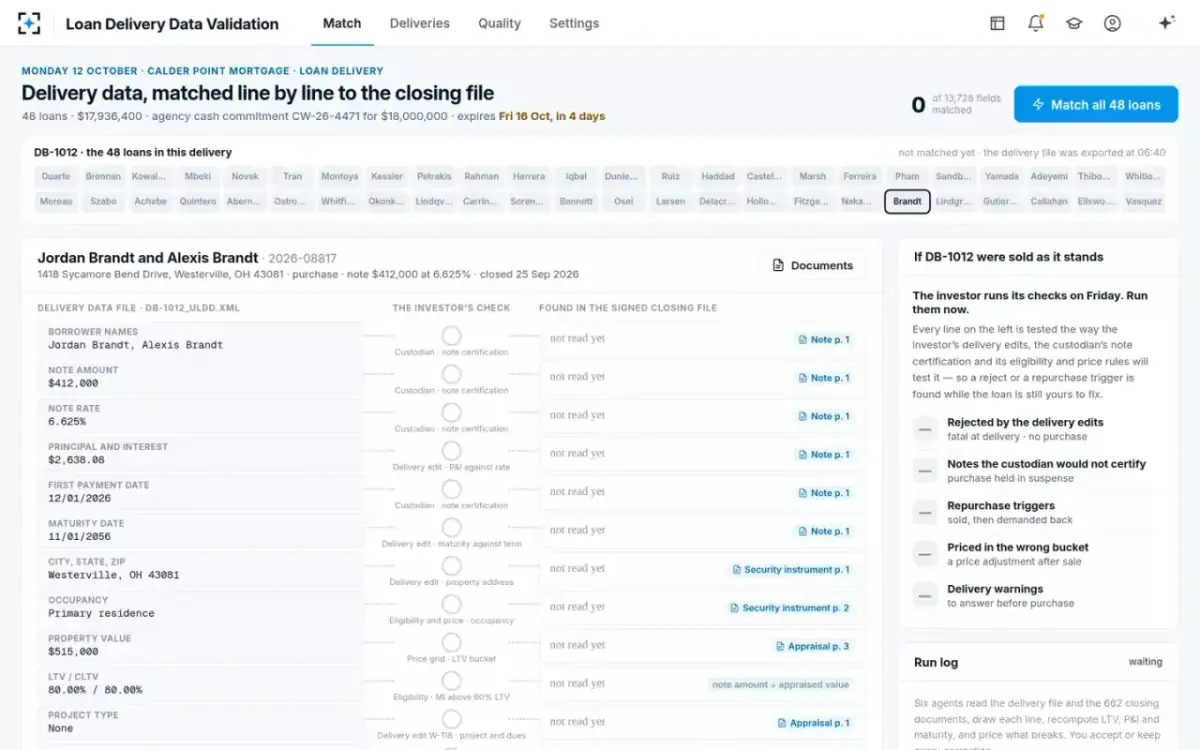
Less than most implementations, because the test runs on what you already have. The delivery file exactly as exported for the batch. The signed closing package for each loan: note, security instrument and riders, Closing Disclosure, final application, title commitment, MI certificate. The appraisal, final underwriting findings, transmittal summary and credit report. The investor's rules and the price grid in force on the delivery date. And the answer key: the custodian's exception reports, suspense items, Purchase Advices and adjustment requests, and any QC findings on those loans.
Pick the batch deliberately. A batch with a relock or two, a closing that moved, a loan with mortgage insurance and one with a project will exercise more of the matching than a batch of plain refinances. Read-only access is enough: the pilot drafts corrections, it does not deliver anything. A clear picture of what that first batch should contain also comes from the trace of one sample batch, document by document.
A pilot’s starting point in Loan Delivery Data Validation: nothing matched yet
How long does a pilot take?
About four weeks is a reasonable plan, and most of it is your team's time, not the software's. A week to gather the batch and the answer key and to agree the pass marks. A few days for the blind run and for your analysts to review every flag. A side-by-side week on a live batch, where the team works its normal way and the tool runs alongside. And a week to score, compare and decide.
A four-week delivery data pilot
| Week | What happens | Who does the work |
|---|---|---|
| Week 1 | Choose the batch, gather the delivery file, closing packages and answer key; agree the pass marks in writing | Post-closing manager, QC |
| Week 2 | Blind run; every flag reviewed against its page and sorted: known, new, rejected | Loan delivery analysts |
| Week 3 | Side by side on a live batch: the team works as usual, the tool runs alongside | Analysts, secondary marketing |
| Week 4 | Score recall, new finds, false flags, coverage and hours against the pass marks; decide | QC scores, management decides |
Who should run the pilot, and who should score it?
The people who will live with the result run it, and someone independent scores it. The post-closing or loan delivery manager owns the pilot and picks the batch. The analysts who delivered that batch review every flag, because they know which differences are real and which are the way your loan system names things. Secondary marketing checks the price effect of each confirmed mismatch, since that is the number that turns a data error into money.
The scoring belongs with QC. Fannie Mae requires QC staff to be "independent of the production, underwriting, and closing departments" (Selling Guide D1-1-02), which is the right posture for a referee: QC holds the answer key from its own findings, did not choose the tool, and will be the team whose sample changes if the tool works. Agree the pass marks in writing before the run; a threshold set after the results are in is a decision, not a test.
How to read the results
Four outcomes are common, and each points to a different next step. High recall and few false flags: the tool found what you knew and more, without burying the analysts; proceed to the live side-by-side. High recall with many false flags: usually a field map that compares the wrong pair, such as an LTV derived from the sale price, or rounding looser or tighter than the investor's; fix the configuration and re-run the same batch. Low recall on a few fields: look at document versions first, because a tool reading the original note instead of the redraw, or an early underwriting run, will miss exactly the errors that matter. Low coverage: fields with no source page usually mean missing documents in the package you provided, not a reading failure, and the list itself is useful to the post-closing desk.
Whatever the outcome, keep the confirmed new mismatches. Each is a discrepancy between delivered data and your loan records on a loan already sold, which the Guide expects you to report through the post-purchase adjustment process, and each points at the step where the value went wrong.
What does mortgage audit software not replace?
It does not replace post-closing QC, and a pilot should not pretend it can. QC must reverify "income and employment, income tax returns, assets, credit history, property eligibility and property value, and occupancy" with third parties (Selling Guide D1-3-03), and its staff "must be independent of the production, underwriting, and closing departments" (Selling Guide D1-1-02). A pre-delivery data check reads the file; it cannot call an employer.
It does not replace the custodian, who certifies the original note in hand, or the investor's edits, which still run and should run again on the corrected file. What it changes is what reaches each of them: fewer note exceptions at the custodian, fewer data findings in the QC sample, and contradictions routed to QC before the sale rather than found in it.
What does the pilot decide, and what does it cost to skip?
The pilot decides whether every delivered field can be checked before sale without adding review time. Skipping it costs a guess. Making a loan already costs an independent mortgage banker $11,094 in production expenses, by the Mortgage Bankers Association's 2025 count (MBA, April 2026), and a data error found after sale adds to that on Fannie Mae's terms: repricing only within 18 months of acquisition (Selling Guide C1-2-02), and for a pattern of the same wrong element on five or more loans, exposure for the life of the loan (Selling Guide A2-2-07).
A pilot also gives the error pattern a name. Wrong values cluster by cause: a relock not posted, an underwriting re-run not carried, a closing date that moved. Finding the cause in one batch tells you which fix at the closing desk would stop the next hundred errors; mortgage data integrity, and where errors enter follows that thread.
Questions people ask
How do you compare mortgage audit software?
By what each compares the loan with, which loans it covers and when it runs, then on a back-test of your own delivered batch. Feature lists hide the difference between checking data against itself and checking it against the signed documents.
Can a delivery data pilot use loans already sold?
Yes, and it should: sold loans come with an answer key in their custodial exceptions, suspense items, adjustments and QC findings. Any real mismatch the pilot finds on a sold loan is also a discrepancy Fannie Mae's Guide requires you to report through the post-purchase adjustment process.
How many loans should a pilot cover?
One full delivery batch, at the size you normally ship, is enough to measure recall, noise and time. A batch of a few dozen loans, with relocks, MI and a project or two, exercises most of the matching rules.
What does a good false-flag rate look like?
There is no industry benchmark, so set your own threshold before the run, in reviewer minutes per batch rather than a percentage. If the flags take longer to clear than the old hand comparison took, the tool has failed that test, however many real errors it found.
Do we need IT to run a pilot?
Only for read-only access to the delivery export and the document images for the chosen batch. Nothing is delivered, nothing in your loan system changes, and corrections stay as drafts.