Fannie Mae loan delivery edits are the automated rules the Loan Delivery application runs on a lender's delivery data, and a loan cannot be bought while any fatal edit is open. They check that required fields are present, that values are valid and consistent with each other, and that the loan is eligible and fits its commitment. What they cannot check is whether a value matches the signed documents, because the edits never see the documents. A first payment date a month off the note, a sales price delivered as the appraised value, a debt-to-income ratio from an earlier underwriting run: each is well formed, each passes, and each is a warranty breach the lender carries for the life of the loan. Botminds' Loan Delivery Data Validation is built for that gap. Its agents compare every delivered field with the page it came from before the loan is sold, then re-run the edits on the corrected file.
Two questions about every delivered field
Right and well formed
Matches the signed page and passes every edit: all but a handful of the Brandt loan’s 286 fields.
Nothing to do
Right but flagged
An unusual value that is true, such as a large loan in a high-cost area. A person confirms it.
Confirm, do not change
Wrong but well formed
First payment a month off the note; the sales price in the value field; a DTI from an earlier run. Every edit passes.
Only the documents show it
Wrong and malformed
A MIN whose check digit fails; dues reported with no project type. The edits stop these.
The edits catch it
What are Fannie Mae loan delivery edits?
They are the business rules inside Loan Delivery, Fannie Mae's web application for delivering whole loans and MBS pools. Lenders "import loan and pool data, perform edits to facilitate error-free delivery, transfer loans between commitments (or pools), track the status of loan deliveries" and export the results (Selling Guide C1-2-02). The edits run on the Uniform Loan Delivery Dataset the lender uploads, at submission and again later: "Loans are subject to all fatal edits in Loan Delivery throughout the submission, loan documentation certification and acquisition purchase process."
Where are the Fannie Mae loan delivery error codes?
The rules themselves are published outside the Guide. Fannie Mae points lenders to the Loan Delivery Business Rules Dictionary, the release notes and the job aids on its website, and to Appendix D of its Implementation Guide for the field definitions. When people search for "Fannie Mae loan delivery error codes", the dictionary is what they are looking for: each edit, its message and the data points it reads.
Read the dictionary for what it is: a specification of what the edits test. Each rule names the data points it reads. The signed note goes to the custodian, not to Loan Delivery, and the appraisal and the findings report are not part of the delivery file, so a rule can test what was delivered but not what was signed. That is the boundary the rest of this page is about.
What is a fatal edit?
A fatal edit is a rule failure that stops the loan. The Guide's language leaves no room: "Loans may only be submitted and purchased in Loan Delivery if they are clear of all fatal edits," and "if a loan encounters a fatal edit, the fatal edit must be resolved for Fannie Mae to acquire the loan" (C1-2-02). Other edit messages flag data for the lender to review without blocking the purchase on their own.
A fatal edit is the good kind of failure: it is found before the money moves, and the message says what to fix. Its cost is time. A fatal edit found on the last day of a commitment can push the loan past expiry, and a loan that misses its commitment can bring an extension fee or a pair-off. The edits that matter most for a delivery team are the ones that fire late, which is a reason to run them early and often.
What Fannie Mae loan delivery edits can test, and what they cannot
| Kind of check | Example | Needs the documents? |
|---|---|---|
| Presence and conditionality | A field required only when another is present: MI coverage above 80% LTV, project type when dues are reported | No |
| Format and valid values | A date that is a date; a code from the list; a MERS MIN whose check digit computes | No |
| Internal consistency | Principal and interest that fit the amount, rate and term; maturity that fits the first payment date and term | No |
| Eligibility | LTV, loan amount and occupancy inside the Guide’s limits for the product | No, on delivered values |
| Commitment match | Mortgage type, amortization, original term and pass-through rate inside the commitment | No |
| Truth against the signed file | The note rate after a relock; the appraised value rather than the price; the final DU run | Yes: no edit can do this |
Do delivery edits check the data against the note?
No. The edits read the delivery file and Fannie Mae's own data; the note is read by the document custodian. That split is the reason a lender can clear every edit and still have a loan held up. Fannie Mae's process sends the package to the custodian, who reviews it and then works "with the lender to correct any certification data or document errors". Lenders can "accept or decline data changes the custodian proposes as a result of the discrepancy on the note and the data they provided" (Selling Guide C2-2-02).
The custodian catches the note fields: amount, rate, dates, names, the MIN. It does not see the appraisal, the final findings, the signed application or the MI certificate, so value, LTV, credit score, DTI, occupancy and coverage go to the investor checked by nobody against their source. One cross-check does exist for value: the Guide requires that "the appraised value as indicated on the appraisal submitted to UCDP matches the appraised value as reported at sale of the loan" (Selling Guide B4-1.1-06). It is the lender's job to make that true before delivery.
Can a loan pass the edits and still be defective?
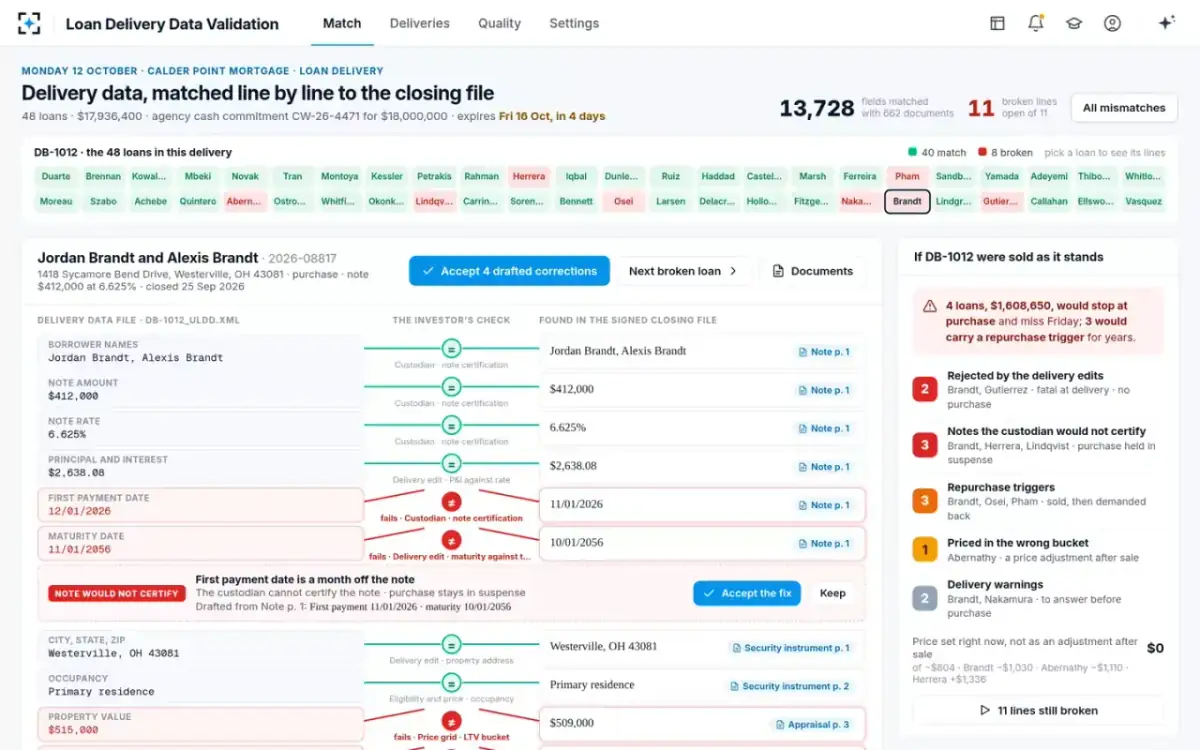
Yes, and the defects that pass are the expensive ones. An edit asks whether a value is possible. A defect is a value that is not true. Take a sample lender, Calder Point Mortgage (fictional, like every borrower named here), and the Brandt loan from a 48-loan batch it was about to sell, as it ran through Loan Delivery Data Validation. Four fields were wrong, and an edit would only have objected to one of them.
The Brandt loan: four wrong fields, three of them invisible to the edits
What the delivery file says: 12/01/2026 and 11/01/2056. Both fit a 360-month term, so the consistency edit passes.
What the signed file says: Note p. 1: 11/01/2026 and 10/01/2056. Closing moved from 1 Oct to 25 Sep; the note was redrawn, the loan system kept December.
What the delivery file says: $515,000, which gives $412,000 ÷ $515,000 = 80.00%: no insurance needed, every eligibility edit passes.
What the signed file says: Appraisal p. 3: $509,000. The $515,000 is the contract price. On the lower value the LTV is 80.94%, delivered as 81% under the Guide’s rounding rule.
What the delivery file says: None, consistent with an 80% LTV.
What the signed file says: A 12% certificate from the mortgage insurer, on file but never linked to the loan.
What the delivery file says: Blank, while dues of $42 a month are reported. This is the one an edit catches.
What the signed file says: Appraisal: a planned unit development with $42 monthly dues.
The value error shows the mechanism most clearly. Fannie Mae computes LTV on "the lower of the sales price or the current appraised value", truncates it to two decimals and rounds up to the next whole percent (Selling Guide B2-1.2-01). Deliver the price in the value field and every downstream number is consistent with the wrong input: the LTV, the absence of mortgage insurance, the price bucket. The edits have nothing to disagree with. Only the appraisal does.
The edits check that the delivery file agrees with itself. The warranty is that it agrees with the loan.
Four ways a wrong value stays well formed
The errors that pass the edits share a small number of causes, and each points at a moment in the loan's life where the system and the documents part ways.
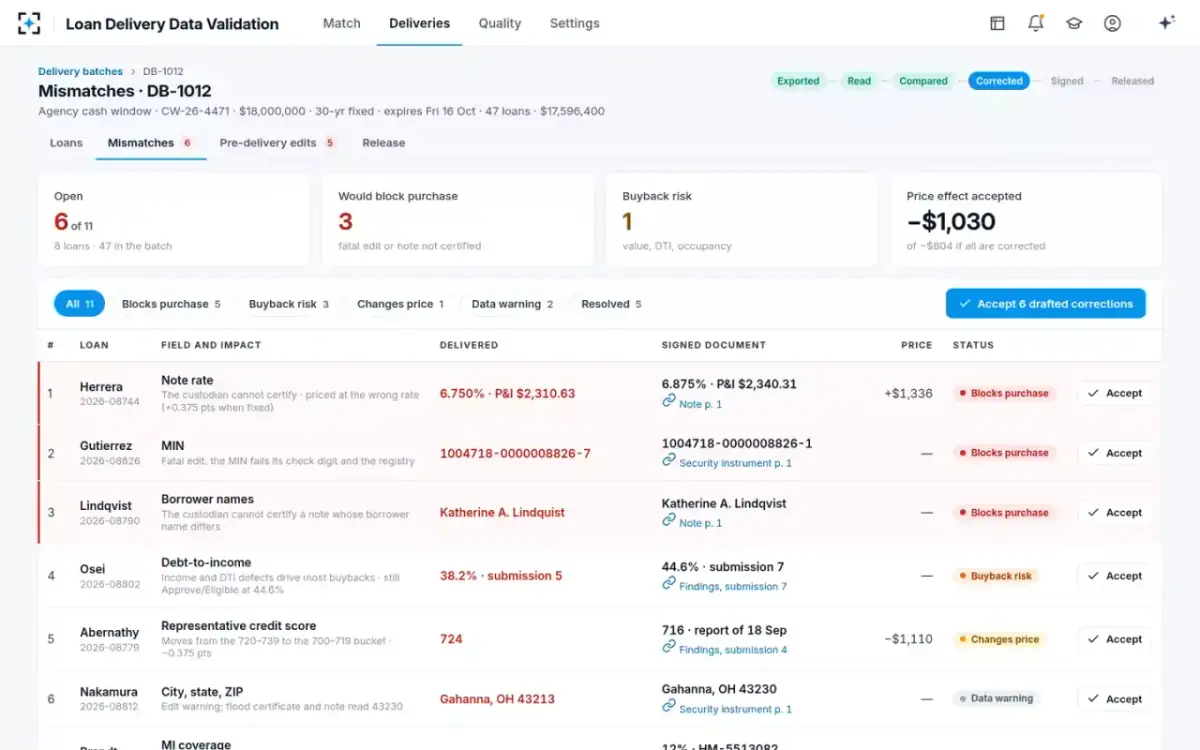
A value from the wrong moment. The rate from the original lock after a relock, dates from the closing that was rescheduled, a score from the first credit report after a re-pull. On the sample batch, Herrera's rate was delivered at 6.750% while the note signed after the relock carries 6.875%.
A value from the wrong document. The contract price where the appraisal belongs; the debt-to-income ratio from underwriting submission 5 instead of the final submission 7 (38.2% delivered, 44.6% final, on the sample Osei loan). The Guide expects the closed loan to match the final DU casefile, and an increase of 3 points or more in DTI calls for resubmission (Selling Guide B3-2-10).
A value typed, not read. A surname taken down by phone as "Lindquist" when the note is signed "Lindqvist". It passes every edit and fails the custodian.
Documents that contradict each other. A file priced as a primary residence whose signed final application marks an investment property. No correction is right here; the loan needs a person in QC, not a fix.
What found the 11 mismatches in a Loan Delivery Data Validation sample batch
What happens if delivery data is wrong after the sale?
It becomes the lender's to report and fix, on Fannie Mae's terms. The Guide requires lenders to notify Fannie Mae of discrepancies between delivered data and their loan records and to use the post-purchase adjustment process; data corrections are considered for repricing loan-level price adjustments only within 18 months of acquisition (C1-2-02). If Fannie Mae finds the error in its own review, it classifies it: Fannie Mae "also checks mortgage loans for data discrepancies ... that may result in the assessment of an LLPA" (Selling Guide D2-1-04), and a defect that would have made the loan ineligible can lead to a repurchase demand.
Patterns carry the longest tail. Data inaccuracy is a life-of-loan exclusion: where the same delivery data element is wrong on five or more loans, differs from the lender's own files, and the truth would have changed eligibility or terms, enforcement relief does not protect the loans (Selling Guide A2-2-07). A wrong field that comes from a broken mapping is, by its nature, a pattern. What a wrong field costs after sale sets out each path and its clock.
Loan Delivery Data Validation: each field, with the check it feeds
Run the edits after the file match, not instead of it
The edits are mandatory and useful, and nothing here replaces them. The order matters. Match the delivery file to the signed documents first, correct what differs, and then run the edits on the corrected file, so that what clears the edits is data already known to be true. In Loan Delivery Data Validation the correction drafter writes a new version of the delivery file once the analyst accepts the corrections (the exported file is never overwritten), re-runs the investor's edits and a custodian certification preview, and shows both results side by side.
On the sample batch the re-run read zero fatal edits, zero warnings and 47 of 47 notes certifying, after one loan went to QC for an occupancy contradiction. The screen also records what the edits alone would have seen: 2 of the 11 mismatches. How the ULDD file is built in the first place, and what the lender warrants about it, is covered in what ULDD is in mortgage lending; the fields that must agree with the Closing Disclosure, and those that must not, are in the UCD and ULDD crosswalk.
Mismatches ranked by what they would cost
Questions people ask
Where can I find Fannie Mae loan delivery error codes?
In the Loan Delivery Business Rules Dictionary, which the Selling Guide lists among the Loan Delivery resources on Fannie Mae's website along with the release notes, job aids and user guide. The ULDD field definitions behind the messages are in Appendix D of the Implementation Guide for Loan Delivery Data.
Is a fatal edit the same as a rejected loan?
Not quite. A fatal edit stops the loan until the data is fixed, and the lender can correct and resubmit. A loan can also be rejected for other reasons: Fannie Mae may reject one for ineligibility, "incomplete or inaccurate loan delivery data, or incomplete document submission packages".
If a loan clears every edit, is the delivery data accurate?
Not necessarily. Clearing the edits shows the data is complete, well formed, consistent and eligible on its face. Accuracy means each value matches the signed note, appraisal, findings and certificates, and that is a comparison the edits do not make.
Do the edits check that the loan matches its commitment?
The loan's terms must match the commitment, "including mortgage type, amortization, original term, and pass-through rate(s)", and the delivered data is what is compared. If the delivered rate is wrong but still inside the commitment's range, that check passes too.
Why does a wrong name stop a loan when every edit passes?
Because the document custodian certifies the original note against the delivered data, and a borrower name that differs from the signature is a discrepancy. The edits have no way to know how the borrower signed.
Should we run the edits before or after a document check?
Both, in that order: the edits early to catch malformed data, a field-by-field document check before release, and the edits again on the corrected file. Corrections can create new conditional requirements, such as MI fields once an LTV rises above 80%.