In the mortgage post closing process, the post closer is the person who turns a closed loan into one an investor will buy. The work usually runs: review the closing package for completeness and signatures, correct or re-execute what is missing, send the original note and custodial documents to the document custodian, confirm the data the lender will deliver matches the signed documents, and track the trailing documents, such as the recorded mortgage and final title policy, until every file is complete. The work is exacting because the lender warrants every delivered field for the life of the loan, and most of the time goes on comparing an export with PDFs. Botminds' Loan Delivery Data Validation does that comparison with agents, so the post closer and the loan delivery analyst start from the fields that differ, each with its page. This guide walks the desks the loan crosses, from the closing table to the custodian's vault.
Five desks between the closing table and the sale
Today
Audits each closed file, ships custodial documents, keys corrections, and chases recorded mortgages and title policies for months.
With agents
Starts from a list of what differs and where it entered; spends the time on documents that are actually missing.
Still theirs: Owns the custodial package and trailing documents
Today
Exports the delivery file, clears the edits, and in the last days before a commitment expires compares fields with PDFs by hand.
With agents
Accepts or rejects drafted corrections, each with its page; re-runs the edits on the new version and signs the data.
Still theirs: Signs that the delivered data is right
Today
Owns commitments, pricing and pair-offs; learns about a wrong field as a price adjustment after sale.
With agents
Sees the batch against the commitment and the price effect of each correction before release.
Still theirs: Releases the batch, or holds it
Today
Certifies the original note against the delivered data and proposes changes where they differ.
With agents
Receives notes that already agree with the data; fewer exceptions to send back.
Still theirs: Certifies, independently of the lender
Today
Finds data defects in the monthly post-closing sample, after the loans are sold.
With agents
Receives contradictions such as occupancy with both pages, before sale; sees error causes by field and closing team.
Still theirs: Stays independent of production and closing
What does a mortgage post closer do?
The post closer checks that the loan that closed is the loan that can be sold. In practice that is four jobs. The first is the file audit: every document present, signed, dated and initialled as required, the right versions of redrawn documents, the riders that belong to the security instrument. The second is the custodial package: the original note endorsed in blank, any allonge, modification or power of attorney, assembled in the order the data was delivered and sent by overnight courier for first-morning delivery. Fannie Mae has the custodian certify each loan under the Master Custodial Agreement in force between it, the lender and the custodian (Selling Guide C2-2-02).
The third job is the data check, and it is the one that grows with volume: confirming that the note terms, names, value, ratios, occupancy and insurance in the delivery file match the signed documents. The fourth is the trailing list: documents that only exist after closing, such as the recorded security instrument and the final title policy, and third-party certificates that arrive late. A good post closer knows which of these an investor will stop a purchase for, and which can follow.
What the post-closing desk must know, and how it is measured
The duties above translate into a short list of skills: knowing the investor's custodial and delivery requirements, reading a note, security instrument, Closing Disclosure and appraisal fluently, comfort with the loan origination system's delivery module, and a habit of tracing a number to its source. The Bureau of Labor Statistics has no post-closer occupation. The nearest is loan interviewers and clerks, whose official description includes reviewing "loan papers to ensure completeness" and completing transactions "upon approval of loan" (BLS OEWS, May 2023), an occupation that also counts processors and closers.
What matters is how the desk is measured. Post closers are judged by suspense items, custodial exceptions and trailing-document ageing, numbers that only move when the error is found before the file leaves. That is why the best post-closing teams push their checks upstream to the closing desk, and why the field-level check matters more than any other part of the post-closing process.
What is a loan shipper, and where does the job end?
A loan shipper, or loan delivery analyst, sends loans to the investor: exports the delivery file, uploads it, clears the edits, allocates loans to commitments and confirms the purchase. Where the post closer's work is the file, the shipper's is the data and the deadline. Fannie Mae's definition of good delivery is the shipper's job description in one sentence: "the applicable error-free mortgage documents and data reach the Fannie Mae-approved document custodian no later than the first morning delivery, the day prior to the expiration date of the commitment; the data reflected on the Loan Schedules pass all of the Fannie Mae purchasing edits" (Selling Guide C2-2-01).
The job ends after the sale, not at it. The shipper reconciles the investor's Purchase Advice and has 30 days to raise "any error, omission, or irregularity" before Fannie Mae assumes the advice is correct (Selling Guide C2-2-05). In the sample lender used on this page, the loan delivery analyst delivers 380 to 450 loans a month across four commitments, and her last week before each expiry is the one where hand comparison crowds out everything else.
Who checks which part of a loan before the sale
| Desk | Checks | Against | Stops the loan by |
|---|---|---|---|
| Post closer | Completeness, signatures, custodial documents, trailing documents | The closing package and the investor’s document list | Holding the package |
| Loan delivery analyst | Delivery data, edits, commitment fit | The edits and, by hand, the signed file | Not delivering, or correcting first |
| Secondary marketing | Commitment fill, price, pair-off exposure | The commitment and the price grid | Not releasing the batch |
| Document custodian | The original note and its endorsements against the delivered data | The note in hand | Not certifying |
| Quality control | A sample: reverifications, data integrity, underwriting | Third-party sources and the full file | Reporting a defect, usually after sale |
What does a document custodian do?
A document custodian holds the original note and the other custodial documents on the investor's behalf and certifies them before the loan is bought or pooled. For Fannie Mae whole loans, the custodian reviews the package "to verify that all of the required documents have been received and are in order", works with the lender to correct certification data or document errors, and transmits a certification to Fannie Mae only "if there are no document or data-related errors" (Selling Guide C2-2-02). For MBS pools, the certification must be complete before pool closing (C3-7-04).
The custodian is paid by the lender but works for the security holder. Ginnie Mae puts it most plainly: the "primary roles of a Document Custodian ... are to make required pool certifications and to maintain physical and custodial control of the related loan, pool and loan package documents", and custodians "work under direct contract with an approved Ginnie Mae Issuer, but have fiduciary responsibilities to Ginnie Mae" (Ginnie Mae MBS Guide, chapter 13).
Ginnie Mae document custodian requirements and final certification
For government loans, certification happens twice. Issuers "are required to obtain an Initial Certification from an Approved Document Custodian for all pool and loan package types", with the exception of project and construction loan pools, "before issuing the related security". Then every pool must "receive a Final Certification by an Approved Document Custodian within 12 months of the issue date of the related MBS" (Ginnie Mae MBS Guide, chapter 11). Final certification means each document meets the "attributes, accuracy, and completeness requirements" of the custodian manual.
The 12-month clock is the post closer's. Final certification needs the trailing documents: the recorded security instrument, the title policy, the assignments. A pool that cannot be finally certified is an issuer problem with Ginnie Mae, so the trailing-documents list is not housekeeping; it is a deadline with a regulator behind it.
Where the analyst’s hours go, by hand and with Loan Delivery Data Validation
| Task, one 48-loan batch | By hand | With the agents comparing |
|---|---|---|
| Comparing note terms and names with the export | 14 h | 1 h |
| Checking value, findings and MI against the file | 8 h | 0.5 h |
| Working out what each error does to price | 3 h | 0.5 h |
| Correcting and re-running the edits | 4 h | 1 h |
| Sign-off and release | 1 h | 1 h |
| Total | 30 h | 4 h |
Secondary marketing and QC: the desks on either side
Secondary marketing owns the commitment. It locks the price, picks the execution, and decides whether a batch that is short goes out, waits for an extension or pairs off. Its exposure to the post-closing desk is direct: a loan that fails certification on the last day is a loan missing from the commitment. Its exposure after sale is a price adjustment it did not expect.
Quality control sits on the far side by design. Fannie Mae requires that "all QC employees ... must be independent of the production, underwriting, and closing departments" (Selling Guide D1-1-02), selects loans "on at least a monthly basis", and must finish the whole cycle "within 90 days from the month of the disbursement date" (Selling Guide D1-3-01). That independence is why a contradiction between documents, such as an occupancy that differs between the file and the signed application, belongs with QC rather than with the person correcting data under deadline.
Who answers for a wrong delivered field?
The lender does, whichever desk made the error. Fannie Mae's warranty is that "all required mortgage loan delivery data is true, correct, and complete, even for such data elements that are not required to qualify a borrower or underwrite a loan" (Selling Guide A2-2-02). The custodian answers for its certification and, for Ginnie Mae, owes a fiduciary duty; QC answers for finding and reporting. Neither moves the warranty off the seller.
That shapes the desks. If only the lender carries the risk, the lender's own desks need a check that reaches every field. In most shops none of them has one: the custodian reads the note, QC reads a sample, the edits read the data against itself. The field-level check falls to whoever has time in the last week, which is usually the shipper. The post closing checklist sets out what that check should cover.
How the desks change when agents do the comparing
The desks stay; the comparison moves. Take a sample lender, Calder Point Mortgage (fictional, with fictional staff and borrowers), as it runs a 48-loan batch through Loan Delivery Data Validation. Agents read the 662 documents, compare 13,728 fields and draft a correction for each mismatch from its page. The loan delivery analyst accepts each one, or keeps the delivered value with a reason and a second person; she signs the data. The post closer sees which batches wait on documents, such as two original notes still with a closing agent on the batch behind this one.
Loan Delivery Data Validation ranks every batch by the commitment clock
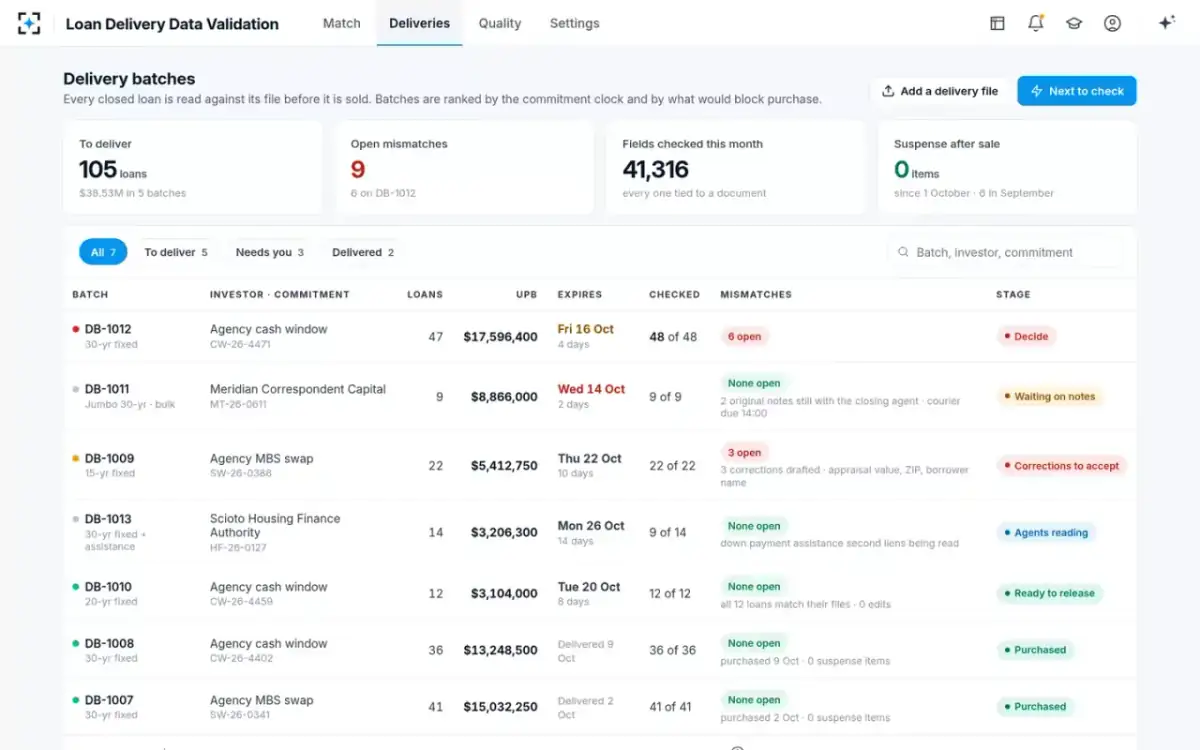
The secondary marketing manager releases only with zero fatal edits and zero certification exceptions, and sees the price effect of every correction first. The QC manager receives contradictions with both pages, before sale. On the sample batch one loan was delivered as a primary residence while the signed application, page 4, marked an investment property; it went to QC and left the batch, which then filled the commitment without it.
A contradiction goes to QC, not to a correction
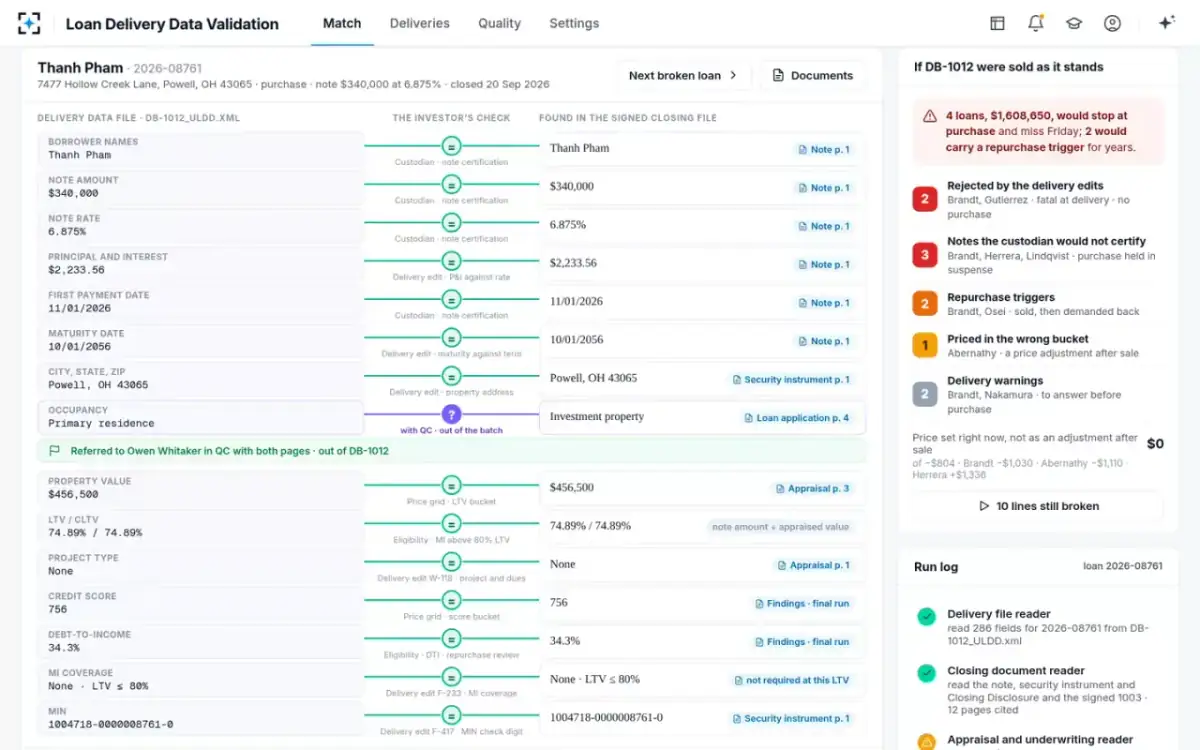
The cost picture behind those desks, a pair-off on one side and a post-sale adjustment on the other, is worked through in the Fannie Mae pair-off fee and the data fix that triggers it.
Questions people ask
Is a post closer the same as a closer?
No. The closer prepares the closing package and coordinates the signing; the post closer works on the file after it is signed, making it complete, accurate and deliverable. In small lenders one person may do both, which removes the second pair of eyes the split was meant to provide.
What should a lender train its post-closing desk on?
Familiarity with closing documents and investor delivery requirements matters more than a degree: reading a note, security instrument, Closing Disclosure and appraisal, and knowing the Fannie Mae, Freddie Mac or Ginnie Mae custodial rules. Loan origination system fluency and a habit of tracing every field to its page matter as much.
What are trailing documents?
Documents that arrive after closing: the recorded security instrument, the final title policy, sometimes the MI certificate or assignments. For Ginnie Mae pools they hold up final certification, which is due within 12 months of the security's issue date.
Who pays the document custodian, and who does it work for?
The lender or issuer contracts and pays the custodian, but the custodian certifies for the investor. Ginnie Mae states that custodians "have fiduciary responsibilities to Ginnie Mae" for the documents in their custody, even though they work under contract with the issuer.
Will automation replace post closers?
It replaces the comparison, not the role. Someone still assembles and ships the originals, chases trailing documents, decides what to do with each mismatch, and signs that the delivered data is right; in the sample lender's estimate the sign-off hour is the one that does not shrink.