A mortgage post closing checklist is the list of things a lender must confirm between the signing table and the sale: that the custodial documents are complete and correctly endorsed, that every delivered data field matches the signed note, appraisal and final underwriting findings, that nothing changed after the last underwriting run, that the closing and appraisal data were accepted electronically, and that all of it reaches the investor before the commitment expires. The documents and the clocks are well understood. The data block is the hard one, because a loan carries a few hundred delivered fields and a post-closing team usually checks them by staring at the export beside the PDFs. Botminds' Loan Delivery Data Validation exists for that block: agents tie each delivered field to its signed page and hand the team only what differs. The checklist below follows Fannie Mae's Selling Guide, the rulebook for most conforming loans.
The mortgage post closing checklist, before a loan is delivered
- Original note endorsed in blank, chain unbroken
Without recourse, with any allonge affixed; the MERS MIN on the note and in the data (E-2-01).
- Modifications, riders and powers of attorney in the package
A power of attorney’s names must match the note and it must have been valid when the note was signed.
- Note terms in the data match the signed note
Amount, rate, term, first payment, maturity, principal and interest, and the borrower names as signed.
- Value, LTV and mortgage insurance agree
LTV on the lower of price and appraised value, rounded the Guide’s way; MI coverage for that LTV, with its certificate.
- Score, DTI and occupancy come from the final run
The closed loan must match the final DU submission or sit inside its tolerances; resubmit if not (B3-2-10).
- UCD and UCDP both Successful
And the appraised value delivered equals the value on the appraisal submitted to the collateral portal (B4-1.1-06).
- Data clear of every fatal edit
Loans are purchased only when clear of all fatal edits; warnings answered before release.
- Package at the custodian by first-morning delivery
Error-free, no later than the day before the commitment expires (C2-2-01).
- After purchase: Purchase Advice reconciled
Errors raised within 30 days of the advice; data discrepancies reported through post-purchase adjustment.
What is post closing in a mortgage?
Post closing is the work that turns a signed loan into a sellable one. The closing table produces the documents; the post-closing desk confirms they are complete, ships the originals to the document custodian, makes sure the data the lender is about to deliver describes the loan that was actually signed, and chases the documents that only exist after closing, such as the recorded mortgage and the final title policy.
Fannie Mae's word for the goal is "good delivery". Its Guide lists the conditions, and every one is a post-closing task: "the applicable error-free mortgage documents and data reach the Fannie Mae-approved document custodian no later than the first morning delivery, the day prior to the expiration date of the commitment; the data reflected on the Loan Schedules pass all of the Fannie Mae purchasing edits"; and the loans delivered add up to at least the minimum the commitment requires (Selling Guide C2-2-01). Miss any of them and the loan is not bought on time.
What documents does the document custodian need?
For a Fannie Mae whole loan, the custodian takes physical possession of the legal documents that make the loan enforceable, and certifies them against the delivered data. The core is the original note, "endorsed 'in blank' and without recourse" with "no break in the chain of endorsements" (Selling Guide E-2-01). Alongside it go the originals of any instrument that modifies the note, such as an ARM addendum or a modification agreement, and a copy of any power of attorney used to sign it.
Small details stop certification. For loans registered with MERS, "the MIN should be added to the upper right-hand corner of the note and must be part of the electronic data delivery". A power of attorney's names "must match the name(s) on the note". Packages go by overnight courier for first-morning delivery, the same day the data is submitted, and the loans in the package must be "in the exact order in which they were transmitted to Loan Delivery".
The custodian's review is a data check as well as a document check. Fannie Mae's process lets lenders "accept or decline data changes the custodian proposes as a result of the discrepancy on the note and the data they provided"; certification follows the next business day only if "there are no discrepancies and no unresolved lien issues" (Selling Guide C2-2-02). A name typed from a phone application, a rate from the original lock, a first payment date from a closing that moved: each stops the certification until someone fixes the data or the note.
Which delivery fields must match the signed documents?
All of them, under the warranty; in practice the review concentrates on the fields that price, qualify or certify the loan. Fannie Mae's rule for the data submitted to its automated underwriting system makes the list for post closing: it "must reflect the loan as it was closed, including occupancy type, product type, amortization, loan term, property type, loan purpose, sales price, and appraised value" (Selling Guide B3-2-10). The delivery file should then say the same thing as the closing file.
The post closing data check: which document settles each field
| Field | Settled by | How it goes wrong |
|---|---|---|
| Note amount, rate, term, P&I | The note, page 1 | Rate from the original lock after a relock; P&I recomputed on the old rate |
| First payment and maturity | The note, page 1 | Closing date moved, note redrawn, the loan system kept the old dates |
| Borrower names | The note, as signed | Spelling taken from the application, not from the signature line |
| Sales price and appraised value | The Closing Disclosure and the appraisal | Price entered in the value field; an earlier appraisal version |
| LTV and CLTV | Recomputed from the note amount and the lower of price and value | Delivered on price when the appraisal came in lower |
| Mortgage insurance | The MI certificate | Required above 80% LTV but the certificate is not linked in the data |
| Score and DTI | The final automated underwriting findings | Taken from an earlier submission or credit report |
| Occupancy | The signed final application and the security instrument | Primary residence on file, investment property on the signed 1003 |
| MIN, project type, address | The security instrument and the appraisal | A failed check digit; project type blank on a PUD; ZIP from the old address |
Two of these need arithmetic, not just reading. LTV is computed on the lower of the sales price and the appraised value, and the coverage the mortgage insurer must provide depends on where it lands: for a 30-year fixed loan between 80.01% and 85%, Fannie Mae's standard coverage is 12% (Selling Guide B7-1-02). A field that says 80% when the documents say 80.94% is not a rounding detail; it is a loan that needs insurance and was about to be sold without it.
Has anything changed since the final underwriting run?
Often, and post closing is where it is caught or missed. Rates are relocked, debts appear, credit is re-pulled and the closing date moves, and each change can leave the loan system and the findings out of step. Fannie Mae's tolerances decide whether the change needs a new underwriting run: the closed loan must match the final DU submission or fall inside the listed tolerances, and any interest rate increase, or a recalculated DTI that "now exceed[s] 45%, or increase[s] by 3 percentage points or more (if the recalculated DTI ratio is 50% or less)", means the casefile "must be resubmitted to DU" (Selling Guide B3-2-10).
When a change after approval forces a new underwriting run
3pts
rise in recalculated DTI that triggers a DU resubmission, up to 50%
45%
recalculated DTI above which the casefile must be resubmitted
Any
increase in the interest rate after the final submission
The post-closing check is not to re-underwrite; it is to make sure the data delivered comes from the run that counts. In the sample batch used on this page, one loan's DTI of 38.2% came from underwriting submission 5, while the final submission 7 read 44.6%. The delivered field passed every format check. It was simply the wrong run, and on that loan the Guide's 3-point trigger had long since been crossed.
What is good delivery for Fannie Mae, and what must be submitted first?
Good delivery means the loans meet the Guide and the commitment, the documents and data arrive error-free on time, the data passes the purchasing edits and the total delivered falls inside the commitment's tolerance. Two electronic submissions must also be accepted before the loan is delivered at all. The Uniform Closing Dataset needs "a 'Successful' status from the UCD collection solution prior to the delivery of the loan", and the file "must contain the borrower data and the PDF of the borrower Closing Disclosure" (Selling Guide C1-2-02). The appraisal must reach Successful in the Uniform Collateral Data Portal, and the value delivered must equal the value on that appraisal (Selling Guide B4-1.1-06).
The clocks set the order of work. Commitments run 1 to 90 days and expire on a business day (Selling Guide C2-1.1-03); the package must be at the custodian the morning before; after certification, the lender must make sure the custodian has the Fannie Mae loan number within 30 days and answer a custodian's request for it within three business days (C1-2-02). A data fix found on the last day is a fix that may not make the commitment: how a late data fix turns into a pair-off fee works through that clock.
The post-closing clocks, from commitment to repricing
1–90days
a Fannie Mae mandatory commitment, expiring on a business day
Daybefore
error-free package and data at the custodian, by first-morning delivery
30days
to raise errors on the Purchase Advice
18months
for data corrections to be repriced
What are trailing documents in a mortgage?
Trailing documents are the ones that do not exist yet when the loan closes, or arrive from a third party afterwards: the recorded security instrument back from the county, the final title policy, and sometimes the mortgage insurance certificate. They do not hold up a Fannie Mae whole-loan purchase the way the note does, but they are the post-closing desk's longest-running list, and for Ginnie Mae pools they have a hard deadline. Ginnie Mae requires that every pool "receive a Final Certification by an Approved Document Custodian within 12 months of the issue date of the related MBS" (Ginnie Mae MBS Guide, chapter 11), and final certification means each document meets the "attributes, accuracy, and completeness" requirements.
The trailing list and the data check meet in one place: a trailing document can prove a delivered field wrong. The MI certificate that arrives after closing is the source for coverage and certificate number; a final title policy can show a different vesting from the names delivered. Checking the field when the document lands, not at the next sample, keeps a trailing document from becoming a post-sale correction.
After purchase: reconcile the Purchase Advice within 30 days
The checklist does not end at the wire. Fannie Mae's Purchase Advice lists each loan's "price adjustments, and purchase proceeds", and the lender must raise "any error, omission, or irregularity" within 30 days of its date; "otherwise, Fannie Mae will assume that the information on its Purchase Advice is correct" (Selling Guide C2-2-05). Separately, lenders "must notify Fannie Mae when they determine there are discrepancies in the data attributes submitted to Fannie Mae at loan delivery and their loan records" (C1-2-02).
Post-closing QC then samples the sold loans, and one of its tests is the same one the post-closing desk should have run: the lender "must confirm that ... the information on the closing documents, including the final settlement statement, is consistent with the underwriting decision and final terms of the loan" (Selling Guide D1-3-02). The difference is timing and coverage. QC reaches a sample, after the sale; the checklist reaches every loan, before it. What a wrong field costs after sale prices that difference.
Running the data block on every loan with Loan Delivery Data Validation
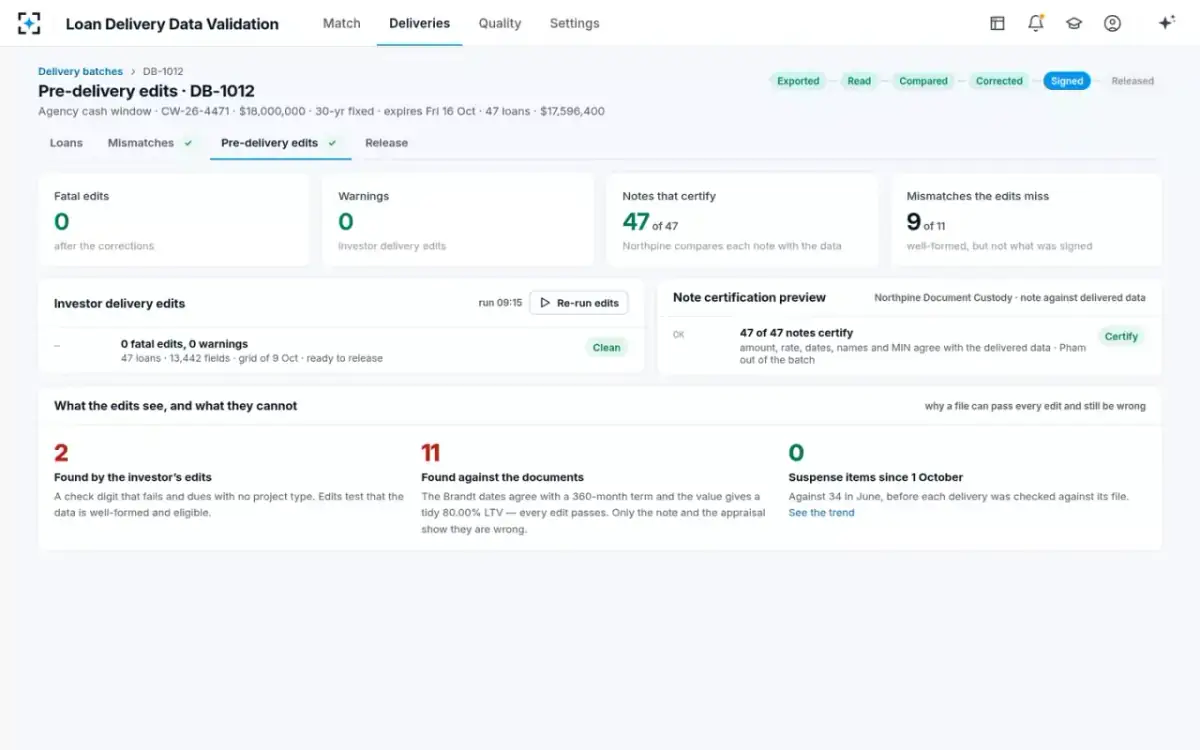
The document and timing blocks of the checklist are mostly logistics. The data block is the one that does not scale by hand, and it is the one the solution takes over. Take a sample lender, Calder Point Mortgage (fictional, as are its borrowers), with 48 closed loans to deliver against a commitment that expires on Friday. Its agents read the 662 documents in the batch, compare all 13,728 delivered fields with their pages, recompute LTV, CLTV, DTI, payment and maturity, and find 11 mismatches on 8 loans, 9 of which would have passed the investor's edits.
Loan Delivery Data Validation’s release screen: the checklist’s data items, ticked
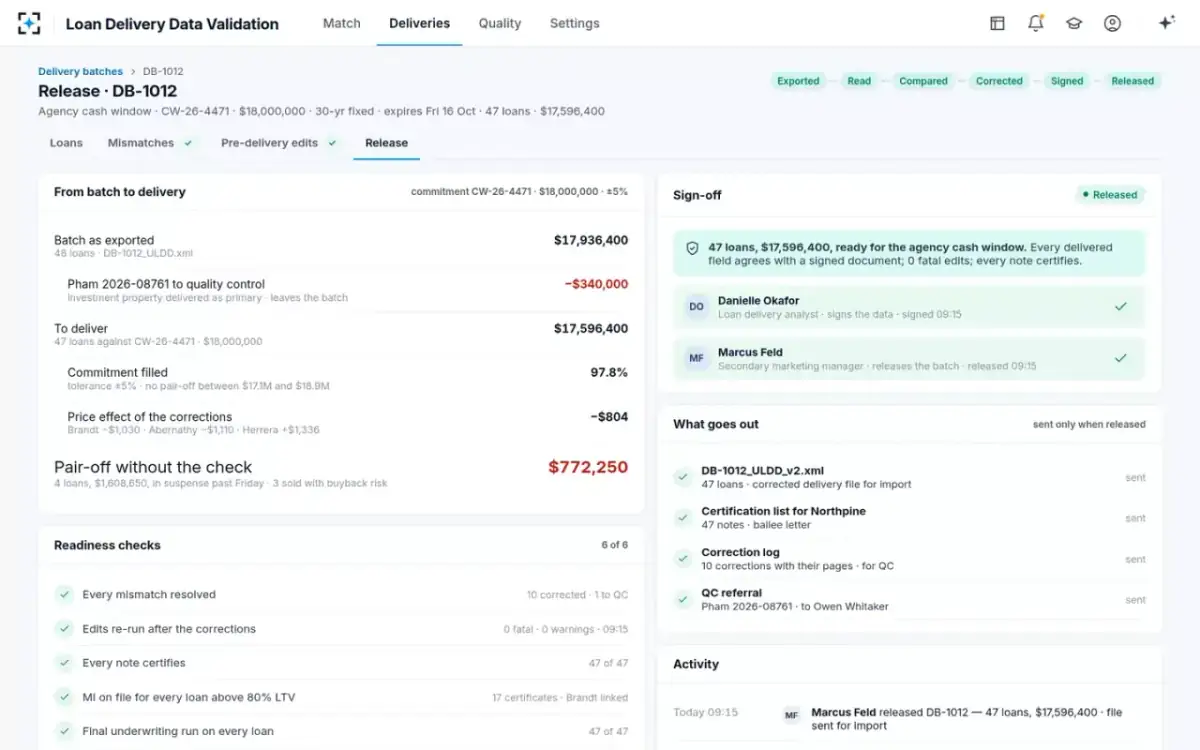
People keep every decision. The loan delivery analyst accepts each drafted correction, which cites its page, or keeps the delivered value with a reason and a second person. A loan whose documents contradict each other goes to QC with both pages and leaves the batch. The corrected file is a new version, the edits and a custodian certification preview re-run on it, and the secondary marketing manager releases the batch only with zero fatal edits and zero certification exceptions. For why passing the edits is not the same as passing the checklist, see what Fannie Mae's loan delivery edits cannot see.
What the edits found, and what the documents found
Questions people ask
What does a post closing department do in a mortgage company?
It reviews the closed loan file for completeness, ships the original note and other custodial documents to the custodian, checks the delivery data against the signed documents, clears the investor's edits and chases trailing documents such as the recorded mortgage and final title policy. In many lenders it also reconciles the investor's purchase advice after the sale.
How long does mortgage post closing take?
It is bounded by the commitment, not by a fixed number of days: Fannie Mae mandatory commitments run 1 to 90 days, and the error-free package must be at the custodian the morning before expiry. The Guide tells lenders to choose a commitment period "that allows sufficient time after loan closing" for shipping and delivery.
What is the difference between post closing and quality control?
Post closing prepares each loan for sale and checks every loan before it goes; post-closing QC reviews a sample of loans after sale, at least monthly, with reverifications of income, assets and value. Both test whether the closing documents agree with the data, but only post closing can still fix the data before the investor sees it.
What happens if the custodian finds a discrepancy?
The custodian proposes a data change, and the lender accepts or declines it and resolves the discrepancy before the note is certified. Until then the loan is not purchased, which is why a mismatch found on the last day of a commitment can force an extension.
Does the post closing checklist differ for FHA or VA loans?
The structure is the same, but the documents and the investor are different: government loans are pooled into Ginnie Mae securities, whose custodians give an initial certification before the security is issued and a final certification within 12 months. The insurance or guaranty evidence replaces the private MI certificate.
How long does a lender have to fix data after a Fannie Mae purchase?
Errors on the Purchase Advice must be raised within 30 days. Data corrections that would change loan-level price adjustments are considered for repricing only within 18 months of acquisition, with a $100 minimum per loan, and the warranty on delivery data runs for the life of the loan.