A Fannie Mae post purchase adjustment is the process a lender uses to correct loan data, or the purchase proceeds, after Fannie Mae has bought the loan. The lender must use it whenever it finds that the data it delivered differs from its own loan records, and the timing decides what the correction is worth: errors on the Purchase Advice must be raised within 30 days, data corrections are considered for repricing loan-level price adjustments only within 18 months of acquisition with a $100 minimum per loan, and the warranty that the data is true runs for the life of the loan. Each path costs staff time and some cost money; the worst turn a data error into a repurchase. Botminds' Loan Delivery Data Validation is built to make the adjustment unnecessary, by checking every delivered field against the signed file while the price is still being set.
Where 11 mismatches found by Loan Delivery Data Validation would have landed
If sold as exported
- Stopped at purchase: edits or note certification · 45.5%
- Sold with a repurchase trigger · 27.3%
- Price adjustment after sale · 9.1%
- Warning to answer · 18.1%
What is a Fannie Mae post purchase adjustment?
It is the lender-initiated route for fixing what was delivered. The Selling Guide states the duty first: "Lenders must notify Fannie Mae when they determine there are discrepancies in the data attributes submitted to Fannie Mae at loan delivery and their loan records, they did not submit housing goal attributes at loan delivery, or the property address has been rezoned. Lenders must follow the post-purchase adjustment process to resolve these matters" (Selling Guide C1-2-02).
Two things follow from that sentence. The adjustment is not optional when the lender knows of a discrepancy, so a lender that finds a wrong field in its own post-closing QC sample has a reporting task, not just a note for the file. And the trigger is the lender's knowledge: the process exists for errors the lender finds, while errors Fannie Mae finds in its own reviews follow the defect process described below.
What is a purchase advice in mortgage?
A Purchase Advice is Fannie Mae's statement of what it bought and paid. It lists "each loan, identified by a Fannie Mae loan number"; "details about the loan purchase, including loan information, price adjustments, and purchase proceeds"; and the payee code for each wire. It is available "on the business day Fannie Mae funds the purchase proceeds" (Selling Guide C2-2-05).
The Guide gives the lender 30 days to object. The lender "must submit a post-purchase adjustment request to provide notice of any error, omission, or irregularity in the transfer of funds ... within 30 days of the date of the Purchase Advice. Otherwise, Fannie Mae will assume that the information on its Purchase Advice is correct." A request carries the nine-digit seller/servicer number, the ten-digit Fannie Mae loan number, the Post-Purchase Adjustment Request form and the supporting documents. Reconciling every advice line by line is the last step of the post-closing desk's work on a loan.
How long do you have to correct delivery data?
For price, 18 months; for the warranty, there is no end. "Lenders must submit data corrections within 18 months of the loan's acquisition date to be considered for repricing of loan-level price adjustments (LLPAs). A minimum $100 requirement per loan (credit or debit) is also required. The 18-month lookback period does not apply to the drafting or collection of repurchase alternative fees" (C1-2-02). Fannie Mae may change the minimum and the lookback at its discretion.
Three clocks start when the loan is sold
| Clock | Length | What it covers | After it runs out |
|---|---|---|---|
| Purchase Advice | 30 days from the date of the advice | Any error, omission or irregularity in the transfer of funds | Fannie Mae assumes the advice is correct |
| LLPA repricing | 18 months from acquisition | Data corrections that change loan-level price adjustments, $100 minimum per loan, credit or debit | No repricing; the lookback never limited repurchase alternative fees |
| Data warranty | The life of the loan | Delivered data true, correct and complete; patterns of the same wrong element on five or more loans survive enforcement relief | It does not run out |
How are LLPAs repriced after purchase?
By recomputing the price adjustments on the corrected data, if the correction comes inside the window and moves the price by at least $100. Loan-level price adjustments depend on attributes such as LTV and the representative credit score (Selling Guide B2-1.2-01), so a corrected score or value can move a loan from one cell of the matrix to another. The $100 floor works both ways: a correction in the lender's favour earns a credit, one against it a debit.
Take a sample lender, Calder Point Mortgage (fictional, as are its borrowers), and three loans from a batch it was about to sell, priced on the lender's own configured grid. The Abernathy loan was delivered with a 724 score from the first credit report; the re-pull used by the final findings reads 716, one score band lower, worth −$1,110. The Brandt loan's LTV, recomputed on the lower appraised value, crosses 80%: −$1,030. The Herrera loan was delivered at the original lock rate, 6.750%, while the note signed after the relock carries 6.875%: +$1,336. Net, −$804. Found before sale, those are three lines on a price sheet. Found after, they are three adjustment requests, or three findings in someone else's review.
Finding, price-adjusted loan or significant defect
When Fannie Mae finds the error itself, it sorts it into one of three outcomes, and the outcome decides the cost. The definitions are in Selling Guide D2-1-03, and the process in D2-1-04, which notes that Fannie Mae "also checks mortgage loans for data discrepancies (which could be independent of a full-file quality control review) that may result in the assessment of an LLPA".
What Fannie Mae does with a defect it finds
| Outcome | Defined as | What the lender owes |
|---|---|---|
| Finding | A defect that, with the true facts known at purchase, would not have changed the price or made the loan unacceptable | No correction or remedy; a data update may be required |
| Price-adjusted loan (PAL) | A loan that was eligible, had the correct data been delivered and the right LLPA paid | The LLPA that should have been paid at purchase. Fannie Mae may not demand repurchase of a PAL, and the lender may not volunteer one |
| Significant defect | A defect that changes the price at which the loan was bought, or makes it unacceptable for purchase | Repurchase, or an alternative Fannie Mae offers: a pricing adjustment, recourse, indemnification, a make-whole payment, loss share |
A wrong credit score that moves the price is the textbook PAL: the loan was fine, the price was wrong, the lender pays the difference. A wrong LTV that hides a missing mortgage insurance policy is not. Fannie Mae's charter requires mortgage insurance, or another listed credit enhancement, on a loan above 80% LTV (Selling Guide A2-2-07), so the true facts make the loan unacceptable as delivered, which fits the Guide's definition of a significant defect.
When does a data error become a repurchase?
When the true data would have made the loan ineligible, or eligible only on different terms. Fannie Mae "may require the lender to immediately repurchase the mortgage loan ... or to remit a make whole payment" when a "significant defect" is identified, and a decision not to demand repurchase at one time "does not waive Fannie Mae's right to demand repurchase at a later time" (Selling Guide A2-3.2-01). A lender can appeal a demand in writing within 60 days, and the framework provides for independent dispute resolution (A2-3.2-03).
Patterns are the long tail. Data inaccuracies are one of the life-of-loan exclusions that survive enforcement relief: the same delivery data element wrong on five or more loans, different from the lender's own files, and significant in that the loan would have been ineligible or eligible under different terms (Selling Guide A2-2-07). A field mapped wrongly in the loan system is wrong on every loan it touches, so the five-loan test is easier to meet than it sounds. FHFA's director told lenders in 2023 that "the losses associated with repurchasing low interest rate loans can be quite steep" (FHFA, October 2023).
What a data error costs before sale, and after
Before sale, a data error costs the time to find it and the price it was always going to carry. After sale, it costs that price plus everything around it. The sum below has four terms; the first is the same either way, the rest exist only because the error was found late.
The cost of a wrong delivered field, found after sale
The price it should have had
LLPA on true data − LLPA paid
Owed either way; inside 18 months it is repriced, outside it the repricing window is gone.
Secondary marketing
Finding and proving it
Hours × loaded rate
Pulling the file, the Purchase Advice and the documents; drafting the request or the rebuttal.
Post closing, QC
Remedy if significant
Repurchase loss or alternative fee
Repurchase at par of a loan now worth less, or recourse, indemnity, a make-whole payment.
Finance
Pattern exposure
Loans sharing the mapping × the above
Five loans with the same wrong element meet the life-of-loan test.
Risk
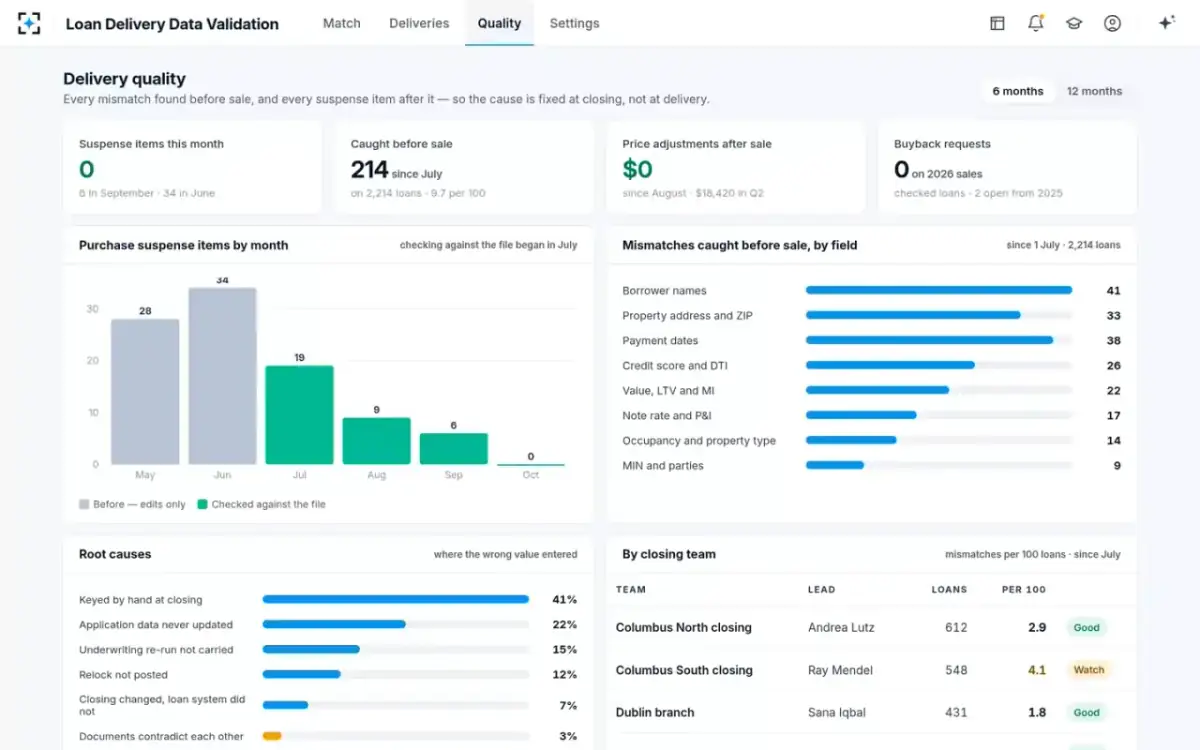
The sample lender's own quality screen shows the change in the after-sale term once every delivery was checked against its file from July. Price adjustments after sale had been $18,420 in the second quarter; since August they were zero, and purchase suspense items fell from 34 in June to none in October. These are sample figures, designed to show what the screen tracks.
A sample lender before and after Loan Delivery Data Validation
$18,420
price adjustments after sale in the second quarter
$0
price adjustments after sale since August
9.7per 100
mismatches caught before sale since July, on 2,214 loans
Mismatches caught before sale, by field and by cause
Fixing the field before the Purchase Advice exists
Every clock on this page starts at the sale. The one window without a clock, and without a request form, is the one before it, when a correction is a new version of the delivery file and the price is simply right. Loan Delivery Data Validation works in that window: its agents compare every delivered field with the signed note, appraisal, final findings and certificates, the price and eligibility checker shows the dollar effect of each correction on the lender's grid, and the loan delivery analyst accepts each one before the secondary marketing manager releases the batch. Contradictions between documents go to QC with both pages, because no correction is the right answer to them.
Errors that pass the investor's edits are the ones that end up here; why the delivery edits let them through explains the mechanism. A data fix found too late before sale has its own cost, a commitment extension or a pair-off, covered in the Fannie Mae pair-off fee. And the case for treating the whole thing as a data integrity problem, not a string of one-off errors, is in what FHFA's auditors found in mortgage data.
Questions people ask
Is there a deadline for a Fannie Mae post purchase adjustment?
Two. Errors in the purchase proceeds must be raised within 30 days of the Purchase Advice, or Fannie Mae assumes the advice is correct. Data corrections are considered for LLPA repricing only within 18 months of acquisition; the duty to report discrepancies the lender finds has no stated end.
Can a post purchase adjustment result in money back to the lender?
Yes. The $100 minimum applies to a credit or a debit, so a corrected value that moves a loan into a better price cell within 18 months can be repriced in the lender's favour. After 18 months it cannot.
What is a price adjusted loan?
A PAL is a loan Fannie Mae's review finds was eligible, but delivered with data that understated the loan-level price adjustment. The lender pays the LLPA that should have been paid; Fannie Mae may not demand repurchase of a PAL, and the lender may not repurchase it voluntarily.
Does a data error always lead to a repurchase?
No. Most data errors are findings or price adjustments. A repurchase demand needs a significant defect: true data that would have made the loan unacceptable, or changed the price at which it was bought, such as a loan above 80% LTV delivered without its mortgage insurance.
Who should own post purchase adjustments at a lender?
Usually the loan delivery or post-closing team prepares them and secondary marketing approves, since they change price. QC findings that reveal delivery data errors should feed the same queue, because the Guide requires the lender to report discrepancies it determines, wherever it finds them.
Does Freddie Mac have the same process?
Freddie Mac runs its own post-funding data correction process under its Seller/Servicer Guide, so check its timelines there rather than assuming Fannie Mae's. The principle is the same: data corrected after funding is corrected on the investor's terms, not the lender's.