Mortgage document classification is the step that identifies what each page of a loan file is: a note, a deed of trust, a rider, a Closing Disclosure, a uniform residential appraisal report, an automated underwriting findings report, a credit report, a mortgage insurance certificate. Software does it by reading the page, not the file name, and the output is a labelled, ordered package. It is a necessary first step, and a buyer should treat it as the easy half. The value lies in what happens next: reading the right values from the right version of each document and comparing them with the data the lender is about to warrant. Botminds' Loan Delivery Data Validation uses agents for the whole chain on closed loans before sale. This page traces one sample batch through it, step by step, and ends with the questions that separate classification from validation when you evaluate any product.
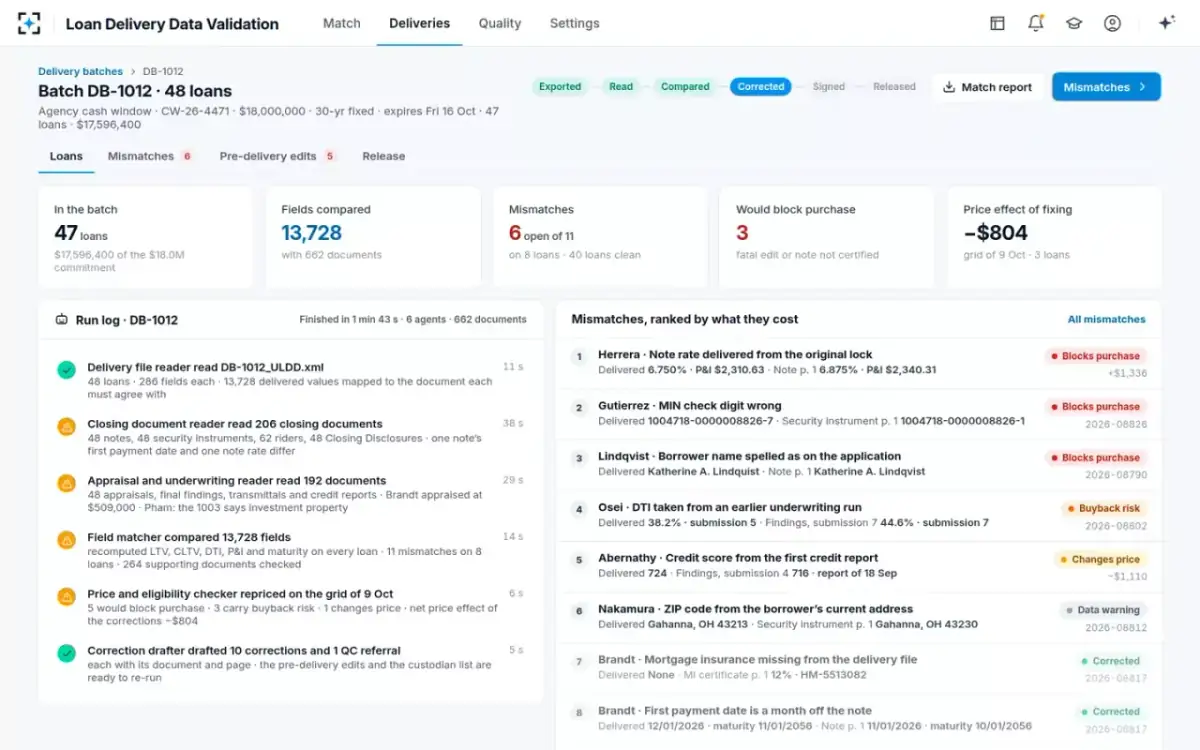
Loan Delivery Data Validation, one sample batch: 662 documents read, by agent
What is mortgage document classification?
It is labelling each document in a loan file by type, and usually by version and date, so that later steps know where to look. A closed loan arrives as one or more image files with hundreds of pages, often scanned in no particular order, with redrawn documents beside the originals they replace. Classification separates them, names them and puts them in order. Good classification also recognises that two pages are the same document signed twice, or two versions of it, and keeps that distinction.
The term covers products with very different reach. Some stop at labels and page splits, for a document management system or a stacking order. Some extract a fixed set of values per document type. A few go on to compare the extracted values with something else: the loan origination system, the delivery file, or the rules of an investor. A search for "mortgage document classification" returns all three, and the difference matters more than the classification accuracy any of them quotes.
What are the mortgage document types in a closing package?
For a delivery review, about a dozen types carry almost all the values that matter. Each is the source of truth for a family of delivered fields.
The document types a delivery review reads, and what each settles
| Document type | Values it settles | Version that counts |
|---|---|---|
| Note, with any riders or addenda | Amount, rate, term, first payment, maturity, P&I, names as signed, MIN | The signed note; the redrawn one if closing moved |
| Security instrument and riders | Property address, occupancy covenant, MERS as nominee, PUD or condo rider | The executed instrument |
| Closing Disclosure | Sales price, loan amount, cash to close, escrows | The final CD the borrower signed |
| Final loan application (1003) | Occupancy, declarations, borrower details | The signed final application |
| Appraisal | Appraised value, effective date, project type and dues, occupant | The final version submitted to the collateral portal |
| Automated underwriting findings | Representative credit score, DTI, recommendation | The final submission |
| Transmittal summary (1008) | Underwriter’s ratios and approval | The final one, matching the findings |
| Credit report | Scores and tradelines | The one the final findings used |
| Mortgage insurance certificate | Coverage percent, certificate number, insurer | The issued certificate |
| Title commitment | Vesting, liens, legal description | The latest commitment |
Why classification is the easy half
Because a perfectly classified file can still produce the wrong answer. Suppose every page is labelled correctly. The file holds two notes, the original and the one redrawn when closing moved; three underwriting findings reports; two credit reports; and an appraisal revised once. A tool that extracts "the note rate" from "the note" can as easily read the superseded note as the signed redraw, and nothing in the classification tells it which one the borrower's final signature is on.
The other hard half is what to compare with. A lender delivering to Fannie Mae warrants that "all required mortgage loan delivery data is true, correct, and complete" (Selling Guide A2-2-02). The useful output is not a list of extracted values but a comparison of each delivered value with its source, with the page cited, so that a person can decide. That is the gap between document classification and delivery data validation.
How does AI read a closing package? A 1 minute 43 second trace
Here is the sample batch. Calder Point Mortgage, a fictional lender, has 48 closed 30-year fixed loans to deliver against an agency cash commitment that expires on Friday. Every borrower named is fictional. Six agents in Loan Delivery Data Validation work in sequence, each with a narrow job and a list of things it may never do.
Loan Delivery Data Validation: six agents, and what each may never do
Agent
Delivery file readerReads the ULDD export (MISMO XML) and maps 286 fields a loan to the document and page each must agree with, using the investor’s field map.
Never: Edits the delivery file.
Agent
Closing document readerReads 48 notes, 48 security instruments, 62 riders and 48 Closing Disclosures, plus title and MI certificates, citing the page for every value.
Never: Infers a value a document does not state.
Agent
Appraisal and underwriting readerReads the appraisals, final findings, transmittals and credit reports.
Never: Uses an underwriting run other than the final one.
Agent
Field matcherCompares every delivered field with its document value under the investor’s rounding, and recomputes LTV, CLTV, P&I and maturity.
Never: Treats a recomputed value as a document value.
Agent
Price and eligibility checkerApplies each corrected value to the investor’s grid and eligibility rules and ranks every mismatch by consequence.
Never: Changes a price or a commitment.
Agent
Correction drafterDrafts each correction from its cited page and refers contradictions to QC.
Never: Releases a batch or sends a file.
A person decides
Loan delivery analystAccepts each correction, or keeps the delivered value with a reason and a second person; signs the data.
The run log shows the time each step took on the sample batch. Reading is most of it; comparing 13,728 fields takes 14 seconds once each value has a page.
Reading takes most of the 1 minute 43 seconds
- Delivery file11 s
- Closing documents38 s
- Appraisal and underwriting29 s
- Matching14 s
- Price and drafts11 s
The run log: what each agent read and found
Which version of a document counts?
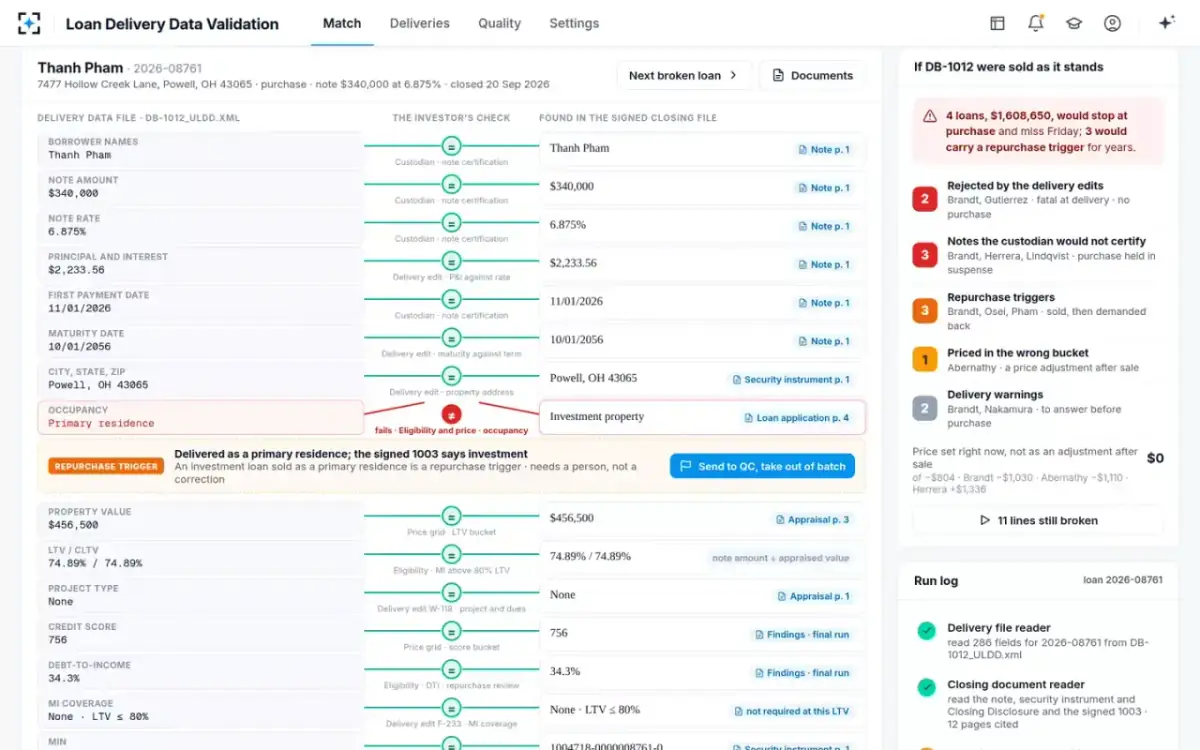
The one the investor and the borrower would point to, and the rules for finding it are specific. For the note it is the signed version: on the sample Brandt loan, closing moved from 1 October to 25 September, the note was redrawn, and only the signed redraw shows first payment 11/01/2026. For underwriting it is the final run: Fannie Mae expects "the terms of the closed loan" to "match the terms of the final loan casefile submission in DU or fall within the tolerances" (Selling Guide B3-2-10). On the sample Osei loan the delivered DTI of 38.2% came from submission 5; the final submission 7 reads 44.6%.
For the appraisal it is the version used to underwrite, which is also the version the lender must have submitted to the collateral portal: "the final version of the report that was utilized in making the underwriting decision must be submitted through the UCDP", and the delivered value must match it (Selling Guide B4-1.1-06). A classifier that labels a revised appraisal and its original both as "appraisal" without dates has not solved this. Ask any vendor to show you how its output distinguishes them.
A field drawn to the signed page that settles it
From fields to findings: recomputing what the investor will recompute
Some delivered values are not on any document; they are computed, and a review must compute them the investor's way. LTV is the clearest case. Fannie Mae divides "the original loan amount by the property value", where for a purchase "the property value is the lower of the sales price or the current appraised value"; the result "must be truncated (shortened) to two decimal places, then rounded up to the nearest whole percent" (Selling Guide B2-1.2-01). On the Brandt loan, $412,000 on the $509,000 appraisal is 80.94%, which the rule delivers as 81%. The delivery file had used the $515,000 price and said 80%.
The recomputation then feeds the next rule. Above 80% LTV the loan needs mortgage insurance; for a fixed-rate loan over 20 years between 80.01% and 85%, Fannie Mae's standard coverage is 12% (Selling Guide B7-1-02). The field matcher recomputes LTV, CLTV, principal and interest and maturity on every loan, and labels the results as computed so they are never mistaken for values read from a page.
Who approves a data correction?
A person, every time. The correction drafter writes each fix from its cited page; the loan delivery analyst accepts it, or keeps the delivered value with a reason and a second person. Accepted corrections create a new version of the delivery file; the exported file is never overwritten. When documents contradict each other, as with the Pham occupancy, the agents draft nothing: the loan goes to the QC manager with both pages and leaves the batch. The secondary marketing manager releases the batch only with zero fatal edits and zero certification exceptions, and the price effect of every correction shown.
On the sample batch the result was 11 mismatches on 8 loans, 10 corrections drafted and 1 QC referral; 9 of the 11 would have passed the investor's edits. The reasons they pass are set out in what Fannie Mae's delivery edits cannot see.
What to ask of mortgage document classification software
Ask what it does after the label, and ask to see it on your loans. The questions below separate a classifier from a validator, and both from a demonstration built on the vendor's own files.
Eight questions for mortgage document classification software
- What does it output after classification?
Labels and page splits, extracted values, or a comparison with your delivery data? Only the last tells you what is wrong.
- How does it pick the version that counts?
Signed over unsigned, redrawn over original, final DU run over earlier ones, the appraisal version sent to the collateral portal.
- Does every value cite a page?
A reviewer needs to open the passage in one click; an extracted value without a page cannot be checked.
- Does it recompute the investor’s way?
LTV on the lower of price and value, truncated then rounded up; MI coverage from the result; P&I and maturity.
- What happens when documents disagree?
It should stop and route to a person, not pick one. Occupancy and income contradictions are not data fixes.
- Does it ever change your data?
Corrections should be drafts a named person accepts, written to a new file version, never over the export.
- What is its accuracy on your document set?
Measured on a batch you already delivered, field by field, including false flags, not a vendor-wide percentage.
- What does it leave on the record?
Every value, page, correction, decision and signer, for QC, audit and any investor question years later.
Question 7 is the one that settles a purchase. Testing mortgage audit software on one delivered batch sets out how to run it, what to measure and what counts as a pass.
Where this approach fits, and where it does not
It fits the window between closing and sale, for lenders who deliver to Fannie Mae, Freddie Mac or private investors from a loan origination system export and have the signed closing package as images. It covers every loan and every delivered field, which a hand review cannot, and it gives the post-closing team and secondary marketing the same ranked list.
It does not replace four things. The custodian still examines the original wet-ink note and its endorsements in hand, which Fannie Mae requires to be "endorsed 'in blank' and without recourse" (Selling Guide E-2-01). Post-closing QC still reverifies income, employment, assets and value with third parties, which no reading of the file can do (Selling Guide D1-3-03). The investor's edits still run; the solution re-runs them on the corrected file rather than skipping them. And a value never written in any document, such as an intention the borrower did not disclose, cannot be found by reading the documents. A product that claims otherwise is claiming too much.
Questions people ask
How accurate is mortgage document classification?
There is no public benchmark for mortgage closing packages, so a vendor-wide figure tells you little. Measure it on your own loans: take a delivered batch, compare the tool's labels and values with what your team confirmed, and count misreads and false flags by document type.
How many fields are delivered on a loan?
It depends on the product and the investor; Fannie Mae's Appendix D lists the required and conditionally required ULDD fields. In the sample lender's configuration, 286 fields are delivered per loan, each mapped to a document page or marked as set by the system.
Can software match delivery data to documents automatically?
Yes, if it reads values with their pages, picks the right version and compares them with the delivery export under the investor's rounding. It should still leave every change to a person and refer contradictions rather than resolve them.
Does classification need a stacking order?
No. Classification reads the page content, so a file scanned in any order can be sorted. A stacking order still matters for the custodian's physical package, which Fannie Mae wants in the exact order the loans were transmitted to Loan Delivery.
What happens to documents the agents cannot read?
A field whose source page cannot be found or read is reported as unmatched, not guessed: the closing document reader is barred from inferring a value a document does not state. The analyst then confirms it by hand or obtains the missing document.