The Uniform Closing Dataset (UCD) is the common data standard that carries a loan's Closing Disclosure to Fannie Mae and Freddie Mac as structured data, with the signed Closing Disclosure PDF embedded in the same XML file. For every conventional loan sold to Fannie Mae, the lender must submit it and receive a "Successful" status before the loan is delivered. The Uniform Loan Delivery Dataset (ULDD) is a different file, sent later, describing the loan the investor is buying. The two share many labels, which tempts lenders to check one against the other. That check is half right: some fields must agree, and some, such as the property value and the LTV on a purchase, must not. Botminds' Loan Delivery Data Validation compares every delivered field with the document that settles it, which handles both cases. This page sets out the crosswalk.
UCD and ULDD: which fields should agree, and which should not
| Field | On the Closing Disclosure (UCD) | In the delivery file (ULDD) | Should they match? |
|---|---|---|---|
| Loan amount | Loan Terms: the note amount | Note amount | Yes: both come from the note |
| Interest rate and P&I | Loan Terms and Projected Payments | Note rate; principal and interest | Yes |
| Borrower names, property address | Closing Information | Borrower names; property address | Yes, and both must match the note and security instrument |
| Sale price (purchase) | “Sale Price” | Sales price | Yes |
| Property value (purchase) | Not shown: a purchase CD prints the sale price instead | Appraised value, which must equal the appraisal in the collateral portal | No source on the CD; compare with the appraisal |
| Property value (refinance) | “Appraised Prop. Value” | Appraised value | Yes, if the CD used the final appraisal |
| LTV and CLTV | Not on the form | Computed on the lower of price and value, rounded up to a whole percent | Nothing to match; recompute |
| Mortgage insurance | A premium in Projected Payments | Coverage percent and certificate number | Consistent, not equal: compare with the MI certificate |
| Unpaid balance | The loan amount at closing | Unpaid balance at delivery | Not after a payment has been made |
| Rate the investor receives | Not on the form | Pass-through rate under the commitment: note rate less servicing fee | No: it is meant to differ from the note rate |
What is the uniform closing dataset?
It is the Closing Disclosure turned into data. Fannie Mae's Guide defines it as "a common industry dataset that allows information on the Closing Disclosure to be transmitted electronically to Fannie Mae", and requires lenders to "electronically submit a UCD XML file of the loan to Fannie Mae and receive a 'Successful' status from the UCD collection solution prior to the delivery of the loan" (Selling Guide C1-2-02). It applies to "all conventional loans, regardless of whether the TILA/Regulation Z Rule requires the Closing Disclosure, including non-owner-occupied property loans".
The UCD is one of four datasets in the GSEs' Uniform Mortgage Data Program. FHFA describes it as allowing "information from the Consumer Financial Protection Bureau's Closing Disclosure to be transmitted electronically to the Enterprises", from September 2017, and says "the common dataset and associated business rules help improve the quality of newly originated loans" (FHFA Insights, 2017). The other three cover the application, the appraisal and the delivery; what ULDD is explains the last.
What is a UCD XML file, and what does Successful mean?
A UCD XML file is a MISMO-format document holding the Closing Disclosure's data points, with the borrower's Closing Disclosure itself attached: "The UCD XML file must contain the borrower data and the PDF of the borrower Closing Disclosure" (C1-2-02). MISMO, the mortgage industry's standards body, says every exchange in the GSEs' data program is built on its standards (MISMO FAQs). Loan origination and closing systems generate the file; the lender submits it to Fannie Mae's UCD collection solution or Freddie Mac's equivalent.
"Successful" is the status the collection solution returns when the file passes its edits. It is a precondition for delivery, not a statement that the data is right. Like the delivery edits, the UCD edits check the file's structure and conditional requirements; they read the data points the lender sent. A Closing Disclosure that correctly discloses a loan whose delivery file is wrong is still Successful.
The UCD comes first, the ULDD last; each is checked by its own edits
Agent
Appraisal to the collateral portalThe final appraisal used to underwrite reaches Successful before sale.
Never: Sees the delivery file.
Agent
UCD to the collection solutionThe Closing Disclosure data and PDF reach Successful before delivery.
Never: Checks the note or the appraisal.
Agent
ULDD to Loan DeliveryThe delivery file must clear every fatal edit before purchase.
Never: Reads a signed document.
A person decides
Document custodianCertifies the original note against the delivered data.
Never: Reads the appraisal, findings or CD.
Is the UCD the same as ULDD?
No, and the difference is purpose. The UCD records what the borrower was told at closing, in the form Regulation Z prescribes. The ULDD records what the investor is buying: the loan's terms, the collateral and its value, the borrower's credit as underwritten, the insurance, the parties, the commitment it fills. The UCD is sent once the Closing Disclosure is final; the ULDD is built from the loan origination system when the loan is shipped, days or weeks later.
So a shared label does not mean a shared value. Regulation Z tells the Closing Disclosure to show, "in credit transactions where there is a seller, the contract sale price of the property ... labeled 'Sale Price'", and only where there is no seller, "the appraised value of the property ... labeled 'Appraised Prop. Value'" (12 CFR 1026.38(a)(3)(vii)). The delivery file carries both the sales price and the appraised value. On a purchase, the CD has no appraised value to compare.
Which UCD fields should match ULDD?
The ones that both read from the same signed document. Loan amount, note rate, principal and interest, and the loan term come from the note on both files; names and the property address from the note and security instrument; the sale price on a purchase from the contract and the Closing Disclosure. If any of these differ between the UCD and the ULDD, one of them is wrong, and the note decides which.
Even here, comparing the two files is the weaker check. If the closing system and the loan system share a stale value, such as the rate from the original lock after a relock, the UCD and ULDD agree with each other and both disagree with the note. On the sample batch used below, one loan was delivered at 6.750% while the note signed after the relock carries 6.875%. The test that catches that is the note, not the other dataset.
The fields that must not match, and why
Three kinds of delivered field are meant to differ from what the Closing Disclosure shows. The first is computed values. Fannie Mae's LTV is the loan amount over "the lower of the sales price or the current appraised value", "truncated (shortened) to two decimal places, then rounded up to the nearest whole percent" (Selling Guide B2-1.2-01). The CD has no LTV; a check that derives one from the CD's sale price will be wrong whenever the appraisal comes in low.
The second is values from another source of truth. The delivered appraised value must match "the appraised value as indicated on the appraisal submitted to UCDP" (Selling Guide B4-1.1-06), not anything on the CD. Mortgage insurance coverage comes from the certificate; the CD shows a premium. The third is values that change after closing by design. The pass-through rate on a whole-loan commitment is "the difference between the gross note rate and the servicing fee" (Selling Guide C2-1.1-02), and the unpaid balance at delivery falls below the loan amount once a payment has been made; Fannie Mae accepts delivery "up to 45 days from the due date of the reported last paid installment" (Selling Guide C2-2-03).
Matching the delivery file to the Closing Disclosure tests whether two systems agree. The warranty is about whether they agree with the loan.
A naive UCD check can bless a wrong value
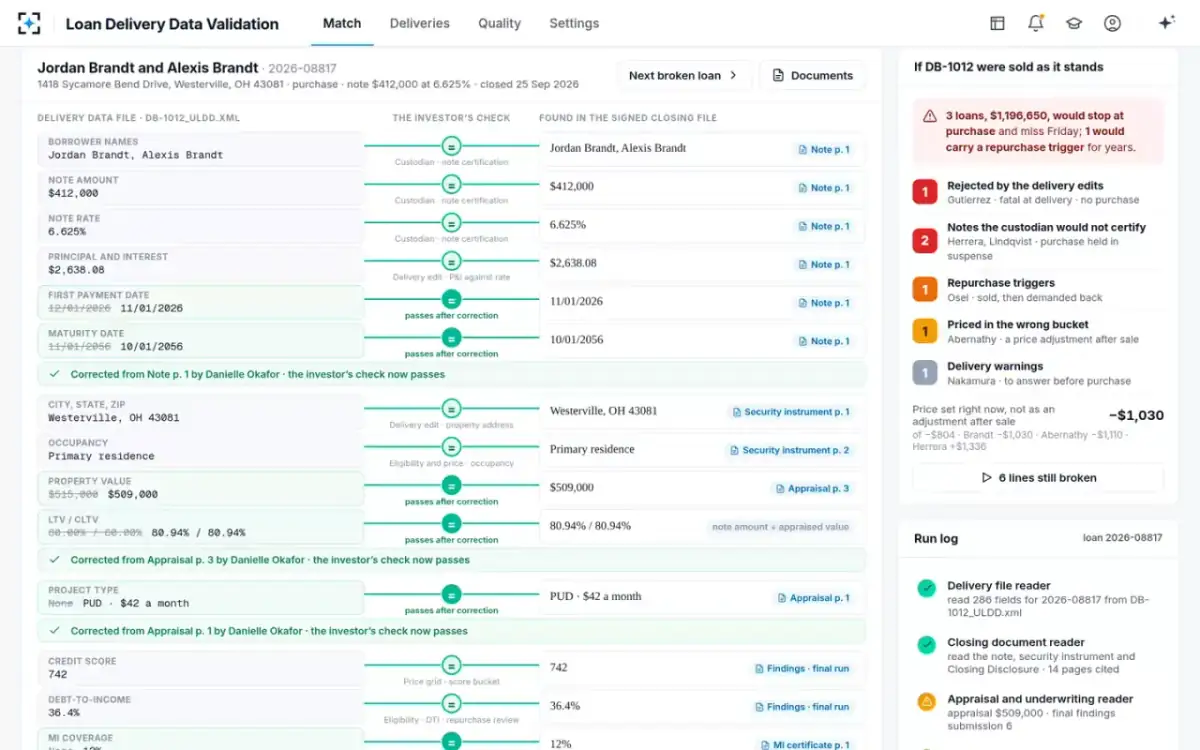
The risk of a UCD-equals-ULDD rule is not only false errors. It can confirm a true one. Take a sample lender, Calder Point Mortgage (fictional, as are its borrowers), and the Brandt purchase from a batch it was about to sell. The delivery file carried a property value of $515,000. The Closing Disclosure's Sale Price was $515,000. A check that compares the two passes. The appraisal valued the house at $509,000.
The same field, two checks: a Loan Delivery Data Validation sample loan
Checked against the Closing Disclosure: $515,000 = Sale Price $515,000. Passes.
Checked against the document that settles it: Appraisal p. 3: $509,000. The delivered value is the contract price. Fails.
Checked against the Closing Disclosure: No LTV on the CD; derived from the sale price: 80.00%. Passes.
Checked against the document that settles it: Recomputed on the lower value: 80.94%, delivered as 81% under the rounding rule. Fails.
Checked against the Closing Disclosure: No MI premium shown, consistent with 80%. Passes.
Checked against the document that settles it: Above 80% the loan needs coverage; standard is 12% for this loan type. A 12% certificate was on file, unlinked. Fails.
Checked against the Closing Disclosure: 6.625% and $2,638.08 on both. Passes.
Checked against the document that settles it: Note p. 1: 6.625% and $2,638.08. Passes.
Every check against the Closing Disclosure passed, because the CD faithfully disclosed the price and nothing else. The error sat in the one field the CD does not hold. The investor's edits pass it too, since an 80% LTV with no insurance is internally consistent; why the delivery edits cannot see it covers the mechanism.
The value corrected from the appraisal, and the lines that follow it
Why does my UCD not match my delivery file?
Usually for one of four reasons, and only some are errors. The field is computed or sourced elsewhere by design, as with value, LTV, MI coverage and the pass-through rate. The loan changed after the Closing Disclosure: a corrected CD after closing, a principal reduction, a first payment already made. The two systems mapped the same value differently, which is a configuration problem that repeats on every loan. Or one of them holds a stale value from before a relock, a redraw or a new underwriting run.
The first two need no fix. The third needs a fix in the mapping, because a wrong mapping is a pattern, and patterns of the same wrong delivery data element on five or more loans carry life-of-loan warranty exposure. The fourth needs the signed document to say which value is right.
What decides a mismatch between the two datasets
1
source of truth per field: the note, the appraisal, the findings or the certificate
2
datasets that can agree with each other and both be wrong
0
appraised values on a purchase Closing Disclosure
Fannie Mae uniform closing dataset requirements, in brief
Four rules cover most of what a post-closing team needs. Every conventional loan needs a UCD file, including investment-property loans for which Regulation Z requires no Closing Disclosure. The file must hold both the Closing Disclosure data and the borrower's Closing Disclosure PDF. It must reach "Successful" in the UCD collection solution before the loan is delivered. And the details of which data points are required sit in the UCD Delivery Specification, which the Guide points lenders to (Selling Guide C1-2-02).
Two neighbouring rules complete the picture. The appraisal used to underwrite must reach Successful in the collateral portal before sale, and if it was revised, it is "the final version of the report that was utilized in making the underwriting decision" that must be submitted (Selling Guide B4-1.1-06). The delivery file then carries the appraised value from that report, not from the Closing Disclosure, which on a purchase never shows it.
Mapping each field to its source in Loan Delivery Data Validation
The solution does not compare the delivery file with the UCD. Its delivery file reader maps each of the 286 delivered fields per loan to the document and page that settles it, or marks it as set by the system, using the investor's field map. The closing document reader reads the note, security instrument and riders, the Closing Disclosure, the title commitment and the MI certificate; the appraisal and underwriting reader takes the appraisal, final findings, transmittal and credit report. The field matcher compares each delivered value with its source under the investor's rounding, and recomputes LTV, CLTV, principal and interest and maturity, labelling every computed value as computed.
On the sample batch of 48 loans that meant 662 documents and 13,728 fields, compared in 1 minute 43 seconds, with 11 mismatches on 8 loans. The loan delivery analyst accepted each drafted correction against its page; the delivery file was rewritten as a new version, never over the export; and the investor's edits and a custodian preview re-ran on the result. Good delivery itself needs the data to "pass all of the Fannie Mae purchasing edits" on time (Selling Guide C2-2-01); the field map makes sure what passes is also what was signed.
Questions people ask
Is the UCD required for every Fannie Mae loan?
For every conventional loan, yes, including investment property loans where Regulation Z does not require a Closing Disclosure. The file must reach Successful status in the UCD collection solution before the loan is delivered.
When did the Uniform Closing Dataset start?
FHFA dates it to September 2017, when the GSEs began accepting Closing Disclosure data electronically under the Uniform Mortgage Data Program. It sits alongside the application, appraisal and delivery datasets.
Does a Successful UCD mean the loan data is correct?
No. It means the file passed the collection solution's edits on structure and conditional requirements. It does not compare the Closing Disclosure with the note, the appraisal or the delivery file.
Should the appraised value in ULDD match the Closing Disclosure?
On a refinance, the CD shows an "Appraised Prop. Value" that should be the final appraisal. On a purchase it shows the sale price instead, so the delivered appraised value must be checked against the appraisal submitted to the collateral portal, which Fannie Mae requires it to match.
Can one XML file serve as both UCD and ULDD?
No. They are separate datasets with separate specifications, submitted to different systems at different times, though both use the MISMO reference model. A loan system produces each from its own mapping.