A Fannie Mae pair off fee is the charge a lender may pay when it purchases back, or "pairs off", all or part of a mandatory whole-loan commitment it cannot fill with loans. Fannie Mae compares the whole-loan price captured when the commitment was made with the price at the time of the pair-off: if the market has moved against the commitment, the lender pays the difference on the amount paired off; if it moved the other way, an eligible lender can receive cash back. Pair-offs are a normal hedging tool, but an unplanned one usually starts with loans that could not make good delivery in time, and a mismatch between the delivery data and the signed note is one way a loan misses that window. Botminds' Loan Delivery Data Validation checks every delivered field against the closing file while there are still days left on the commitment, so a fix is a correction, not an extension or a pair-off.
Where a data fix lands on a mandatory commitment
Step 1 · Day 1
Commitment taken
1 to 90 days, counted in calendar days, expiring on a business day. Price fixed now.
Step 2 · Morning before expiry
Good delivery deadline
Error-free documents and data at the custodian; data clear of the purchasing edits; total inside the tolerance.
Step 3 · If short
Extension
Requested by the lender, up to 30 days in all; or automatic, at least five calendar days. Either way, a fee.
Step 4 · If still short
Pair-off
Requested, or automatic on an expired commitment already extended. A fee, or cash back if eligible.
What is a pair off fee?
It is the cost of not delivering what you committed to deliver. Under a mandatory commitment, the lender agrees to sell Fannie Mae a dollar amount of loans with set characteristics by a date, at a price fixed when the commitment is made. If the loans do not arrive, Fannie Mae has still priced and hedged the trade. Fannie Mae "may charge lenders for lender-requested and automatic extensions for mandatory commitments ('extensions'), delivering more than the maximum delivery amount of their commitment ('overdelivering'), repurchasing all or part of a commitment ('pairing-off'), or otherwise failing to satisfy mandatory commitment requirements" (Selling Guide C2-1.1-02).
Fees are "drafted from the lender's designated account the business day following the assessment". A lender that pays one late faces a compensatory fee of "the greater of $50 or a daily interest charge equal to the prime rate plus 3% of the fee that is due" (Selling Guide A2-3.3-01).
How is the Fannie Mae pair off fee calculated?
From two prices and one amount. The Guide states the method in principle: "For overdelivery and pair-off fees, including cash back pair-offs, whole loan prices captured at commitment and again at the time of the overdelivery or pair-off are used to determine if a fee will be charged or if cash back is due and, if so, the amount. All pair-off amounts (including cash back pair-offs) are calculated from the original commitment amount, not the low delivery tolerance" (Selling Guide C2-1.1-02). Fannie Mae quotes the exact figure through its whole-loan committing application or its Capital Markets Pricing and Sales Desk, and the lender "must accept the quotation within a short time frame" (C2-1.1-04).
To see the scale, take the fictional sample lender worked through further down: an $18,000,000 commitment that ends up $1,672,250 short because four loans stall on data problems in the last days. Put an invented half-point price move against it and the arithmetic looks like this.
A pair-off fee, worked on the sample with an invented price move
$1,672,250
amount paired off: the original commitment less the loans delivered
0.50pts
whole-loan price move against the commitment, invented for the example
≈ $8,361
fee: amount × price move, before Fannie Mae’s own quotation
$50+
late-payment fee floor, or prime + 3% a day on the fee if larger
What is a cash back pair-off?
It is a pair-off in the lender's favour. When a lender requests a pair-off and "the whole loan price at commitment is greater than the price at the time of the pair-off solely as a result of market fluctuations ... Fannie Mae will not charge a lender a pair-off fee but will provide cash back to the lender" (Selling Guide C2-1.1-04). The protection has limits. A lender is not eligible for cash back where the commitment is paired off automatically and the loans delivered under it are deemed ineligible, and negotiated transactions and commitments above the daily volume limit may not qualify. Fannie Mae can also end a lender's cash back eligibility if it is "obtaining commitments without the intent to deliver".
The asymmetry matters for planning. A pair-off chosen in a falling market can cost nothing or pay; a pair-off forced by missing loans arrives on whatever day the loans failed, at whatever the market is doing that day.
What is a commitment extension?
It is more time, for a fee. A lender "may extend commitments on or before the original commitment expiration date for up to a maximum of 30 days from that date", in one or several requests, each made before the expiry then in effect (C2-1.1-04). It may extend the whole outstanding balance or part of it, if it pairs off the rest. Extension fees are based on three things: the amount extended, the number of days, and "daily interest charge, which is based on the minimum pass-through rate posted on the original commitment" (C2-1.1-02).
Four ways a mandatory commitment can end
| Outcome | When | What it costs |
|---|---|---|
| Good delivery | Loans inside the tolerance, documents and data error-free at the custodian the morning before expiry | Nothing beyond the price agreed |
| Lender-requested extension | On or before expiry, up to 30 days in total | An extension fee on the amount and days extended |
| Automatic extension | Good delivery missed and the commitment never extended | At least five calendar days and the extension fee |
| Pair-off, requested or automatic | The lender cannot fill it; or an extended commitment expires unfilled | A pair-off fee, or cash back if eligible; automatic pair-offs on ineligible loans get no cash back |
What happens if a loan misses the commitment date?
The commitment rolls into the extension rules, whether the lender asks or not. "If a lender fails to meet Fannie Mae's good delivery requirement within the original commitment period and has not previously extended the commitment, Fannie Mae will automatically extend it. Commitments expiring with outstanding unpaid principal balances will be automatically extended a minimum of five calendar days and assessed the appropriate extension fee." If no deliveries are made by the end of that extension, "Fannie Mae will effect an automatic pair-off", and any expired, unfilled commitment that has already been extended is paired off automatically (Selling Guide C2-1.1-04).
The loan itself can still be sold, on a new commitment at a new price. Fannie Mae may also "assess a late delivery fee for loans that are redelivered after a commitment has expired" (Selling Guide C1-2-01). What a missed date really costs is the difference between the price the loan was hedged at and the price available now, plus the fees on the way.
What is the Fannie Mae delivery tolerance? Good delivery in dollars
The tolerance is the greater of $10,000 or 2.5% of the original commitment, in either direction. The Guide sets the minimum required delivery amount at "an amount that will not fall below the original commitment amount by more than the greater of $10,000 or 2.5% of the original commitment amount", and the maximum the same distance above (Selling Guide C2-2-01). Good delivery also requires that "the data reflected on the Loan Schedules pass all of the Fannie Mae purchasing edits" and that error-free documents and data reach the custodian "no later than the first morning delivery, the day prior to the expiration date of the commitment".
Apply it to a sample. Calder Point Mortgage, a fictional lender, has an $18,000,000 commitment expiring Friday and a 48-loan batch of $17,936,400 to fill it. The tolerance is $450,000, so anything from $17,550,000 to $18,450,000 is good delivery. Every borrower named in the batch is fictional, too.
The sample batch against Fannie Mae’s minimum delivery amount
Can a data error cause a pair off?
Yes, indirectly and often. Inaccurate data is one of the stated reasons Fannie Mae "may reject a loan", alongside ineligibility and incomplete document packages (Selling Guide C1-2-01). A loan is purchased only once it is "clear of all fatal edits" (C1-2-02), and the custodian certifies the note only when "there are no discrepancies" between it and the data (C2-2-02). Each of those is a data problem that keeps a loan out of the commitment until someone fixes it.
In the sample batch, the agents found 11 mismatches on 8 loans when the batch was matched against the closing file on Monday, four days before expiry. Four loans would have stopped at purchase: two on fatal edits (a MERS MIN with a bad check digit, and dues reported with no project type) and three notes the custodian would not certify (first payment and maturity a month off on a redrawn note, a rate from the original lock after a relock, a borrower surname misspelled). One loan appears in both groups. Together they were $1,608,650, enough to take the batch below the minimum.
A sample commitment in Loan Delivery Data Validation, by the numbers
$450,000
Fannie Mae tolerance on an $18,000,000 commitment: the greater of $10,000 or 2.5%
$1,608,650
in four loans that would have stopped at purchase on data
97.8%
of the commitment delivered after corrections, inside tolerance
The fix has a deadline set by the trade, not by the file
A data correction takes minutes once someone knows it is needed. The problem is when it becomes known. If the first check against the signed file is the custodian's, on the morning before expiry, a wrong first payment date is discovered with no time left to correct the data, resubmit and recertify. Found on Monday, the same fix is a line in a corrected delivery file. The commitment's clock, not the difficulty of the fix, decides whether it costs anything.
Loan Delivery Data Validation moves the check to the start of that clock. Its agents read the batch's 662 documents, compare all 13,728 delivered fields with their pages, and rank each mismatch by what it would do: block purchase, carry buyback risk, change price, or warn. The loan delivery analyst accepts each drafted correction; a loan whose documents contradict each other, such as the sample's occupancy case, goes to QC and leaves the batch. The secondary marketing manager sees the batch against the commitment before releasing it. On the sample, the corrected 47 loans delivered $17,596,400, inside the tolerance, with the edits and a custodian preview re-run clean.
Loan Delivery Data Validation shows the batch against its commitment
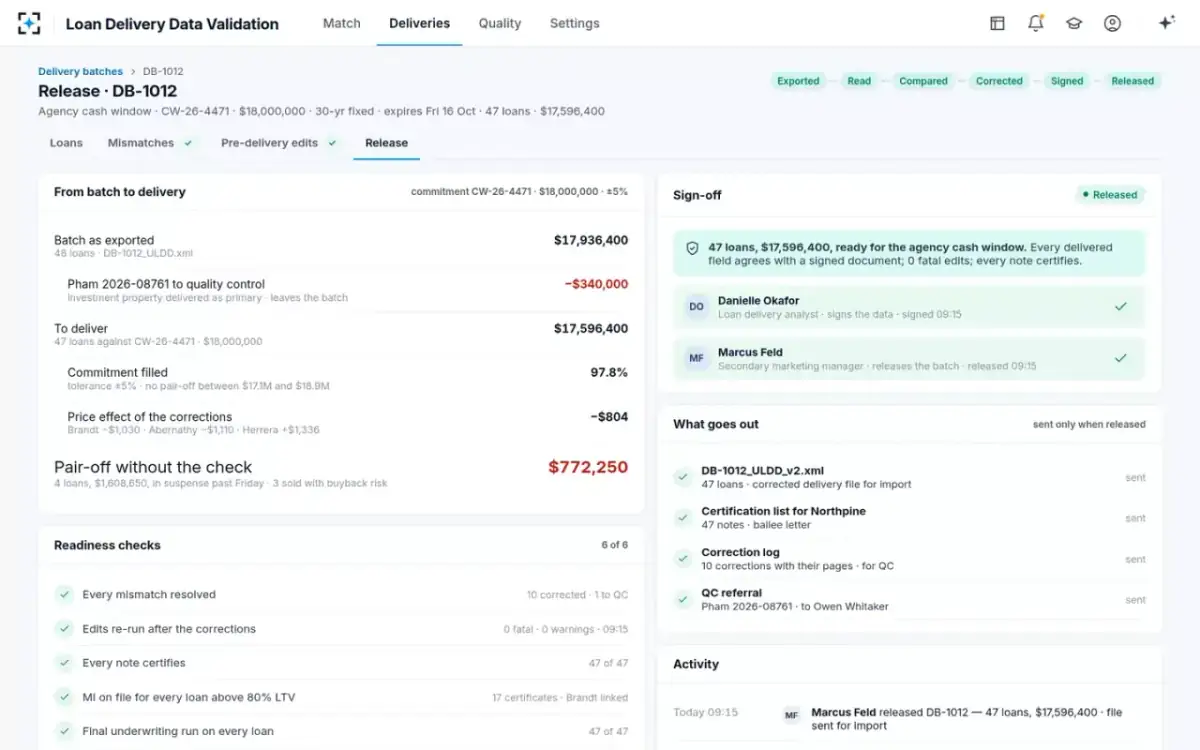
The checklist that keeps each loan deliverable in the first place is in the mortgage post closing checklist. Errors that slip past both the commitment and the sale are priced in what a wrong field costs after the sale.
Questions people ask
Is a pair-off fee a penalty?
Not in form. It settles the price difference on a trade the lender did not complete: the lender pays when the market has moved against the commitment, and an eligible lender receives cash back when it has moved the other way. Fannie Mae does charge separate compensatory fees for late payment of fees and for failures it believes the lender controlled.
Can a lender pair off only part of a commitment?
Yes. A lender may pair off all or part of a mandatory commitment at any time between execution and expiry, and may extend part of the balance if it pairs off the rest. After a partial pair-off, the minimum required delivery falls to $50 below the revised commitment amount.
When can pair-offs and extensions be requested?
Pair-offs between 8:15 a.m. and 5:00 p.m. Eastern time and extensions between 8:15 a.m. and 10:00 p.m. on any business day, through the whole-loan committing application or the Capital Markets Pricing and Sales Desk. Calls are recorded, and the Guide tells lenders to keep detailed records of extensions requested.
How long can a Fannie Mae commitment be?
Commitments for most products run 1 to 90 days, are counted in calendar days and must expire on a business day. Fannie Mae tells lenders to choose a period that leaves enough time after closing for shipping and delivery.
Is there a limit on how much a lender can commit in a day?
Yes: $200 million in aggregate commitment volume per day without Fannie Mae's permission. A lender that exceeds it without approval may be required to pair off at its own expense, and commitments over the daily limit may not be eligible for cash back.