Writing a final investment committee memo for a mid-sized buyout takes about 60 associate hours, seven and a half working days, by our estimate for a first full draft, before the deal lead's and partner's review and excluding the preliminary memo written weeks earlier. No regulator or independent study publishes the figure, so a firm should measure its own. The hours are mostly not writing: pulling figures from the deal model into tables, reading diligence reports, re-checking every figure after each model change and anticipating the committee's questions take about five-sixths of them. Those are the hours where copy-paste errors enter the memo and where AI helps most, provided its work is checked against its sources. Botminds' Investment Committee Memo Drafting assembles the tables from model cells, cites every figure and finding to its page, re-checks the memo on every model version and rehearses the committee's questions, which in our estimate brings the first draft to about 11 hours, most of them judgment.
This guide is for the deal team leads, the chief operating officer and the investment committee secretary of a private equity firm. The hour figures are our estimate using a fictional sample deal in the solution, a buyout whose memo carries 186 figures; the research figures are linked where they appear.
Where an associate's 60 hours on one IC memo go, by hand
How long does it take to write an investment memo?
For a final IC memo on a mid-sized buyout, our estimate is about 60 associate hours for the first full draft; a preliminary memo or a follow-on investment takes far less, and a carve-out with diligence in several languages takes more. The memo's length is not the driver. The sample memo's 186 figures each come from a model cell, a CIM page or a diligence page, and every one has to be found, placed, formatted and then re-checked when the model moves, which it does several times in the weeks before the committee.
Two of the six tasks are almost entirely mechanical: pulling figures and re-checking them, 24 hours, two-fifths of the total. Reading diligence is a mix: finding the page that matters is mechanical, deciding what it means is not. Writing and anticipating questions are where the associate's judgment lives. A firm that wants to cut memo hours without weakening memos should start with the first two rows and protect the last two.
How a firm can measure its own memo hours
Ask one associate to log, for one memo, every hour against six headings, and repeat on a second memo of a different kind. Two memos are enough to see the shape; ten give a baseline a firm can manage against. The log costs minutes a day and turns a debate about productivity into a table.
A one-memo time log: what to record against each task
| Task | Start | End | Also record |
|---|---|---|---|
| Pulling figures into tables | First table started | All tables filled | Figures placed; model version used |
| Reading diligence | First report opened | Findings summarized | Reports read; pages cited; languages |
| Writing sections | First section drafted | Draft complete | Sections; rounds of edits |
| Re-checking after model changes | Each new model version | Memo matches it | Versions received; figures changed |
| Anticipating questions | First question listed | Gaps closed | Questions; gaps that needed new analysis |
| Approvals and papers | Draft to deal lead | Pack distributed | Rounds of review; items sent back |
Two counts are worth more than the hours. The number of model versions received while drafting shows how much re-checking the process forces, and the number of figures changed in each version shows how much of that re-checking was needed. In the sample, model v14 changed two figures in the memo; finding them by hand means re-reading 186.
What do the memo hours cost a firm?
At public wage data the mechanical hours in one memo cost a few thousand dollars of associate time, and the number of memos multiplies it. Official statistics have no category for private equity associates; the closest is financial and investment analysts, whose median pay in securities, commodity contracts and other financial investments was $124,370 in May 2025 (BLS Occupational Outlook Handbook). That excludes bonuses and overheads, so it understates the cost to a firm and is best treated as a floor.
Pricing one IC memo's hours from public wage data
| Line | Calculation | Result |
|---|---|---|
| Hourly wage at the median | $124,370 ÷ 2,080 hours | $59.79 |
| First draft by hand | 60 hours × $59.79 | $3,587 |
| First draft with agents | 10.8 hours × $59.79 | $646 |
| Associate time released per memo | $3,587 − $646 | $2,941 |
| Memos a committee reads per closed deal | 61.8 reviewed ÷ 6.1 closed, per 100 opportunities | about 10 |
The wage line is the smallest part of the cost. In the Gompers, Kaplan and Mukharlyamov survey, firms reviewed about ten opportunities for each one they closed (NBER working paper 21133), so the drafting load falls mostly on deals the firm will not do. The larger costs do not show in a wage calculation: a memo sent back by the committee for missing analysis costs the deal team a week, and an associate re-pasting tables the night before papers close is not thinking about the deal.
Which memo hours should AI take?
The assembly hours: tables from model cells, citations, first drafts of descriptive sections, diligence findings with their pages, and the re-check after every model change. People should keep the argument: the thesis, the judgment on price and risk, the choice of conditions and the decision to sign. The research supports both halves of that line.
What controlled experiments found about AI on professional work
40%
less time on professional writing tasks with ChatGPT, 453 professionals
18%
higher rated quality of the same writing
19%
less likely to reach a correct answer on a task outside the AI's abilities, 758 knowledge workers
Noy and Zhang gave half of a group of professionals ChatGPT for occupation-specific writing tasks; those with the tool finished 40% faster and their output was rated 18% better, and "Inequality between workers decreased" (Science, 2023). For a committee that cuts both ways: a junior associate's draft improves fastest, and fluent prose says less than it used to about how much thought went in, so an AI-assisted memo should be judged by its sources.
The second experiment marks the limit. Dell'Acqua and colleagues found that consultants using GPT-4 on tasks within its abilities completed 12.2% more tasks, 25.1% more quickly, but on a task chosen to fall outside them, "subjects using AI were 19% less likely to produce correct solutions compared with those without AI" (Harvard Business School working paper, published in Organization Science, 2026). An IC memo straddles that boundary. Assembling a returns table from labelled model cells sits well inside it; judging whether an exit multiple is defensible, or noticing that the director of the plant at the centre of the value-creation plan has a contract ending in March 2027, sits near the edge or outside.
The same memo, by hand and with agents: where the remaining hours sit
By hand, about 60 hours
- Figures, re-checks and approvals · 46.7%
- Reading diligence · 23.3%
- Writing and the committee's questions · 30%
With agents, about 11 hours
- Figures, re-checks and approvals · 22.2%
- Reading diligence · 29.6%
- Writing and the committee's questions · 48.1%
Of the roughly eleven hours left, almost four-fifths are reading diligence findings, editing the argument and closing the committee's likely gaps, the work an associate is hired to learn. In the sample, closing one gap meant adding a currency case to the model, not writing a paragraph. How the vice president's and partner's roles shift with it is set out in IC memo private equity: who drafts, approves and signs.
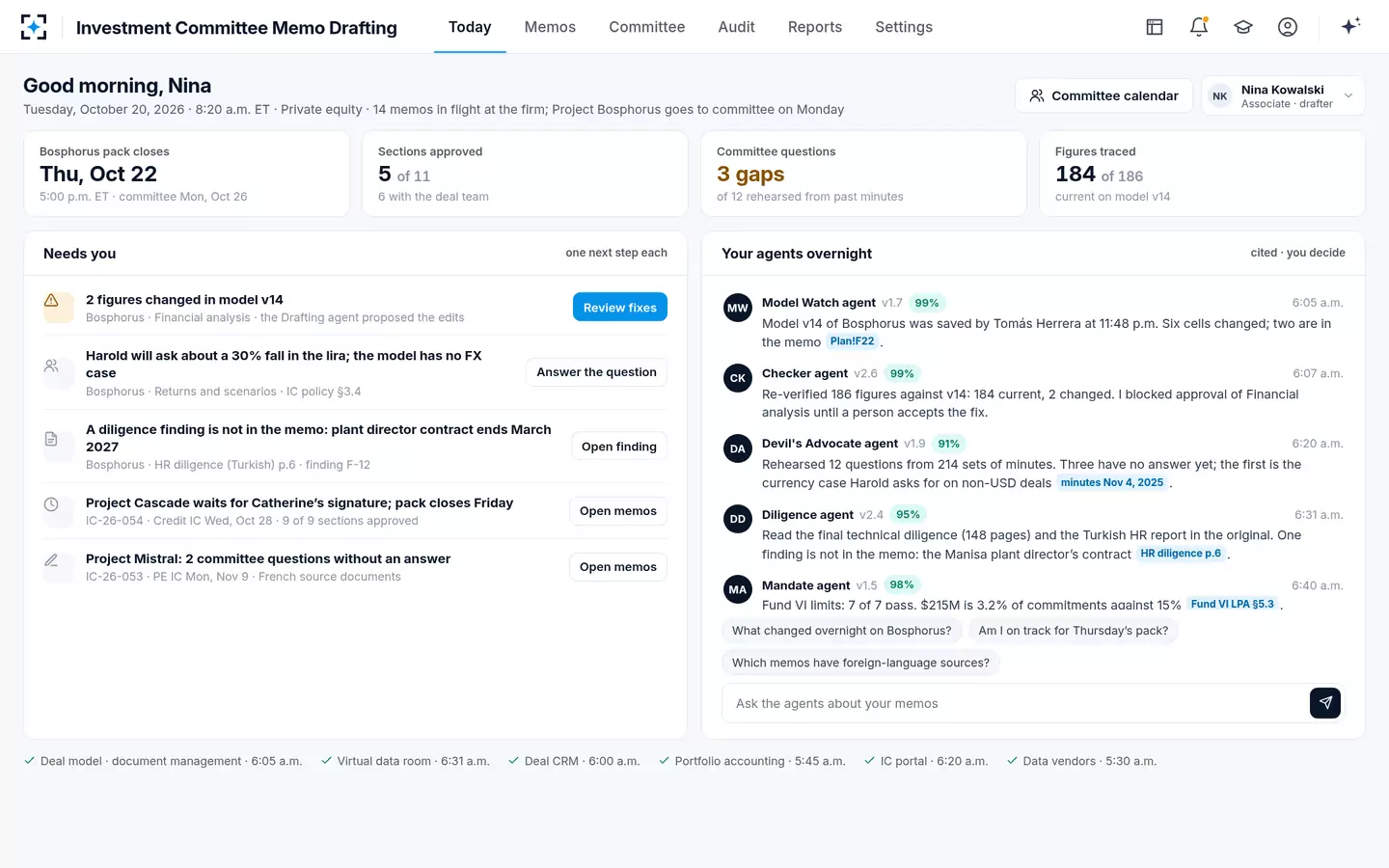
The associate's morning: what needs her, not what needs typing
What happens to memo hours when the model changes?
Each new model version costs a re-check of every figure in the memo, whether or not the figure moved, unless the firm can see which cells changed and where each sits in the memo. That is the eight hours of re-checking in our estimate, and it grows with the number of versions the deal team saves before papers close. In the sample, model v14 changed two of the memo's 186 figures; by hand, finding them means re-reading all 186, and missing one puts a stale number in front of the committee.
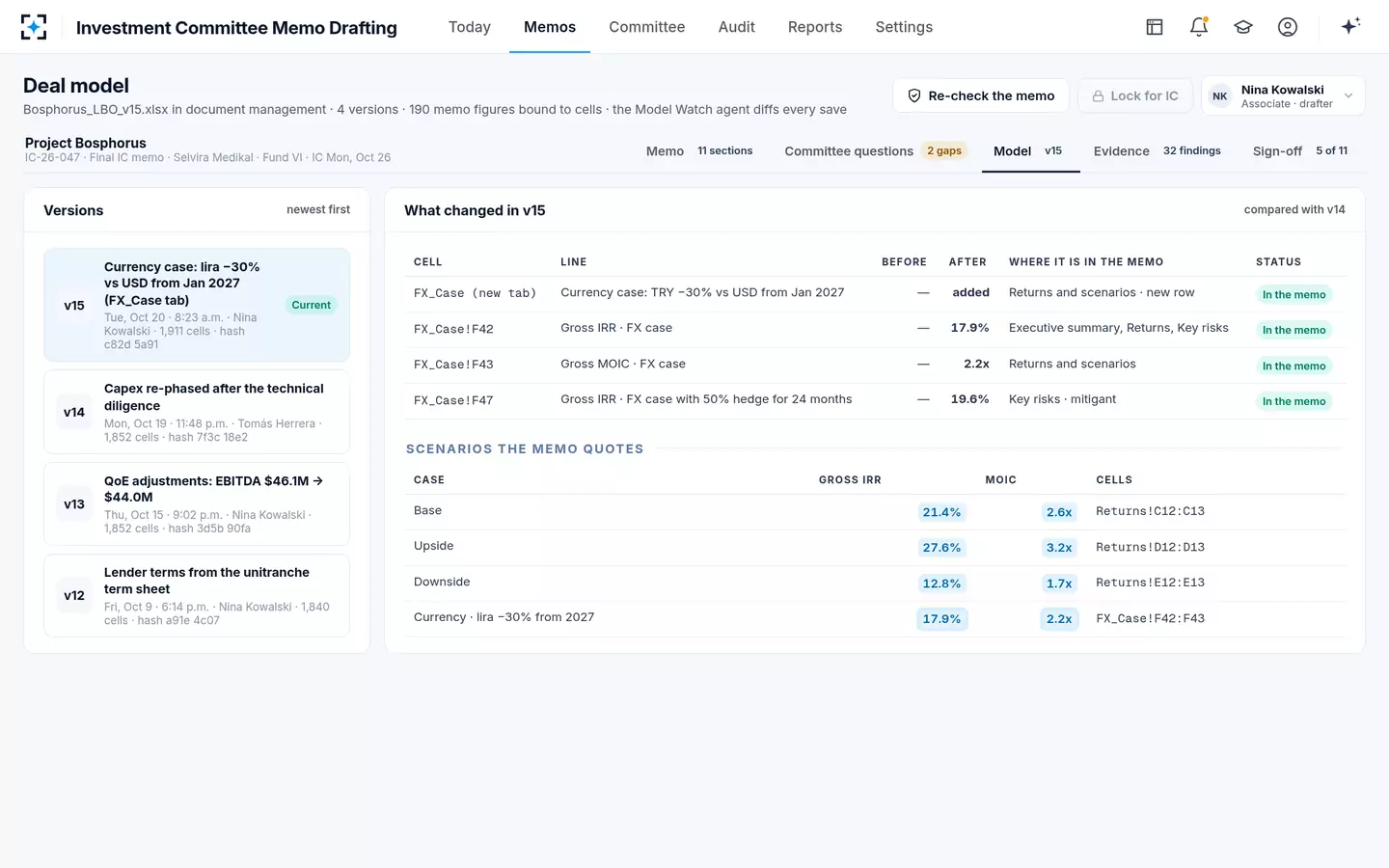
The fix is version-aware tracing. Investment Committee Memo Drafting records each saved model version with who saved it, when and its hash, lists the cells that changed and the memo figures that depend on them, and flags any figure that is stale before a section can be approved. When the sample team added a lira −30% case in model v15, the memo's figures rose to 190, all current on v15, with the new currency row in the returns table and a hedge condition, each cited to its model tab. The associate reviewed the changes, not the memo.
Every saved model version, the cells it changed, and where each sits in the memo
Can deal teams use a general AI assistant for IC memos?
For a short note with a few figures the associate can check personally, often yes, if compliance has approved the tool; for a final IC memo built from a data room, no. A CIM and a data room usually arrive under a confidentiality agreement and can contain material nonpublic information about the company or a listed party, and section 204A of the Investment Advisers Act requires every registered adviser to have, and enforce, written policies aimed at stopping that information from being misused (15 U.S.C. 80b-4a). Pasting a CIM into a consumer chat window sits badly with both.
The second limit is quality. A general assistant has no access to the model and no way to check its own figures, and a final memo has hundreds of figures from a model that keeps changing, read by people who vote on a fund's capital. Using a general assistant to polish a paragraph of the thesis is a different act from using one to produce the returns section; a firm that allows the first should say so in writing and forbid the second. Why a drafting model must not check itself is set out in AI investment memo generator: maker and checker.
How should a firm check the hours AI saves were not quality lost?
By checking the memo against its sources and tracking what the committee sends back. Five mechanical checks run on every version: every figure opens the cell or page it came from, every derived figure recomputes, every figure is current on the latest model version, every factual sentence carries a source, and every material diligence finding has a place in the memo or is flagged as missing. They leave the reviewer's time for the argument.
Measures that show whether faster memos are still good memos
- Figures traced
Share of figures that open their source cell or page; 184 of 186 in the sample on model v14.
- Figures current
Share matching the latest model version; a stale figure should block approval.
- Derived figures recomputed
Every ratio and total recalculated from its inputs, not read from the draft.
- Findings placed
Every material diligence finding in the memo or flagged as missing.
- Memos sent back
Committee returns for missing analysis, per quarter, before and after.
- Hours by task
The six-task log, so saved hours show where they went.
The honest evaluation of any drafting tool is a redraft of a closed deal: give it the sources the team had, compare its memo with the one the committee saw figure by figure, and log the hours. Each measure, and how to report it, is defined in investment committee memo: every figure tied.
What Investment Committee Memo Drafting takes, and what it does not
It takes the assembly and the re-checking, from the firm's own systems: the deal model in document management with each saved version, the data room's reports in their original language, the deal CRM, portfolio accounting, the committee portal and the compliance system. It does not decide the thesis or the price, and it is only as complete as what those systems hold. Each section is approved by the deal lead with a reason code, the partner signs against a named memo and model version, and the run is kept for an examination or an ILPA due diligence questionnaire.
The hour savings on this page are our estimate on sample data until a firm measures its own with the log above. The go-live sequence that measures them is in investment memo generator: a go-live plan, and the product is on the Investment Committee Memo Drafting page.
Questions people ask
How many hours does an investment committee memo take?
By our estimate, about 60 associate hours for a first full draft of a final buyout memo, before senior review; no independent study publishes a figure. Logging one memo against six tasks gives a firm its own number.
Which part of writing an IC memo takes longest?
In our estimate, pulling figures from the model into tables (16 hours) and reading diligence reports (14 hours). Writing the sections takes about 10 of the 60 hours.
How much associate time can AI save on one memo?
In our estimate for a buyout memo like the sample's, a first full draft falls from about 60 hours to about 11, most of the saving in pulling and re-checking figures. That is an estimate, not a measured result.
Which part of an IC memo should never be delegated to AI?
The recommendation and the judgment behind it: whether the price is right, which risks are acceptable, which conditions to require. AI can draft each for a person to edit, but the decision and the signature belong to the deal team and the committee.
How many memos does a private equity firm write per deal closed?
In Gompers, Kaplan and Mukharlyamov's survey of 79 private equity investors, firms reviewed about 61.8 of every 100 opportunities they considered and closed about 6.1, roughly ten reviews per deal closed; many of those memos are shorter preliminary ones.
Is it safe to put a CIM into a general AI chat tool?
Not without compliance approval of the tool and its data handling. A CIM usually arrives under a confidentiality agreement and may contain material nonpublic information, which section 204A of the Investment Advisers Act requires registered advisers to guard with written, enforced policies.