Investigator-initiated study (IIS) management software comes in three generations. The first is email and a spreadsheet: concepts arrive in an inbox and a programme manager keeps a tracker. The second is the grants portal: one submission form, configured routing, status and reports. The third adds agents that read each concept, budget sheet and cover email and prepare the judgment a committee needs: fit to research priorities, design, overlap with existing studies, feasibility, fair market value and compliance. Each generation fixes the previous one's bottleneck. Only the third touches the work that takes reviewers' time, which is reading.
The work itself is old and hard. A drug or device company supports research that an independent investigator designs and sponsors, and a cross-functional committee has to decide which concepts to fund without drifting into promotion or paying above fair market value. Botminds built Investigator-Initiated Study Review for that third generation: seven agents score and cite each concept, and people confirm, sign and decide. Once the contract is signed, its sibling Investigator-Initiated Study Management runs each funded study, or externally sponsored research (ESR) project, through milestones, quarterly reports, payments and product supply to the final report. This page is for the IIS programme lead and the procurement team choosing between the three, and planning the switch.
What investigators wait for today, whatever the software
61days
median from submission to a pharma sponsor’s decision on an investigator’s concept
IQR 31–183 days, thoracic oncology, 2014–2024
25%
of those concepts approved by the pharma sponsors they went to; 72% declined
15 of 60 concepts
18months
median from first submission to activation for approved concepts
91days
median to full execution of a clinical trial contract at 29 US academic sites
sponsor- and investigator-initiated contracts
Three generations of IIS management software
Each generation is defined by the job it takes off people. Spreadsheets take away nothing but the need to remember; grants portals take away intake, routing and reporting; agents take away first-pass reading. A programme can sit in any of them, and many sit in two at once: a portal for intake and a spreadsheet beside it for the things the portal does not hold.
Generation 1: can you manage investigator-initiated studies in Excel?
For a few dozen concepts a year in one therapeutic area, yes; beyond that a spreadsheet fails on two things: concepts that never reach the tracker, and decisions nobody can reconstruct. The IIS community's own guidance treats the tracker as a staffing commitment as much as a tool, calling for "dedicated manpower" responsible for "timely and accurate data entry of required information", and the MAPS life-cycle talk calls a "good tracking system necessary to identify overlap". A spreadsheet kept between other duties meets neither.
Generation 2: grants portals
The portal fixes intake and accountability. One form, one queue, configured routing, status the investigator can see, and an audit history. In the rolling model the MAPS talk describes, "applications accepted throughout the year via submission portal website" come with review-meeting timeframes published on the same site. When every concept enters through one door, nothing waits in someone's inbox.
Portals also changed what can be measured. The IIS community's own metrics framework asks for "time from submission to review decision" and "time from approved proposal to executed contract", numbers a spreadsheet rarely produces honestly.
Generation 3: agents that read and prepare the judgment
What a portal does not do is read the documents it holds. The concept form, budget sheet and cover email still go to a reviewer as attachments, and the reviewer still works out the fit to priorities, the overlap, the enrolment arithmetic and the budget by hand. Summarising a proposal into form fields helps with triage, but it leaves that work where it was. The third generation goes further: agents score each concept against the committee's own rubric, search for overlap, check the budget line by line and cite every finding, then stop where a person has to decide.
What IIS management software does, capability by capability
Portals own the workflow; agents own the reading; people own every decision in all three. The matrix below sets out thirteen jobs in an IIS review and who does each in each generation. The rows where a grants portal shows "partly" are where reviewers' hours still go.
Thirteen jobs in IIS review, and which generation of software does each
Software does itPartly: a person finishes itA person does it
Where grants portals stop: reading, overlap and the budget
A portal stops at the attachment. Everything that requires opening the concept form and comparing it with something else stays manual, and those comparisons are what a committee is accountable for. US compliance guidance names "research that is unnecessarily duplicative" among the signs of questionable research, and asks manufacturers to "insulate research grant making from sales and marketing influences". A practitioner deck on running an IIS programme puts the operational consequence in six words:
"Good tracking system necessary to identify overlap"
Saberwal, Medical Affairs Professional Society, 2018
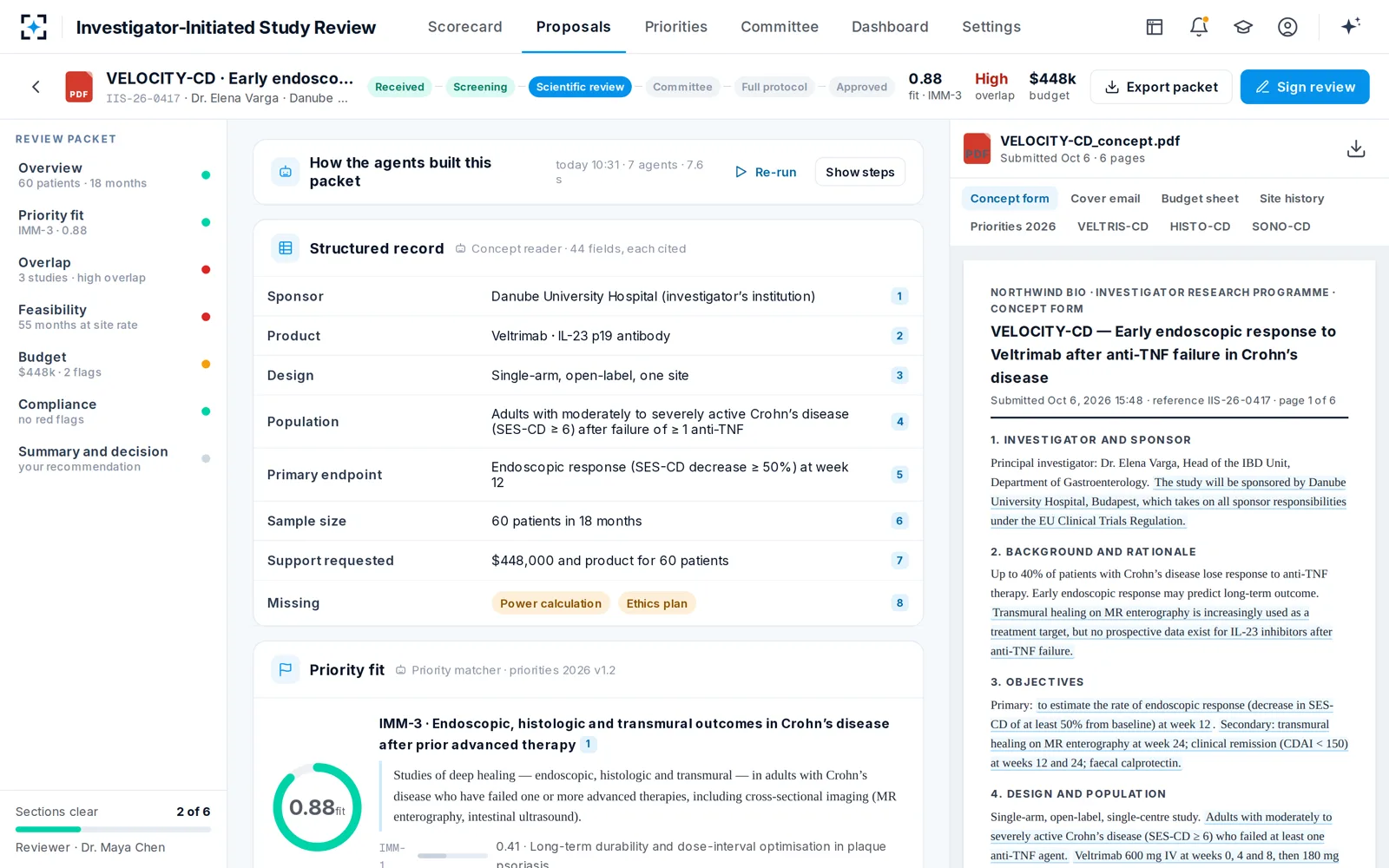
Tracking finds the overlap you already suspect. It does not find that a new concept asks the same question, in the same population, at the same timepoint, as your own registered phase 3b. Take a sample concept as it runs through the solution: VELOCITY-CD, a fictional single-arm study of early endoscopic response in Crohn's disease. The agents read it into 44 cited fields and named what was missing, a power calculation and an ethics plan. They scored it 74 before the overlap check. Then the overlap finder searched 412 studies in the sample registry, found the company's own phase 3b asking the same primary question, and the score fell to 62. That search is the subject of a page of its own on checking a concept for overlap.
The packet a reviewer opens: every field read from the documents, gaps named
Budgets follow the same pattern. Programmes are told to "require detailed budget breakdown to allow FMV calculations", and to base the analysis on "comparators, bench marking tool" agreed with compliance. The range is the input. Applying it to every line of every budget sheet, and to the overhead rate, is the work, and in the second generation a person still does it. The method behind that check is set out on the page on compliance and fair market value.
How to choose investigator-initiated study management software: start from where your days go
Choose by your bottleneck, not by the feature list. Take last cycle's concepts and split receipt-to-decision into stages, the measure the IIS community's own framework puts first: "time from submission to review decision". The stage that holds the most days tells you which generation of software would pay for itself, and which delay no software touches.
Where the days go decides what to buy
| Where the days go | What usually causes it | What fixes it |
|---|---|---|
| Screening and chasing what is missing | Concepts arriving by email, post and field hand-offs, incomplete | A portal with required fields; agents that name the gaps in the documents on receipt |
| Scientific review | Reviewers reading every document and checking overlap and budgets by hand, beside a full medical role | Agents that read, search and check, with every finding cited for the reviewer to confirm |
| Waiting for the committee | The meeting calendar | Cadence, not software: a monthly committee halves the average wait of a bimonthly one |
| The decision letter | Letters written from scratch, with care over what may be disclosed | A draft built from the signed decision, internal names removed, edited and sent by a person |
| Contracting after the yes | Negotiating terms afresh for each study | Master agreements and pre-agreed terms, which cut final negotiation by a mean of 33 days at 29 academic sites |
Two consequences are worth saying plainly to a buying committee. If most of your days sit in the committee wait, buy nothing until you have changed the meeting calendar. And if most sit in scientific review, a portal alone will not move them, because a portal routes the documents to the same reviewer who still has to read them. Botminds' Investigator-Initiated Study Review is aimed at that second case, and at the screening stage beside it; it leaves contracting and payments to the grants system you already run.
Twenty questions to ask any IIS software vendor
Ask every vendor, including Botminds, to answer on your own concepts, not on a demonstration set. The questions below are grouped by what they test: whether the software reads, whether its findings can be checked, whether it holds the compliance line, and what it costs to own.
Twenty questions that separate tracking from reviewing
- Show us a concept you have never seen, read into fields.
Which fields come from the documents, and which does the investigator type?
- Where does each field and score come from?
A finding without the passage behind it cannot be checked by a reviewer or an auditor.
- What does it do with a missing field?
It should say "missing", not fill the gap with a plausible value.
- Which priorities version did it score against?
Fit must use the approved, published priorities, and quote the one it relied on.
- Score against our rubric, with our weights.
And show what changes when a weight moves.
- Which sources does the overlap search cover?
Your own studies, studies you already fund, and public registries are three different searches.
- How is overlap compared?
Element by element (population, intervention, comparator, outcome, timepoint, region) or by keyword?
- Can investigators ever see our internal studies?
Overlap uses them; letters must never name them.
- Where does enrolment feasibility come from?
The site’s own history, or the number the investigator wrote?
- Which fair-market-value benchmarks, and who chooses the version?
Line by line, by country and cost item, with overhead tested against your cap.
- Can the software change an investigator’s budget?
It should not. The reviewer decides; the letter asks.
- How does it detect sales or marketing involvement?
Reading correspondence is different from a checkbox the investigator ticks.
- Who can clear a compliance red flag?
Only a person in compliance; and a held concept should not be ranked.
- What does a signature record?
Name, time and what the signer is attesting to, for the reviewer and for the chair.
- What is in the audit trail?
Every automated step, vote, signature, letter and settings change, with timestamps.
- Where are concepts processed, and are they used to train anything?
Proposals are confidential; NIH banned generative AI from its own peer review over exactly this.
- How do we validate it?
Ask for a method you can run on your past concepts, not only the vendor’s figures.
- Does it work beside our current portal?
Or does adopting it mean migrating intake, investigators and history?
- What feeds transparency reporting and drug supply?
Research payments are reported separately, by study, under Open Payments.
- What do we pay for, and what do we maintain?
Licences, configuration, benchmark updates and the people-hours each generation still needs.
Question 17 deserves the most time. The FDA's January 2025 draft guidance on AI "does not address the use of AI models … when used for operational efficiencies (e.g., internal workflows …)", so no regulator will validate an IIS review tool for you, and few teams have done it before: in the 2024 MAPS benchmark survey of 34 respondents, just ~10% used generative AI for medical evidence and education. The test method has to come with the software. A way to measure agreement with your committee, overlap recall and citation fidelity is set out on the page on measuring AI accuracy in IIS review.
What you need to start: inputs your programme already holds
Almost everything the agents need already exists as a document or a list somewhere in medical affairs. PhRMA's principles expect companies to publicly disclose "the general areas or types of studies that it does or does not support", so research priorities are usually written down. The committee has a rubric, compliance has fair-market-value benchmarks and an overhead cap, and clinical operations knows which sites enrolled what.
What Investigator-Initiated Study Review needs, in the form you probably hold it
Usual form: A published areas-of-interest page or slide per therapeutic area
Who owns it: Medical affairs leads per area; the version used is recorded with every score
Usual form: A scoring sheet, often in the committee charter
Who owns it: Committee chair; weights become a setting the committee can change
Usual form: A spreadsheet or a licensed benchmark set, by country and cost item
Who owns it: Compliance; the version in use is chosen in settings
Usual form: Clinical trial registry export; the portal’s list of supported studies
Who owns it: Clinical operations and the IIS programme manager
Usual form: Enrolment by site from past company and investigator studies
Who owns it: Clinical operations
Usual form: The last one or two cycles from the portal or the shared drive
Who owns it: IIS programme manager; used to test the agents before anyone relies on them
How long does it take to implement IIS software? Plan for one cycle
Plan the switch around your review calendar, not around a vendor's weeks: configure, test on past concepts, run one live cycle in shadow, then switch. The solution goes live once every quality check has passed, and it is shown on your own concepts first, so the useful unit is a review cycle. With quarterly windows, as in the sponsor calendar above, the back-test uses the cycle just decided and the shadow runs on the next one.
A one-cycle switch to Investigator-Initiated Study Review
A person decides
ConfigureProgramme lead, chair and compliance load the approved priorities, set the weights and thresholds, pick the benchmark version and name reviewers.
Agent
Back-test on past conceptsThe agents review the last cycle’s concepts as if they were new, with the committee’s decisions held back for comparison.
Never: decide anything; they score, search and draft
A person decides
Compare with what the committee decidedReviewers check each score, overlap and budget flag against the real outcome. Disagreements become setting or rule changes, written down.
Agent
Shadow one live cyclePackets are prepared for every concept in the live cycle while the committee decides the way it always has.
Never: send a letter or touch a budget
A person decides
SwitchThe chair and programme manager decide whether the cited packet becomes the committee’s working document from the next cycle.
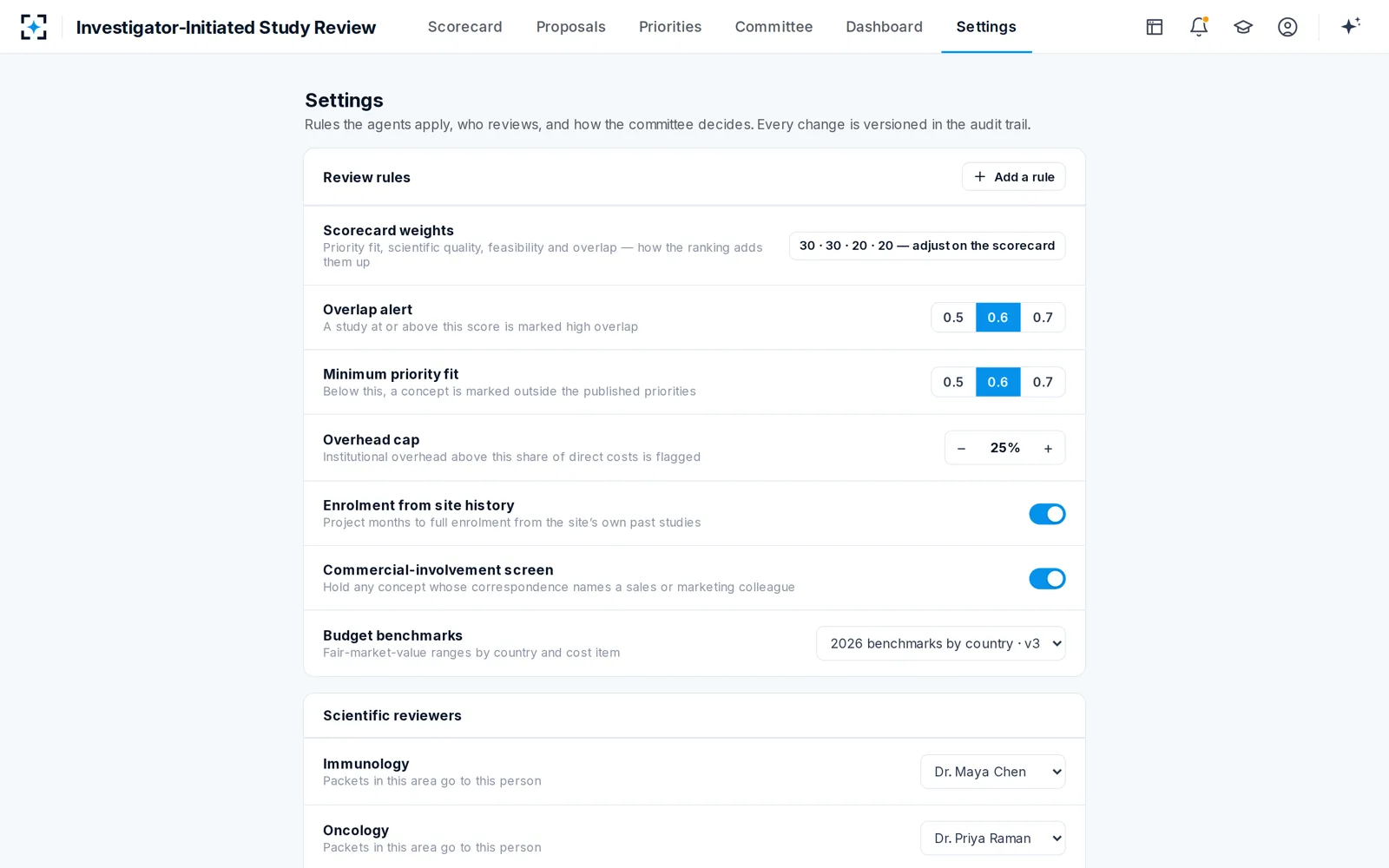
The settings are the configuration. Each one is a decision the committee already makes implicitly, now written down and versioned, which is what makes a back-test repeatable: change the overlap alert from 0.6 to 0.7, run the back-test again, and see which past concepts move.
Configuration is a short page of committee decisions, each versioned
Two caveats. The back-test runs on reviewers' time: someone has to score past concepts against what the agents prepared, and the scientific reviewers are usually medical directors with a full role beside IIS, so book it into review time they already have rather than on top of it. And decide in advance what agreement you need before switching, or the shadow cycle turns into an open-ended pilot. The economics of that decision are on the page on IIS programme ROI and KPIs.
Running agents beside the grants portal you already own
You do not have to replace a working portal. The portal stays the investigator's front door and the system of record for intake, contracts and milestones; the solution picks up concept forms, budget sheets and cover emails from it every 15 minutes, and sends the decision letter back through it. Concepts that arrive by email can be dropped in by hand, as PDF, Word, Excel or .eml files.
After the decision, everything flows back to the systems you already run
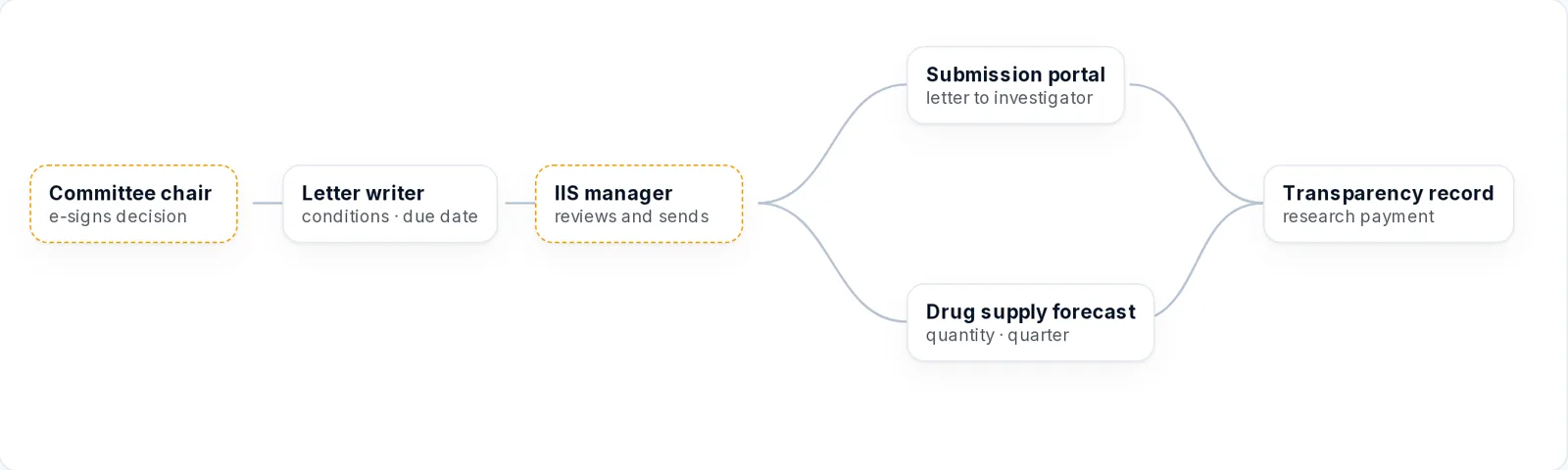
This division keeps the switch reversible. If a programme stops using the agents, intake, history and contracting are still in the portal, and the cited packets remain as records of what each committee saw. It also keeps the scope honest: after approval, the four milestone payments a typical IIS contract carries, from contract execution to the final report, stay with the portal and the contracts team.
What changes for each person on day one
The roles stay the same; the first hour of each review changes. Nobody's signature moves to software, and the committee still votes with a quorum. What disappears is retyping, chasing and the reviewer's solitary search for an overlap. The five people who carry a concept from the portal to the letter each get something different:
Day one in Investigator-Initiated Study Review, role by role
Today
Screens portal concepts, chases what is missing, builds the docket and writes letters.
With agents
Each concept arrives as a cited record with its gaps named; the docket fills as reviewers sign; the letter is drafted for her.
Still theirs: Assigning reviewers, editing and sending every letter.
Today
Reads each concept on top of a medical role and checks overlap from memory.
With agents
Opens a packet already scored and searched for overlap, with every finding cited.
Still theirs: Confirming every score, setting conditions, signing the recommendation.
Today
Signs decisions on packets of uneven depth.
With agents
Sees the cycle ranked on one scorecard, one page per concept, overlap shown.
Still theirs: The decision and its signature.
Today
Relies on someone noticing a sales colleague’s name in a cover email.
With agents
Receives every red flag the screener raises; review of that concept pauses.
Still theirs: Clearing or holding every flag.
The fifth person, in drug supply, stops learning what a study needs after the vote: product quantity and timing appear in each packet before it, for confirmation.
What each of the seven agents does, and what each is written never to do, is on the page about the agents in IIS review. To see the packet built on concepts from your own last cycle, start from Investigator-Initiated Study Review.
Questions people ask
Is IIS software the same as grants management software?
It overlaps but is not the same. Grants management handles applications, approvals and payments for many kinds of support; IIS review also has to judge study design, enrolment feasibility, overlap with clinical programmes and drug supply, under research-specific compliance rules. That is why a programme can run IIS intake on a grants platform and still do the review by hand beside it.
What is the best software for investigator-initiated studies?
The one that removes your largest stage of days, and no independent comparison exists to say which product does that: what is published about IIS software is vendor material, and no company publishes its own IIS cycle times. Measure your stages first, then ask each vendor to run your last cycle and show the days it removes.
Do we need a large IIS programme to justify agents?
The case grows with volume and with the number of therapeutic areas, because overlap and priority fit get harder to hold in one head. A mid-size company might receive 150 to 250 concepts a year across three or four cycles, which is our estimate, not a benchmark. Run the back-test on your own last cycle and judge from that.
Does it handle contracts and milestone payments after approval?
No. Investigator-Initiated Study Review runs from the concept received to the signed decision and the letter, and updates the drug supply forecast and transparency record when the letter is sent. Contracting, milestones and financial reconciliation stay in the systems that handle them today.
Can an investigator see why a concept was declined?
The letter states the decision and any numbered conditions in plain words, with internal study names removed by a policy check before it is sent. The cited packet behind it stays internal to the company.