To check for duplicate clinical trials before funding an investigator-initiated study (IIS) concept, search three sources: the company’s own studies, the investigator studies it already funds, and the public trial registries. Compare the concept with each candidate on six elements: population, treatment, comparator, outcome, timepoint and region. Then ask two more questions. When will the closest study read out? And what would this concept add that no other study measures? A concept that matches on population, outcome and timepoint asks a question that is already being answered.
One sample concept, checked against 412 studies
412
studies searched in three sources
96 company · 61 funded · 255 registry
3
studies ask part of the same question
0.86
overlap with the closest, the company’s own phase 3b
62was 74
score out of 100 once overlap counts: seventh to last of nine
The check is easy to describe and hard to do. A medical affairs committee reviews concepts from outside researchers several times a year, and the reviewers are medical directors who carry the work on top of a full medical role. They judge scientific merit and fit with the published research priorities well. Whether the question is already being asked usually rests on someone’s memory of the portfolio. Botminds built Investigator-Initiated Study Review to make that check a method: agents search every source, compare each candidate element by element, and cite both passages, while people decide.
This page shows how the method works, using a sample concept as it runs through the solution. VELOCITY-CD is a fictional proposal from an inflammatory bowel disease unit in Budapest: a single-arm study of Veltrimab, an IL-23 antibody, in 60 patients with Crohn’s disease after anti-TNF failure, with endoscopic response at week 12 as the primary endpoint. The company, the drug, the studies and the people are invented. The method is not.
Why overlap is the check IIS review most often misses
Overlap gets missed because no single reviewer can see all three places a duplicate hides, and none of the usual review criteria forces the search. A scientific reviewer reads the concept form and judges the design. A programme manager checks completeness and budget. A committee compares concepts with each other. None of these steps puts the concept beside the company’s registered phase 3b, the investigator studies funded last year and the 255 public trials in the same disease.
The profession knows the risk. A Medical Affairs Professional Society (MAPS) presentation on managing the IIS life-cycle tells companies to “limit overlap with Company sponsored strategy/studies”, adds that they “should try to not have patient overlap as well”, and lists among its review principles a “good tracking system necessary to identify overlap”. The same deck notes that rolling submissions “could lead to greater number of similar trials”, while fixed windows minimise trials that are duplicative, because all proposals are compared together.
The stakes are higher than wasted money. The US Office of Inspector General lists duplication among the signs that research support is really a payment for business:
“Indicia of questionable research include … research that is unnecessarily duplicative or is not needed by the manufacturer for any purpose other than the generation of business.”
HHS Office of Inspector General, Compliance Program Guidance for Pharmaceutical Manufacturers, 2003
So a committee that funds a study duplicating its own trial has spent research money on a known answer, and it has created a file that is hard to defend. Overlap is a scientific question with a compliance edge, which is why the compliance and fair-market-value checks and the overlap check belong in the same packet.
There is a third cost: patients. A concept that recruits the same population as a running company trial at the same hospital competes with it for the same people. Recruitment is already the weak point of investigator-sponsored work. Across 1,017 randomised trials approved by six ethics committees, those sponsored by investigators were discontinued for poor recruitment far more often than industry-sponsored ones, 26.5% against 8.4%.
Three places a duplicate hides: your pipeline, your funded studies, the registries
A complete overlap check searches the company’s own studies, the investigator studies it already supports, and the public registries, because each source holds questions the others miss.
- Company studies. The registered trials and the ones still in planning. A planned study is not public yet, so only an internal search finds it. It is also the overlap with the sharpest consequence, because the company is about to answer the question itself.
- Funded investigator studies. Studies the programme supported in earlier cycles, often in another therapeutic area team or another country. These are the duplicates a committee approves twice without noticing.
- Public registries. ClinicalTrials.gov, the EU Clinical Trials Information System (CTIS) and the other registries the WHO International Clinical Trials Registry Platform gathers. They hold other companies’ trials and other academic groups’ work, including studies on a competitor’s drug in the same population.
Registries are now complete enough to search seriously. ICH E6(R3) states that the “transparency of clinical trials includes timely registration on publicly accessible and recognised databases”. In the EU, every trial approved under the old Directive that was still running had to be recorded in CTIS from 31 January 2025. And industry-supported investigator studies are there in volume: a query we ran on ClinicalTrials.gov counts 28,570 interventional studies with an academic or hospital lead sponsor and an industry collaborator, a proxy that undercounts, since companies need not be listed (ClinicalTrials.gov API).
Search the registry, not just the literature. In a cohort of 691 trials, 19% of those with results had published them only in a registry, and a literature search alone would miss them. And many trials that are running have no results anywhere yet, which is exactly when an overlap matters most.
Investigator-Initiated Study Review: the scorecard after the overlap check
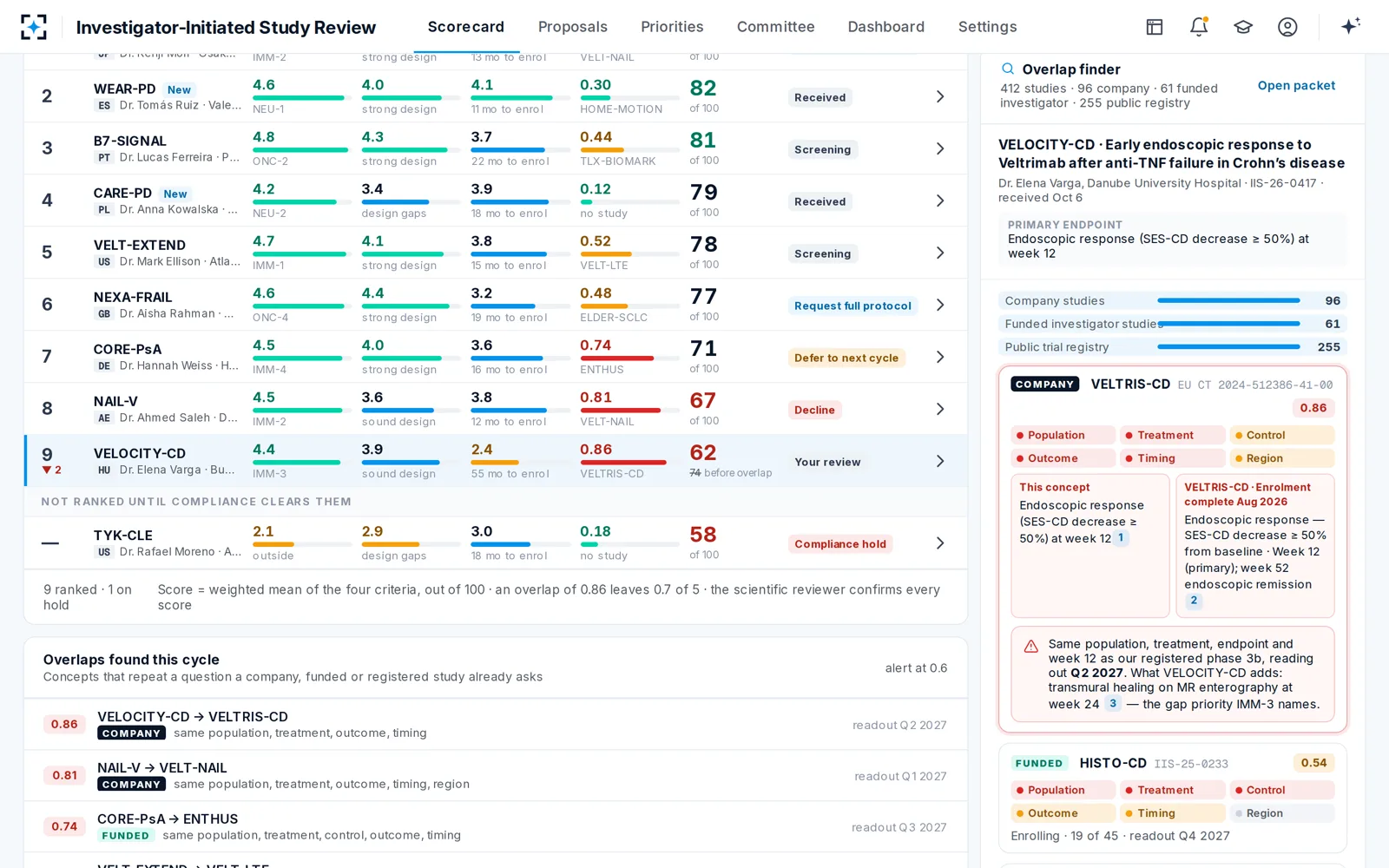
The concept moves from seventh to ninth on the scorecard without anyone re-scoring it by hand. Below the table, the cycle’s other high overlaps are listed with the date each existing study reads out.
How to search ClinicalTrials.gov, CTIS and the WHO ICTRP for similar trials
Search by condition and intervention rather than by title, in all three registries, and then read each candidate’s primary outcome and its time frame. Titles are written for recruitment, not comparison: two trials of the same question can share no words in their titles, and two with near-identical titles can measure different things at different weeks.
- Name the product every way it is named. The international non-proprietary name, any brand, the development code and the drug class, because early-phase and investigator records often carry only the code. Add the competitor products of the same class: a study of another IL-23 antibody in the same population answers much of the same question.
- Switch the status filters off. Include trials not yet recruiting, recruiting, active and completed without results. The trials that matter most for overlap are the ones still running, which a results or publication search never finds.
- Search all three, then deduplicate. ClinicalTrials.gov, the EU Clinical Trials Information System and the WHO International Clinical Trials Registry Platform, which gathers national and regional registries, so one trial can appear more than once under different numbers. Treat matching secondary identifiers and sponsors as the same trial.
- Read four fields, not the summary. The eligibility criteria, the arms, the primary outcome measure with its time frame, and the primary completion date. Those four decide whether the question is the same and when it will be answered.
- Keep the search. Record the terms, registries and date, so the next reviewer can re-run it before the contract is signed, when a newly registered trial can still change the answer.
Step three is harder than it looks. Analysing 285,000 registry records, van Valkenhoef, Loane and Zarin estimated that 45% of duplicate registrations go undetected; in their review the title field discriminated duplicates best, and identical secondary identifiers under the same sponsor were a strong signal. A reviewer who counts every hit as a separate trial overstates how crowded a question is, and one who merges too eagerly loses a study.
The six elements that decide whether two studies ask the same question
Two studies ask the same question when they share population, treatment, outcome and timepoint. Comparator and region decide how much the second study would still add. The six elements extend the PICO framework that systematic reviewers use (population, intervention, comparator, outcome) with the timepoint and the region, and both matter in IIS review. An endpoint at week 12 and the same endpoint at week 52 are different questions. A study in one Hungarian hospital may add evidence a nine-country trial cannot, or may simply recruit the same patients.
Each element is judged as same, partly the same or different, and each judgement cites the passage it rests on in both documents. That last requirement is what turns a reviewer’s impression into something a committee can check.
VELOCITY-CD against its three closest studies, element by element
Read the rows and the method explains itself. VELTRIS-CD, the company’s own phase 3b, matches on population, treatment, outcome and timepoint: the same entry criteria, the same dosing, an SES-CD decrease of at least 50% at week 12. Its placebo induction phase and its nine-country footprint make two cells “partly”, and neither changes the question being asked. HISTO-CD, a study the programme already funds, shares the population, drug and single-arm design, but measures histologic remission at week 24, a different outcome at a different time. SONO-CD, another company’s trial found in a public registry, shares only its single-arm design outright.
One detail from the packet matters more than any cell. The concept’s own hospital was one of VELTRIS-CD’s sites. The unit proposing the study has already enrolled patients into the company’s trial of the same question. That is common, and it is not bad faith: investigators propose what they know. It is also exactly the overlap that memory misses, because the reviewer knows the trial and not the site list.
How to measure overlap between two clinical trials: a score from 0 to 1
An overlap score turns the six judgements into one number from 0 (nothing shared) to 1 (the same study), and an alert threshold decides which concepts a reviewer must look at before anything else. In the solution the default alert sits at 0.6, and the committee can move it to 0.5 or 0.7. Every change is versioned in the audit trail.
Where to set the alert is a judgement about how many near-misses a committee wants to see. Plotting a whole cycle shows what the choice does.
The whole cycle on one overlap scale: where the alert falls changes what reviewers see
In this cycle the default does what it should. The three concepts above 0.6 each repeat most of a question an existing study already asks, and the reviewers’ recommendations on screen reflect it: decline for NAIL-V (0.81 against a company study) and deferral to the next cycle for CORE-PsA (0.74 against a funded study). Lowering the alert to 0.5 adds one concept, VELT-EXTEND at 0.52. A committee that prefers to see near-misses can live with one extra flag a cycle. A committee that sets the alert at 0.7 or higher should check what slips under it.
How overlap moves the score
An alert names the concept. The score decides where it ranks. On the scorecard, overlap is one of four criteria alongside priority fit, scientific quality and feasibility, weighted 30 · 30 · 20 · 20 by default. Overlap counts against a concept as 5 × (1 − overlap) on the same 1-to-5 scale as the others, so an overlap of 0.86 leaves 0.7 of 5.
For VELOCITY-CD, priority fit 4.4, quality 3.9 and feasibility 2.4 give a weighted mean of 3.71, or 74 out of 100: seventh of nine. Adding the overlap criterion at 0.7 brings the mean to 3.11, or 62: last. The concept did not get worse. The committee learned something about it. If the committee raises the overlap weight to 40%, VELOCITY-CD falls further, to 54, and the rest of the list re-orders live.
When each study answers: readout timing turns overlap into a decision
Overlap alone does not decide a concept. Timing does. The useful question is whether the new study could answer before the existing one, or would only confirm a result already published. “Publication Timing” is one of the review criteria in the MAPS deck, and the overlap grid shows each candidate’s expected readout next to the concept’s own projected one.
VELTRIS-CD answers the question years before VELOCITY-CD could
- To readoutQ2 2027
- To readoutQ4 2027
- To readoutQ3 2028
- Start-up7 mo
- Enrolment18 mo
- Wk 123 mo
- Start-up7 mo
- Enrolment at 1.1 a month55 mo
- Wk 123 mo
Even on its own requested timetable, VELOCITY-CD would answer its primary question nearly two years after VELTRIS-CD. At the 1.1 patients a month this site actually enrolled in earlier studies, the gap stretches to about five years. The enrolment forecast from the site’s own history is a separate check, but here the two compound: a slow duplicate is the weakest possible case.
The calendar also shows when timing would rescue a concept. If the closest study were three years from readout and the concept could answer in eighteen months, a high overlap might argue for funding it, as an early signal. Overlap and readout have to be read together.
From decline to reshape: naming what the concept adds
The most useful output of an overlap check is not the score but the sentence that follows it: what this concept would add that no other study measures. A high overlap with a good investigator, a good site and an on-priority idea is often a study in the wrong shape rather than a bad study. Naming the addition lets the committee ask for the right study instead of declining.
For VELOCITY-CD, the packet names it: transmural healing on MR enterography at week 24. The concept already measures it, but only as a secondary endpoint. VELTRIS-CD does not measure it at all. HISTO-CD looks at tissue, not the bowel wall. SONO-CD measures transmural response, but by ultrasound, at week 16, with a different drug. And the company’s published research priority for Crohn’s disease, IMM-3, asks specifically for transmural outcomes.
Research priorities, with the studies already answering each one
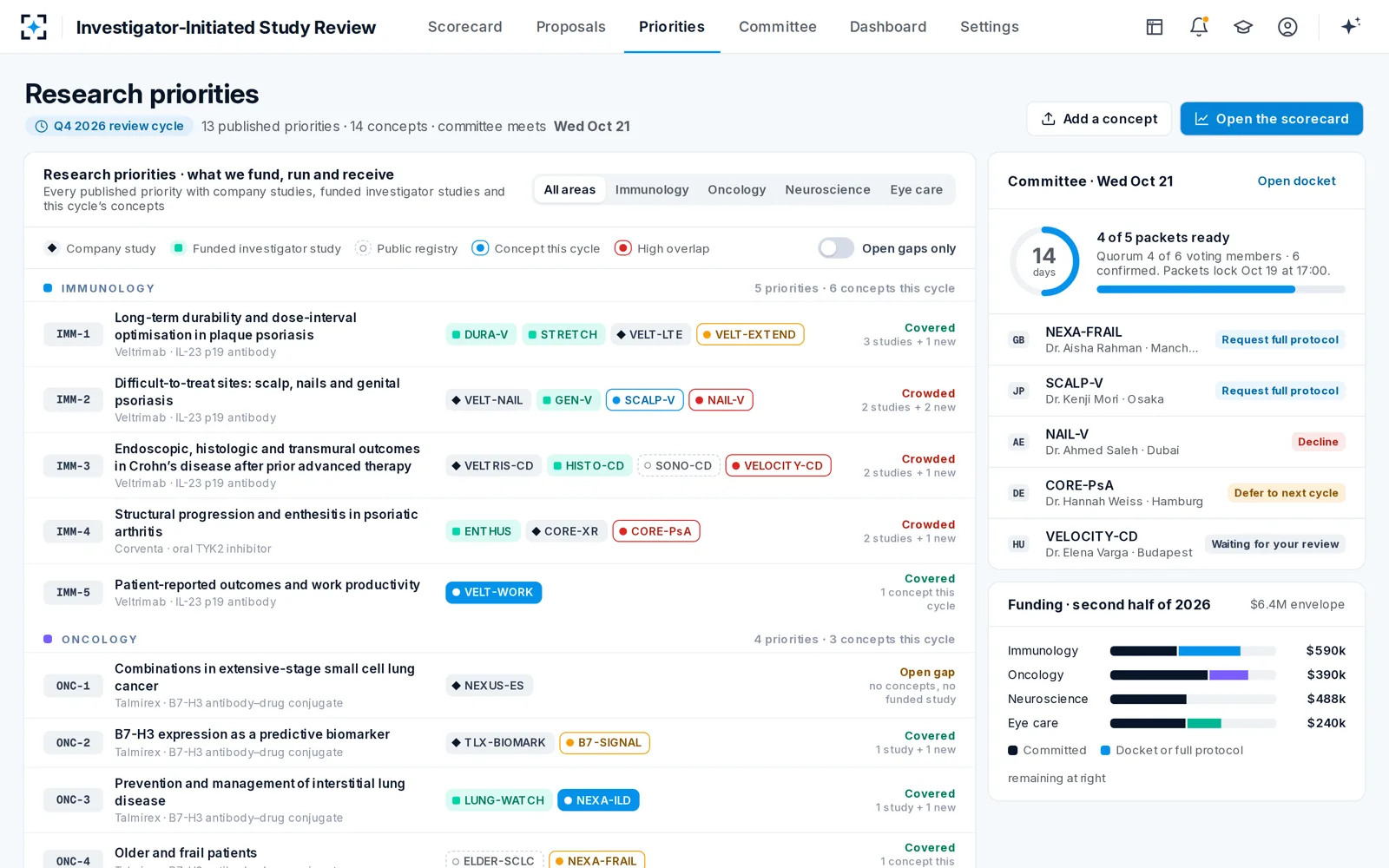
The same map that shows a crowded priority shows the empty ones, which the medical science liaison team can share as published areas of interest. Overlap and gaps are two views of one portfolio.
The scientific reviewer turned the addition into the first condition of her recommendation: make transmural healing at week 24 the primary endpoint. The committee voted to request a full protocol with that condition and three others. The investigator gets a better study than she proposed, the company gets evidence it does not have, and nobody funds a second answer to the week-12 question. How the reasons reach the investigator, and why the letter matters, is the subject of the page on how a committee scores and decides each concept.
Reshaping is not always possible. NAIL-V matches its closest company study on five of six elements, and its reviewer recommends a decline. But a committee that only ever sees “high overlap” declines everything above the line. A committee that sees “high overlap, and here is what it would add” can reshape the ones worth keeping.
Keeping internal studies internal
A sponsor must search its unpublished studies to find overlap, and it must never tell an investigator what they are. Planned trials, protocol details and internal study codes are confidential. Yet the most decisive overlap is often with exactly those. The method has to use internal information to reach a decision and keep it out of the explanation.
Both sides of every match are cited, and the internal side stays internal
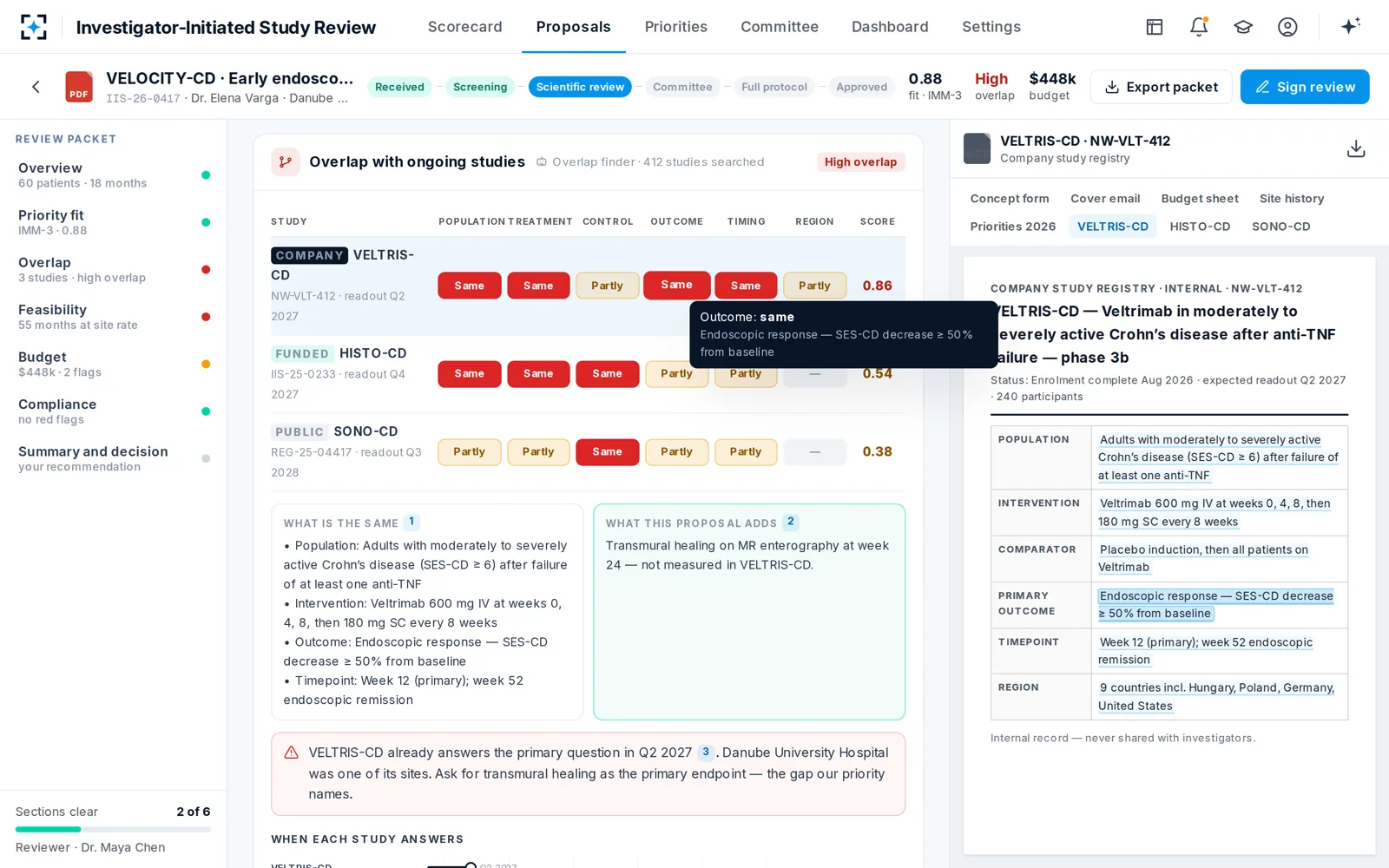
In the solution this is built into three places. The overlap finder searches internal studies but labels them as internal wherever they appear. The letter to the investigator is drafted from the signed decision and its conditions. And before the programme manager can send it, a check removes internal study names and confirms the wording is plain. The investigator reads “make transmural healing on MR enterography at week 24 the primary endpoint”. She does not read the name of the trial that made it necessary.
The letter asks for the reshaped study without naming the study behind it
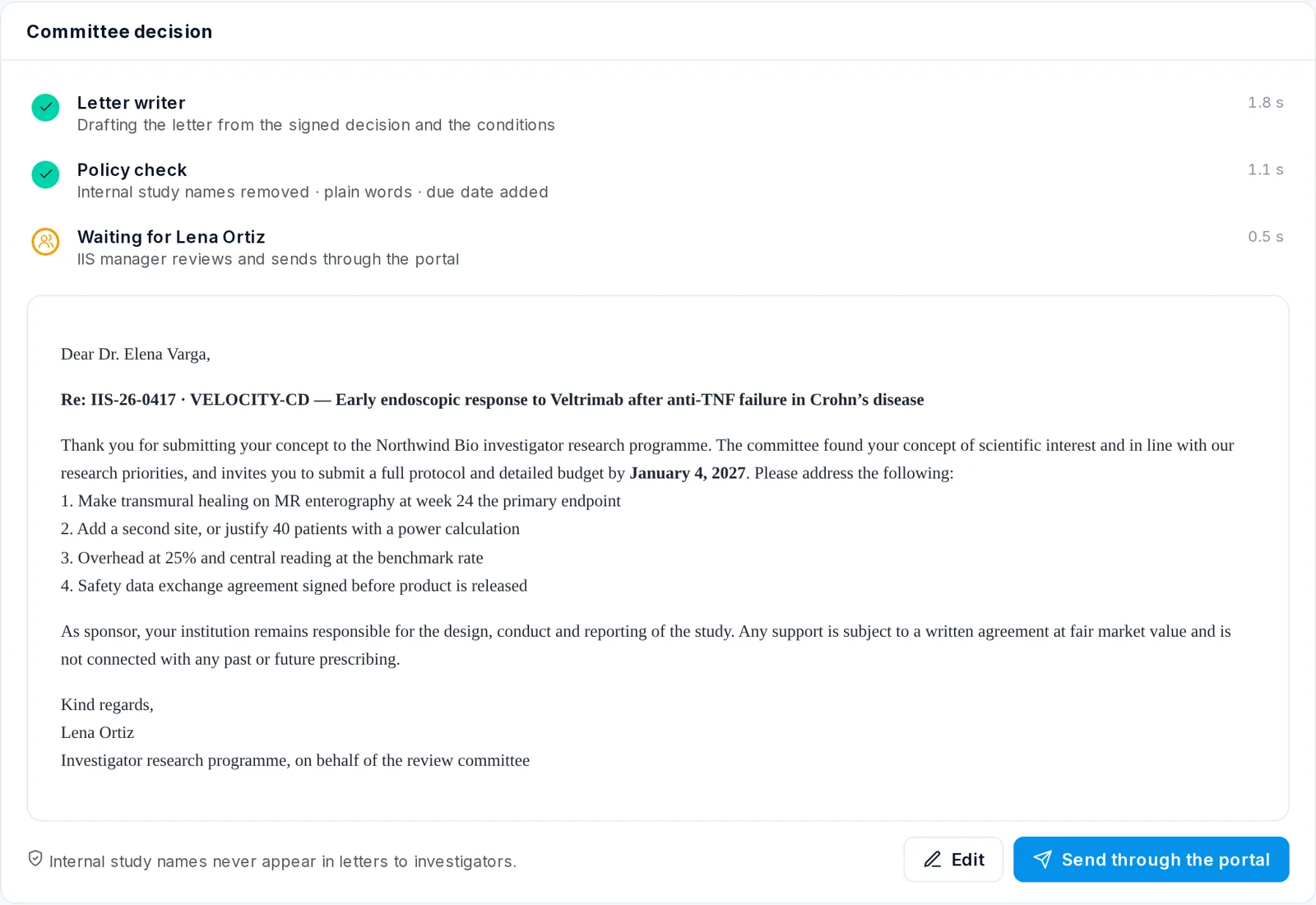
There is a judgement call here. Telling an investigator “a similar study is under way” is often fair and useful, and a public registry study can be named freely. What the method prevents is the accidental disclosure, a pasted reviewer note that names an unpublished company trial. The rule is simple to state and easy to break by hand.
An overlap check any IIS committee can run
The method needs no software to understand. It needs discipline and a portfolio that can be searched. A committee can start applying it at its next cycle.
Checking a study concept for overlap, step by step
- Search all three sources, every time
Company studies including those still in planning, funded investigator studies from every area, and the public registries.
- Extract the six elements from the concept first
Population, treatment, comparator, outcome, timepoint, region, each with the page it came from. Missing elements are a finding.
- Judge each element same, partly or different
And cite the passage on both sides. A match nobody can trace is an opinion.
- Test population, outcome and timepoint first
If all three match, the question is the same; comparator and region only decide what is left to add.
- Check the site lists, not just the protocols
An investigator proposing a study may already be enrolling the same patients in yours.
- Put readout dates side by side
A duplicate that answers years later confirms; one that answers first may be worth funding.
- Write down what the concept adds
One sentence. It is the basis of a reshape condition, and of a fair decline when there is nothing.
- Keep internal studies out of the letter
Use them to decide; explain the decision in terms of the question, not the confidential trial.
By hand, each of these steps costs hours per concept, and the search is the part that gets cut when the docket is full. In Investigator-Initiated Study Review, one agent among seven does the search and the comparison and cites both sides; the page on the seven agents describes what it may and may not do. A scientific reviewer reads its findings, confirms or changes the score, and signs. Whether an agent finds the overlaps a reviewer would have found is a question to measure before trusting it, and the page on measuring an AI review sets out how to test overlap recall against a cycle you have already decided.
Questions people ask
What is PICO, and why add timepoint and region?
PICO (population, intervention, comparator, outcome) is the frame systematic reviewers use to state a clinical question. It misses two things a funder needs: two trials with the same outcome at week 12 and week 52 answer different questions, and a study in a region the pivotal trials skipped can add evidence a regulator or payer there will ask for.
Does overlap with a competitor’s trial count?
Yes, for the science: if another company’s registered trial will answer the same question in the same population first, a new study mostly confirms it. The OIG’s warning about research that is “unnecessarily duplicative” does not say whose trial is duplicated, and a competitor’s trial, being public, can be named in the letter.
Is a high overlap always a reason to decline?
No. It is a reason to look at timing and at what the concept adds. If the new study would answer earlier, or could be reshaped around an outcome no other study measures, the committee can request a full protocol with conditions instead of declining.
Should the investigator be told which study overlaps?
A public study can be named, and doing so helps the investigator. An unpublished company study should not be. The decision letter can still explain what to change, by asking for the different endpoint or population, without naming the trial that prompted it.
Why can’t registries alone settle the question?
Because the most decisive overlaps are often with studies no registry shows yet: a sponsor’s planned trials and its funded investigator studies before registration. And registered trials report late. On ClinicalTrials.gov, only 40.9% of trials due to report results did so within the one-year deadline, so a running trial’s entry often shows the question without the answer.