Grant review software earns its place on an investigator-initiated study committee only if it lets the committee rank a whole cycle fairly, and a committee ranks a cycle well only when every concept is scored on the same criteria, from the same depth of evidence, on one sheet, with weights the committee has agreed in advance. Investigator-initiated studies (IIS, also called investigator-sponsored research or ISR, and externally sponsored research or ESR) are designed and sponsored by independent investigators; the company decides whether to support them with funding or drug. Medical affairs receives the concepts, a scientific reviewer appraises each, and a cross-functional committee decides. What usually breaks is comparison: each concept arrives at a different time, is read by a different reviewer and reaches the room in a packet of a different depth. Most grant review tools route applications and collect reviewers’ scores; they do not read a concept, search for overlapping studies or test a budget against fair market value. Botminds built Investigator-Initiated Study Review to do that preparation, so the comparison holds.
In the solution, seven AI agents read each concept, score it on four criteria, search for studies that already ask the same question and assemble a cited one-page packet; people confirm the scores, vote and sign. This page follows one quarter through it. Take a sample company's Q4 2026 cycle: Northwind Bio, its products, investigators, hospitals and studies are all fictional, as is every figure that describes them.
The sample Q4 2026 cycle, two weeks before the committee
10open
concepts this cycle, plus 4 decided at the previous meeting
Sample data
412
studies searched for overlap with each concept: company, funded and public registry
Sample registry size
5
packets on the docket for Wednesday 21 October
Packets lock Oct 19, 17:00
4of 6
voting members needed for a quorum; drug supply and compliance attend without a vote
Why a committee should see the whole cycle at once
Because a concept's merit is partly relative: to the company's priorities, to the budget for the period and to the other concepts asking for it. Programmes run on one of two calendars. In a window model, a cross-functional committee "reviews all proposals together with a set budget"; in a rolling model, concepts are accepted all year and decided as they arrive, one presentation to the Medical Affairs Professional Society sets out.
The same deck sets out the trade-off. Windows let a committee compare everything at once and minimise duplicative trials, at the price of "all eggs in one basket". Rolling review answers investigators sooner but invites near-identical studies. Even the rolling model batches the money: in the version the deck describes, a brief application gets a "decision provided with 45 days of submission" but "no funding decisions", which wait for "quarterly review meetings".
Window submissions: "Ensures comparison of all submitted proposals together." Rolling submissions: "Could lead to greater number of similar trials."
Saberwal and Mena, Medical Affairs Professional Society, 2018
A ranked cycle is the practical form of the window model's advantage. It is only as good as the scores behind it, which is why the rubric matters more than the ranking.
What should grant review software do for an IIS committee?
It should prepare the evidence each criterion needs, not only collect the scores. Grant review tools are built mostly for foundations and public funders, where the work is routing applications to a panel, recording conflicts of interest and averaging scores. An IIS committee needs all of that and six things more, because its applicants propose clinical studies of the company's own product, under anti-kickback rules, against a pipeline the applicant cannot see.
Grant review software, and what an IIS committee needs on top
| Step | A typical grant review tool | What an IIS committee also needs |
|---|---|---|
| Intake | An application form and a portal | The concept form, budget sheet and cover email read into fields, each cited, with missing items named on receipt |
| Reviewers | Assigned by panel, with conflict-of-interest declarations | A reviewer per therapeutic area, plus compliance and drug supply in the room without a vote |
| Scores | A form each reviewer fills in | Scores prepared from the evidence, each citing its passage, and confirmed by the reviewer |
| Novelty | Usually none, or a text-similarity check | Overlap with the company’s own studies, its funded studies and the registries, with internal names kept internal |
| Ranking | A sorted list of averages | Weights the committee owns, versioned, with the re-ranking visible before the meeting |
| Budget | The requested amount recorded | Each line against a country benchmark and the overhead cap |
| Compliance | Conflict-of-interest forms | A screen of the correspondence for sales involvement and links to prescribing, held until compliance clears it |
| Decision | An approval step | Signatures that state what each signer attests, and a letter drafted from the signed decision |
The fastest way to test a product against that column is to give it a past cycle whose outcome you know: the concepts, the budgets and the cover emails as they arrived. Watch whether it finds the duplicate you declined, flags the budget line you cut and holds the concept compliance stopped. The rest of this page is that test, run on one sample quarter. How to score such a trial run is set out in how accurate AI grant review is, and how to measure it; how the software compares with spreadsheets and grants portals is in investigator-initiated study management software compared.
How do review committees score proposals? A four-criterion IIS rubric
On a fixed rubric, scored before the meeting. The sample committee scores every concept on four criteria, each on a 1 to 5 scale, and combines them with weights of 30, 30, 20 and 20. Priority fit and scientific quality carry the most weight; feasibility and overlap carry the rest. The score out of 100 is the weighted mean times 20.
Two choices in this rubric are worth copying. First, overlap is scored as a penalty, not a bonus for novelty: a concept that repeats a question someone is already answering loses points in proportion to how closely it repeats it. That puts a number on what HHS-OIG's compliance guidance lists among the indicia of questionable research: research "that is unnecessarily duplicative". Second, feasibility is projected from the site's own enrolment history, not from the rate the investigator requests. Investigator-sponsored trials were discontinued for poor recruitment far more often than industry-sponsored ones, 26.5% against 8.4% in a cohort of 1,017 randomised trials.
The Investigator-Initiated Study Review rubric, scored on one concept
Fit to a published research priority, 0 to 1, times 5
0.88 to priority IMM-34.4 of 5
1 to 5 on the committee rubric: question, endpoint validity, design fit, sample-size justification, analysis plan
Single arm, validated endpoint, power calculation missing3.9 of 5
1 to 5, from months to full enrolment at the site’s own past rate
1.1 patients a month: about 55 months for 602.4 of 5
Counts against: 5 × (1 − overlap), where overlap runs 0 to 1
0.86 with the company’s own phase 3b0.7 of 5
Score = weighted mean of the four criteria × 20 → 74 62 of 100
Every score cites the passage behind it: the concept form for the endpoint, the site's history for the enrolment rate, the registry record for the overlap, the published priorities document for the fit. A scientific reviewer confirms each before it counts. The rubric's anchors are what let two reviewers in different therapeutic areas produce scores that can sit on one sheet.
The scorecard: the whole cycle ranked, one concept held below the line
The scorecard puts the whole cycle on one screen, ranked by score, with the four criteria visible for every row. On the morning of 7 October, eight concepts are scored and ranked: SCALP-V leads at 85, two more score above 80, and the bottom of the list is held down by overlap. VELOCITY-CD, received the day before, is marked new and not yet scored.
The Q4 2026 cycle on one Investigator-Initiated Study Review scorecard
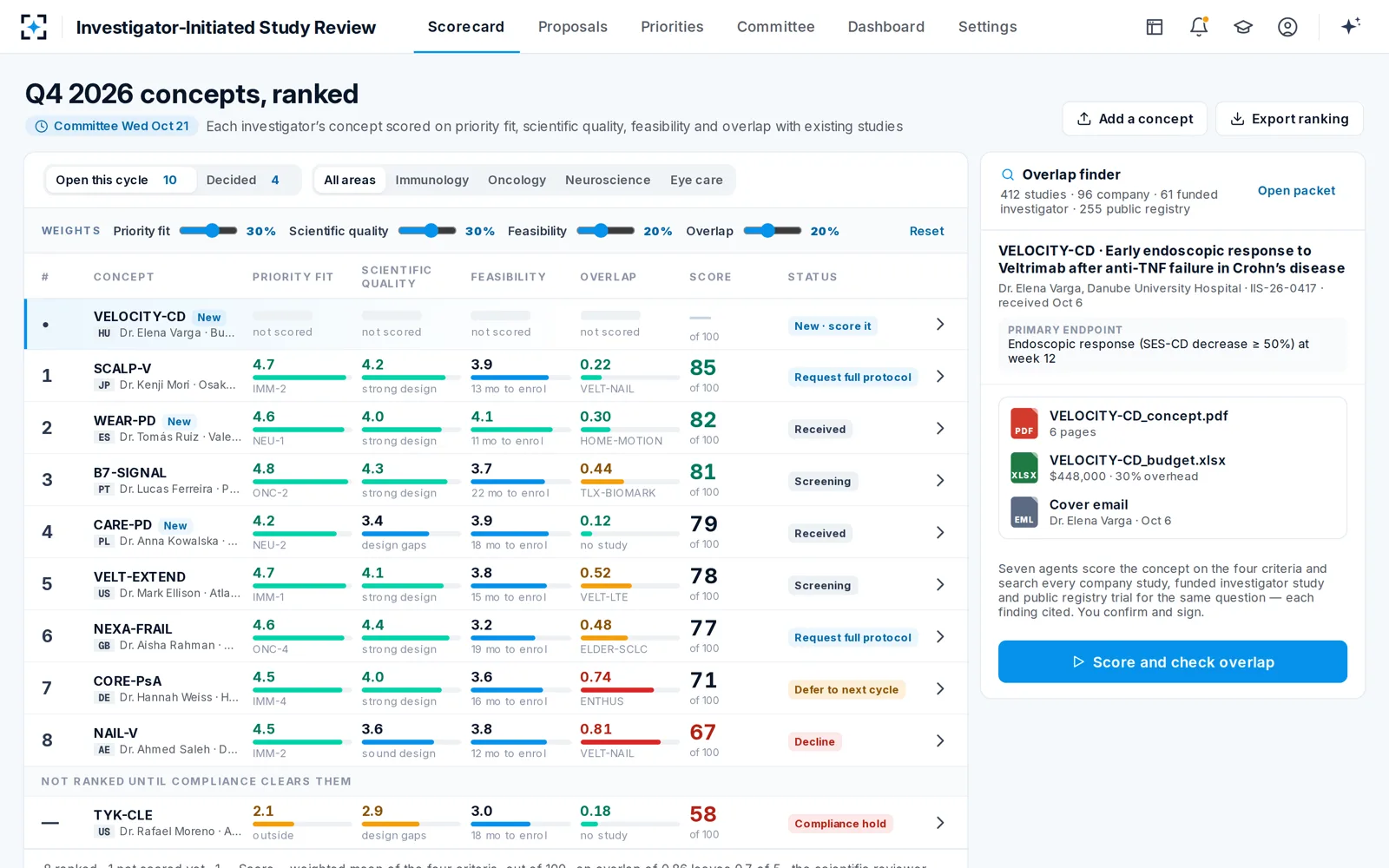
One concept, TYK-CLE, sits under the line: the compliance screener held it because a sales colleague is named in its cover email. A held concept is not ranked and no decision is taken on it until compliance clears or holds the flag.
The held concept is a design decision worth naming. OIG's guidance says manufacturers "should insulate research grant making from sales and marketing influences". Ranking a concept with an open red flag would put it into the funding conversation before that question is answered. Putting it below the line keeps it visible without letting it compete.
How one concept moved from 7th to last
VELOCITY-CD dropped from 7th to 9th when the overlap search found the company's own registered study asking the same question. Dr. Elena Varga of Danube University Hospital proposed to measure early endoscopic response to Veltrimab in 60 patients with Crohn's disease after anti-TNF failure, asking for $448,000. Scored on fit (4.4), quality (3.9) and feasibility (2.4), it reached 74 and ranked 7th.
The overlap finder then searched 412 studies and found VELTRIS-CD, the company's phase 3b, with the same population, treatment, primary endpoint and week-12 timepoint, reading out in Q2 2027. Overlap 0.86 left 0.7 of 5, and the concept fell to 62. The search also named what the concept would add: transmural healing on MR enterography at week 24, which is exactly the gap that priority IMM-3 describes. The element-by-element comparison is set out in how to check a study concept for overlap; the 55-month enrolment projection behind its feasibility score is in forecasting enrolment from the site's own history.
Last place did not mean decline. It meant the committee would see, on one page, that the question as asked is already being answered and the question worth asking is a different one.
How to rank proposals with weighted scores, and what moving a weight does
Changing a weight re-ranks the middle of the list far more than its ends. When the sample committee drags the overlap weight from 20 to 40, every score is recomputed. The leader stays the leader, the three high-overlap concepts each lose eight points but were already at the bottom, and the four concepts in the middle swap places in pairs.
Raising the overlap weight from 20 to 40 reorders the middle of the list
Two lessons follow for a committee chair. First, weights are policy, not a tuning knob: they decide which of two concepts of similar merit is funded when the envelope runs out, and in this cycle that line would fall in the middle of the list. In the solution, each weight change is versioned in the audit trail and Reset returns the committee default. Second, test the weights before the meeting, not during it. A ranking that changes when someone moves a slider in the room invites the question of which ranking the committee actually agreed to.
What should a committee review packet include?
A chair needs four things on one page: the reviewer's signed recommendation, a short summary in which every claim is cited, the criteria scores and the flags. For VELOCITY-CD, the packet writer drafted a summary of at most 180 words with seven citations and proposed four conditions. Dr. Maya Chen, the medical director acting as scientific reviewer, kept all four and signed on 7 October at 10:35. The signature dialog states what she is attesting: "I reviewed this proposal and its cited evidence and make this recommendation to the IIS review committee."
The four conditions turn a last-ranked concept into one the committee could fund: make transmural healing at week 24 the primary endpoint; add a second site or justify 40 patients with a power calculation; bring overhead to 25% and central reading to the benchmark rate; and sign a safety data exchange agreement before product is released.
The committee's view: the docket and one packet per concept
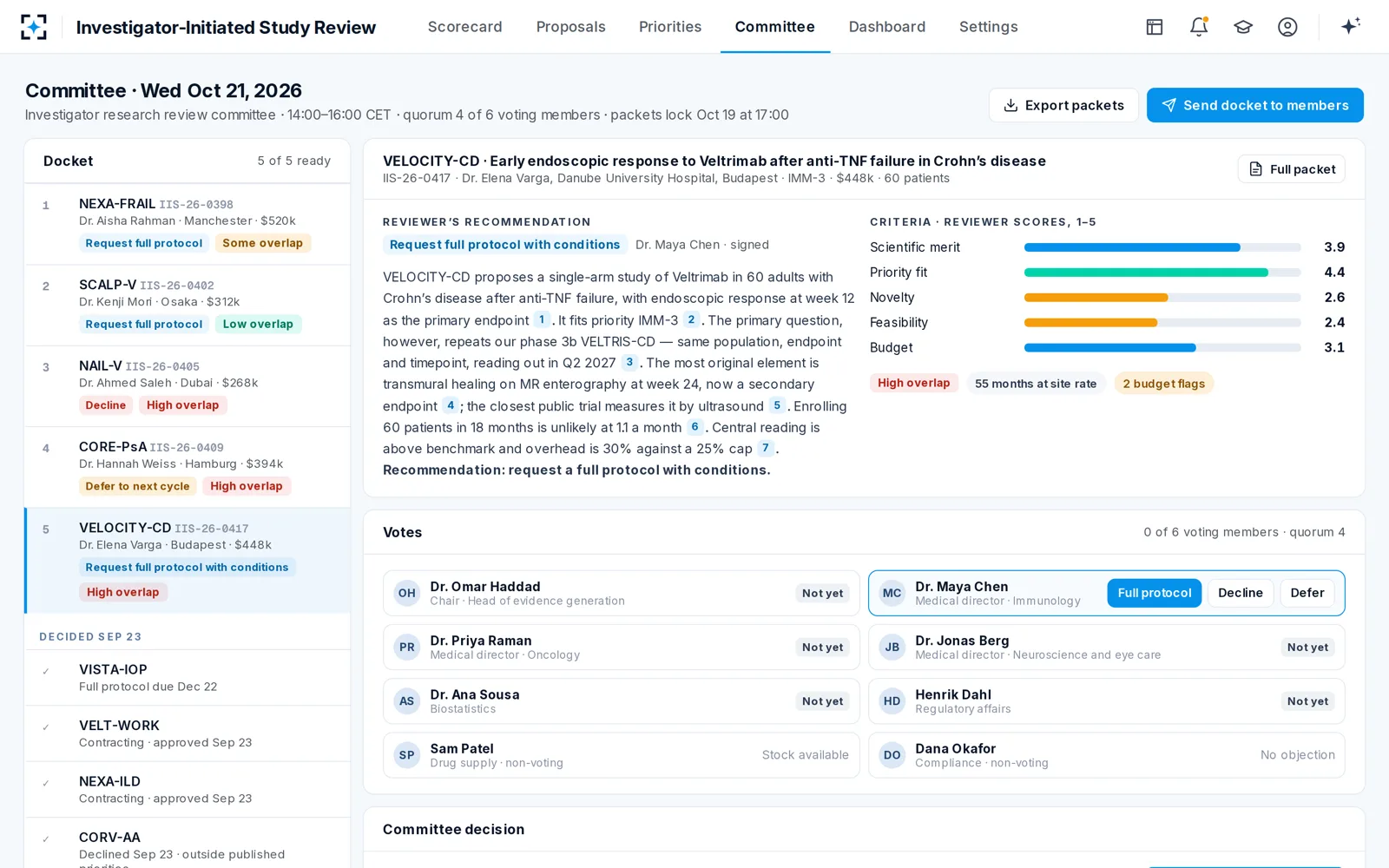
Read the docket against the scorecard and one thing stands out. The five packets on it are SCALP-V (ranked 1st), NEXA-FRAIL (6th), CORE-PsA (7th), NAIL-V (8th) and VELOCITY-CD (9th). The concepts ranked 2nd to 5th are still being received or screened. A docket holds the concepts whose reviewers have signed, not the top five, so the ranking frames the discussion across the cycle while each meeting decides what is ready. Recommendations run the full range: two requests for a full protocol, one with conditions, one deferral and one decline.
The meeting: docket, quorum, non-voting seats and the chair's signature
The sample committee has six voting members and a quorum of four. They are the head of evidence generation as chair, three medical directors, a biostatistician and a regulatory affairs lead. Drug supply and compliance sit at the table without a vote. That mirrors the cross-functional committee the MAPS deck calls industry standard, with medical affairs, clinical, regulatory, safety, legal and biostatistics, plus ad hoc specialists. Its listed assessment criteria, "Within Strategy?", "Scientific Rigor", "Enrollment Rate" and "Total Cost" among them, map closely onto the four-criterion rubric above.
The non-voting seats do real work. Drug supply had already confirmed "Stock available" for 180 IV vials and 360 prefilled pens; compliance recorded "No objection". Neither is a vote, and neither should be: one is a constraint on what can be promised and the other a precondition for discussing the concept at all.
All six voters chose "request full protocol with conditions". The chair, Dr. Omar Haddad, then signed the decision, and the solution lets him choose an outcome other than the majority's, because the signature is his.
The chair signs, and the signature states what it means
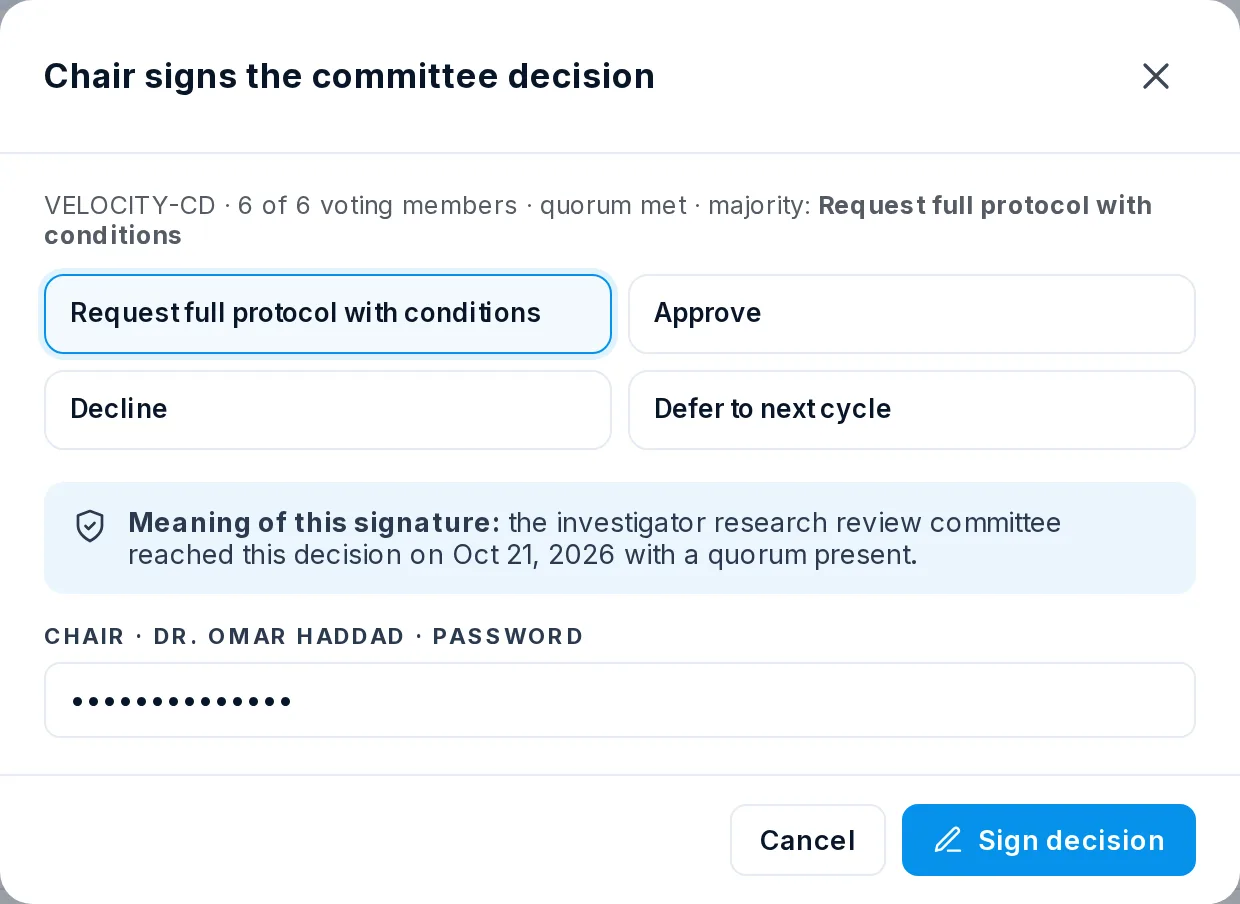
A signature that states its meaning settles a question auditors and investigators both ask later: what exactly did this person attest? The reviewer vouched for the evidence and the recommendation; the chair vouched that a quorate committee reached the decision on that date. Neither signs for the other.
From the signed decision to the letter, in fifteen days
VELOCITY-CD went from receipt on 6 October to a letter on 21 October. The letter writer drafted it from the signed decision and the four conditions, and a policy check removed internal study names, so the investigator learns what to change without learning about VELTRIS-CD. It asks for a full protocol and detailed budget by 4 January 2027, restates that the institution remains the sponsor, and says support is subject to a written agreement at fair market value and "not connected with any past or future prescribing". Lena Ortiz, the IIS programme manager, sent it through the portal at 14:48.
One concept through the cycle, and who acted at each step
Agent
Reading, scoring, overlap · Oct 6–7Reads the three files into 44 cited fields, naming what is missing; scores 74 (7th), then finds VELTRIS-CD at 0.86 and re-scores to 62 (9th).
Never: guess a missing field
A person decides
Scientific reviewer · Oct 7, 10:35Dr. Maya Chen confirms the scores, keeps four conditions and signs a recommendation: request a full protocol.
A person decides
Committee and chair · Oct 21Six of six vote for a full protocol with conditions; Dr. Omar Haddad signs the decision.
Agent
Letter writer and policy checkDrafts the letter with the numbered conditions and a due date; internal study names are removed.
Never: sign or send
A person decides
IIS programme manager · 14:48Lena Ortiz reviews the letter and sends it through the portal; drug supply and transparency records update.
Fifteen days is a property of this concept's timing, not of the method: it arrived two weeks before a meeting. In a window model, the wait for the next committee is set by the calendar, and it is the stage that agents shorten least. For comparison, a thoracic oncology consortium found that pharmaceutical sponsors took a median of 61 days (interquartile range 31 to 183) from concept submission to decision, and that concepts with shorter projected durations were more likely to be approved.
What changes in the cycle's days, and what doesn't
Preparation shrinks; the committee calendar mostly does not. The sample programme's estimated baseline is 52 days from receipt to decision by hand. The solution's design target is 27. Split by stage, the target removes most of the screening, half of the scientific review and almost all of the letter, but only a third of the wait for the committee, which becomes the largest share of what remains.
Receipt to decision by stage: where the days go, and which stage stays long
- Screening6 d
- Scientific review18 d
- Waiting for committee21 d
- Letter7 d
- Screening2 d
- Scientific review9 d
- Waiting for committee14 d
- Letter2 d
That shapes the right question for a head of evidence generation. Once packets are ready days after receipt rather than weeks, meeting cadence becomes the lever: a monthly committee halves the average wait of a bimonthly one, and no amount of preparation speed substitutes for it. The IIS community's own metric for this, time "from submission to review decision", is worth tracking per stage, not only end to end. What the days are worth in money and in studies started is the subject of the economics of an IIS programme.
What does not change is who decides. The sample cycle ends with four people's names on the record: the reviewer who recommended, the chair who signed, the compliance lead who raised no objection and the programme manager who sent the letter. Whether the scores those people relied on can be trusted is a measurement question, taken up in measuring agreement, overlap recall and citation fidelity.
How to adapt the rubric to your own IIS committee
Start from the decisions your committee actually makes and work back to criteria and weights. The sample rubric is a reasonable default, not a standard. Nothing in it requires software to adopt, though software makes the same depth of evidence affordable for every concept rather than the few a reviewer has time for.
Building an IIS scoring rubric a committee can rank a cycle on
- Score every concept on the same few criteria, on one scale
Four is enough to separate concepts; more criteria dilute the weights and invite double counting.
- Write anchors for each score
A 2 and a 4 on scientific quality should mean the same thing to an oncologist and a neurologist.
- Count overlap against a concept, and show what it would add
A penalty on its own declines good investigators; the added element is what turns a duplicate into a condition.
- Project enrolment from the site’s own history
Requested rates are a plan, not a forecast; score the forecast.
- Agree weights before the cycle, and version every change
Weights move the middle of the list, which is where a funding line tends to fall.
- Keep red-flagged concepts visible but unranked
A concept under compliance review should not compete for money until the flag is resolved.
- Give each signature a stated meaning
The reviewer attests to the evidence and recommendation; the chair to a quorate decision on a date.
- Lock packets before the meeting
In the sample, packets lock two days ahead, so every member reads the same version.
- Track days by stage, not only end to end
It shows whether preparation or the meeting calendar is holding decisions back.
A ranked cycle does not decide anything. It gives the committee one honest view of what it is choosing between, and leaves the choice, and the signatures, with the people accountable for it. To see the scorecard, the packet and the signatures on your own concepts, start from Investigator-Initiated Study Review.
Questions people ask
What criteria do IIS review committees use?
The cross-functional committee described in one Medical Affairs Professional Society presentation weighs fit with strategy, scientific rigour, enrolment rate and total cost, alongside contract terms, publication timing, sub-sites and the institution's experience. The difference between committees is less the list than whether each criterion is scored on a common scale with written anchors.
Can a committee chair overrule the majority vote?
In the sample committee the chair signs the decision and may choose an outcome other than the majority's, because the signature and its stated meaning are the chair's. A charter should say when that is allowed and require the reason to be recorded.
What is a quorum for a review committee?
Whatever the committee's charter sets; no regulation fixes one for IIS committees. The nearest regulated model is the IRB, which under 21 CFR 56.108(c) decides at meetings where a majority of members are present, including at least one whose primary concerns are non-scientific. The sample committee's four of six is a majority quorum on the same logic.
How does NIH score grant applications, and is it a model?
NIH reviewers give an overall impact score from 1 (exceptional) to 9 (poor) in whole numbers, and the final score is the panel's mean multiplied by 10, giving 10 to 90. It is a good model for anchoring a scale with written descriptors, but an IIS committee also needs criteria NIH does not score: fit to the company's published priorities, overlap with its own studies and fair market value.
Should a concept on compliance hold still be scored?
It can be read on scientific merit, but it should not be ranked or decided until compliance has cleared or held the flag. Ranking it puts it into the funding conversation before the question of commercial influence is answered.