Externally sponsored research (ESR), also called investigator-initiated studies (IIS) or investigator-sponsored research, is a pharmaceutical or device company's support, in drug, device or funding, for studies that outside investigators design and sponsor. The company's part is the decision: a medical affairs committee reviews each concept and decides whether to support it, usually by scoring four things (fit with the company's published research priorities, scientific quality, feasibility of enrolment, and overlap with studies already under way) and treating budget at fair market value and compliance as conditions. It is hard because concepts arrive in every format, a cycle has to be ranked on one scale, and US compliance guidance treats duplicative research or research steered by sales as a warning sign. Botminds' Investigator-Initiated Study Review takes each concept from submission to the committee's decision, with every score cited, while scientific reviewers, the committee and the chair decide.
This guide is for heads of medical affairs, ESR or IIS programme managers and the committee members who vote. The worked example is a fictional concept, VELOCITY-CD, a single-site study of an IL-23 antibody in Crohn's disease, in a sample programme; research figures are from peer-reviewed studies and the compliance rules from HHS OIG and PhRMA's published principles.
What the published evidence says about concepts and their outcomes
25%
of 60 thoracic oncology concepts sent to pharmaceutical sponsors were approved; 43 were declined
61days
median from submission to the sponsor’s decision (interquartile range 31 to 183)
26.5%
of investigator-sponsored trials stopped for poor recruitment, against 8.4% of industry trials
What review criteria should an externally sponsored research committee use?
Four scored criteria answer the committee's real question (should we support this study, will it finish, and is anyone else already running it?), and two conditions sit beside them. A Medical Affairs Professional Society talk on running a programme lists the assessment areas as "within strategy", scientific rigour, enrolment rate, total cost, sub-sites and institution experience (MAPS, 2018), which map closely onto the rubric below.
The four scored criteria in the sample programme, weighted 30 · 30 · 20 · 20
| Criterion | Weight | The question | What scores high | What scores low |
|---|---|---|---|---|
| Priority fit | 30% | Does it answer a question the company has published as a priority? | Names the priority and makes the outcome it names the primary endpoint | Fits the product and disease but not the question |
| Scientific quality | 30% | Will the design answer the question it asks? | One clear question, validated endpoint at a justified timepoint, power calculation, analysis plan | Single-arm with no comparator rationale, no power calculation; missing sections scored as missing |
| Feasibility | 20% | Can the site enrol what it promises, in the time asked? | Enrolment rate from the site’s own past studies, screen failure stated, a second site if needed | A target needing three times the site’s historical rate |
| Overlap | 20% | Is someone already answering this question? | Asks something no company, funded or registered study asks | Same population, treatment, endpoint and timepoint as a study that reads out first |
The weights are a policy choice and should be written down before the cycle opens. At 30 · 30 · 20 · 20, fit and design decide 60% of a concept's score, and an overlap can undo much of the rest. A programme that wants more completed studies might raise feasibility; one focused on evidence gaps might raise fit. What matters for defensibility is that every concept in a cycle is scored on the same weights by the same rubric, and that the weights are not adjusted after the scores are known.
Priority fit: published priorities, and the line on solicitation
Fit is judged against the company's published research priorities, and publishing them is what keeps the process on the right side of the solicitation line. PhRMA's principles say a company "should not solicit research projects, study descriptions, or protocols from investigators" but "may publicly disclose the general areas or types of studies that it does or does not support" (PhRMA principles on IIS, 2014).
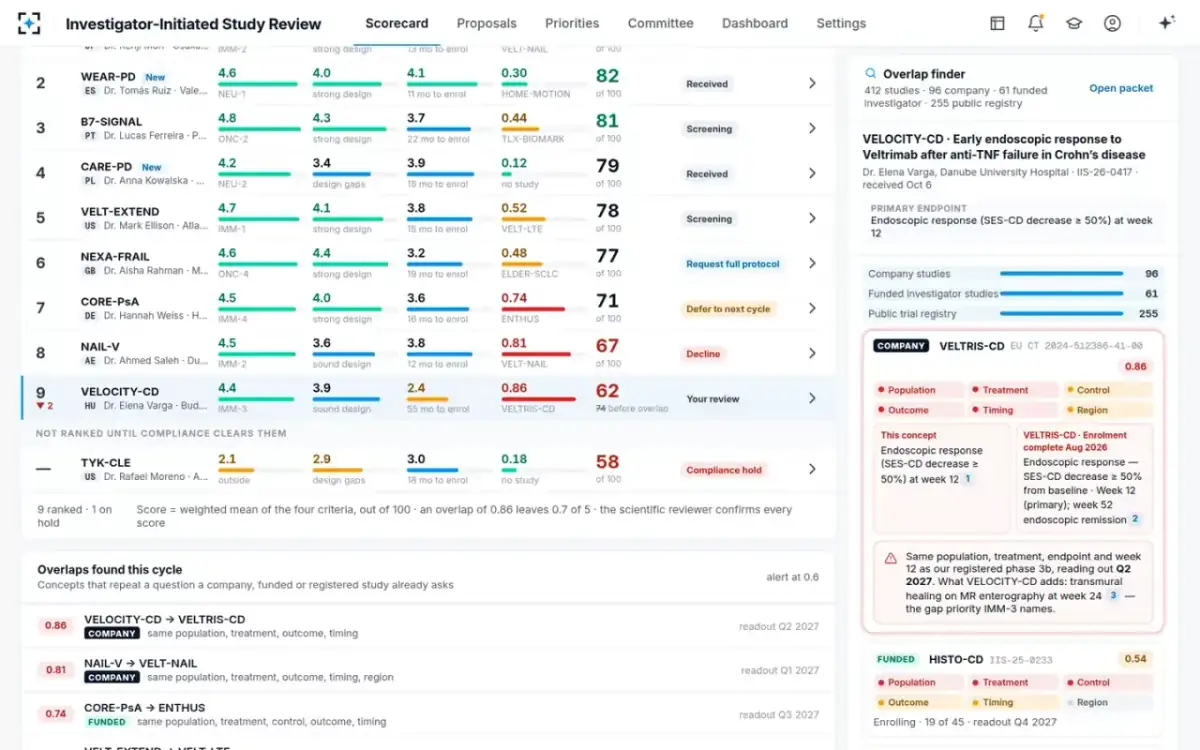
Score fit on the question, not the molecule. A concept that uses the company's product in the right disease but measures an outcome the priority does not name has low fit, however good its science. VELOCITY-CD matched the published priority on deep healing in Crohn's disease at 0.88, 4.4 of 5, but its primary endpoint was endoscopic response at week 12 rather than the transmural healing the priority describes, a gap the committee later closed as a condition. A priorities map that shows which published questions are crowded and which are open also tells the programme where to direct medical science liaisons' scientific exchange.
Scientific quality without designing the study
The committee can judge whether a design answers its question; it should not write the design. PhRMA's principles put the line plainly: the company "generally should not participate in the scientific design of the IIS, in the creation of the protocol or management of the study", although where its products are used it "should be allowed to review protocols and provide scientific comments" (PhRMA, 2014).
A design score is therefore the comment the company is allowed to make, made consistently. The sample appraiser scores five elements (the research question, the validity of the primary endpoint, how well the design fits the question, the sample-size justification and the analysis plan) and cites the passage behind each. VELOCITY-CD scored 3.9 of 5: a validated endpoint, a single-arm design, and no power calculation or ethics plan. A missing section is scored as missing, never guessed, so two concepts with the same gaps score the same.
How should a committee judge feasibility?
From the site's own history, not from the target in the concept. The committee should compare the enrolment rate the concept needs with the rate the site has achieved on comparable studies, adjusted for its screen-failure rate, and ask for added sites when the arithmetic does not close. Investigator-sponsored trials stop for poor recruitment far more often than industry trials: 26.5% against 8.4% in one cohort of 1,017 randomised trials (Kasenda et al., JAMA 2014). A study that does not finish answers nothing.
Months to reach 60 patients for the sample concept, as asked and at the site's own rate
Duration matters to sponsors as well as to science: in the thoracic oncology consortium, concepts with shorter projected durations were more likely to be approved (Gerber et al., 2025). Note where the sample site's history came from: one of its two earlier studies was the company's own trial at the same hospital, so the sponsor often knows a site's real rate better than the concept states it. How that projection is built is set out in forecasting an investigator study's enrolment.
Overlap: the duplication compliance guidance warns about
A concept that repeats an ongoing company study, another funded investigator study or a registered trial should lose most of its overlap score, and the reason is compliance as well as budget. The HHS Office of Inspector General's guidance for drug manufacturers lists among the "indicia of questionable research" research "that is unnecessarily duplicative or is not needed by the manufacturer for any purpose other than the generation of business" (HHS OIG, 68 FR 23731, 2003).
Overlap should be judged element by element (population, intervention, comparator, outcome, timepoint and region), not by title. The sample check found the company's own registered phase 3b with the same population, treatment, endpoint and week-12 timepoint, reading out in the second quarter of 2027: an overlap of 0.86. That finding became a design change rather than a bare decline, and because internal studies are confidential, the letter says the question is already being addressed without naming by whom. The method is set out in checking for duplicate trials before funding.
The overlap found element by element, with both endpoints quoted
Compliance and fair market value: conditions, not scores
Compliance and budget are pass-or-fix tests, not points to trade against good science. A concept with a commercial red flag should not be scored at all until compliance clears it, and a budget above fair market value is a condition to correct, never a reason to like a concept less or more.
“Prudent manufacturers will develop contracting procedures that clearly separate the awarding of research contracts from marketing. Research contracts that originate through the sales or marketing functions … are particularly suspect.”
HHS OIG Compliance Program Guidance for Pharmaceutical Manufacturers, 2003
In practice that means the committee's procedure should screen every concept for who introduced it, who is copied on correspondence, promotional wording and recent payments to the investigator, and route any red flag to compliance before scientific review. PhRMA's principles add the money rules: support only for "legitimate, reasonable, and necessary study activities" at no more than fair market value, paid in milestones "to the institution, not to the individual investigator or any third party", with unused funds returned, and approval never "conditioned upon the purchase of the pharmaceutical company's products".
On the sample concept two budget lines caused the whole overrun: central endoscopy reading at $520 a read against a $260 to $340 benchmark, and overhead at 30% against the programme's 25% cap. At benchmark and 25% the request fell from $448,000 to about $397,750, inside the $360,000 to $410,000 range for the design. The line-by-line method is in fair market value for investigator-initiated studies.
From scores to a decision: outcomes, conditions and the letter
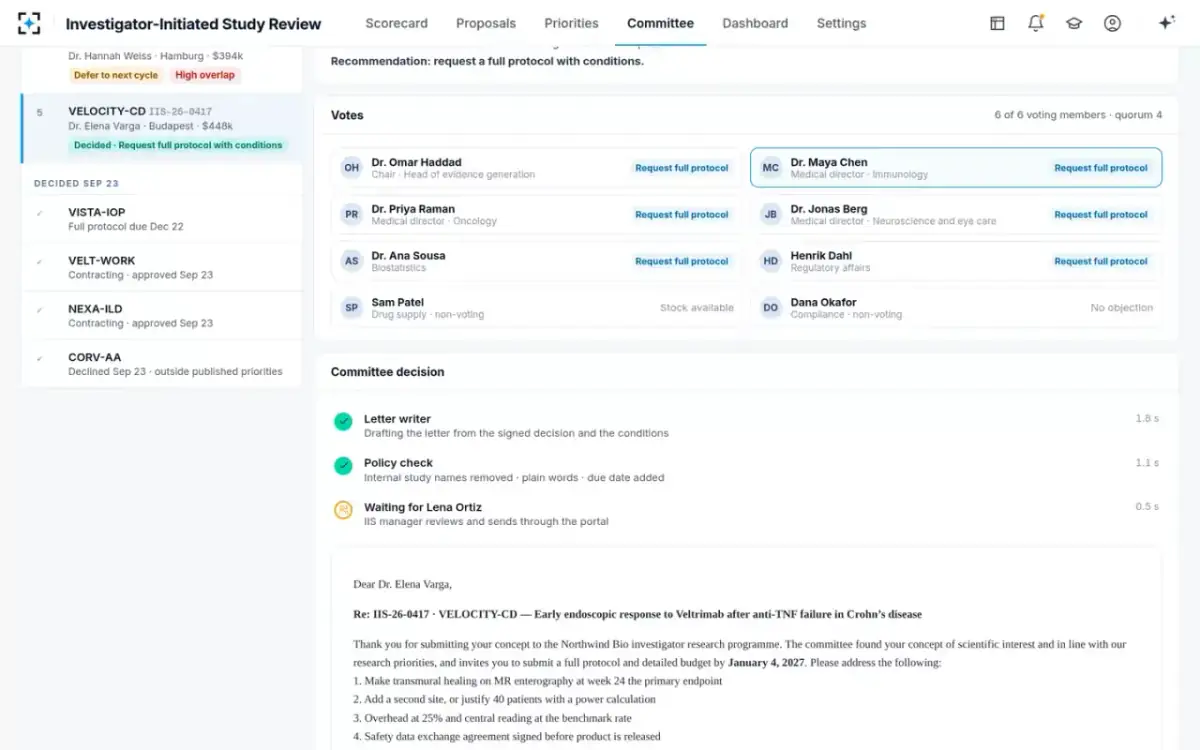
A ranked cycle still needs a vote. The sample programme's committee has six voting members with a quorum of four, with drug supply and compliance attending without a vote, and four possible outcomes: approve as submitted; request a full protocol, usually with numbered conditions; defer to the next cycle; or decline with the reason explained. All six voted to request a full protocol for VELOCITY-CD, and the chair signed.
One concept, as submitted and as the committee conditioned it
As submitted: Endoscopic response at week 12, the same endpoint and timepoint as the ongoing phase 3b.
As conditioned: Transmural healing on MR enterography at week 24, the outcome the published priority names.
As submitted: 60 patients at one site in 18 months.
As conditioned: A second site, or 40 patients justified by a power calculation.
As submitted: $448,000, central reading at $520 and 30% overhead.
As conditioned: Central reading at benchmark and overhead at 25%: about $397,750.
As submitted: Not addressed.
As conditioned: A safety data exchange agreement signed before product is released.
Each condition should trace to a score, and the letter should say so in terms the investigator can act on. In the sample, the scientific reviewer signed a recommendation that proposed four conditions, the committee adopted them, and the drafted letter was checked to remove internal study names before it went out. "Request a full protocol" is a conditional yes: support follows only when the protocol and budget meet the conditions and a written agreement with the institution is signed.
Votes recorded, the chair's decision, and the letter with its numbered conditions
Documenting declines the programme can defend
A decline should leave the same evidence as an approval: the scores, the citations behind them, the committee's vote and the reason given. Programmes are judged later on whether decisions were consistent and free of commercial influence, and a decline recorded only as "not aligned with strategy" cannot show either.
What the file should hold for every concept, funded or not
- The concept as received, and the date.
With any clarification requested and answered.
- The compliance screen and its result.
Who introduced the concept, who was copied, payments in the last 24 months, and any hold.
- Each criterion score with the passage behind it.
Confirmed by the scientific reviewer, on the weights fixed for the cycle.
- The overlap finding, element by element.
Internal studies named in the file, not in the letter.
- The budget against benchmark and the overhead cap.
Lines out of range and the condition set.
- The vote, quorum, decision and signature.
Approve, request a full protocol with conditions, defer or decline.
- The letter as sent.
With the reason or conditions the investigator can act on.
Where Investigator-Initiated Study Review fits in an ESR programme
Investigator-Initiated Study Review reads each concept whatever its format into a structured file with every field cited, matches it to the published priorities, appraises the design on the committee's rubric, projects enrolment from the site's history, searches company, funded and registered studies for overlap, checks the budget line by line against benchmarks and the overhead cap, and screens for commercial red flags. It ranks the cycle on one score out of 100 and drafts the reviewer summary, the committee packet and, after the decision, the letter.
The cycle ranked on one score, with compliance holds kept apart
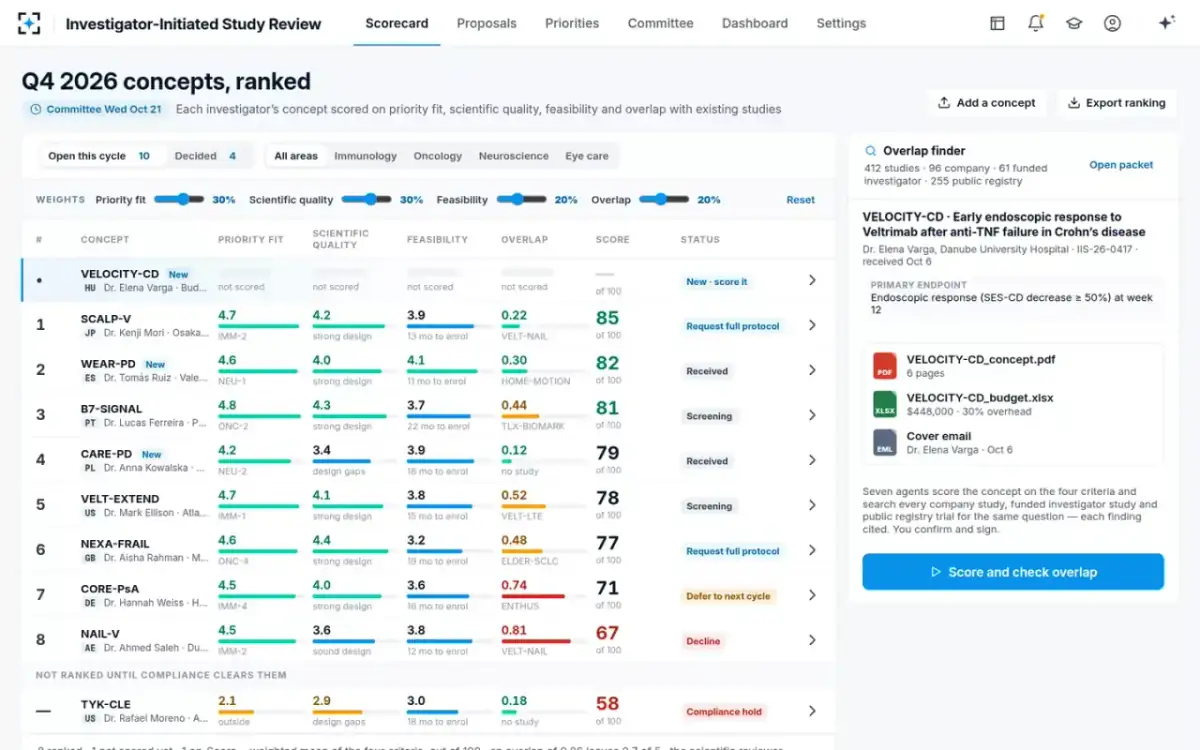
The agents score and draft and make no decisions. Red flags always go to a person, and no concept on compliance hold is scored; the scientific reviewer confirms every score and signs the recommendation; the committee votes with a quorum and the chair signs the decision. What the programme gains is consistency (every concept read the same way against the same rubric) and a file behind every decision. How a programme measures what it funds is covered in medical affairs KPIs for an IIS programme.
Questions people ask
What is externally sponsored research in pharma?
It is a company's support (investigational product, devices or funding) for a study an outside investigator designs and sponsors, with the investigator's institution as the sponsor. The company decides whether to support it, usually through a medical affairs committee, and under PhRMA's principles generally does not take part in the study's scientific design.
How do pharma companies evaluate investigator-initiated study proposals?
Most score fit with published research priorities, scientific quality, feasibility of enrolment and overlap with existing studies, and check budget at fair market value and compliance as conditions. In one oncology consortium only 25% of concepts sent to sponsors were approved, with a median of 61 days to decision.
Who should sit on an ESR review committee?
Medical and scientific members who vote, with a quorum, and compliance and drug supply attending without a vote. HHS OIG guidance treats research that is not reviewed by a manufacturer's science component, or that originates in sales or marketing, as a warning sign, so commercial staff should not take part in the decision.
Can a company tell investigators what studies it wants?
It can publish the general areas or types of studies it does or does not support, and answer questions about the availability of support. PhRMA's principles say it should not solicit specific projects or protocols, and should not plan specific new investigator studies in its clinical or marketing planning.
Why would a committee decline a scientifically strong concept?
Because it falls outside published priorities, cannot enrol on the site's track record, or duplicates an ongoing company, funded or registered study. OIG guidance names unnecessarily duplicative research as an indicator of questionable research, so overlap is a compliance concern as well as a budget one.
How long should an externally sponsored research review take?
There is no standard, and many programmes review in windows rather than continuously. In the thoracic oncology consortium study the median time from submission to the sponsor's decision was 61 days, with an interquartile range of 31 to 183, and funded concepts took a median of 18 months to activation.