An investigator-initiated study (IIS) is a clinical study that an independent investigator designs and sponsors, with a pharmaceutical or device company supplying funding, product or both; the company supports the study but is not its sponsor. Inside that company, the concept is reviewed by five people: an IIS programme manager who runs intake and the docket, a medical director who reviews the science, a committee chair who signs the decision, and compliance and drug supply, who in many programmes advise without a vote. Each asks a different question of the same concept, and the investigator who wrote it sees none of them, only the wait. Botminds' Investigator-Initiated Study Review is software for medical affairs teams that has agents read each concept, check it against the company's priorities, its own studies, fair market value and compliance rules, and build a cited packet for each of those five people. They still decide.
The work is hard because the questions are spread across people who each hold one piece. The scientific reviewer can judge the design but may not know that a company phase 3b already asks the same question. Compliance can spot a sales colleague in a cover email, but only if someone forwards the email. Drug supply learns what a study needs, often, only after the vote. Seen from the outside, the result is slow and opaque.
From the investigator's side, the wait is long and the odds are short
61days
median from submitting a concept to a pharmaceutical sponsor to its decision (IQR 31 to 183)
25%
of 60 concepts sent to sponsors were approved; 72% were declined
18months
median from first submission to an activated trial, for those approved
What is the difference between IIS, IIT, ISR and ESR?
There is none of substance: the four names describe the same arrangement, and each company picks its own. The Medical Affairs Professional Society defines the whole family as "unsolicited, independent research where the investigator or the Institution … serves as the Sponsor". The company supports; it does not sponsor.
What each name stresses:
- IIS / IIT: investigator-initiated study or trial, the most common terms.
- ISR / ISS / IST: investigator-sponsored research, study or trial, which stress who holds the sponsor's duties.
- ESR: externally sponsored research, the term some companies use for the same programme.
- IIR: investigator-initiated research, the umbrella term MAPS and some programmes use for all of the above.
The legal anchor is the sponsor-investigator. Under 21 CFR 312.3 it is "an individual who both initiates and conducts an investigation", and ICH E6(R3), adopted in January 2025, adds that "the obligations of a sponsor-investigator include both those of a sponsor and those of an investigator". When the institution is the sponsor, the same logic holds: the company's review decides support, not the study's existence.
Most programmes work in two steps. A short concept comes first; a full protocol and detailed budget follow only after a yes, then a written agreement. These studies matter beyond the company that funds them: KEYNOTE-016, registered with the Sidney Kimmel Comprehensive Cancer Center at Johns Hopkins as lead sponsor and Merck as collaborator, was one of five single-arm trials behind pembrolizumab's May 2017 approval, which FDA reviewers describe as "the first time that the FDA has approved a cancer treatment for an indication based on a common biomarker rather than the primary site of origin".
Investigator-initiated vs sponsor-initiated trials: who carries the sponsor's duties?
The difference is who holds the sponsor's legal duties. In a company-sponsored trial the company designs the study, holds the IND and answers to the regulator for monitoring, safety reporting and results posting. In an investigator-initiated study every one of those duties moves to the investigator or the institution, and the company's role shrinks to what a written agreement says it supplies.
Those duties are heavy. Under 21 CFR 312.50, sponsors are responsible for "selecting qualified investigators", "ensuring proper monitoring" and "ensuring that FDA and all participating investigators are promptly informed of significant new adverse effects or risks". FDA's own draft guidance on sponsor-investigator INDs concedes that sponsor-investigators "often do not have the regulatory knowledge or the resources to hire experts" for the submission, which is why a reviewer's question about the site's research infrastructure is not idle.
Investigator-initiated or company-sponsored: the same duties, different owners
| Duty | Investigator-initiated study | Company-sponsored trial |
|---|---|---|
| Designs the question and protocol | The investigator; the company may comment on the concept but does not write it | The company |
| Is the sponsor in law | The investigator (a sponsor-investigator, 21 CFR 312.3) or the institution | The company |
| Holds the IND, when one is needed | The sponsor-investigator, often cross-referencing the company’s IND or NDA through a letter of authorisation | The company |
| Reports serious unexpected reactions to FDA | The sponsor-investigator: 7 calendar days if fatal or life-threatening, 15 days otherwise (21 CFR 312.32) | The company, on the same clocks |
| Registers and posts results on ClinicalTrials.gov | The investigator or institution as responsible party, results within one year of primary completion (42 CFR 11.44) | The company |
| What the company supplies | Funding, product or both, under a written agreement at fair market value | Everything, including the sites’ fees |
Two duties stay with the company even in an investigator's study. When it supplies drug under "any investigator's IND", 21 CFR 312.32 requires it to tell those investigators of new serious risks within 15 calendar days. And in Europe the line is drawn sharply: under Article 72 of Regulation 536/2014, where a trial has more than one sponsor and the contract does not say who carries a duty, "that responsibility shall lie with all sponsors". A company that drafts the protocol or runs the monitoring has quietly become a sponsor, which is why review committees comment on a concept but never rewrite it.
The path of one concept: eleven handoffs between six people
In a typical path, a concept passes through around a dozen handoffs between the investigator and five reviewers before a letter goes back, and each handoff is a chance to wait. The sequence below follows one concept from the submission portal to the decision letter. Read it as a relay: every arrow is something one person must finish before the next can start.
One concept, eleven handoffs: who passes what to whom
- INV investigator
- PM IIS programme manager
- REV scientific reviewer
- COMP compliance
- DRUG drug supply
- CHAIR committee chair
- agents prepare it
- a person decides or signs
Two things stand out. The programme manager sits on almost every arrow, which is why that role feels like a switchboard. And the green arrows, the actual decisions, are fewer than the blue ones: most of the relay is moving and preparing information, not judging it.
Take a sample programme as it runs through the solution: a fictional company's Q4 2026 cycle of 14 concepts, with an estimated by-hand median of 52 days from receipt to decision. The chart splits those days by the person who owns each stage, with the design target beside it.
The longest stretch is the wait for the committee, not the review
- Screening · programme manager6 d
- Scientific review · reviewer18 d
- Waiting for the committee · chair21 d
- Letter · programme manager7 d
- Screening2 d
- Scientific review9 d
- Waiting for the committee14 d
- Letter2 d
The IIS programme manager: "half my week goes on chasing what's missing"
The IIS programme manager owns the process, not the verdict: intake, completeness, reviewer assignment, the docket and the letter. The IIS Research Alliance's metrics guidance names the bottlenecks this role lives with, "budget submissions, legal reviews, contract approvals", and puts "time from submission to review decision" first among its efficiency measures. That number is the programme manager's, even though most of it is spent waiting on others.
Intake is where the week goes. Concepts arrive incomplete, and through more than one door: the MAPS life-cycle guidance has programmes take them through a "submission portal website/field team", so a concept can start as a conversation with a medical science liaison and reach the queue weeks later as an attachment. The same guidance calls a "good tracking system necessary to identify overlap", which is hard to keep when the inputs are scattered.
In the solution, every concept lands in one queue already read. In the sample cycle, the concept reader turns VELOCITY-CD's six-page concept form, budget sheet and cover email into 44 cited fields and names what is missing at receipt: a power calculation and an ethics plan. The queue shows each concept's priority fit, overlap level, budget, stage and days in process, so the chase starts on day one rather than in week three.
The programme manager's queue in Investigator-Initiated Study Review
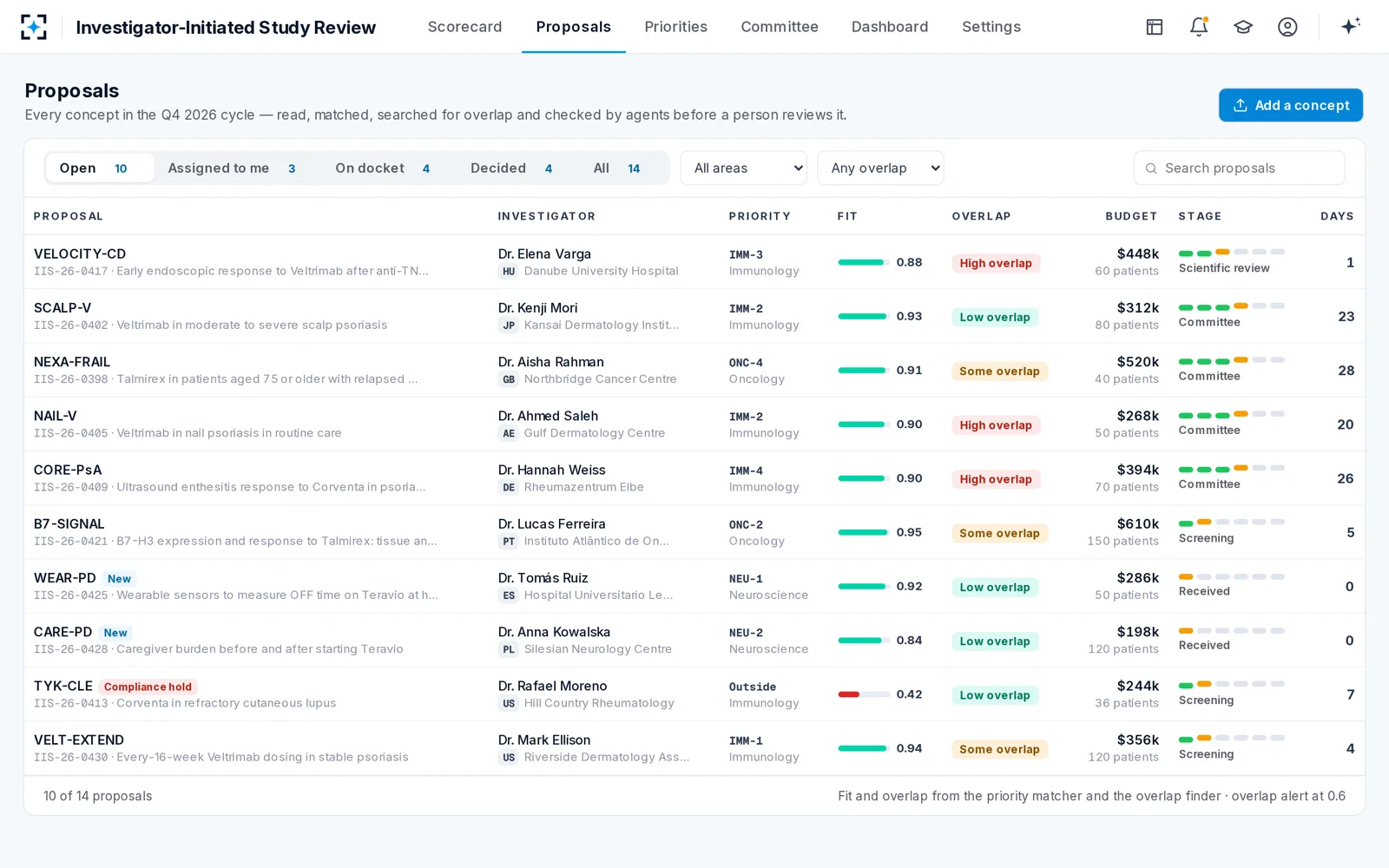
TYK-CLE is held for compliance and shows a fit of 0.42, below the programme's minimum; VELOCITY-CD shows high overlap after one day in process.
The scientific reviewer: a medical director reviewing on top of a full role
The scientific reviewer, usually a medical director for the therapeutic area, judges whether the question matters and the design can answer it, and writes the recommendation the committee votes on. In the sample programme the reviewer takes three to five concepts a cycle beside a full medical role, and the question that matters most is the one hardest to answer from memory: "Tell me first whether we already answer this question."
That is not only a scientific concern. The U.S. Office of Inspector General lists research that is "unnecessarily duplicative" among the signs of questionable research, next to research "not … reviewed by, a manufacturer's science component". A duplicate is a compliance exposure as well as wasted money.
In the sample cycle, the overlap finder searches 412 company, funded-investigator and public-registry studies and finds the company's own registered phase 3b with the same population, treatment, endpoint and week-12 timepoint. The concept's score falls from 74 to 62 and it drops to last of nine. It also names what the concept would add: transmural healing on MR enterography at week 24, exactly the gap the matching research priority describes. The overlap check is a method of its own.
The scientific reviewer's packet: every field tied to its passage
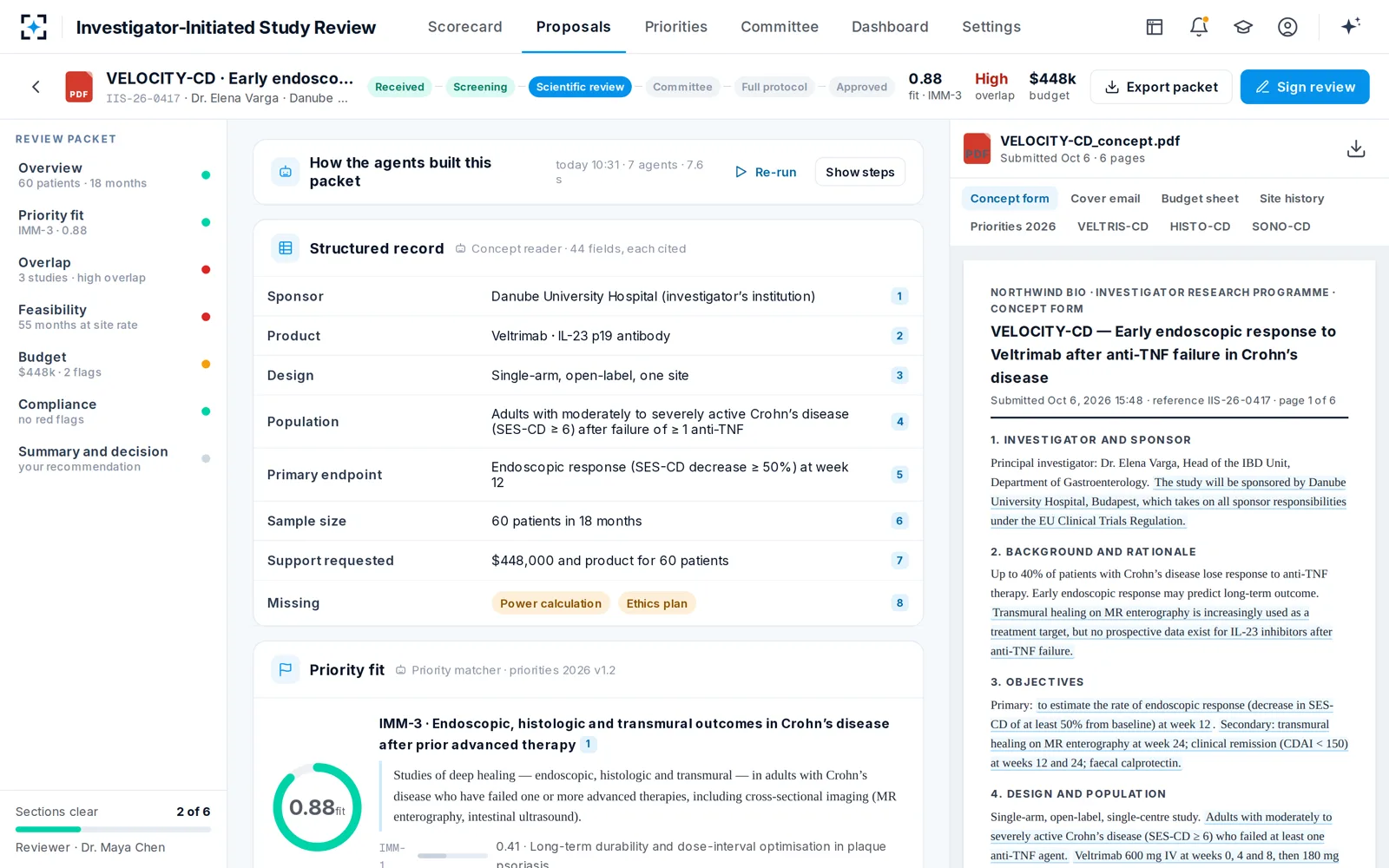
The reviewer starts from what is missing and what is cited, not from a blank page.
The committee chair: ranking a cycle on packets of uneven depth
The committee chair, often the head of evidence generation, has to rank a whole cycle against one budget and sign a decision the committee can defend. A typical cross-functional committee, as MAPS describes it, draws on medical affairs, clinical, biostatistics, regulatory, safety and legal, with clinical pharmacology and translational research as ad hoc reviewers. Its assessment covers strategy fit, scientific rigour, enrolment rate, total cost, institution experience and publication timing.
The difficulty is comparability. One reviewer writes a page, another a line; one checked overlap, another did not. Cadence adds pressure: in a submission window, as the MAPS guidance describes it, a "cross functional committee reviews all proposals together with a set budget", so every packet sits beside every other and a thin one is exposed at once.
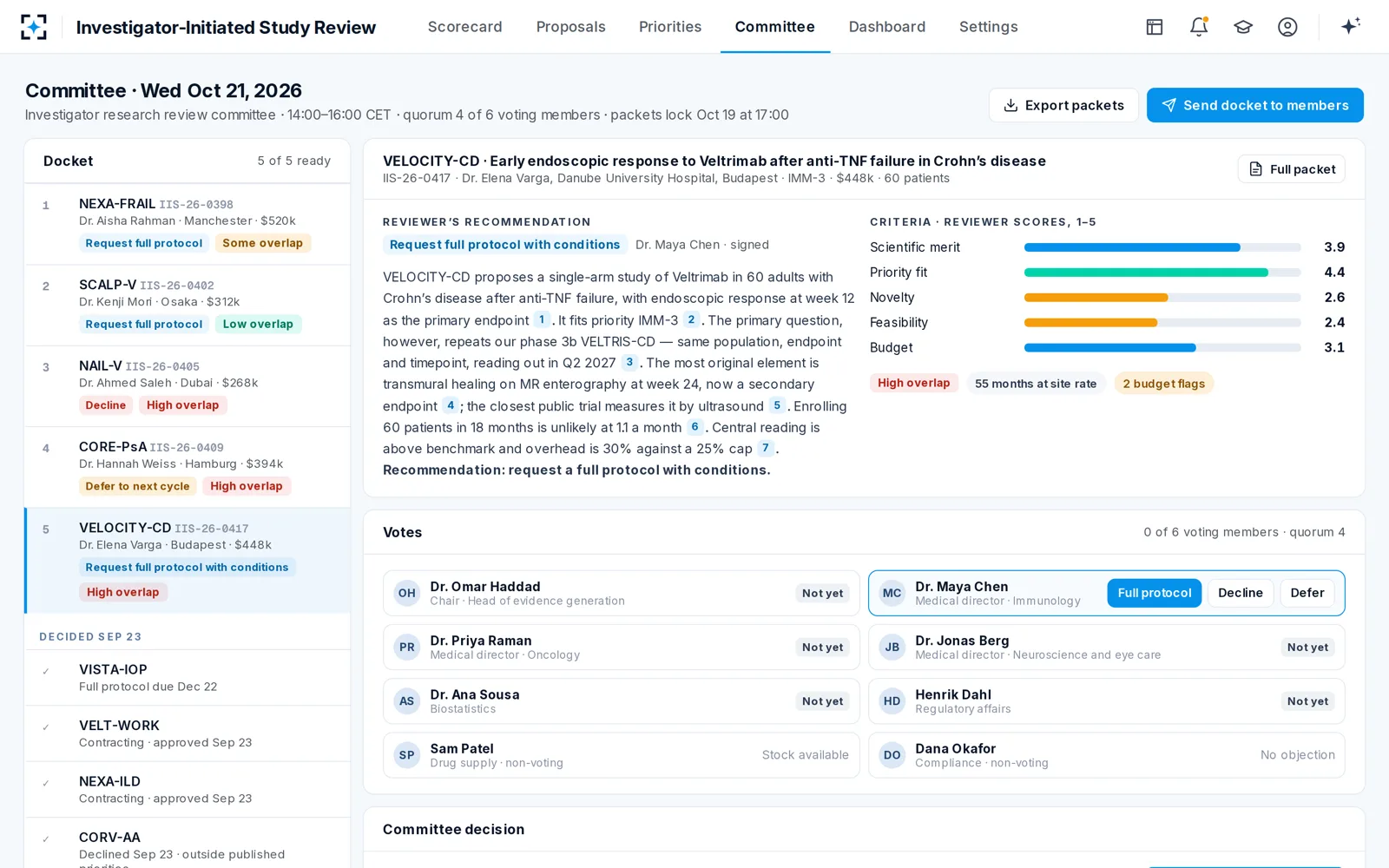
In the solution the chair sees each concept as a one-page packet: the reviewer's signed recommendation and cited summary, criteria scores and flags such as high overlap, 55 months to enrol at the site's own rate, or two budget lines above benchmark. In the sample committee, six members vote with a quorum of four, and the chair signs with the meaning stated on screen: the committee "reached this decision on Oct 21, 2026 with a quorum present."
The chair's docket: one page per concept, votes and non-voting advice
Compliance and drug supply: in the room without a vote
Compliance and drug supply attend the committee to protect the programme, not to judge the science, so neither usually votes. Their questions are binary and early, and they are the questions most often asked late.
Compliance: "support can never follow prescribing"
Compliance asks whether the support could be read as a reward. The OIG's 2003 guidance tells manufacturers to "insulate research grant making from sales and marketing influences", and PhRMA's principles add that companies "should not preferentially select investigators who are customers" and should pay the institution, in milestones, at no more than fair market value. Every payment is then public: research payments made up $9.50 billion of the Open Payments data CMS published in 2026.
Research contracts that originate through the sales or marketing functions — or that are offered to physicians in connection with sales contacts — are particularly suspect.
OIG Compliance Program Guidance for Pharmaceutical Manufacturers, 68 FR 23731 (2003)
By hand, that check depends on someone reading every cover email. In the solution, the compliance screener reads the correspondence for sales or marketing colleagues, links to prescribing, promotional wording or a sponsor other than the institution, and notes payments to the investigator in the last 24 months. In the sample cycle it holds one concept because a sales colleague is named in its cover email. The screener never clears a flag; a held concept is not ranked until compliance decides. Compliance and fair market value goes line by line through the budget side.
Drug supply: "tell me the quantity before you approve"
Drug supply asks how much product a study needs, in which presentation and from when. Standard practice, in the MAPS life-cycle guidance, is to "forecast as soon as the study is approved", with labelling per country and central re-labelling to plan. That means supply learns the number after the decision it might have changed. In the sample cycle, the solution works out 180 IV vials and 360 prefilled pens for 60 patients over 52 weeks from dose and duration, and drug supply confirms stock from Q2 2027 before the vote.
The investigator: what waiting looks like from the other side
The investigator sees a portal status and, weeks later, a letter. Investigators are, in the words of the MAPS guidance, "clinicians along with being researchers", with a "lack of time and administrative process patience". The rolling model in the MAPS guidance promises a "decision provided with 45 days of submission" on a brief application, but that decision carries no funding; full applications wait for quarterly review meetings.
The independent evidence is less kind. In the thoracic oncology consortium above, sponsors took a median of 61 days to decide and approved a quarter of concepts, and concepts with shorter projected durations were more likely to be approved. The yes is not the finish either: across 29 US academic sites, clinical trial contracts took a median of 91 days to full execution.
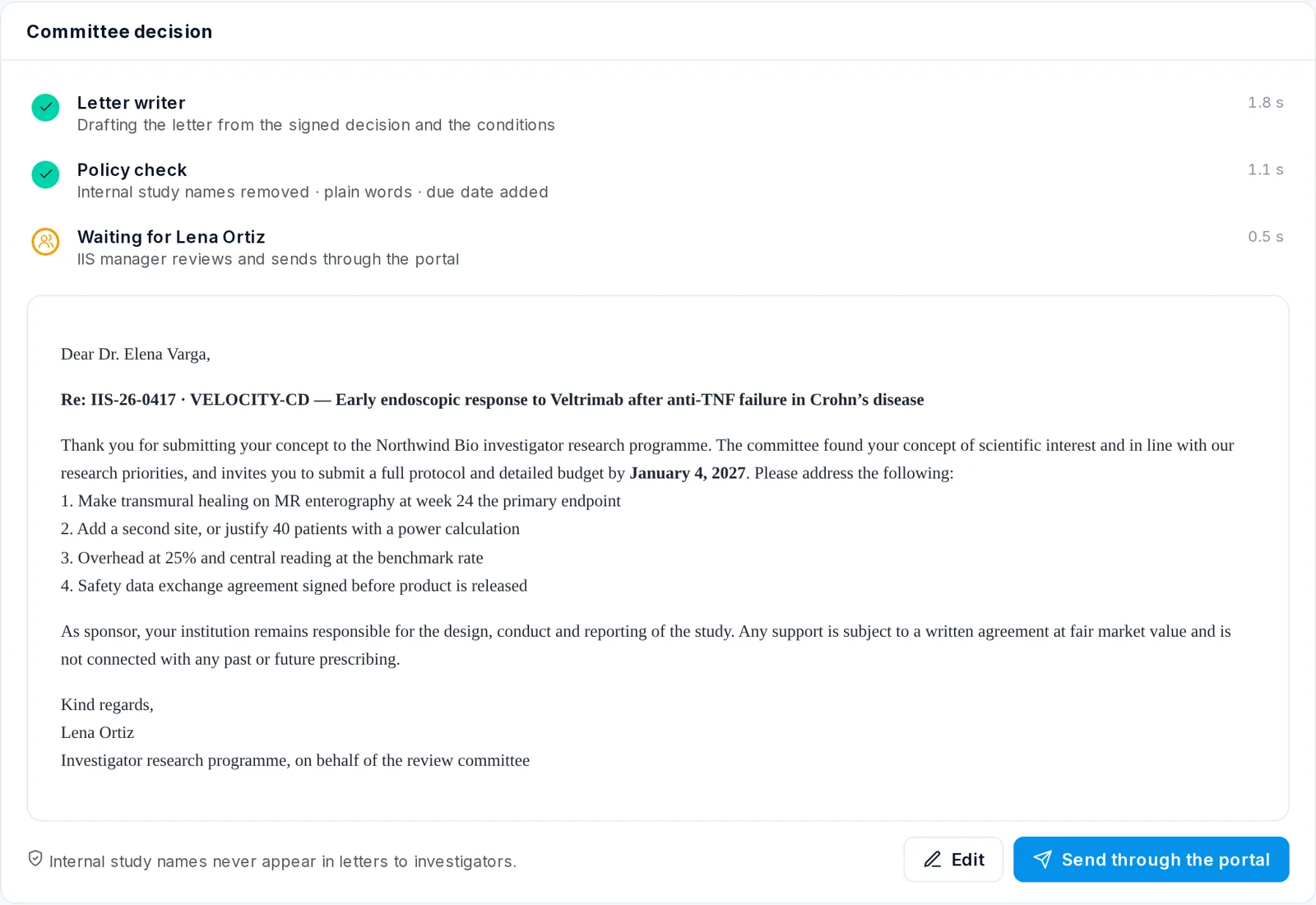
What the investigator most needs is a reason they can act on. In the sample cycle, the letter asks for a full protocol by January 4, 2027, under four numbered conditions, and states that the institution remains the sponsor and that support "is not connected with any past or future prescribing". A policy check removes internal company study names before the programme manager edits and sends it. How the committee scores a concept traces each condition in that letter back to its criterion.
What the investigator receives: conditions, a due date, no internal names
The same cycle with agents preparing the work
With agents, each person receives their part of the work already done: a cited summary, a screen, a quantity, a packet or a draft. Seven agents do the reading and cross-checking in Investigator-Initiated Study Review; four people make the calls. The relay keeps its shape, but every blue arrow in the diagram above now carries work the agents have already prepared and cited.
Five reviewers and the investigator: the question each brings
Today
“Half my week goes on chasing what’s missing.” Screens portal concepts, assigns reviewers, builds the docket by hand.
With agents
Each concept arrives read and cited, with missing items named; the docket fills as reviewers sign; the letter arrives drafted.
Still theirs: assigning, the docket, editing and sending the letter
Today
“Tell me first whether we already answer this question.” Checks overlap from memory.
With agents
Opens a packet already scored and searched against company, funded and registry studies, every finding cited.
Still theirs: the recommendation, its conditions and the signature
Today
“Rank them, show me why, and show me the overlap.” Ranks on packets of uneven depth.
With agents
Sees the cycle ranked on one scorecard and one page per concept, with scores, overlap and votes.
Still theirs: the decision and its signature
Today
“Support can never follow prescribing.” Relies on someone forwarding the cover email.
With agents
Receives every red flag the screener raises; scientific review pauses until it is resolved.
Still theirs: clearing or holding every flag
Today
“Tell me the quantity before you approve.” Forecasts after the decision.
With agents
Sees vials, pens and timing per concept before the vote.
Still theirs: confirming stock and timing
Today
A portal status, then a decision weeks later, with reasons of uneven clarity.
With agents
A letter with numbered conditions, a due date and the support terms stated plainly.
Still theirs: the design, the protocol and the sponsor’s duties
Investigator-Initiated Study Review: agents prepare, people decide
Agent
Concept readerTurns the concept form, budget sheet and cover email into cited fields.
Never: guesses a missing field; it reports it missing
Agent
Five checks in parallelPriority fit, design quality, overlap, feasibility and budget, and compliance, each quoting its source.
Never: clears a red flag or edits the investigator’s budget
Agent
Packet writerDrafts a cited summary of at most 180 words and proposes conditions.
Never: signs, or names internal studies in a letter
A person decides
Scientific reviewerEdits the summary, sets the conditions, chooses the recommendation and e-signs it.
A person decides
ComplianceClears or holds every red flag before the concept can be ranked.
A person decides
Committee and chairMembers vote with a quorum; the chair signs the decision with its meaning stated.
The seven agents are each defined as much by what they may never do as by what they do. Scoring weights and thresholds are programme settings, and every change to them is versioned in the audit trail.
What stays human in IIS review, and why
Every decision that commits the company, and every signature that attests to it, stays with a person. That is a design choice with outside backing. NIH prohibits generative AI in its own grant peer review, partly because sharing application material with such tools breaches review confidentiality (notice NOT-OD-23-149). A company's IIS review is not NIH peer review, but the principle carries: the judgment belongs to the named reviewer.
Three lines hold in the solution. Agents score, cite and draft; they never decide, sign or clear a flag. Signatures carry their meaning, name and time: the reviewer's states "I reviewed this proposal and its cited evidence and make this recommendation to the IIS review committee." And internal studies are used to find overlap but never reach the investigator; a policy check strips their names from every letter.
What changes is where human time goes. The reviewer spends it on whether the question is worth answering, not on finding the registry entry. The chair spends it on the ranking, not on evening out packets. Compliance spends it on the flags, not on reading every email in case one exists.
Questions people ask
Who sits on an IIS review committee?
Usually medical affairs leads for each therapeutic area, with biostatistics, clinical, regulatory, safety and legal; clinical pharmacology or translational research join as needed. Compliance and drug supply often attend without a vote, and the chair, in many programmes a senior medical affairs or evidence-generation leader, signs the decision.
Can a medical science liaison propose or solicit an IIS?
An MSL may discuss a company's published areas of interest, but PhRMA's principles say companies "should not solicit research projects" from investigators. In practice MSLs are deeply involved: in a survey of 179 Spanish MSLs, 79% took part in developing investigator-initiated trials, which is why the line between scientific exchange and solicitation needs a written rule.
How long does an investigator-initiated study review take?
The rolling model MAPS describes aims to answer a brief application within 45 days, with funding decided at quarterly meetings. An academic consortium measured a median of 61 days from submission to a sponsor's decision, with a long tail to 183 days at the upper quartile. Contracting after a yes adds its own months.
Does an investigator-initiated study need an IND?
Not always. A study of a drug lawfully marketed in the US is exempt under 21 CFR 312.2(b) if it is not meant to support a new indication or significant labelling change, does not raise risk through route, dose or population, and runs with ethics review and informed consent. A new indication, a new dose or an unapproved product needs an IND, which the sponsor-investigator files.
Do investigator-initiated trials post their results?
Less reliably than company trials. Of 4,209 ClinicalTrials.gov trials due to report, 40.9% did so within the one-year deadline, and industry sponsors were about three times as likely to comply as non-industry sponsors (odds ratio 3.08). That gap is one reason committees now ask for a registration and publication plan at the concept stage.