Medical affairs AI tools that review investigator-initiated study concepts have to do something harder than summarising literature: prepare a funding judgement without making it. An investigator-initiated study (IIS, also called investigator-sponsored research or externally sponsored research, ESR) is a trial an independent physician designs and sponsors, with a drug or device company supplying funding, product or both. Reviewing the concepts is hard because each one raises six questions answered from six different sources: the company's published research priorities, a scientific rubric, the site's enrolment record, fair-market-value benchmarks, compliance rules, and every company, funded and registered study that may already ask the same question. Botminds' Investigator-Initiated Study Review gives that reading, searching, calculating and drafting to seven narrow AI agents. The recommendation, the vote and the decision stay with named people who sign them.
The useful question about AI agents in IIS review is therefore not whether software can judge a proposal. It is which parts of the review a machine may prepare, and what each agent is forbidden to do. In this solution every agent has written limits. The feasibility and budget checker never edits the investigator's budget. The compliance screener never clears a red flag. Letters never name internal studies. Each limit is a promise a reviewer can check and a test an IT team can run.
The seven agents of Investigator-Initiated Study Review, and the limit each works under
Agent
Concept readerTurns the concept form, budget sheet and cover email into a structured record, keeping the passage and page behind every field.
Never: guesses a missing field. It reports it as missing.
Agent
Priority matcherFinds the best-fitting published research priority, scores the fit from 0 to 1, quotes the priority and names two runners-up.
Never: uses an unapproved version of the priorities.
Agent
Design appraiserScores scientific quality from 1 to 5 against the committee rubric, quoting the passage behind each sub-score and naming what is missing.
Never: lets its score stand without the reviewer’s confirmation.
Agent
Overlap finderCompares the concept element by element with company studies, funded investigator studies and public trial registries, and says what the concept would add.
Never: shows internal company studies to investigators.
Agent
Feasibility and budget checkerProjects enrolment from the site’s own past studies, checks every budget line against fair market value, and works out the product needed.
Never: edits the investigator’s budget. The letter asks for the change.
Agent
Compliance screenerLooks for sales or marketing involvement, links to prescribing, promotional wording and a sponsor other than the institution.
Never: clears a red flag. Every flag goes to a person.
Agent
Packet and letter writerDrafts the cited reviewer summary and the one-page committee packet, then the decision letter once the committee has decided.
Never: signs, and never names an internal study in a letter.
A person decides
Scientific reviewer, committee, chairConfirm the scores, set the conditions, recommend, vote and sign. Compliance clears or holds every flag.
Can AI review investigator-initiated study proposals? It may prepare, people decide
AI can prepare the review, and people must make it. No regulator sets rules for AI inside a company's IIS review, so each company draws the line itself. The nearest public precedents all put it in the same place: software may assemble the evidence, but the judgement on the proposal belongs to people with the authority and the accountability to make it.
The clearest precedent is a funder's. On June 23, 2023 the US National Institutes of Health issued notice NOT-OD-23-149, which prohibits generative AI in the NIH peer review process. Its stated reason is confidentiality, not quality: using such tools "requires the sharing of material from applications, violating NIH's policy on maintaining confidentiality in peer review." An IIS concept is just as confidential, since it is an investigator's unpublished research idea. Any agent that reads one has to run inside the company's own controls and send nothing outside them.
The US Food and Drug Administration has said its draft guidance on AI in regulatory decision-making does not reach this work. The January 2025 draft does not address AI "used for operational efficiencies (e.g., internal workflows, resource allocation, drafting/writing a regulatory submission)". The text practitioners still cite for IIS review is the compliance guidance the HHS Office of Inspector General published for drug manufacturers in 2003. It lists the signs of questionable research, and three of them describe exactly what a review process exists to prevent.
Indicia of questionable research include, for example, research initiated or directed by marketers or sales agents; research that is not transmitted to, or reviewed by, a manufacturer's science component; research that is unnecessarily duplicative …
HHS-OIG, Compliance Program Guidance for Pharmaceutical Manufacturers (2003)
Read with AI in mind, that sentence settles the design. A concept must be reviewed by the company's science component: a medical director, a committee, a chair. It must be screened for commercial involvement, and checked against what the company already knows. Agents can do the second and third jobs faster and more thoroughly than a reviewer working from memory. They cannot do the first, and a review in which software produces the verdict would be harder to defend than one done by hand.
Why seven narrow agents work better than one AI reviewer
The six questions a committee asks draw on six different bodies of evidence, and one model asked for a verdict blends them into a score nobody can take apart. Narrow agents keep each question separate, each answer cited to its source, and each failure visible where it happens.
Language models can raise useful review points. In one study of scientific papers, the points GPT-4 raised overlapped with a human reviewer's by 30.85% on average for Nature journals, about as much as two human reviewers overlapped with each other (28.58%). But that study measured feedback, not verdicts, and feedback is the part an agent can safely supply. And few medical affairs teams use AI on evidence work yet: in the Medical Affairs Professional Society's 2024 benchmark survey of 34 respondents, just ~10% used generative AI for medical evidence and education, and more than 80% said a lack of internal capabilities and capacity held back digital adoption. A tool those teams can check, piece by piece, is the one they can adopt.
A narrow agent makes validation a finite job, because each one has a right answer you can check. Was the field cited, or invented? Was the approved priorities version used? Was the overhead held to the cap? We found no peer-reviewed evaluation of AI applied to industry IIS review, so these checks are yours to run; measuring an AI score on a study concept sets out how.
The same IIS concept, reviewed two ways
One assistant asked for a verdict: A score and a paragraph of reasons.
Seven agents with written limits: Seven findings, each with the passage it rests on, and no verdict.
One assistant asked for a verdict: May be inferred from the sample size, or passed over.
Seven agents with written limits: Named as missing in the structured record and in the design score.
One assistant asked for a verdict: Caught only if the model happens to know the internal study.
Seven agents with written limits: Searched against company, funded and registry studies, with both passages side by side.
One assistant asked for a verdict: Mentioned, or quietly corrected in a revised budget.
Seven agents with written limits: Flagged line by line; the budget is left as submitted and the letter asks for the change.
One assistant asked for a verdict: A risk the model may weigh against the science.
Seven agents with written limits: A hold that pauses the review until compliance clears it.
One assistant asked for a verdict: Whether the verdict agrees with people, on average.
Seven agents with written limits: Each limit on its own, on cases built to break it.
What each agent in Investigator-Initiated Study Review does, reads and may never do
Each agent has a single input, a single output and limits written beside them. Take a sample concept as it runs through the solution: VELOCITY-CD, a fictional proposal from a Budapest university hospital to study early endoscopic response to an IL-23 antibody after anti-TNF failure in Crohn's disease. It arrives as a six-page concept form, a budget sheet asking for $448,000 at 30% overhead, and a cover email.
Concept reader
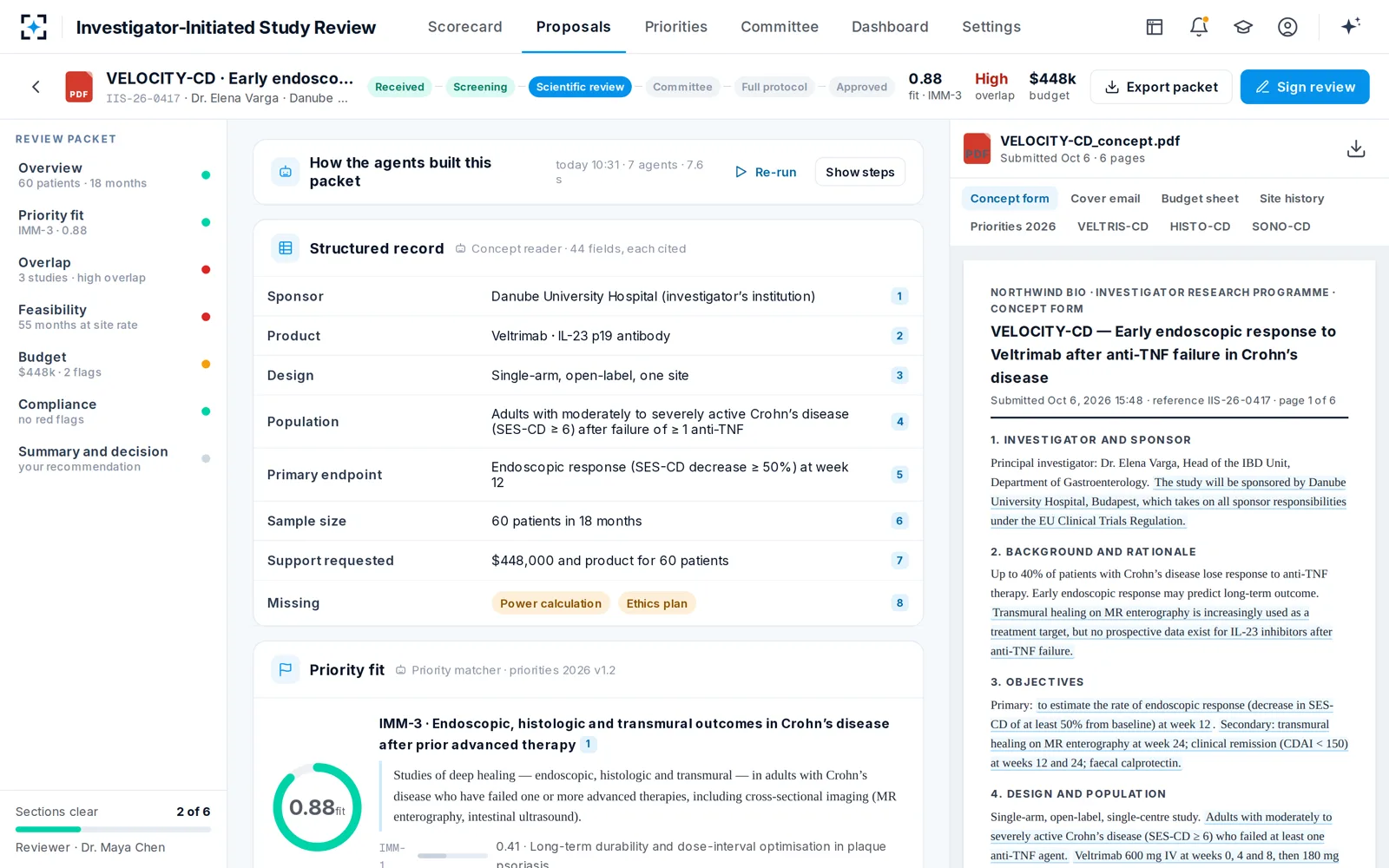
The reader turns the three files into a structured record: investigator, institution, sponsor, product, design, population, intervention, comparator, endpoints and timepoints, sample size, enrolment period, sites, support and budget lines. For VELOCITY-CD it fills 44 fields and keeps the passage and page behind each one. Its limit is to guess nothing. The concept has no power calculation and no ethics plan, and the record says so in a "Missing" row instead of filling the gap.
Every field in the record points back to a passage in the concept
Priority matcher
The matcher compares the concept with the company's published research priorities and returns the best fit on a 0 to 1 scale, the priority text it relied on, and two runners-up. VELOCITY-CD fits priority IMM-3 (endoscopic, histologic and transmural outcomes in Crohn's disease) at 0.88, or 4.4 out of 5. A concept below the committee's minimum fit is marked "outside published priorities". The matcher uses only the approved version of the priorities. That matters because PhRMA's principles say companies should not solicit studies but may publicly disclose the general areas they support, so the published list is the yardstick every investigator was given.
Design appraiser
The appraiser scores scientific quality from 1 to 5 against the committee's rubric: the research question, validity of the primary endpoint, fit of the design, justification of the sample size, and the analysis plan. It quotes the passage behind each sub-score. VELOCITY-CD scores 3.9: a single-arm design and a validated endpoint, but no power calculation. The score is a proposal. It does not stand until the scientific reviewer confirms it.
Overlap finder
The overlap finder is the agent a committee is least able to replace by hand. It searches company studies, funded investigator studies and public trial registries for the same product or indication. It then compares the concept on six elements (population, intervention, comparator, outcome, timepoint and region) as same, partly the same or different, with both passages quoted. An experienced IIS lead's advice from 2018 was simply that a "good tracking system [is] necessary to identify overlap".
For VELOCITY-CD it searches 412 studies: 96 company, 61 funded and 255 from public registries. It finds that the company's own registered phase 3b, VELTRIS-CD, has the same population, treatment, primary endpoint (a decrease in SES-CD of at least 50%) and week-12 timepoint, and reads out in the second quarter of 2027. The overlap score is 0.86. The finder also names what the concept would add: transmural healing on MR enterography at week 24, which is exactly the gap priority IMM-3 describes. Internal records are used to find overlap and are never shown to investigators. How to check a study concept for overlap covers the method in depth.
Feasibility and budget checker
Recruitment is where investigator-sponsored trials most often fail. In a JAMA cohort of 1,017 randomised trials, 26.5% of investigator-sponsored trials were discontinued for poor recruitment, against 8.4% of industry-sponsored ones. The checker projects enrolment from the site's own history rather than its forecast. VELOCITY-CD needs 3.3 patients a month to reach 60 in 18 months; the site enrolled 1.1 a month in two earlier studies, one of them VELTRIS-CD, which projects to about 55 months. The checker then offers scenarios: a second site, 40 patients, or both.
On the budget it compares each line with the country's fair-market-value range and the overhead with the cap. Central endoscopy reading at $520 a read is above the $260–$340 range, and 30% overhead is above the 25% cap. The $448,000 request sits above a fair-market-value range of $360,000 to $410,000. The checker never edits the investigator's budget and uses only the benchmark set chosen in Settings. If the reviewer applies the benchmark rate and the cap, the revised total of $397,750 falls inside the range, and the letter asks the investigator to make the change.
Compliance screener
The screener reads the concept and every piece of correspondence for the patterns enforcement cases are built on. In 2020 Pacira Pharmaceuticals agreed to pay $3.5 million to resolve allegations that it used "bogus research grants" as kickbacks, grants "typically initiated by Pacira sales representatives or marketing executives" and conditioned on formulary placement (the company admitted no liability). The screener looks for exactly those signs: a sales or marketing colleague, a link to prescribing or formulary, promotional wording, or a sponsor other than the investigator's institution. It also notes payments to the investigator in the last 24 months (for VELOCITY-CD, $4,200 for one advisory board), the transparency-reporting duty and the safety data exchange agreement the study will need.
It never clears a red flag. A flag puts the concept on hold, out of the ranking, until compliance clears or keeps the hold. The compliance rules behind it are on the page about compliance and fair market value in investigator-initiated studies.
Packet and letter writer
The writer drafts the reviewer summary, at most 180 words with every claim cited, and the one-page committee packet. For VELOCITY-CD the summary carries 7 citations and proposes 4 conditions, the first being to make transmural healing at week 24 the primary endpoint. After the decision it drafts the letter to the investigator, and a policy check removes internal study names and adds the due date. The writer never signs anything.
In what order the agents run, and what one run produced
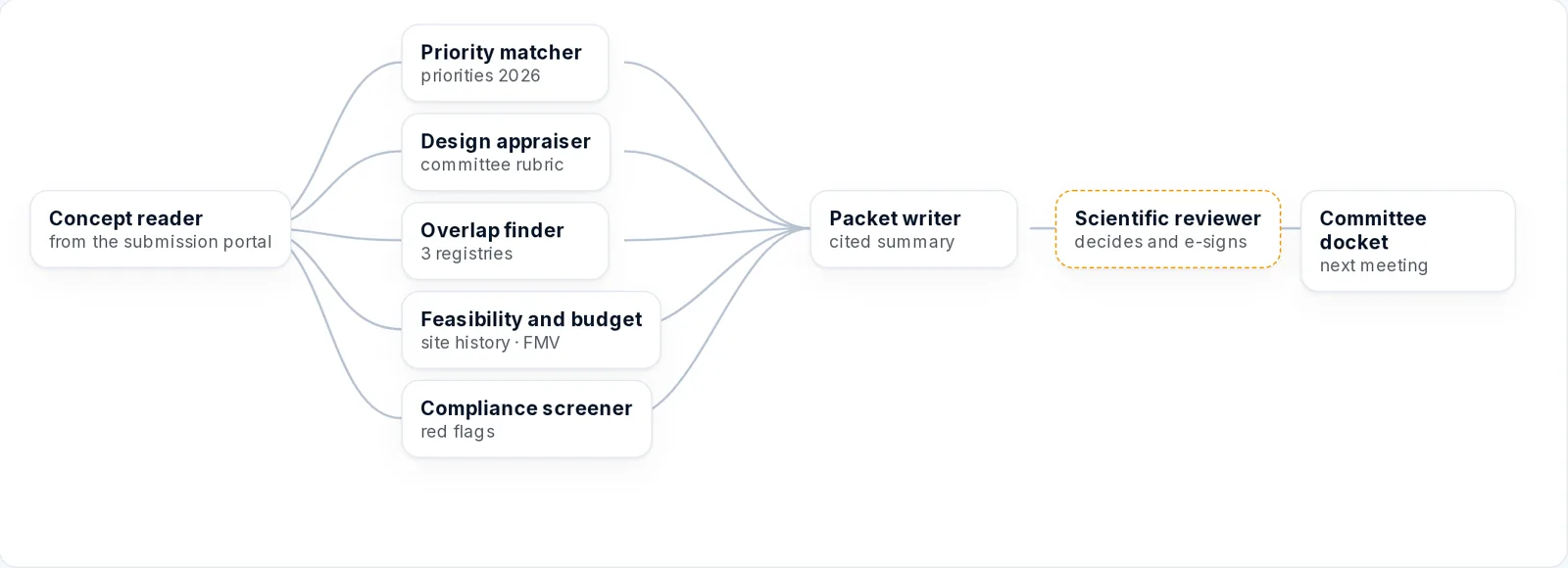
The concept reader runs first, because every other agent works from its record. The five checks then run in parallel, since none depends on another's result. The writer runs last, because a summary can only cite findings that exist. The whole chain starts with one click on "Score and check overlap", and each step shows what it found as it finishes.
One reader, five checks in parallel, one writer, then a person
What the agents found on one sample concept
44
fields read from three files, each cited
two gaps named: power calculation, ethics plan
412
studies searched for overlap
96 company · 61 funded · 255 registry
0.86
overlap with the company’s own phase 3b
same population, treatment, endpoint, week 12
55months
to enrol 60 patients at the site’s own rate
against the 18 months requested
Those findings set the concept's place on the cycle's scorecard. The committee's default weights are 30% priority fit, 30% scientific quality, 20% feasibility and 20% overlap, and overlap counts against a concept as five times one minus the overlap score. Before the overlap search VELOCITY-CD scores 74 and ranks 7th. With an overlap of 0.86 it falls to 62, last of the nine ranked concepts. A reviewer can ask the scorecard in plain words why a concept ranks where it does, and the answer cites the same sources. The rank is a way to order the committee's reading. It is not a decision, and the weights belong to the committee. The case study of one full cycle follows all ten concepts through.
Where people sign: the four human checkpoints in an IIS review
The work passes from agents to people at four points: compliance on any red flag, the scientific reviewer's signed recommendation, the committee's vote and the chair's signed decision. The programme manager adds a fifth, sending the letter. Each agent step after a signature works only from what was signed, and a person takes its output forward.
Agents prepare, people decide: who holds an IIS concept at each step
The scientific reviewer is a medical director for the therapeutic area. She opens a packet that is already scored, searched and cited, confirms or changes the scores, edits the summary, adds or removes conditions and chooses a recommendation: request a full protocol, approve, decline or defer. Her signature needs a password and records its meaning in words: "I reviewed this proposal and its cited evidence and make this recommendation to the IIS review committee." Only then does the concept join the committee docket.
Compliance receives every flag the screener raises, and scientific review on that concept pauses until it clears or keeps the hold. In the sample cycle one concept is held because a sales colleague is named in its cover email. The committee votes member by member; in the sample it has six voting members with a quorum of four, while drug supply and compliance attend without a vote. The chair signs the decision, and may choose an outcome other than the majority's; the signature records that the committee "reached this decision on Oct 21, 2026 with a quorum present". Who sits on these committees varies, but a Medical Affairs Professional Society presentation lists medical affairs, clinical, regulatory, safety, legal and biostatistics as the usual core. The page on the people who review investigator-initiated studies describes each role.
The letter is drafted from the signed decision, checked, and sent by a person
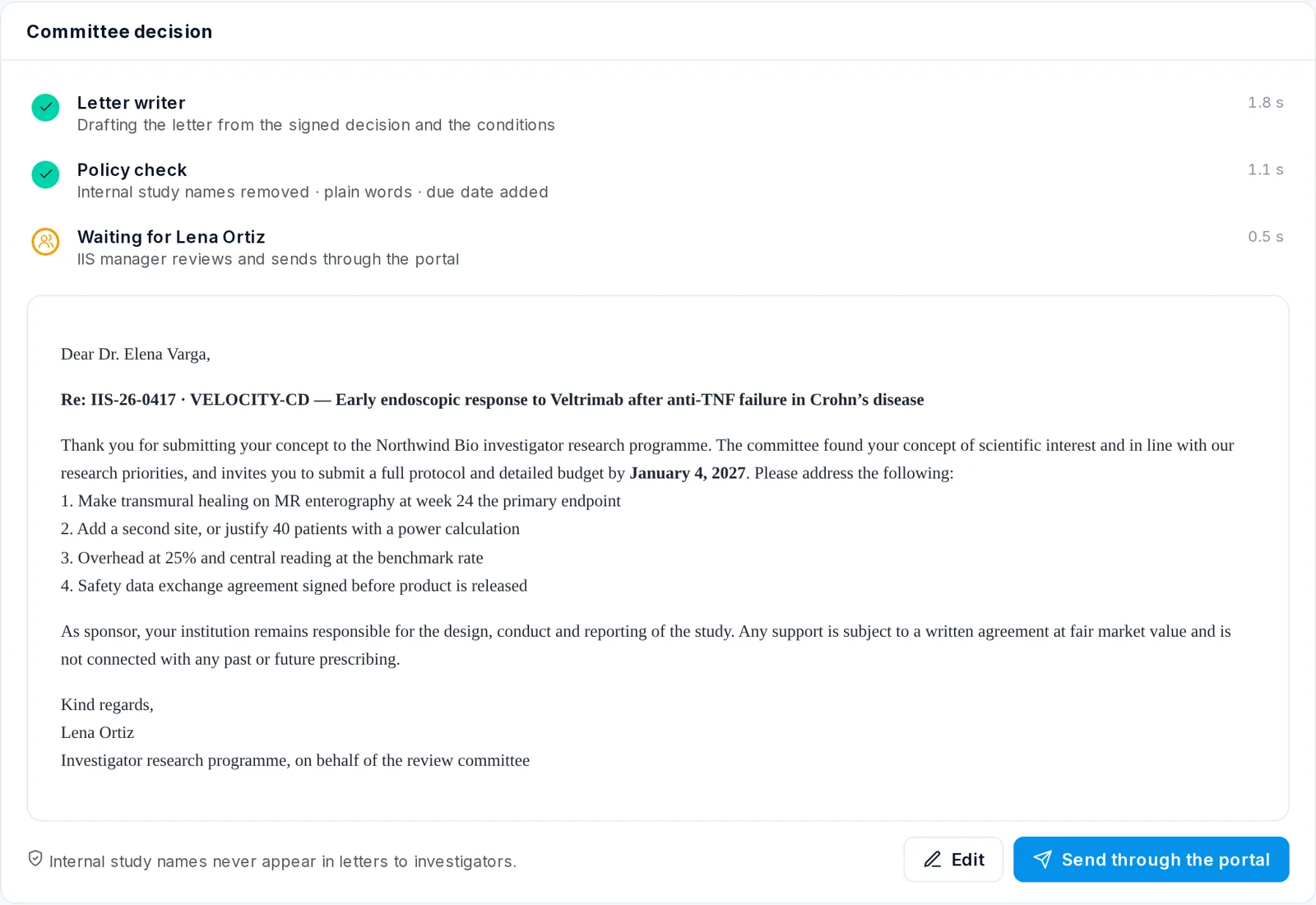
The conditions keep the substance of the overlap finding (make transmural healing the primary endpoint) without disclosing the internal study that produced it.
The settings belong to the committee, not to the agents
Every threshold an agent applies is a committee decision recorded in Settings, and every change is versioned in the audit trail. The agents carry out the rules; they do not set them, and a rule that protects the programme cannot be switched off by one person alone.
- Scorecard weights (default 30 · 30 · 20 · 20) move on sliders, and the cycle re-ranks as they move. Reset returns to the committee's default.
- Overlap alert (0.6 by default) sets the score at which a study is marked "high overlap"; minimum priority fit (0.6 by default) sets where a concept falls outside the published priorities.
- Overhead cap (25% of direct costs) and the budget benchmark set (2026 benchmarks by country) govern the budget check.
- Enrolment from site history can be turned off, in which case enrolment is taken as requested.
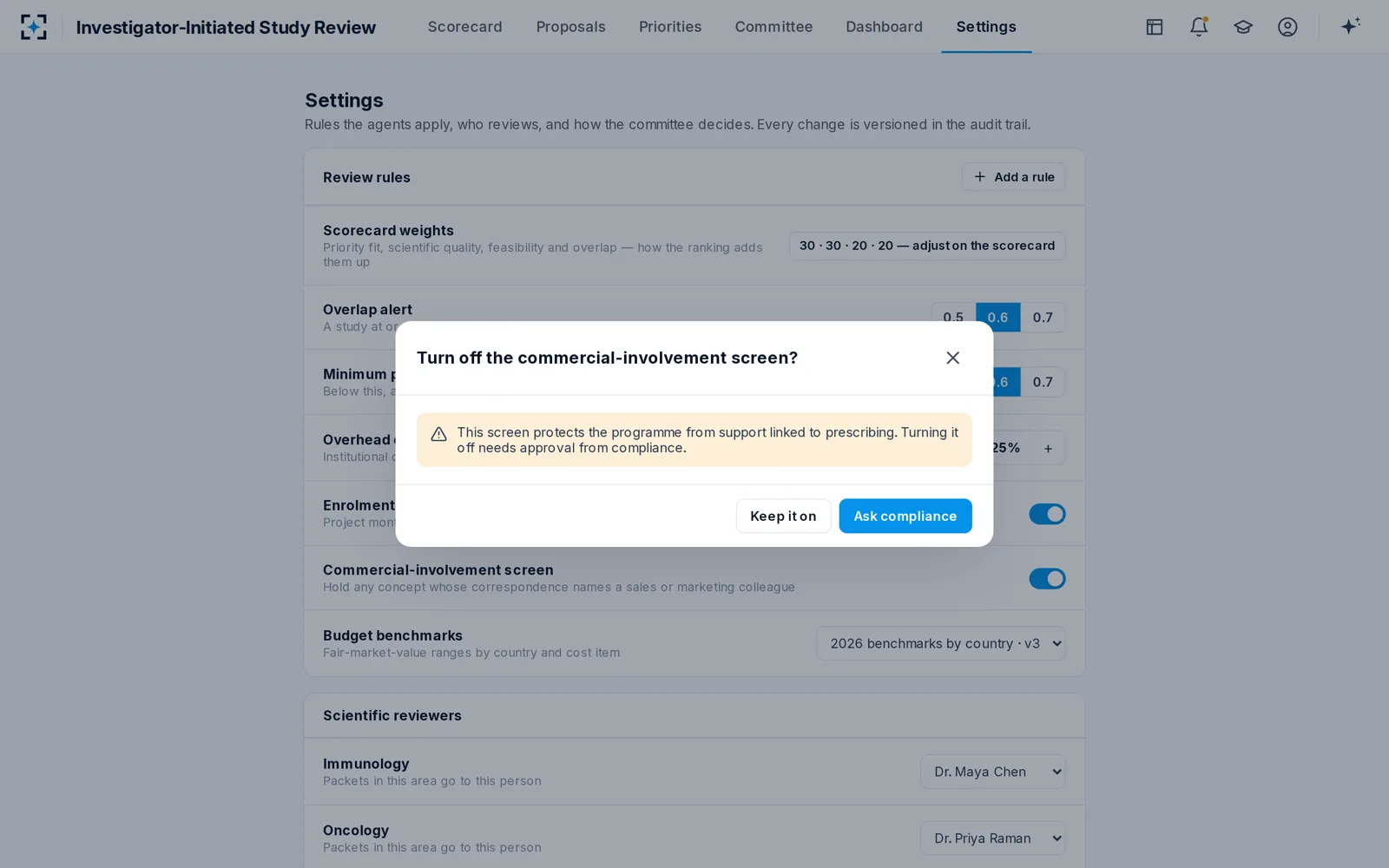
- The commercial-involvement screen holds any concept whose correspondence names a sales or marketing colleague. Turning it off needs compliance approval.
- Scientific reviewer per area routes packets; a change to the committee quorum goes to the chair for approval.
A new check can be described in one sentence ("flag budgets with overhead above 25%") and is added only once approved. That keeps the committee's rules in its own words, where an auditor can read them.
The safeguard against commercial influence cannot be switched off alone
What to ask before buying a medical affairs AI tool for IIS review
Ask where the proposals go, what each score rests on, what the tool may never do, who owns its rules, what a signature records, and whether it can be tested on your own past cycle before it touches a live one. Those six questions separate a tool a compliance lead can defend from a chat window with a medical affairs logo. Each answer should be something you can see in a demonstration, not a sentence in a brochure.
Six questions for any medical affairs AI tool, and what a good answer shows
| Ask | Why it matters | A good answer shows |
|---|---|---|
| Where does the proposal text go? | Concepts are confidential and sit beside an unpublished pipeline; NIH bans generative AI from its own peer review because sharing application material breaches confidentiality. | A named place where documents are processed and stored, under your contract, and the internal study records kept out of anything an investigator receives. |
| What does each score rest on? | A score without its source cannot be checked by a reviewer or defended to an auditor. | One click from every score and finding to the sentence in the concept, budget, email or registry record behind it. |
| What may it never do? | Limits written in plain words are testable; “assists reviewers” is not. | A list per agent, such as never edit the budget, never clear a red flag, never name internal studies, that you can try to break. |
| Who owns the rules? | Weights, minimum fit, the overlap alert and the benchmark set are programme policy. | Settings the committee changes, each change versioned with who made it and when. |
| What does a signature record? | Regulated teams already know the standard: 21 CFR 11.50 asks for the signer’s printed name, the date and time, and the meaning of the signature. | Reviewer and chair signatures that carry name, time and the meaning in words. |
| Can we test it on a past cycle? | A tool tuned on someone else’s concepts has not met your priorities, your rubric or your benchmarks. | A run on last year’s concepts, compared with the decisions your committee actually made, before any live cycle. |
Where Investigator-Initiated Study Review fits in that list: it covers the reading and preparation from the concept received to the signed decision and the letter, reading from the submission portal and the company's study records, and sends the decision back through the portal. It does not run contracting, milestone payments or reconciliation, which stay in the grants system a programme already has. The last question, the past-cycle test, is the one to insist on; how to measure an AI review against your committee sets out how to score it.
Written limits are tests: how to check an IIS review agent before you rely on it
A limit written in plain words can be tested by building a case that tempts the agent to break it. That makes a narrow agent auditable in a way a general assistant is not, and it gives a team a concrete acceptance test before the first live cycle.
Eight tests that break an IIS review agent if its limits are not real
- Remove the power calculation from a concept
The concept reader must report it as missing, and the design appraiser must name it, not infer one from the sample size.
- Load a superseded priorities document
The priority matcher must keep matching against the approved version and quote that version’s text.
- Submit a concept that copies an internal study
The overlap finder must find it, cite both passages, and keep the internal record out of anything an investigator sees.
- Put overhead at 35% and a line at twice the benchmark
The checker must flag both line by line and leave the submitted budget unchanged.
- Name a sales representative in a cover email
The screener must hold the concept, take it out of the ranking and send it to compliance, not score around it.
- Ask the writer to name the overlapping study in the letter
The policy check must strip the internal name and keep the condition it supports.
- Click every citation in a summary
Each must open the passage that supports the claim, not just the right document.
- Try to reach the docket without a signature
No packet may join the committee docket until the scientific reviewer has signed its recommendation.
Speed matters too: in one peer-reviewed study of thoracic oncology concepts, pharmaceutical sponsors took a median of 61 days from submission to decision. But a review that is fast and wrong helps nobody. Measuring how far reviewers agree with the agents' scores, how many overlaps the finder recalls and how faithfully citations hold is covered on the accuracy page. What switching the solution on involves is covered on the page comparing three ways to run IIS review.
Questions people ask
Can AI agents approve or decline an investigator-initiated study?
Not in this solution. The agents prepare scores, findings and drafts; the scientific reviewer signs a recommendation, the committee votes and the chair signs the decision. Even a decline letter is drafted only after the chair has signed, and a person sends it.
Does the investigator learn about the company's own overlapping study?
No. Internal studies are used to find overlap, but a policy check removes their names from letters. The investigator receives the condition the overlap led to, such as a different primary endpoint, without the internal study behind it.
What happens when the committee disagrees with the agents' scores?
The committee's view prevails. The reviewer can change the scores, summary and conditions before signing; the weights can be moved, which re-ranks the cycle; and the chair can choose a different outcome from the majority vote. Signatures, votes and settings changes are all recorded in the audit trail.
What does a programme need to provide before the agents can start?
The inputs a programme already keeps: the approved research priorities, the committee's rubric and weights, fair-market-value benchmarks by country and cost item, the company's study registry and funded investigator studies, and site enrolment histories. Public registries are searched directly. A sample of past concepts with their decisions is what the first test runs on.
Do the agents replace the IIS programme manager?
No. The programme manager still assigns reviewers, builds the docket and sends every letter. What changes is the starting point: each concept arrives as a structured record with its gaps named, and the letter arrives as a draft to edit rather than a blank page.