Fair market value in clinical research is the price an independent buyer would pay for the research work at arm’s length, set by a documented method and never by how much business the payee might bring; for a company supporting an investigator’s study, it is the line between research and reward. An investigator-initiated study (IIS, also called investigator-sponsored research or ISR, and externally sponsored research or ESR) is research an independent doctor designs and sponsors, with a drug company supplying product, money or both. The compliance requirement behind every rule that touches it is one sentence: the support must buy legitimate research at fair market value and must not be a reward for prescribing. The HHS Office of Inspector General's 2003 guidance, the Anti-Kickback Statute, the Sunshine Act's Open Payments reporting and the EFPIA Code each restate that line in their own words. Botminds' Investigator-Initiated Study Review is software in which AI agents prepare each concept for a medical affairs review committee; this page is about the part compliance officers, legal reviewers and grants budget reviewers own: the commercial-involvement screen, the payment history, the budget checked line by line against benchmark ranges, the overhead cap, and the letter that leaves internal studies out.
The principle is easy to state and hard to show. An auditor does not ask whether your programme believes in independence; they ask how a given concept was screened, who cleared it, and why this budget was the price. That is a method question. This page quotes the texts, maps each to a step of review, and works one sample budget through. It is a reading of public texts, not legal advice; your counsel and your SOPs decide how they apply to you.
Research money is large, reported and criminally exposed
$9.50B
Research payments reported to CMS Open Payments for program year 2025
All research, mostly company trials; no field marks an IIS
$100k
Maximum fine per Anti-Kickback Statute felony, with up to 10 years in prison
42 U.S.C. 1320a-7b(b)
$3.5M
Pacira settlement over what the US Attorney called "bogus research grants"
Allegations only; no admission of liability
£647.3M
R&D transfers of value disclosed in the UK for 2025, 70% of the total
ABPI, Disclosure UK
What makes support for an investigator-initiated study lawful?
It must pay for research the company has a scientific reason to support, at fair market value, kept apart from sales. The OIG says it in one line of its 2003 Compliance Program Guidance for Pharmaceutical Manufacturers: "Payments for research services should be fair market value for legitimate, reasonable, and necessary services." Three tests sit inside that sentence. Legitimate: the research is real and the company's science function wants it. Reasonable: the price matches what the work costs in that country. Necessary: the study is not repeating something already answered.
The same guidance names the risk the tests guard against. Research grants, "if linked directly or indirectly to the purchase of product", can be "misused to induce the purchase of business", so "manufacturers should insulate research grant making from sales and marketing influences." The remedy it prescribes is organisational before it is financial: separate who decides from who sells.
"Indicia of questionable research include, for example, research initiated or directed by marketers or sales agents; research that is not transmitted to, or reviewed by, a manufacturer's science component; research that is unnecessarily duplicative or is not needed by the manufacturer for any purpose other than the generation of business; and post-marketing research used as a pretense to promote product."
HHS-OIG Compliance Program Guidance for Pharmaceutical Manufacturers, 68 FR 23731, May 2003
Read that list as a review specification. Each indicium becomes a question a review must answer and leave evidence for: who initiated the concept, did the science function review it, does it duplicate a study already running, and is the post-marketing study a study. The OIG has been warning about the last one since its 1994 Special Fraud Alert, which described a "research grant" program where physicians made "brief notes, sometimes a single word, about the treatment outcome" and were paid for it.
The IIS compliance rules in the US and Europe, and what each asks of review
Six texts carry most of the weight: two US laws, the OIG guidance, the US reporting rule, the EFPIA Code and PhRMA's IIS principles. They differ in force, from felony statute to industry code, but they converge on the same handful of controls.
Six texts, quoted, and the review step that answers each
What the text says: Whoever "knowingly and willfully solicits or receives any remuneration … directly or indirectly, overtly or covertly, in cash or in kind" in return for ordering or recommending federally reimbursed items commits a felony.
The step in review that answers it: Screen every concept and its correspondence for a link to prescribing, purchasing or formulary before scientific review starts.
What the text says: Compensation "consistent with fair market value in arm's-length transactions" and not set by "the volume or value of any referrals or business".
The step in review that answers it: Price each budget line against a benchmark range for the country and cost item, chosen before the concept arrived.
What the text says: "Insulate research grant making from sales and marketing influences"; duplicative research is an indicium of questionable research.
The step in review that answers it: Hold any concept a sales colleague touched; check every concept for overlap with company and funded studies.
What the text says: Research payments "must be reported to CMS separately", including those made "indirectly to a covered recipient through a third party".
The step in review that answers it: Know, at approval, what will be reported, against which study name and principal investigator.
What the text says: Grants must "not constitute an inducement to recommend and/or prescribe"; "Donations and Grants to individuals are not permitted."
The step in review that answers it: Pay the institution, never the investigator; disclose R&D transfers of value under the national code.
What the text says: Support only for "legitimate, reasonable, and necessary study activities" at no more than fair market value, "paid in stages based on pre-determined milestones".
The step in review that answers it: Write milestones and a fair-market-value statement into the decision and the contract.
Two caveats on the sources. The statute quoted is the clause on soliciting or receiving; its penalty, "fined not more than $100,000 or imprisoned for not more than 10 years, or both", is the figure in the table above. PhRMA's 2014 statement was written to inform IIS regulation in Japan, so treat it as a statement of industry principles rather than a binding US code; its value is that it is specific, down to "Payments should be made to the institution, not to the individual investigator or any third party, and any unused funds should be returned to the pharmaceutical company."
What the enforcement cases describe, control by control
The settlements read like a list of the controls that were missing. The clearest is Pacira Pharmaceuticals, which in 2020 agreed to pay $3.5 million to resolve allegations, which it did not admit, that it "paid kickbacks to doctors in the form of bogus research grants" for its analgesic EXPAREL, according to the US Attorney's Office for New Jersey. The release describes, point by point, what a review programme exists to prevent.
Each allegation in the Pacira release, and the control that would have caught it
What the release alleges: "The research grants in question were typically initiated by Pacira sales representatives or marketing executives."
The control: A commercial-involvement screen on the concept and its correspondence, with a hold only compliance can clear.
What the release alleges: "Pacira also required that EXPAREL be placed on formulary at the physician's institution before awarding any research grant."
The control: A check for any link to prescribing or formulary; PhRMA: approval "should not be conditioned upon the purchase" of products.
What the release alleges: Pacira "did not contractually require that the grant recipient adhere to the proposed research topic or achieve certain milestones before payment."
The control: Conditions written into the signed decision; payment in milestones tied to the protocol.
What the release alleges: "In some cases, the grant recipient did no work at all."
The control: Milestone payments against deliverables, and a reconciliation at study close.
What the release alleges: Pacira "did not document why it needed the research or the fair market value of the proposal."
The control: A cited fit to a published research priority, and every budget line priced against a benchmark range.
What the release alleges: Executives "coached grant recipients and other employees on how to avoid internal scrutiny of the grant payments."
The control: An audit trail of every step, and a screen no one can switch off without compliance approval.
Device makers have faced the same theory with company-run studies rather than investigator-sponsored ones. In 2011 Medtronic agreed to pay $23.5 million over post-market studies and registries that paid physicians "a fee ranging from approximately $1,000 to $2,000 per patient", and St. Jude Medical $16 million over studies paying each physician "a fee that ranged up to $2,000 per patient". The St. Jude release states the line plainly: companies "can use post-market studies legitimately", but "they cannot use those studies, and the honoraria associated with them, to induce physicians to select their products."
What are the compliance red flags in an investigator-initiated study?
Four recur: a sales or marketing colleague in the correspondence, wording that reads as promotion, a link to prescribing or formulary, and a sponsor other than the investigator’s institution. The screen should run before any scientific scoring, and its finding should stop the concept rather than lower its score. A red flag is not a quality problem that a strong design can outweigh; it is a question about why the concept exists. So the useful design is a hold: the concept leaves the ranking, scientific review pauses, and only a person in compliance can clear it.
That is how Investigator-Initiated Study Review treats it. Its compliance screener reads the concept form, the budget sheet and the cover email for a sales or marketing colleague, wording that reads as promotion, a link to prescribing or formulary, or a sponsor other than the investigator's institution. It never clears a red flag. A held concept is not ranked and no decision is taken on it; the screen itself can only be switched off with compliance approval. What each of the seven agents does, and what it may never do sets out the screener's limits next to the others'.
A red flag stops the concept; a person decides whether it moves again
Agent
Concept readerTurns the concept form, budget sheet and cover email into a structured summary, each field cited to its passage.
Never: guesses a missing field
Agent
Compliance screenerLooks for sales or marketing involvement, promotional wording, a link to prescribing or formulary, a sponsor other than the institution. A finding holds the concept: unranked, scientific review paused.
Never: clears a red flag
A person decides
Compliance clears or holdsOpens a review, asks the field team for the contact log, and decides. Every step is time-stamped.
A person decides
Scientific review resumesOnly a cleared concept goes back to the medical director for scoring and a signed recommendation.
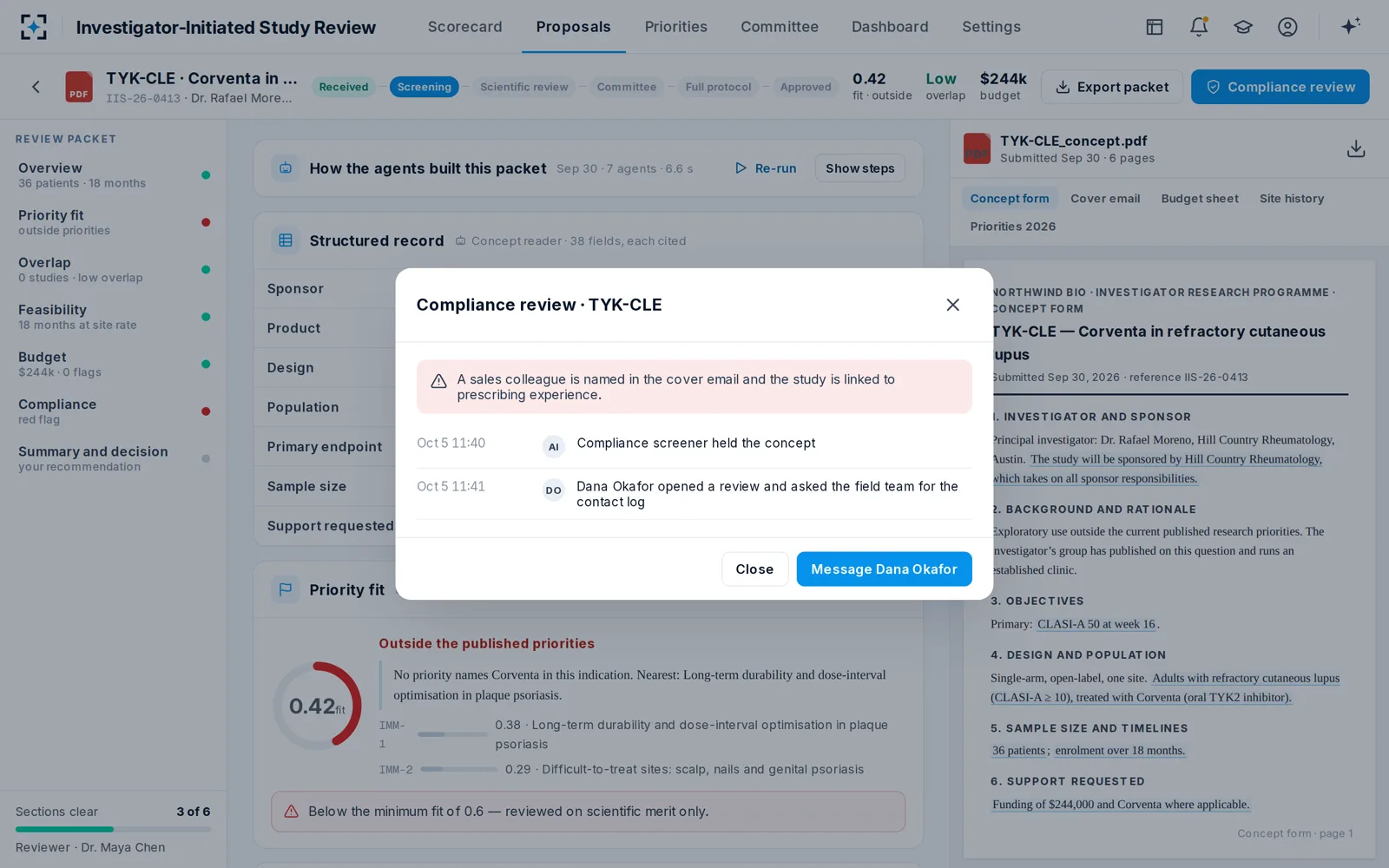
Take a sample concept in the solution, TYK-CLE, submitted with fictional names. The screener held it at 11:40 because "a sales colleague is named in the cover email and the study is linked to prescribing experience". At 11:41 the compliance officer opened a review and asked the field team for the contact log. The scorecard shows the concept below the line; nothing about it can be decided until compliance acts.
A held concept: the reason, the time, and the person who now owns it
One judgement call deserves a written rule: what the screen should flag. Flagging every medical science liaison would drown compliance, because liaisons legitimately take part in scientific exchange; the Medical Affairs Professional Society practice deck lists areas of interest ("AOI") among what field-based liaisons share, "based on detailed documents reviewed by compliance", and PhRMA allows companies to "publicly disclose the general areas or types of studies that it does or does not support". What they may not do is solicit: companies "should not solicit research projects, study descriptions, or protocols from investigators". The screen in the sample notes a named liaison "for scientific exchange only" and flags sales and marketing names. Where to draw it, and how sensitive to make it, is your policy to set.
What is fair market value in clinical research?
It is a range for each cost item in each country, built before any concept arrives, that says what the work would cost between parties with no other business between them. The legal shape comes from the personal-services safe harbor of the Anti-Kickback Statute, under which the method for setting compensation is "set in advance, is consistent with fair market value in arm's-length transactions, and is not determined in a manner that takes into account the volume or value of any referrals or business". Neither the statute nor the safe harbor gives a number; they ask for a method that would produce the same price whoever the investigator was.
Programmes build that method from three kinds of evidence. A benchmark of what comparable studies paid for the same item in the same country, kept by cost item rather than by study. Published fee schedules for standard procedures, such as imaging and laboratory tests, which anchor a range to something outside the company. And loaded hourly rates for investigator and coordinator time, multiplied by the hours the protocol actually needs. The benchmark set, its version and its date belong in the file, because an auditor's first question about a price is where it came from.
Three tests follow for each line. Is the item needed by this protocol at all; equipment, for instance, is commonly excluded. Is the unit count what the protocol requires: the sample budget’s 120 central reads, two per patient, should match the reading schedule, not a round number. And is the unit price inside the range for that country. A line can fail any one of them, and only the third is about price.
How is fair market value determined for investigator payments? One IIS budget, line by line
Fair market value is a range per cost item and country, set before the concept arrives, and a budget passes only when each line and the overhead fit it. The practice is old: the MAPS deck tells programmes to "Require detailed budget breakdown to allow FMV calculations", use "comparators, bench marking tool", "work closely with compliance to establish ground rules for FMV, develop SOP", and it lists among costs not supported "equipment costs" and a "limit on O/H costs". A total compared with a total proves little. A line compared with its range shows where the price came from.
Take a sample concept, VELOCITY-CD, from a fictional university hospital in Budapest, as it runs through the solution. The investigator asks for $448,000 with 30% institutional overhead. The budget checker prices each of the seven lines against the sample programme's 2026 benchmarks by country. Five lines sit inside their ranges. Two do not: central endoscopy reading at $520 a read, against a range of $260 to $340, for 120 reads; and overhead at 30%, above the programme's 25% cap. The whole request sits above the concept's fair-market-value range of $360,000 to $410,000.
Seven lines, each against its range; two are out
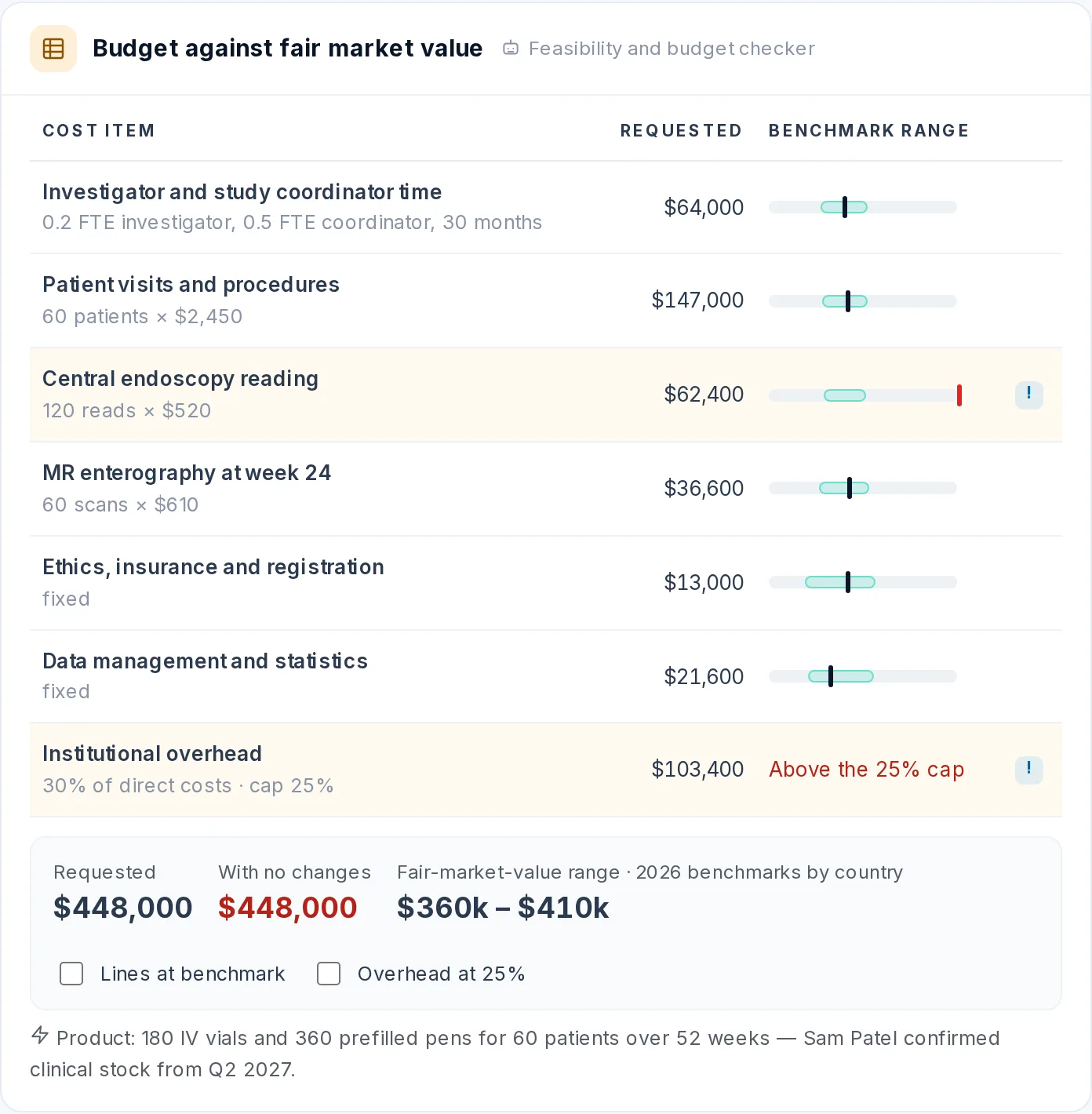
The reviewer can then see what the budget would be at the benchmark rate and the cap. The arithmetic is worth showing because it is the part an auditor re-does. Direct costs of $344,600 fall to $318,200 when reading is priced at the benchmark ($36,000 instead of $62,400). Overhead at 25% of that is $79,550 instead of $103,400. The revised total, $397,750, sits inside the range.
Investigator-Initiated Study Review: one sample budget brought inside the range
The overhead cap, and a line that stays above range
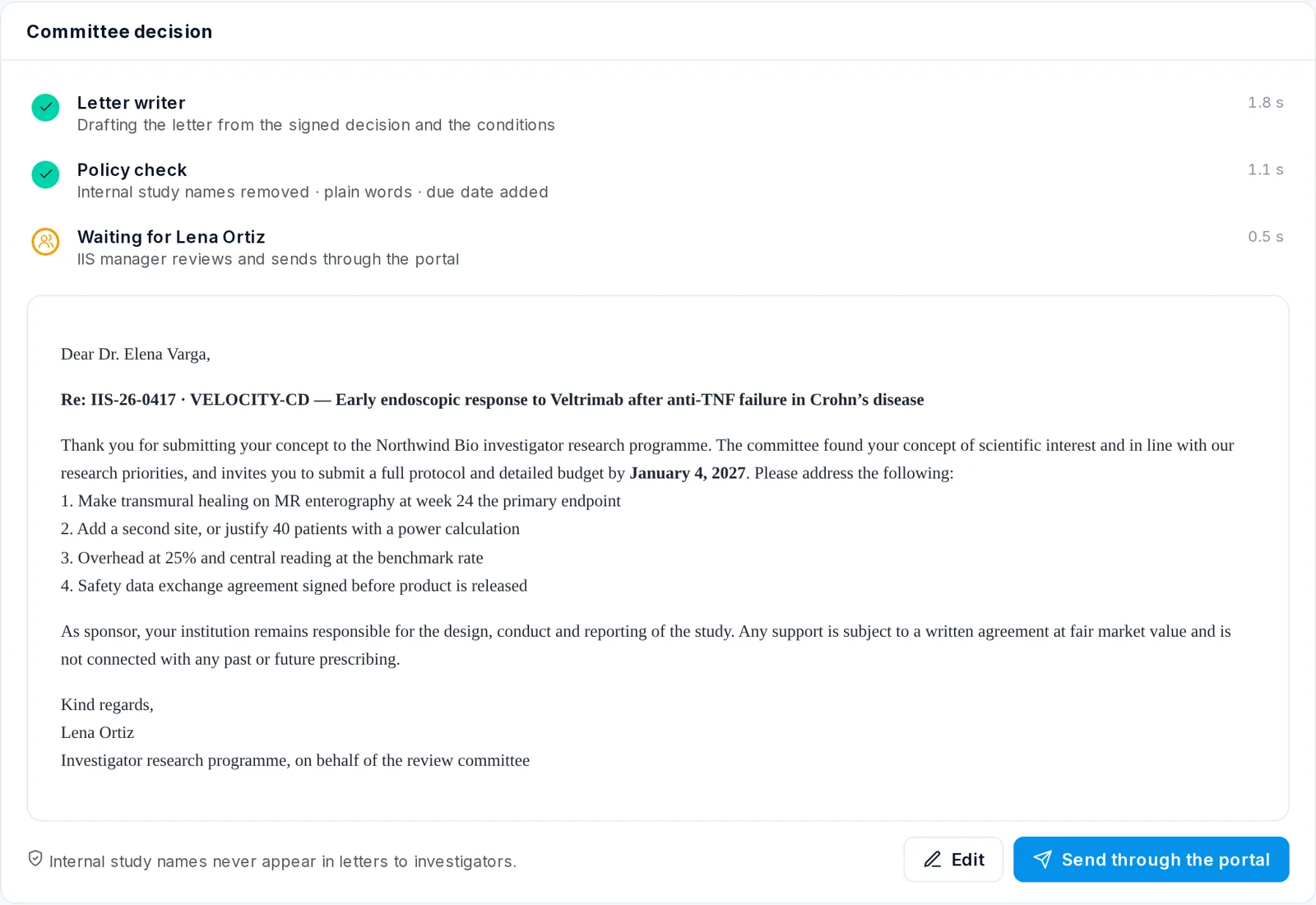
The agent never edits the investigator's budget. It shows the gap and the arithmetic; the decision letter asks the investigator for the change, as a numbered condition ("Overhead at 25% and central reading at the benchmark rate"). That matters for two reasons. The budget remains the institution's own proposal, which fits PhRMA's model of the investigator designing and the company supporting. And a line can be above range for a good reason, such as a specialised central reader with no local comparator; the MAPS deck lists "lack of comparators" among the exceptions. In the solution a budget above the range needs a written reason, so the exception is visible rather than absorbed.
The cap and the benchmark set are settings, not constants. The sample programme uses 25% of direct costs and "2026 benchmarks by country · v3"; a programme can choose another set, and every change is versioned in the audit trail. Which benchmark source you buy or build is your decision; the go-live guide covers what you bring. For how budget sits among the committee's other criteria, how a committee scores a concept sets out the full rubric.
Payment history and disclosure: Open Payments, EFPIA and the last 24 months
Two questions belong in every packet: what has this investigator already received from us, and what will this support make public? The first tests independence; the second tells the committee the decision will be seen.
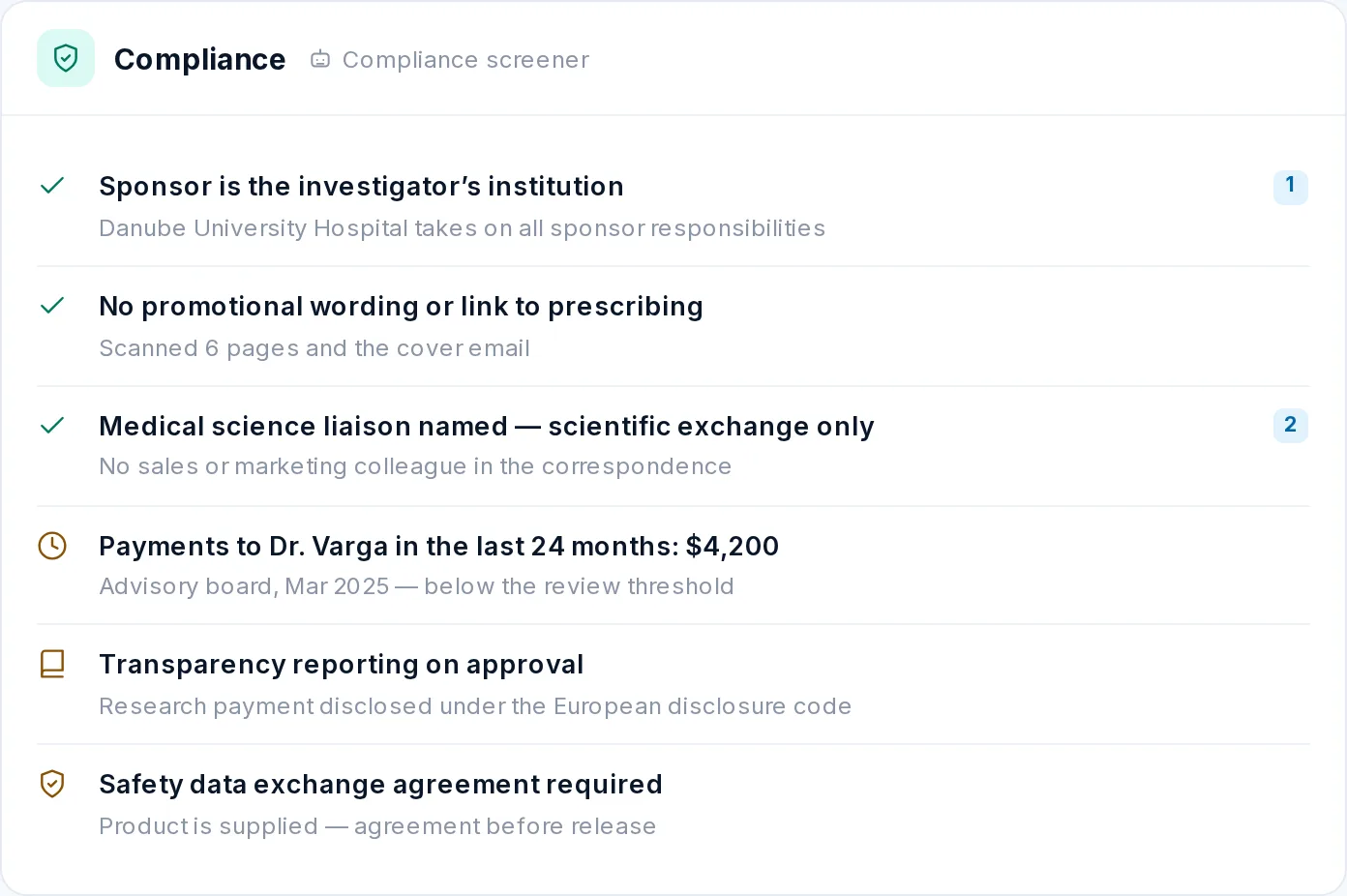
For payment history, the sample programme looks back 24 months. VELOCITY-CD's investigator received $4,200 for an advisory board in March 2025, below the programme's review threshold. The look-back period and threshold are programme policy rather than law; what the law offers is the principle behind them. PhRMA's statement says companies "should not preferentially select investigators who are customers", and the OIG asks whether funding "is based, in any way, expressly or implicitly, on the physician's referral of the manufacturer's product." A history of fees to the same person is the first thing anyone checking that will pull.
The compliance section of one review packet
In the US, the Open Payments rule treats research separately. Research-related payments, "including research-related payments or other transfers of value made indirectly to a covered recipient through a third party, must be reported to CMS separately from other payments". The entry carries the "Name of the research study", the "Total amount of the research payment", and "Information about each non-teaching hospital covered recipient principal investigator (if applicable)". Payments for research on a new product or a new application can be held back from publication until FDA approval or "Four calendar years after the date the payment or other transfer of value was made", whichever comes first. Failing to report costs "not less than $1,000, but not more than $10,000" per payment, up to $150,000 a year, and for knowing failures "not less than $10,000, but not more than $100,000" per payment, up to $1,000,000, each "as adjusted annually".
Do not expect the public data to show IIS spend. CMS reported $9.50 billion in research payments for program year 2025, but that covers all research, mostly company-sponsored trials, and no field in the research file marks a study as investigator-initiated. Your own programme's figures are the only reliable ones.
In Europe, the EFPIA Code (quoted from its 2026 consolidated text; members apply it through their national codes) defines Research and Development Transfers of Value to cover the planning or conduct of "clinical trials (as defined in Regulation 536/2014)", and says they "must be disclosed by each Member Company on an aggregate basis." Individual grants are visible inside the company, not to the public, which raises the bar on internal records rather than lowering it. In the UK alone, the ABPI reports R&D accounting for "70 per cent of all disclosed transfers of value" in 2025, £647.3 million.
Internal studies stay internal, and duplication is a compliance question
The overlap check is a compliance control as well as a scientific one: the OIG lists research that is "unnecessarily duplicative" among its indicia of questionable research. If a company funds a study whose question its own registered trial already answers, the only remaining purpose the money can serve is the one the guidance warns about. How to check a concept for overlap covers the method; here the point is the boundary it creates.
To find duplication, the solution searches the company's own studies, studies it already funds and public registries. Some of what it compares against is confidential pipeline information. So the boundary runs one way: internal studies inform the committee and never reach the investigator. Registry pages from company sources are marked "Internal record — never shared with investigators", and after the decision a policy check on the drafted letter removes internal study names before a person reviews and sends it. No regulation quoted above dictates that step; it is a confidentiality rule, and it is easier to keep when a check enforces it than when every letter writer must remember it.
The decision letter: conditions, a due date and the fair-market-value statement, with no internal study named
Safety data exchange and product release
Supplying the drug brings the company into the study's safety reporting, which is why product release should wait for a signed safety agreement. Under 21 CFR 312.32, a sponsor must notify "all investigators to whom the sponsor is providing drug under its INDs or under any investigator's IND" of potential serious risks "in no case later than 15 calendar days after the sponsor determines that the information qualifies for reporting", and FDA of any unexpected fatal or life-threatening suspected adverse reaction "in no case later than 7 calendar days" after first receiving it. In the EU, Article 42 of the Clinical Trials Regulation sets the same 7- and 15-day clocks for the sponsor, which in an IIS is the institution. Companies set the investigator's reporting back to them by contract; one published master agreement between Pfizer and the University of Texas System asks the investigator to report a serious adverse event "Within 24 hours of first awareness of the event".
In the sample, the compliance section notes "Product is supplied — agreement before release", the reviewer's fourth condition reads "Safety data exchange agreement signed before product is released", and drug supply sees the quantity before the vote. The condition is in the signed recommendation, the committee's decision and the letter, so it cannot quietly drop out between approval and shipment.
What an auditor will ask for in an IIS programme
For any one study, an auditor will want to retrace why it was supported, who decided, and why it cost what it cost. A programme that can answer from its own audit trail, rather than from email, has turned the principle into a method. The list below is drawn from the texts quoted on this page.
The evidence to produce for any supported investigator-initiated study
- Who initiated the concept
The submission channel, the correspondence, and the screen result showing no sales or marketing involvement, or the compliance decision that cleared it.
- Review by the science function
The scientific reviewer's signed recommendation, with the meaning of the signature and the evidence it cites.
- The need for the research
The published research priority it fits, quoted, and the overlap check against company, funded and registry studies.
- The price, line by line
Each budget line against its benchmark range, the overhead against the cap, the benchmark version used, and a written reason for any line left above range.
- The payee and the payment plan
Payment to the institution, never the individual, in milestones tied to deliverables, with unused funds returned.
- The investigator's payment history
Transfers of value in the look-back period, and how they compare with the programme's threshold.
- The committee's decision
Votes, quorum and the chair's signature with its stated meaning; non-voting compliance and drug supply positions recorded.
- Disclosure and safety
The Open Payments or national-code disclosure the support will produce, and the signed safety data exchange agreement before product release.
In Investigator-Initiated Study Review those items come from the same place: each agent step, vote, signature, letter and settings change is time-stamped, every finding cites the passage it rests on, and the agents prepare while people decide. The committee packet and the decision can be exported, with citations as footnotes. None of this makes a programme compliant on its own; it makes the programme's own rules visible and repeatable, which is what an audit tests.
Questions people ask
Can a sales representative pass an investigator's study idea to medical affairs?
The OIG calls research contracts "that originate through the sales or marketing functions" "particularly suspect", and lists research "initiated or directed by marketers or sales agents" as an indicium of questionable research. A common answer is a submission portal as the one way in, with a sales name in the correspondence treated as a red flag for compliance to resolve rather than a disqualification decided by a reviewer.
Is fair market value for an IIS the same as for a company-sponsored trial?
The standard the texts state is the same: payment consistent with fair market value and not tied to the volume or value of business. The inputs differ, because an IIS budget is the institution's own and may include sponsor costs (ethics, insurance, registration) a company trial would carry itself.
Are research payments published in Open Payments straight away?
Not always. Under 42 CFR 403.910, publication is delayed for payments connected with research on a new drug, device or biological, or a new application of an existing one, until the earlier of FDA approval or four calendar years after the payment. An IIS on a marketed product's approved use is usually published in the normal cycle.
What are the penalties for not reporting a research payment?
Civil money penalties per payment not reported: under 42 CFR 403.912, $1,000 to $10,000 each, capped at $150,000 a year, and for knowing failures $10,000 to $100,000 each, capped at $1,000,000 a year, all adjusted annually for inflation. The exposure is per payment, so a milestone schedule with four payments is four reporting events.
Does the company report an IIS payment that goes to the hospital, not the doctor?
Under the US rule, research payments made "indirectly to a covered recipient through a third party" are reportable, and the report carries information about the principal investigator where applicable. In Europe, EFPIA members disclose R&D transfers of value in aggregate. How a specific payment is classified is a question for your transparency team and counsel.