An insurance marketing summary is the document an account executive gives a commercial client after taking its account to market. It lists each insurer approached and how each answered (quoted, declined or indicated only), sets the quotes against the client's written insurance requirements, prices what each would leave the client to pay in a bad year, states total cost with taxes and the paper each quote sits on, lists the conditions to bind and the date each offer lapses, and ends with a recommendation that says in one sentence what every other option gives up. It is hard to do well because carriers answer in their own layouts and the terms that decide the comparison sit in forms the summary page never shows. Botminds' Insurance Quote Comparison is agentic software for commercial brokers: it reads each quote and form, cites every value to its page, flags values that only look equal, and drafts the client summary for the account executive to approve.
The worked example is the solution's sample renewal: a fictional brokerage, Tollbridge Partners, renewing the cyber and privacy liability of a fictional health billing company, Meridale Health Billing Services, with five quotes from five fictional carriers, twenty days before the effective date. Its figures are sample data and our arithmetic, not any firm's results.
What an insurance marketing summary contains, and the question each part answers
| Part | What it shows | In the sample renewal |
|---|---|---|
| Markets | Each insurer approached, the date, and its answer: quote, indication, declination or no reply. | Five carriers quoted; the market list is the placement team’s to complete. |
| Requirements | Each insurance demand in the client’s contracts, board decisions and expiring policy, with its clause. | Six requirements from a hospital MSA, a business associate agreement, a board memo and the expiring policy. |
| Comparison | Each term with its basis (each claim, aggregate, shared, sublimit) and the quote page it came from. | 25 terms per quote, 125 cells, three marked as only looking equal. |
| A bad year, priced | What the client keeps under each quote on the two or three losses it fears most. | From $300,000 to $2,000,000 on the same two losses. |
| Total cost and paper | Premium, taxes and fees; admitted or surplus lines; the home-state tax. | Two non-admitted quotes carry Ohio’s 5% surplus lines tax. |
| Conditions and dates | What each carrier needs before and after binding, and when each offer lapses. | 17 conditions, 7 already met; one quote expires before the effective date. |
| Changes from expiring | The renewal against the expiring policy, term by term. | 22 terms compared, 6 changed, one new exclusion. |
| Recommendation | The option advised, what each other option gives up, and how the broker is paid. | Renew at $204,750, the only quote meeting all six requirements. |
What is an insurance marketing summary?
It is the broker's report of the marketing it did for one account, written so the client can choose and so the broker can later show what it offered. A proposal recommends; a marketing summary also proves the search. The two often travel as one document, and the strongest versions keep both halves: the evidence of the market, then the advice that follows from it.
The search half matters because New York's highest court has fixed what a broker owes. An agent has “a common-law duty to obtain requested coverage for their clients within a reasonable time or inform the client of the inability to do so”, with no continuing duty to advise on additional cover (American Bldg. Supply v Petrocelli, 2012, quoting Murphy v Kuhn). A marketing summary is where the broker either delivers the cover requested or tells the client, in writing and in time, that the market would not offer it. Which request the broker is answering decides the case; insurance broker duty of care traces how.
For carriers, the summary is where their quote is judged against the competition. Its “what this option gives up” line is the most specific feedback an underwriter's distribution team can get on why a quote lost, and the carrier sees it only if the broker passes it on.
What goes in a marketing summary for a commercial account?
Eight parts, in the order the client needs them: the markets, the client's requirements, the term-by-term comparison, a bad year priced under each quote, total cost and paper, conditions and dates, changes from the expiring policy, and the recommendation with compensation. The table above gives each part's job; the requirements, the comparison and the bad year decide which quote is recommended.
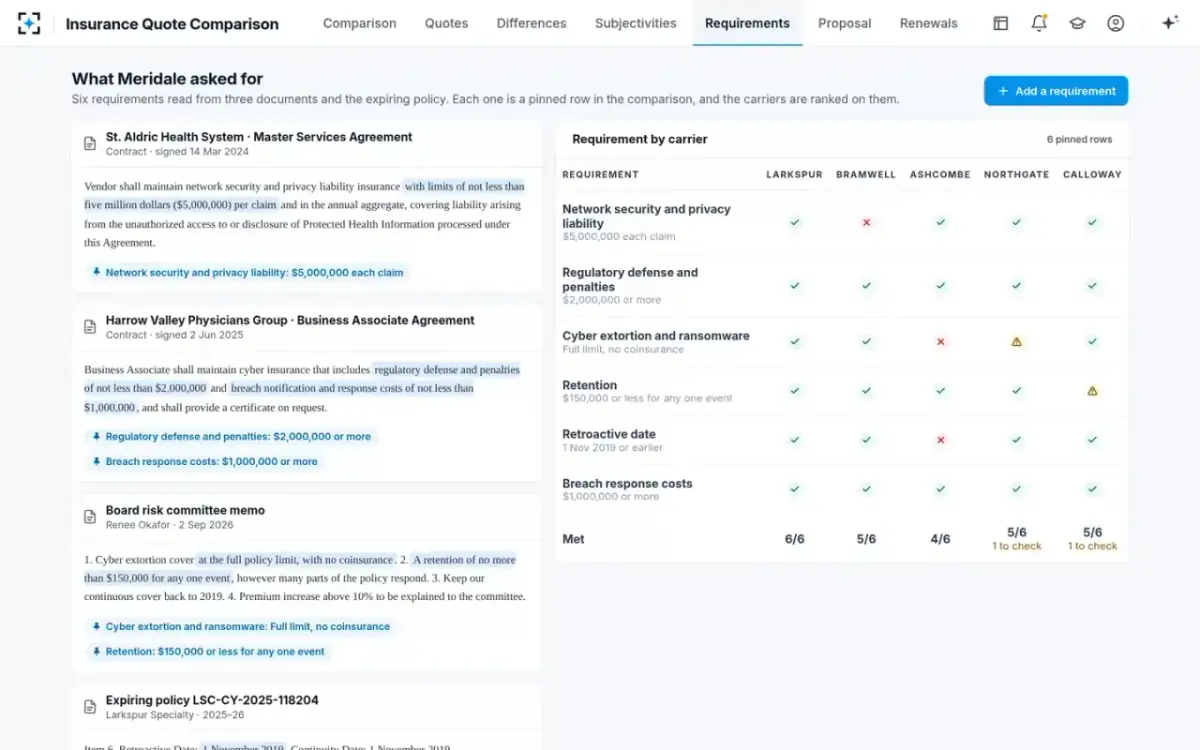
The requirements come first because they decide the ranking. In the sample renewal they are six lines, each traced to its source: $5,000,000 privacy liability each claim from section 11.3(b) of a hospital system's master services agreement; regulatory defense of at least $2,000,000 and breach response of at least $1,000,000 from section 7.2 of a business associate agreement; ransomware at full limit with no coinsurance and a retention of $150,000 or less from the board's risk memo; and prior acts back to the date in the expiring policy. A summary ranked on these rows cannot quietly recommend the cheapest quote, because the cheapest one fails a row.
Insurance Quote Comparison: the client's requirements as the rows every carrier is scored on
The comparison comes next, and it must state the basis of every number, not only the number. The bad-year scenario follows, because retentions, coinsurance and sublimits only show their cost when a loss is applied to them. The sections below take each in turn.
Why the lowest premium is the wrong first row
Because a lower premium usually buys a narrower promise, and a summary that leads with price invites the client to stop reading before the narrowing appears. In the sample renewal the cheapest quote, at $171,900, is the most expensive year by a wide margin once two losses are applied.
Five commercial quotes in a marketing summary, priced on one bad year
Larkspur · $504,750 in all
- Premium $204,750 · 41%
- Client keeps $300,000 · 59%
Calloway · $621,000 in all
- Premium $221,000 · 36%
- Client keeps $400,000 · 64%
Northgate · $797,715 in all
- Premium $197,715 · 25%
- Client keeps $600,000 · 75%
Ashcombe · $813,580 in all
- Premium $188,580 · 23%
- Client keeps $625,000 · 77%
Bramwell, lowest premium · $2,171,900 in all
- Premium $171,900 · 8%
- Client keeps $2,000,000 · 92%
The summary's job is to name which narrowing applies to each quote, with the page it sits on. The GAO's review of the cyber market describes the pressure behind several of them: rising attack frequency and severity, “especially ransomware attacks”, led insurers to reduce cyber limits for riskier sectors such as health care and education “and to add specific limits on ransomware coverage” (GAO-21-477, 2021). Meridale is a health care business, so the ransomware rows are read first.
Six reasons a commercial quote is cheaper, and the line the summary should carry
| Reason | Where it hides | Sample quote | Line in the summary |
|---|---|---|---|
| A shared aggregate | The limits section of the policy form | Bramwell: one $5,000,000 for all loss under all parts | Does not give the hospital customer $5,000,000 per claim |
| A sublimit | The schedule, beside the headline limit | Ashcombe: ransomware capped at $2,500,000 | Pays at most half the limit on a ransomware event |
| Coinsurance | An endorsement listed only by number | Northgate: 20% of extortion loss above $1,000,000 | Client keeps $500,000 of a $3,000,000 event |
| Retention per insuring agreement | The retention clause | Calloway: $100,000 for each part that responds | One event can cost three retentions |
| No prior acts | The retroactive date on the declarations | Ashcombe: retroactive date at inception | No cover for acts before 1 November 2026 |
| A new exclusion | The forms list against last year’s | Larkspur renewal: tracking technologies excluded | Matters because the payment portal uses analytics tags |
How do you show a client a bad year under each quote?
Pick the two or three losses the client most fears, apply each quote's retention, coinsurance, sublimits and aggregate in the order the policy applies them, and print what the client keeps. Two losses in one year are enough to expose a shared aggregate; one large first-party loss is enough to expose coinsurance and sublimits.
What a client keeps in a year under one quote
Premium and tax
premium + surplus lines tax + fees
Ashcombe: $179,600 + 5% Ohio tax = $188,580
Paid whatever happens
Retentions
retention × times it applies
Calloway: $100,000 × 3 parts on one ransomware event
Per claim, event or insuring agreement
Coinsurance
share × loss above threshold
Northgate: 20% × ($3,000,000 − $1,000,000) = $400,000
Often added by endorsement
Limit shortfall
loss − sublimit or what is left of the aggregate
Bramwell: $1,950,000 of the September claim after March used $2,950,000
Shared aggregates and sublimits
Run it on Northgate's quote. The $3,000,000 ransomware event costs the client its $100,000 retention plus 20% of the $2,000,000 above the coinsurance threshold, $500,000 in all; the September privacy claim costs another $100,000 retention. On the expiring carrier the same event costs the $150,000 retention, and the board's memo asks for no coinsurance at all. That one worked figure does more for the client's decision than any premium column.
The scenario is illustrative and the summary should say so. It is not a loss forecast, and it does not price probability; it shows how each contract responds to losses the client has already named as the ones it cannot absorb.
Two quotes that both say $5,000,000: writing the difference down
Put the two passages side by side under the client's requirement, and write one sentence on what the difference means for this client. Equal numbers with unequal wording are where a summary most often misleads without anyone intending it.
The sentence a marketing summary needs when two limits only look equal
Bramwell Indemnity, $171,900: One aggregate pays all loss under every insuring agreement, so a ransomware payment reduces the liability limit
Larkspur Specialty, $204,750: A liability aggregate of its own, which first-party payments cannot reduce
Bramwell Indemnity, $171,900: One pot of $5,000,000 for everything in the year
Larkspur Specialty, $204,750: $5,000,000 for each liability claim, kept apart from first-party loss
Bramwell Indemnity, $171,900: Not met once anything else has been paid
Larkspur Specialty, $204,750: Met
The wording discipline is a regulatory matter as well as an E&O one. The NAIC's model unfair trade practices act, which states have adopted in their own words, treats as an unfair practice any “estimate, illustration, circular or statement, sales presentation, omission or comparison” that “misrepresents the benefits, advantages, conditions, or terms of any policy” (NAIC Model #880, § 4A). A comparison row that prints “$5,000,000” for both quotes, with no basis, is an omission of exactly that kind.
Insurance Quote Comparison: both passages under the client's requirement, the call left to the account executive
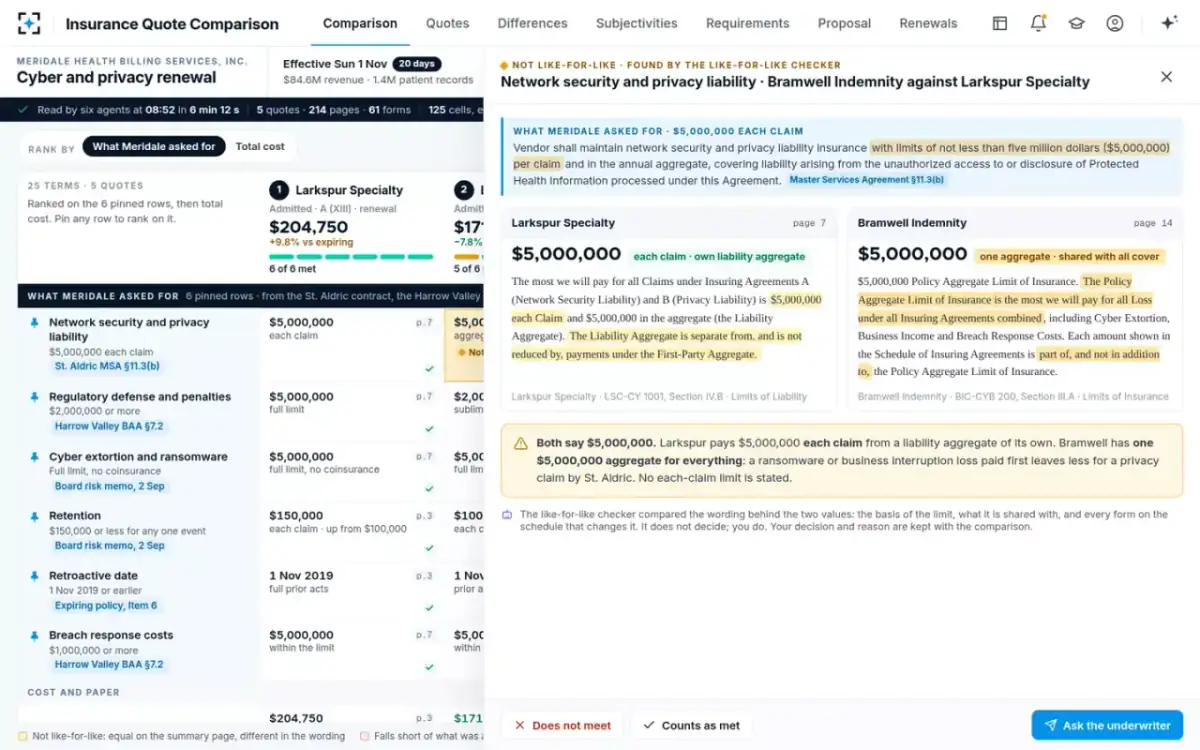
A sheet built by hand loses this at the retyping stage, because the cell keeps the value and drops the passage; an insurance quote comparison spreadsheet shows how to test one against its sources.
The market list: declinations are evidence, not filler
The market section shows which insurers the broker approached and what each said, and for surplus lines placements it is the working file behind a sworn statement. A summary that shows only the quotes received cannot show the search.
New York makes the point precisely. An excess line broker must affirm, under penalty of perjury, that “after diligent effort, the full amount of insurance required could not be procured” from authorized insurers it had reason to believe might write the class, and it must list on the affidavit “the name, date of the declination, and national association of insurance commissioners code of each authorized insurer declining a risk”, with the basis for believing each might write it. The reason for a declination need not be given, and declinations from affiliated insurers count only if they operate as distinct and autonomous competitors (N.Y. Insurance Law § 2118(b)(3)). Within 45 days of procurement the declarations page goes to the state's excess line association for stamping.
What the market section must let a compliance reviewer prove
- Every insurer approached, with the date
Including those that never replied.
- Each answer, in the carrier’s terms
Quote, indication, declination; an indication is not an offer to bind.
- NAIC code for each declining authorized insurer
The New York affidavit asks for it by name and date.
- Why each insurer was approached
Recent acceptance of the class, its own advertising, or another valid basis.
- Affiliation between insurers
Declinations from affiliates count only if they compete as distinct entities.
- The exempt commercial purchaser file
The disclosure given and the client’s written request, where the search is waived.
- The home state of the insured
Only that state may tax the nonadmitted premium.
Federal law removes the search for large buyers. Under the Nonadmitted and Reinsurance Reform Act, a surplus lines broker placing cover for an exempt commercial purchaser need not satisfy any state diligent-search requirement if it has told the purchaser the insurance “may or may not be available from the admitted market that may provide greater protection with more regulatory oversight”, and the purchaser has then asked in writing for a nonadmitted placement (15 U.S.C. § 8205). To qualify, the purchaser must employ or retain a qualified risk manager, have paid more than $100,000 of commercial P&C premium in the past 12 months, and meet one size test, such as net worth above $20,000,000, revenue above $50,000,000 or more than 500 employees, the dollar tests adjusted for inflation every five years (15 U.S.C. § 8206). That disclosure and written request belong in the summary file.
Paper belongs in the total-cost row. Only the insured's home state may require premium tax on nonadmitted insurance (15 U.S.C. § 8201), which is why the sample adds Ohio's 5% to both non-admitted quotes. Some states also put the difference on the policy itself: Florida requires a surplus lines policy to state that persons insured by surplus lines carriers “do not have the protection of the Florida Insurance Guaranty Act”, and, in at least 14-point bold type, that the insurer's rates and forms “are not approved by any Florida regulatory agency” (Fla. Stat. § 626.924). A client choosing between admitted and surplus lines quotes should read those words in the summary, not first on the policy.
Insurance Quote Comparison starts from the quotes that came back. It does not keep the market list or the diligent-search affidavit; those stay with the placement team and its agency system, and the summary should carry both.
Conditions and dates: an option the client cannot bind is not an option
List each carrier's conditions to bind, which documents already meet them, and the date each offer lapses, before the decision meeting. In the sample renewal the five quotes carry 17 subjectivities between them, due before binding or within 30 days after; 7 are already met by documents on file, and one signed MFA attestation satisfies three carriers at once.
One condition blocks a quote outright: the second-ranked carrier needs written confirmation of EDR on 100% of endpoints before binding, and the client is at 402 of 414 devices. That same quote must bind by its expiry date, which falls before the effective date. A summary that presents it as an equal alternative without those two facts is presenting an offer that may not exist on the day. Insurance quote subjectivities and the insurance quote validity period treat each clock in depth.
How should compensation appear in a marketing summary?
State how the broker is paid on each option, and give the amount when the client asks; several rules require exactly that. New York's Regulation 194 requires a producer to give a mandatory initial disclosure to every purchaser, delivered as a copy rather than posted in an office, and to disclose compensation amounts “only if the purchaser asks for that information” (NY DFS, Regulation 194 FAQ). In the UK, an intermediary “must, on a commercial customer's request, promptly disclose the commission that it and any associate receives”, in cash terms, estimated if necessary, and in writing (FCA Handbook, ICOBS 4.4.1R).
Where the broker also charges the client a fee, the NAIC's producer licensing model would bar it from taking insurer compensation for the same placement unless, before the purchase, it obtained the client's documented acknowledgment and disclosed the amount, or the method of calculating it with a reasonable estimate (NAIC Model #218, § 18). States have adopted that section unevenly, so the summary template should follow the strictest state the brokerage writes in.
Commission and brokerage as a share of earned premium, by commercial line, 2024
Those averages explain why the question comes up. Claims-made general liability carries commission at about two-thirds above the rate on workers' compensation, so a client comparing options across carriers and structures can fairly ask whether the recommendation follows the pay. A summary ranked on the client's written requirements first, then total cost, answers that before it is asked.
What does each signature on the summary mean?
Each signature should certify one thing a named person checked. In the sample workflow the account executive decides every cell marked as only looking equal and approves the summary; the producer, who owns the relationship, co-signs that the recommendation fits what the client asked for; the placement and E&O lead signs off when the recommended quote still has an open question; and the client chooses at the meeting.
“[F]ailure to read the policy, at most, may give rise to a defense of comparative negligence but should not bar, altogether, an action against a broker.”
New York Court of Appeals, American Bldg. Supply Corp. v Petrocelli Group, Inc. (2012)
That holding sets the limit of what a summary can do for the broker. Handing the client the policy, or a summary that says “the policy wording governs”, does not move the broker's duty onto the client. What protects the broker is a summary that answered the specific requests in writing: the same court repeats that “a general request for coverage will not satisfy the requirement of a specific request for a certain type of coverage” (Petrocelli). A requirement row such as “$5,000,000 privacy liability each claim, MSA §11.3(b)” is a specific request; the summary row that answers it, met or not met, with the page, is the evidence.
The sample proposal still carries the disclaimer, “This comparison summarizes the carriers’ quotes; the policy wording governs”, because the summary is a summary. The disclaimer tells the client where the contract lives. It does not cure a row that summarizes the contract wrongly.
What a carrier's distribution team learns from losing in the summary
The reason a quote lost is often a single wording choice that the summary names, and the carrier sees that line only if the broker sends it. In the sample renewal each of the four quotes not recommended loses on its wording: a shared aggregate, a ransomware sublimit, a coinsurance endorsement, a retention that applies per insuring agreement. None loses on premium alone, and the lowest premium ranks fourth.
For an underwriter's distribution team, that is the useful half of the quote-to-bind number. A falling ratio on commercial cyber says quotes are not binding; the summary line says which term cost the bind. The sample shows the loop working in one direction: the account executive's one-click request asks the second-ranked carrier's underwriter to delete its coinsurance endorsement, with the wording quoted, and that carrier becomes the recommended alternative if it agrees. Nothing goes to a carrier until the account executive sends it. The quote to bind ratio sets out the funnel measures on the underwriting side.
New York's affidavit rule cuts the other way for declinations: a broker need not give the reason an authorized insurer declined (§ 2118(b)(3)(C)). A carrier that wants to know why it declined or lost has to ask, and a brokerage whose summary already states the deciding line for each quote can answer in a sentence.
Building the marketing summary with Insurance Quote Comparison
The solution prepares the quote half of the summary and leaves every judgement to the account executive. Six agents read the quotes, open every form on every schedule, check equal-looking values against their wording, match the client's requirements, track subjectivities and draft the client-facing summary; a person decides each flagged cell, approves, co-signs and sends.
In the sample renewal the agents read 214 pages in 6 minutes 12 seconds, filled 125 cells each with its page, opened 61 of 61 forms and found four that change a term the schedules do not show, marked three cells as only looking equal, and listed 17 subjectivities. Our estimate of the by-hand work for the same five-carrier renewal is about five hours, most of it reading and retyping.
Insurance Quote Comparison on a five-carrier renewal: where the hours go
By hand, about 5 hours: 1.5 h
With the solution, about 1 hour: 0.1 h
By hand, about 5 hours: 1 h
With the solution, about 1 hour: 0.1 h
By hand, about 5 hours: 1 h
With the solution, about 1 hour: 0.1 h
By hand, about 5 hours: 0.5 h
With the solution, about 1 hour: 0.25 h
By hand, about 5 hours: 1 h
With the solution, about 1 hour: 0.5 h, mostly review and approval
The client summary Insurance Quote Comparison drafts: options, what each gives up, every figure cited
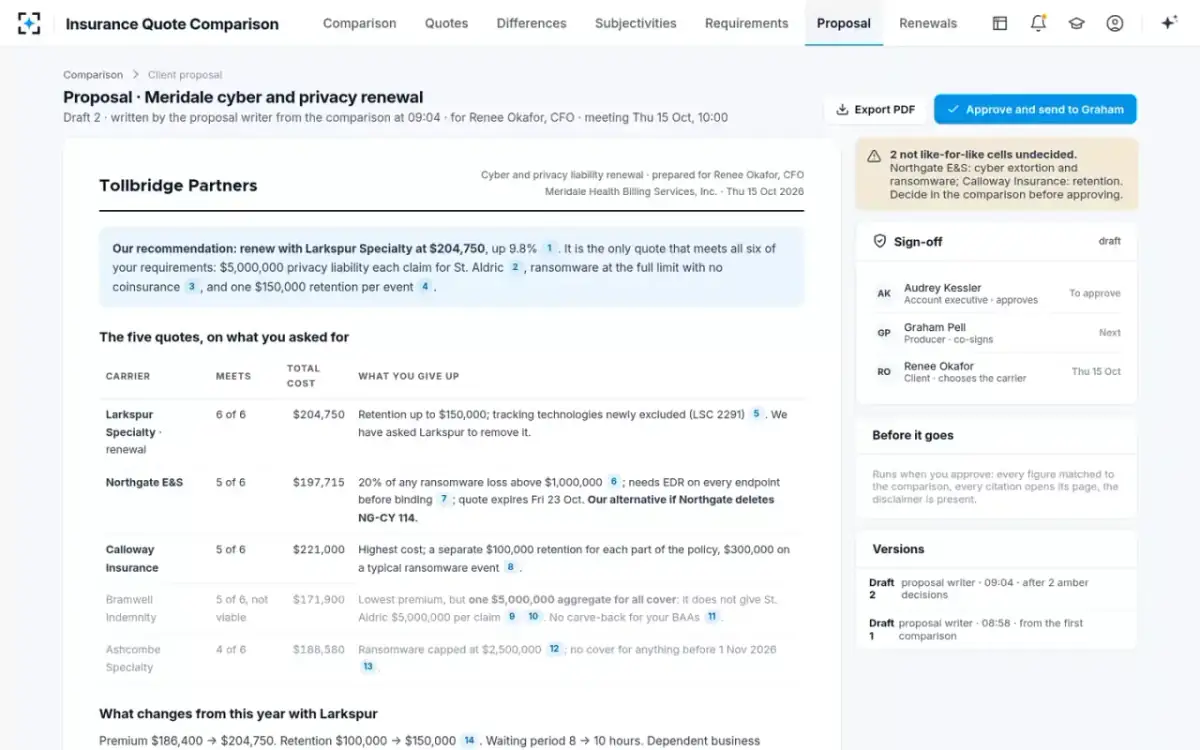
Where it does not fit: the solution does not approach markets, keep the declination log, file the surplus lines affidavit or bind. It reads what the carriers sent back and drafts what the client will read; the brokerage's agency system and placement team keep the rest. Brokerages that want to see the comparison behind the summary can start from Insurance Quote Comparison.
Questions people ask
Is a marketing summary the same as an insurance proposal?
Not quite. A proposal recommends cover; a marketing summary also reports the search behind it: who was approached, who declined and what each quote offered. Many brokerages send them as one document, with the market list first and the recommendation last.
Should a marketing summary include declinations?
Yes, with the insurer and the date. For a New York surplus lines placement the broker must list each declining authorized insurer's name, declination date and NAIC code on a sworn affidavit, so the summary's market list and the affidavit should agree. The reason for a declination need not be stated there.
Can an exempt commercial purchaser skip the diligent search?
Under 15 U.S.C. § 8205, yes, if the broker has disclosed that the cover may or may not be available from the admitted market and the purchaser then asks in writing for a nonadmitted placement. The purchaser must use a qualified risk manager, have paid over $100,000 of commercial P&C premium in the past year, and meet one size test such as revenue above $50,000,000.
Does a disclaimer protect the broker if the summary is wrong?
Not by itself. New York's Court of Appeals held in 2012 that a client's failure to read the policy may support comparative negligence but does not bar a claim against the broker. A row that misstates a term is also the kind of comparison the NAIC's unfair trade practices model treats as a misrepresentation.
When should the marketing summary go to the client?
Before the decision meeting and before the earliest quote lapses, with enough time to meet the pre-bind conditions of the recommended option. In the sample renewal one quote expires before the effective date and needs an EDR confirmation the client cannot yet give, so it is shown as conditional, not equal.
Do brokers have to show commission in the marketing summary?
The rules usually require disclosure of the amount on request rather than in every document. New York's Regulation 194 requires an initial disclosure in all cases and the compensation amount when the purchaser asks; the FCA's ICOBS 4.4.1R requires a UK intermediary to give a commercial customer its commission in cash terms on request.