Insurance producer compensation models come in four forms: straight commission, salary plus commission, a recoverable draw against commission, and salary plus bonus. The Bureau of Labor Statistics confirms the pattern from the employee side: independent agents may be paid by commission only, employees by "salary only, salary plus commission, or salary plus bonus", and "commissions are the most common form of compensation, especially for experienced agents". Inside each model sits the choice that decides how often an agency claws pay back: whether a producer's split is paid on the commission the agency system expected or on the commission a carrier actually paid. That makes producer pay a second reconciliation behind the first, carrier to agency, then agency to producer, and every short payment, missing policy and wrong chargeback the first one misses reaches the producer as a reversal months later. Botminds' Insurance Commission Reconciliation reconciles each carrier statement line by line and pays producer splits on commission received, holding the producer's share of anything in dispute until the carrier pays.
This guide is written for the agency principal, the controller and the sales leader who design and run producer pay. It describes the rules as published, not legal advice for any agency or state. The worked example follows one fictional producer, Tomas Reyes-Hale of Thackery Insurance Group; screens show the solution's own fictional sample agency.
Two reconciliations, one month apart: carrier to agency, then agency to producer
Carrier → agency
Agency → producer
What are the insurance producer compensation models?
Four, and they differ in who carries the timing risk. Straight commission pays the producer only a share of what the agency earns, so the producer carries the risk of slow or short carrier payments. Salary plus commission moves part of that risk to the agency. A recoverable draw advances a fixed amount and reconciles it against commission at set intervals, so the agency carries the risk between reconciliations. Salary plus bonus pays a fixed base and a variable amount tied to goals; the BLS notes that "When agents meet their sales goals or when an agency meets its profit goals, agents usually get bonuses" (BLS Occupational Outlook Handbook).
The occupation is large enough that the model choice is a real cost line. The BLS counts about 572,600 insurance sales agent jobs in 2025, 63% of them in insurance agencies and brokerages, with a median annual wage of $62,280 in May 2025 and $61,550 in agencies and brokerages. Those wage figures cover employees, including their commissions and bonuses; they exclude self-employed agents, the group most likely to be on commission alone.
Four producer compensation models, and who carries a carrier's short payment
| Model | Producer is paid | When a carrier pays short or late | Wage-law point to check |
|---|---|---|---|
| Straight commission | A split of commission, nothing else | The producer waits or is clawed back, depending on the split’s base | Minimum wage and overtime apply unless an exemption, such as outside sales, fits |
| Salary plus commission | A base, plus a split, often lower than a straight-commission split | The base continues; the split behaves as above | Overtime on the base for a non-exempt producer |
| Draw against commission | A fixed advance, reconciled to earned commission | The draw balance absorbs it until the next reconciliation | In New York the written terms must state how often the draw is reconciled |
| Salary plus bonus | A base, plus a bonus on sales or agency profit goals | Only the bonus moves, at the next measurement date | Bonus terms in writing; in New York, paid no later than the plan says |
Commission split models: new business, renewals and the base
A split is a percentage of the commission the agency earns on each policy the producer handles, set in a written producer agreement. Three terms do most of the work: the new business percentage, the renewal percentage and the base the percentage is applied to. In the solution's sample agency, commercial producers' agreements pay 40% or 35% of new business commission and 25% to 30% of renewals; personal lines producers are on 20% and 15%. An agreement can also exclude house accounts the agency services directly, or set a lower split on accounts the agency assigns to a producer.
The base is the term that decides whether a carrier's error reaches the producer. "Commission" can mean what the agency system expected when the policy bound, what the carrier's statement paid, or what the carrier's statement paid after the agency's reconciliation. On a renewal paid at last year's rate, the first base pays the producer on $4,500.00 and the second on $3,750.00. Commission rates by line, as carriers report them, are compared in insurance commission rates by line; who may receive a split at all is set out in commission split rules.
Salary, draw or straight commission: what wage law requires
A straight-commission model is lawful for an employee only if the producer is exempt or the commission covers the wage floor. Under the federal outside sales exemption, the employee's "primary duty must be making sales" and the employee "must be customarily and regularly engaged away from the employer's place or places of business", and when that test is met, "The salary requirements of the regulation do not apply" (US Department of Labor, Fact Sheet #17F). An agency producer who sells from the office by phone and email does not meet it: "Outside sales does not include sales made by mail, telephone or the Internet" unless that contact only supplements personal calls, and a home office used for telephone selling counts as one of the employer's places of business.
New York adds rules specific to commission pay. Its definition of a commission salesperson expressly covers an employee whose principal activity is selling "insurance" and whose earnings are based in whole or in part on commissions, excluding supervisory, managerial, executive or administrative employees (N.Y. Labor Law §190(6)). Such an employee must be paid "not less frequently than once in each month and not later than the last day of the month following the month in which they are earned", and the terms must be in writing, signed by both sides, kept for three years and describe how pay is calculated (§191(1)(c)). Where the writing provides for a recoverable draw, it must state how often the draw is reconciled, and an agency that cannot produce the writing faces a presumption that the producer's account of the terms is correct.
Seven terms every producer compensation agreement should state
- The base of each percentage
Commission expected, commission paid, or commission paid after the agency’s reconciliation.
- New business and renewal percentages
With the line, carrier or account types each applies to, and any house accounts excluded.
- When commission is earned
On binding, on the carrier’s statement, or on collection of premium; New York’s pay deadline runs from this date.
- Disputed amounts
Whether the producer’s share of a short payment is held until the carrier pays, and when it is released.
- Chargebacks
Pro rata or flat on cancellation, and the producer’s share of a return premium on endorsements and audits.
- Draw and reconciliation
The draw amount and how often it is reconciled, as New York requires in writing.
- Termination and renewals
What is paid after the producer leaves, and on which renewals, within the licensing rule on deferred commission.
When is commission earned, and why does it decide clawbacks?
Commission is earned when the agreement says it is, and that date decides both when a producer must be paid and how often pay is reversed. An agency that pays on expected commission pays in the month the policy binds, before the carrier has put it on a statement. An agency that pays on received commission pays when the carrier's statement arrives and has been reconciled, which on new business may be a month or more later. Both settle on the same day once the carrier pays; the difference is whether money goes out and comes back in between.
One renewal, two ways to pay the producer
- Paid early, 30 Sep1–30 Sep
- Short, 14 Oct1–14 Oct
- Clawed back15–31 Oct
- Repaid, 30 NovNov
- Waiting for the statement1 Sep–14 Oct
- Paid, share held15–31 Oct
- Released, 30 NovNov
For an employed producer in New York, the earned date also starts the statutory clock: pay is due by the last day of the following month. An agreement that defines commission as earned on binding, and then waits for the carrier's statement to pay, can fall behind that deadline on any carrier that pays slowly. Defining it as earned on the reconciled statement keeps the agreement and the payroll on the same date.
What is a producer clawback, and which ones are avoidable?
A producer clawback is a deduction from later pay to reverse commission already paid, and it comes from two different causes. Some reflect real changes to the policy: a cancellation mid-term, a premium reduced by endorsement or audit. Those follow the policy whichever model the agency uses, and their arithmetic is set out in whose money a return premium is. The others reflect the agency paying before checking: a carrier's short payment, a missing policy or an oversized chargeback that went straight through to the producer's statement.
The second kind is avoidable, and it is the kind that damages producer relationships, because the producer repays the carrier's error before anyone has argued with the carrier. In the example above, paying on expected commission sent Tomas $1,545.00 in September, took $607.50 back in October and repaid it in November. Paying on received commission sent $937.50 in October, held $607.50 with the carrier's reason beside it and released it when the carriers paid.
Renewals and the book when a producer leaves
Renewal commission after a producer leaves is a contract question inside a licensing limit. The NAIC's model act lets "Renewal or other deferred commissions" be paid to a person who "was required to be licensed under this Act at the time of the sale, solicitation or negotiation and was so licensed at that time" (NAIC Model #218, §13C), so a departed producer need not hold a current licence to receive renewals the agreement grants. The same act bars paying or accepting commission for selling, soliciting or negotiating insurance if the person is required to be licensed and is not (§13A, §13B).
The operational requirement is evidence. An agency paying a departed producer's renewals needs the agreement clause, the producer of record on each policy and the licence status on the date of each original sale. Without the third, the controller cannot show the payment is lawful; without the second, the renewals drift to whoever services the account and the dispute arrives a year later.
The producer statement: the second reconciliation
A producer statement is the agency's monthly account to a producer: one line per policy transaction, with the commission the agency received or expected, the producer's split, the amount paid and any adjustment. New York gives employed commission salespeople a right to "a statement of earnings paid or due and unpaid" on written request (§191(1)(c)). A statement built from the agency system's expectations is a forecast; one built from reconciled carrier statement lines can be traced, line by line, to what a carrier paid.
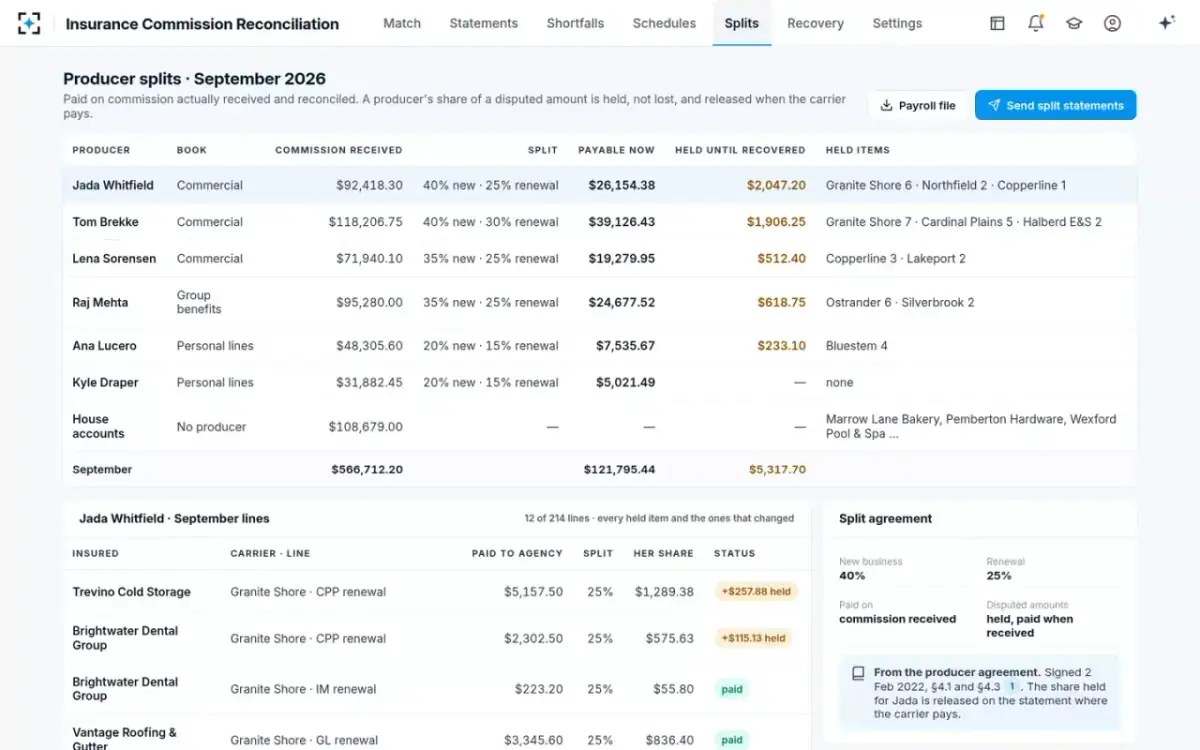
Each producer paid on commission received, with held items named
One month of producer pay at the sample agency
$566,712.20
commission received from carriers in September
$121,795.44
producer splits payable now
$5,317.70
producer shares held until carriers pay disputed items
$2,500
disputes above this need the controller’s approval
Moving producers to pay on received commission without a pay gap
Switching from expected to received commission delays some pay by about one statement cycle, once. Plan for that month rather than let producers discover it on payroll. First, change the agreement before the pay: the base of the percentage and the treatment of disputed amounts are contract terms, and in New York the method of calculation must be in the writing. Second, bridge the first month: pay the last month on expected and the next on received, and show producers the held list on the first day so a gap reads as a hold, not a cut.
Third, publish the release rule: a held share is paid on the statement where the carrier pays, and the agency's dispute letters and the carriers' replies are visible to the producer by item. Fourth, measure it: count clawbacks per month before and after, and the days a held share waits, by carrier. At the sample agency, held shares were $5,317.70 across all producers in September against $121,795.44 paid out. A producer who can see that list stops asking whether a renewal was paid and starts asking when.
Where Insurance Commission Reconciliation fits in producer compensation
The solution works the first reconciliation so the second can be trusted. It reads each carrier's direct bill statement, matches every line to a policy in the agency system, checks the rate against the carrier's schedule and the chargeback against the agency agreement, and lists policies that bound but never appeared on a statement. Producer splits are then built from those reconciled lines under each producer's agreement, with disputed amounts held and named. Tolerances, the 60-day window before a policy is called missing, the controller's approval threshold and whether disputed shares are held are settings the agency's controller approves.
It does not set the compensation model. Which model, which percentages and which base are the principal's decisions, and wage-law questions about exemption, draws and deductions belong with employment counsel in each state where producers work. What the solution changes is the evidence: every line on a producer statement points to the carrier statement line it came from, and every held amount to the dispute behind it.
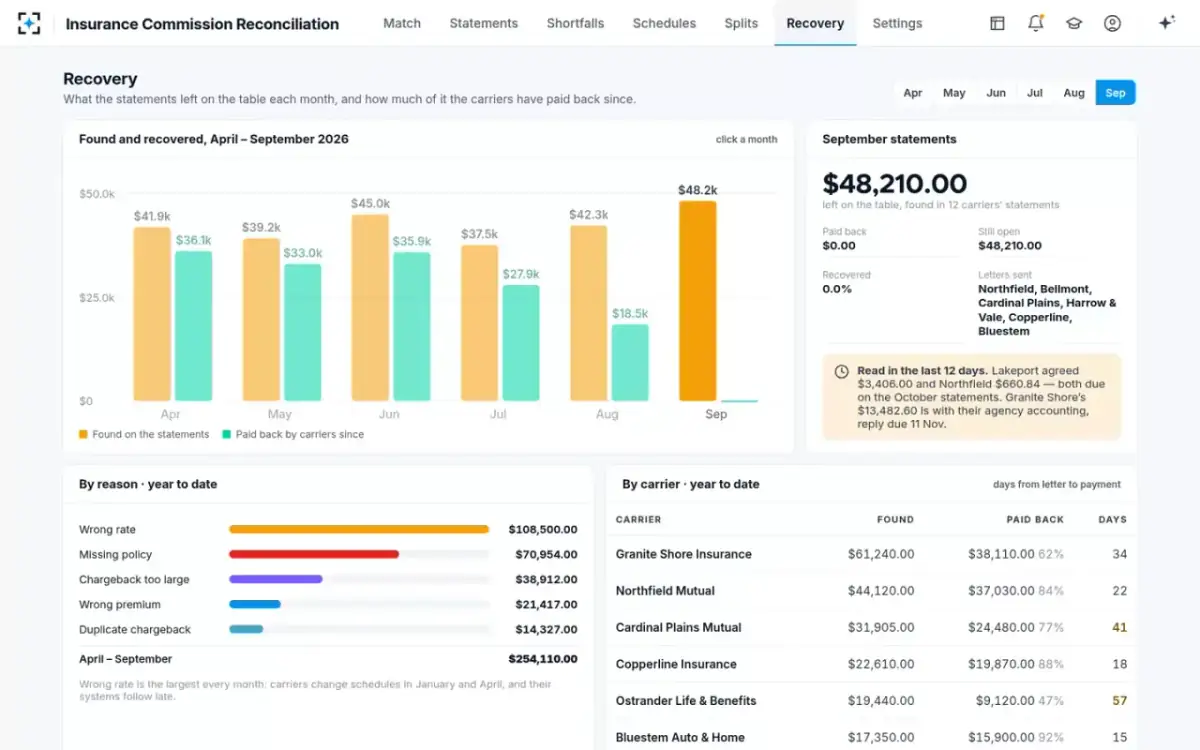
What carriers paid back, and how fast: the release dates for held shares
Questions people ask
What is the most common insurance producer compensation model?
Commission, by the BLS's account: independent agents may be paid by commission only, and among employees commissions are the most common form of pay, especially for experienced agents. Employees may also be paid salary only, salary plus commission, or salary plus bonus.
Can an agency pay an inside sales producer straight commission?
Only if commission covers federal minimum wage and overtime, unless the producer qualifies for an exemption. The outside sales exemption requires selling customarily and regularly away from the employer's places of business, and sales by mail, telephone or the internet do not count unless they supplement personal calls.
Does a producer agreement have to be in writing?
In New York, yes, for an employee whose principal activity is selling insurance on commission: signed by both sides, kept for three years, and stating the method of calculation, any draw's reconciliation frequency and the terms on termination. Other states set their own rules.
Can a departed producer be paid renewal commissions?
Under the NAIC model act, yes, if the producer was licensed when the policy was sold, solicited or negotiated, even if not licensed now. Whether renewals are owed at all is a term of the producer agreement.
What is a draw against commission for insurance producers?
A regular advance paid against commission the producer is expected to earn, reconciled to actual commission at set intervals. In New York, a written agreement with a recoverable draw must state how often it is reconciled.
How do agencies stop clawing back producer commission?
By paying splits on commission the carrier has paid and the agency has reconciled, and holding the producer's share of disputed items until the carrier pays. Clawbacks for real cancellations, endorsements and audits remain, because they follow the policy.