The required elements of informed consent are the statements a consent form has to carry for a person's consent to be legally effective, and there is no single list of them. For an FDA-regulated clinical investigation, 21 CFR 50.25 names eight basic elements, six additional elements that apply when appropriate, and one sentence that must appear word for word. For research conducted or supported by HHS, 45 CFR 46.116 names nine basic and nine additional elements, and requires the form to open with the key information. Writing a consent form is therefore less about prose than about proof: every element has to be present, and someone has to be able to show a committee which sentence meets which rule. Botminds' Informed Consent Authoring drafts the master consent form from the protocol and the Investigator's Brochure, keeps the source on every statement, and reads the draft back against both lists, naming the statement that satisfies each element and drafting a plain sentence for anything missing.
The study, the medicine and the people in the screens and product figures on this page are fictional sample data in the solution — a Phase 3 study of a drug called Veltrimab. The regulations are quoted from their own text, linked where they appear.
Two lists, one form: what each rule actually counts
8basic
elements every FDA-regulated consent form must contain, at 21 CFR 50.25(a)
6more
additional elements at 50.25(b), required when they are appropriate to the study
1exact
sentence prescribed word for word at 50.25(c), for an applicable clinical trial
9+9
basic and additional elements under the revised Common Rule, 45 CFR 46.116(b) and (c)
What are the required elements of informed consent?
They are the items of information a person must be given before agreeing to take part in research. Both rules introduce their list the same way — in seeking informed consent, the following information shall be provided to each subject — and then enumerate it. The list is not the whole requirement, though, and this is the first thing a new writer gets wrong.
Above the elements sit general requirements that no element restates. Consent must be sought in circumstances that give the person enough time to consider and that minimise coercion or undue influence. The information must be, in the regulation's words, "in language understandable to the subject or the representative". And no consent, oral or written, may contain exculpatory language. A form can carry all fourteen FDA elements and still be unlawful if it reads like a legal release or arrives with a signature deadline attached.
The distinction matters at review time as well. An institutional review board may, on findings it has to document, waive or alter the elements in paragraphs (b) and (c) of 45 CFR 46.116 — but it "may not omit or alter any of the requirements described in paragraph (a) of this section". The elements are negotiable in narrow circumstances. Understandable language and the absence of exculpatory wording are not.
Every required element, FDA beside the Common Rule
| The statement the form must carry | FDA · 21 CFR 50.25 | Common Rule · 45 CFR 46.116 |
|---|---|---|
| Research, purpose, duration, procedures, what is experimental | 50.25(a)(1) — basic | 46.116(b)(1) — basic. Same words. |
| Reasonably foreseeable risks or discomforts | 50.25(a)(2) — basic | 46.116(b)(2) — basic. Same. |
| Benefits that may reasonably be expected | 50.25(a)(3) — basic | 46.116(b)(3) — basic. Same. |
| Appropriate alternative procedures or courses of treatment | 50.25(a)(4) — basic | 46.116(b)(4) — basic. Same. |
| How far confidentiality of records will be maintained | 50.25(a)(5) — basic, and it adds that the form must note "the possibility that the Food and Drug Administration may inspect the records" | 46.116(b)(5) — basic, with no inspection sentence |
| Compensation and medical treatment if injury occurs (research above minimal risk) | 50.25(a)(6) — basic | 46.116(b)(6) — basic. Same. |
| Whom to contact about the research, about rights, and about an injury | 50.25(a)(7) — basic | 46.116(b)(7) — basic. Same. |
| Participation is voluntary; refusal and withdrawal carry no penalty | 50.25(a)(8) — basic | 46.116(b)(8) — basic. Same. |
| What happens to identifiable information or biospecimens after identifiers are removed | Not in part 50 today; FDA has proposed adding it | 46.116(b)(9) — basic, and one of the two statements it offers must be chosen |
| The ClinicalTrials.gov sentence for an applicable clinical trial | 50.25(c) — prescribed word for word | Not in 46.116; instead 46.116(h) requires one approved form to be posted on a federal website |
| Risks that are currently unforeseeable | 50.25(b)(1) — additional | 46.116(c)(1) — additional. Same. |
| When the investigator may end a person’s participation without their consent | 50.25(b)(2) — additional | 46.116(c)(2) — additional. Same. |
| Additional costs the person may face | 50.25(b)(3) — additional | 46.116(c)(3) — additional. Same. |
| Consequences of withdrawing, and how to withdraw in an orderly way | 50.25(b)(4) — additional | 46.116(c)(4) — additional. Same. |
| Significant new findings will be passed on | 50.25(b)(5) — additional | 46.116(c)(5) — additional. Same. |
| The approximate number of participants | 50.25(b)(6) — additional | 46.116(c)(6) — additional. Same. |
| Whether biospecimens may be used for commercial profit, and whether the person shares in it | Not in part 50 today; proposed | 46.116(c)(7) — additional |
| Whether clinically relevant results, including individual results, will be returned | Not in part 50 today; proposed | 46.116(c)(8) — additional |
| Whether research on biospecimens will or might include whole genome sequencing | Not in part 50 today; proposed | 46.116(c)(9) — additional |
| An opening that is a concise and focused presentation of the key information | Not in part 50 today; proposed at 50.20(e)(1) | 46.116(a)(5)(i) — a general requirement, not an element |
The eight basic elements under 21 CFR 50.25(a)
The first element is the longest, and it carries four separate obligations in one sentence: the form must give "a statement that the study involves research, an explanation of the purposes of the research and the expected duration of the subject's participation, a description of the procedures to be followed, and identification of any procedures which are experimental". Writers routinely satisfy three of the four. The one that goes missing is the expected duration, or rather the honest version of it — not the treatment period, but the whole commitment including safety follow-up.
Elements two, three and four form the decision a person is actually making: the reasonably foreseeable risks, the benefits that may reasonably be expected, and the alternatives, including the alternative of standard treatment outside the study. The rule says reasonably foreseeable, not every risk ever reported, and it says benefits that may reasonably be expected, which is why "you may benefit from this new medicine" fails where "this study is testing whether the medicine helps; you may get no benefit" passes.
Element five is the confidentiality statement, and it is the first place the two rules diverge. The FDA's version requires the form to note the possibility that the agency may inspect the records; the Common Rule's does not. A form written from a Common Rule template for a trial that is also FDA-regulated will be short exactly one clause, and it is a clause a careful committee will ask for.
Element six applies only to research involving more than minimal risk, and asks two questions a sponsor must answer before a writer can draft it: whether compensation is available if an injury occurs, and whether medical treatment is. Element seven asks for three contacts, not one — questions about the research, questions about a participant's rights, and a research-related injury — and the rights contact is usually someone independent of the study team, such as the review board. Element eight is the voluntariness statement, and it has to cover both refusing at the start and stopping later, each without penalty or loss of benefits the person is otherwise entitled to.
None of this requires the form to be long. FDA's own position, in its August 2023 informed consent guidance, is that detail belongs elsewhere: if describing every procedure would make the form too lengthy, the agency recommends giving the general procedures in the form "with an addendum describing the details of the study procedures to be performed at each visit", because "removing procedural details from the consent form will reduce its length, enhance its readability, and allow the consent document to focus on content related to the risks and anticipated benefits, if any". Element one is satisfied by a chart of visits and a sentence; it is not satisfied better by four pages.
The six additional elements, and what "when appropriate" means
Paragraph (b) opens differently from paragraph (a): "When appropriate, one or more of the following elements of information shall also be provided to each subject." That phrasing is easy to misread, because it sounds like discretion and is not. The discretion is over whether the element applies to this study. Once it applies, the word is shall.
Who decides whether it applies? In practice the sponsor's writer proposes and the review board decides, and the board's view is the one that counts, because it approves the form. The six are: risks currently unforeseeable; the circumstances in which the investigator may end someone's participation without regard to their consent; additional costs; the consequences of withdrawing and how to withdraw in an orderly way; a promise to pass on significant new findings; and the approximate number of participants.
Three of the six are appropriate in most interventional trials, and a writer who treats them as optional is writing a query into the form. A study with an investigational medicine has unforeseeable risks by definition. A study with stopping rules has circumstances under which the investigator ends participation. A study that will run for two years is likely to produce new findings. Argue the other three — costs, withdrawal mechanics and the participant count — on the facts of the protocol, and write the argument down, because that is what the board will ask for.
The one element that must appear word for word
Everything above can be written in the sponsor's own plain words. One statement cannot. For an applicable clinical trial, 21 CFR 50.25(c) does not describe the information to be conveyed; it prescribes the sentence, and the regulation prints it between quotation marks.
The only sentence the regulation writes for you
“A description of this clinical trial will be available on http://www.ClinicalTrials.gov
When it applies
Only to an applicable clinical trial, as defined in 42 U.S.C. 282(j)(1)(A). A Phase 1 drug study usually is not one.
What you may change
Nothing in the sentence. The regulation gives the words; a plain-language pass must leave them alone.
What you may add
A plain explanation beside it, as long as the prescribed words themselves survive intact.
The sentence is dated — the capitalised "Web site", the bare http address — and it is still the text the rule requires. Rewriting it to match the rest of a grade-8 form is an easy, well-intentioned error in plain-language work, which is why the wording you may not change is worth knowing as a list before an editor starts.
Do the FDA and the Common Rule require the same elements?
Almost, and the gaps are specific. Eight of the FDA's basic elements and eight of the Common Rule's are the same requirement in near-identical words. The differences are these: the FDA's confidentiality element adds the agency's right to inspect records; the Common Rule adds a ninth basic element about what happens to identifiable information and biospecimens once identifiers are removed, and three additional elements the FDA does not have — commercial profit from biospecimens, the return of clinically relevant results, and whole genome sequencing. The Common Rule requires the form to begin with key information; the FDA requires the ClinicalTrials.gov sentence. Each rule, in other words, asks for something the other does not.
FDA has proposed to close most of the gap. Its notice of proposed rulemaking of 28 September 2022 would add the Common Rule's language to part 50, including a key information requirement at 21 CFR 50.20(e)(1) and new elements at 50.25(a)(9) and (b)(7) through (9). The proposal has not been finalised, and the agency has said it intends to exercise enforcement discretion for studies already under way if the new requirements take effect. Until then, a trial that is both FDA-regulated and HHS-supported satisfies both lists, and a trial that is only one of the two still has to know which.
Which list applies to your study
Three questions settle it, and they are answerable from the protocol's first page. Is the study an FDA-regulated clinical investigation — an investigational new drug or device application, or a study whose data will be submitted to the agency? Then 21 CFR part 50 applies. Is it conducted or supported by HHS, or by an institution that applies the Common Rule to all of its human research under its own policy? Then 45 CFR 46.116 applies. Is it running in the European Union? Then the consent must also carry the facts Article 29 of Regulation (EU) No 536/2014 requires, among them the EU trial number and information about the applicable damage compensation system — neither of which exists anywhere in the US lists, and both of which travel as country requirements.
Most industry trials answer yes to at least two. That is why a single master consent form plus country versions is the standard shape, and why the element question is never asked once: it is asked again of every country version, because each one adds its own requirements on top of the master's.
Two elements that are easy to miss
No regulator publishes a league table of missing elements, and anyone who offers you one is guessing. What the FDA does publish, in its fiscal year 2024 clinical investigator inspection metrics, is the themes behind the 483 observations it issued: of 692 clinical investigator inspections, 156 ended in a 483, and the consent sub-themes under protocol compliance are "ICF Not Per Investigational Plan", "Revised Consent Not Obtained/Timely" and consent not obtained before screening, re-consent or dosing. Those are process failures, not drafting ones. The drafting failures surface earlier, in committee queries, which nobody aggregates.
Two elements are easy to miss, and both sit where a US writer's attention is not: one in the additional column, where "when appropriate" invites a writer to skip it, and one that exists only in the EU. The first is 50.25(b)(2): "Anticipated circumstances under which the subject's participation may be terminated by the investigator without regard to the subject's consent." Protocols always have these — a stopping rule on liver enzymes, a dose the person cannot tolerate, a withdrawal criterion — and a consent form can easily describe only the participant's right to leave, not the investigator's duty to remove them. The second, on EU versions, is the EU trial number: a single identifier that Article 29(2)(e) of the EU regulation requires, easy for a US writer to overlook, and the likely subject of a query wherever it is absent.
What the element asks for, and what forms tend to write
What the rule asks for: The expected duration of the person’s participation — the whole commitment, treatment and follow-up together.
What a committee sends back: "You will be in the study for 52 weeks" where the protocol runs treatment to 52 weeks and safety follow-up to 68. The number is right about the wrong thing.
What the rule asks for: The anticipated circumstances in which the investigator ends participation without regard to the person’s consent.
What a committee sends back: Only the mirror statement — "you may leave at any time" — with nothing about the stopping rules the protocol already names.
What the rule asks for: Whether compensation is available if injury occurs, whether treatment is, and if so what it consists of or where to find out.
What a committee sends back: A sentence that reads as a limitation of liability rather than an explanation, which runs into the separate prohibition on exculpatory language at 50.20.
Showing a committee that every element is present
A review board does not ask whether you believe the elements are present. It asks which sentence meets which one. That is a mapping problem, and it is the part of consent authoring that software can carry without taking a judgement away from anyone: read the draft, find the statement that satisfies each element, name it, and where there is no such statement, say so and offer wording.
That is what the elements checker does in Informed Consent Authoring. It reads the master against 21 CFR 50.25(a), (b) and (c), the key information requirement, Article 29 of the EU regulation and the study team's own country rules, and lists the statements that meet each item. On the fictional sample study it found two gaps — the EU trial number, and when the study doctor may take a person out of the study under 50.25(b)(2) — and drafted one plain sentence for each, with its source, for the medical writer to accept or rewrite. Release of a version is blocked while a required item is still missing; that is the solution's own rule, not a regulatory one, and it exists so that a form cannot reach a committee with a known gap in it.
Each element, and the sentence that meets it
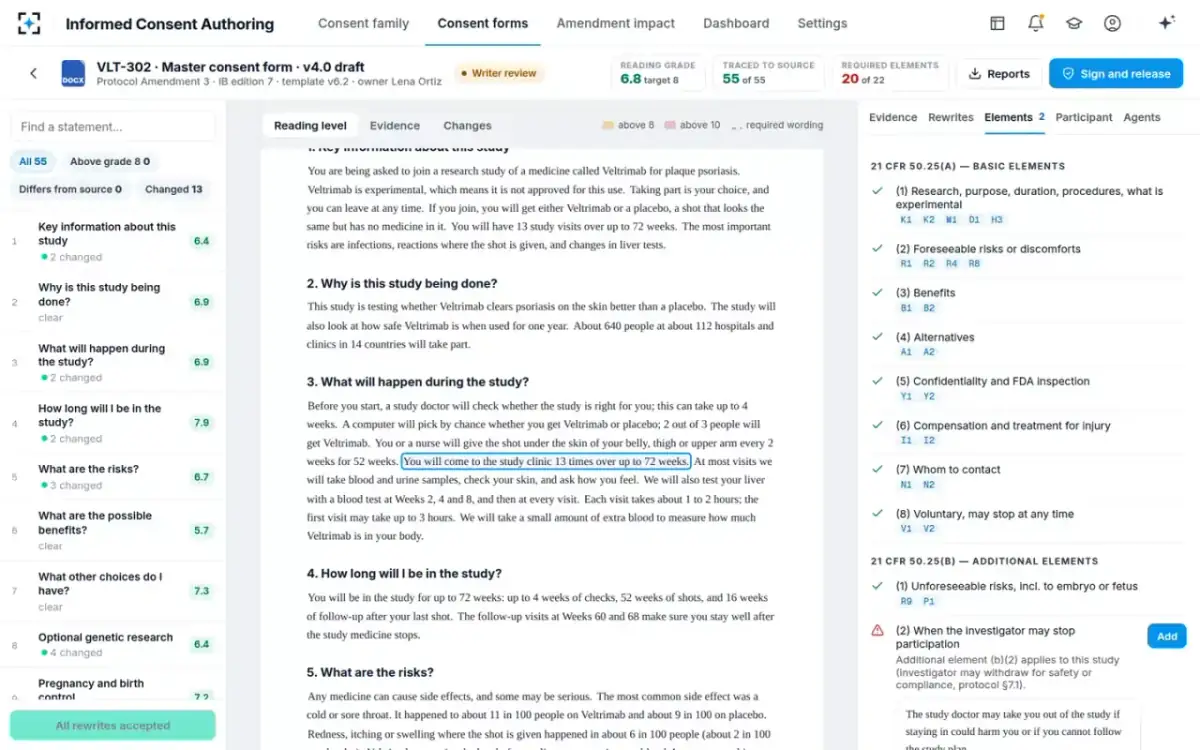
The element audit to run before you submit
- Decide which rules apply, and write the answer down
FDA-regulated, HHS-conducted or supported, EU, or more than one. Everything below depends on it, and the answer belongs in the submission, not in someone’s head.
- Map each element to a sentence, by citation
Not "risks are covered" but "section 6, paragraph 2, meets 50.25(a)(2)". If no sentence can be named, the element is missing however well the topic is discussed.
- Check the expected duration against the schedule of activities
Treatment plus follow-up, as the protocol has it after the latest amendment. This is the number that most often disagrees with the source document.
- Decide each additional element explicitly, and record the reason
"When appropriate" is a decision, not an omission. A board that can see the reasoning rarely argues with it.
- Confirm the 50.25(c) sentence is present and unaltered
Only if the trial is an applicable clinical trial — and then character for character, in the document and in the consent discussion.
- Re-read 50.20 after the plain-language pass
Understandable language and no exculpatory wording are general requirements that an element-by-element audit does not catch.
- Run the audit again on every country version
Each adds its own items on top of the master’s — the EU trial number, the damage compensation system, the local insurer and contacts.
What a missing element costs in review time
Nobody publishes an average, and the honest answer is that it costs a review cycle — whose length is set by the committee's calendar, not by the size of the gap. What the rules do fix is that you cannot use the form while the cycle runs. FDA's guidance states the position plainly: "An investigator may not begin the informed consent process with prospective subjects until the IRB reviews and approves the clinical investigation, consent form, and any other information to be given to subjects as part of the consent process". A missing element found at submission does not delay a document; it delays first enrolment at every site that form serves.
The arithmetic gets worse in parallel. A master consent form with eleven country, site and special versions behind it has eleven committees waiting, each with its own clock and its own queue, so a gap caught late is multiplied rather than added — which is the whole argument of what a protocol amendment does to every consent form. That is also why the check belongs before the signature rather than after the submission: three named people sign a released master in the solution — the author, the medical monitor, and privacy and legal counsel — and the release is what the country versions inherit from.
Signing a master that has already been read back against both lists
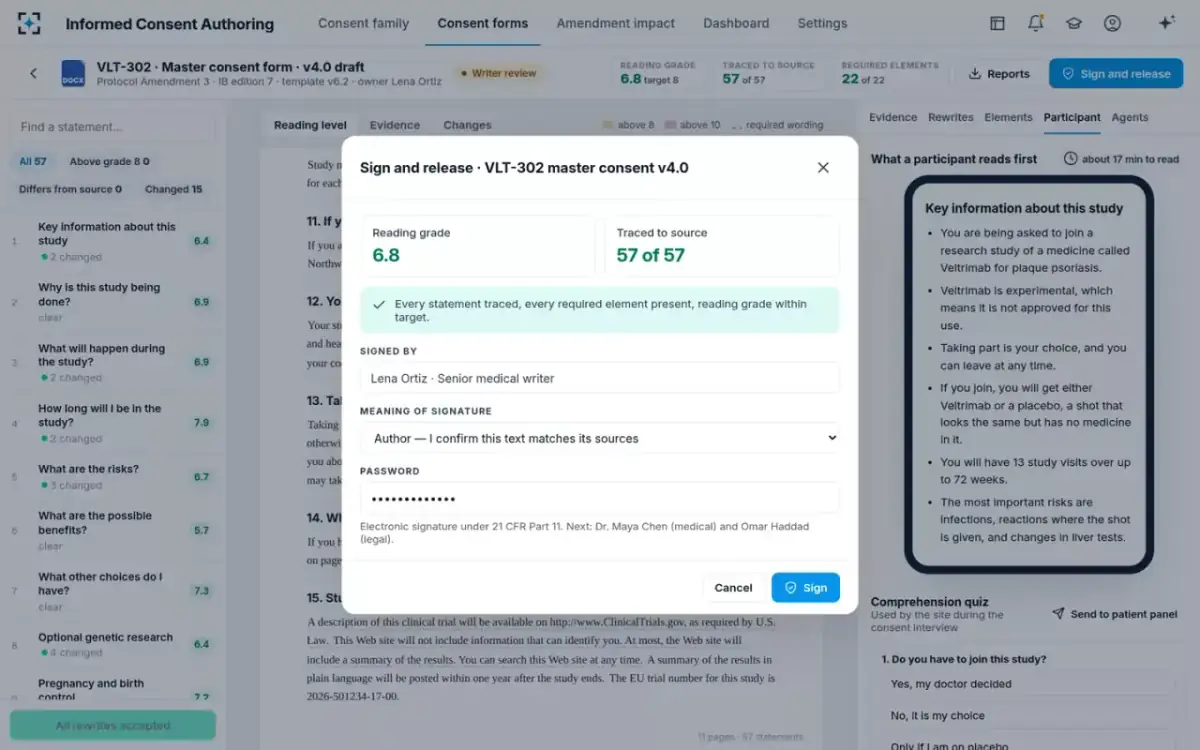
The elements are the floor, not the goal. A form can satisfy every one of them and still be unreadable, which is a separate and measurable failure: consent form reading level is where that work starts, and the key information section is where the Common Rule turns the order of the elements into a requirement of its own.
Questions people ask
How many elements of informed consent are there?
There is no single number, which is why the question gets so many different answers online. Under FDA regulations there are eight basic elements at 21 CFR 50.25(a), six additional elements at 50.25(b), and one prescribed sentence at 50.25(c) — commonly described as eight, or fourteen, or fifteen depending on what the speaker counts. Under the revised Common Rule there are nine basic and nine additional elements at 45 CFR 46.116(b) and (c). A trial subject to both satisfies both lists.
Does every consent form need all the additional elements?
No. Paragraph (b) requires them "when appropriate", so the question is whether each one applies to this study. The decision is not the writer's alone: the review board approves the form, so it effectively decides. Three of the six — unforeseeable risks, the investigator ending participation, and significant new findings — apply to most interventional trials, and leaving them out invites a query rather than saving space.
Who checks that every element is present?
In order: the sponsor's medical writer, the review board that must approve the form before it is used, and the FDA at inspection. The board's check is the one that holds up enrolment. The inspection check is retrospective and looks mostly at process — whether consent was obtained, from whom, when, and on the approved version — rather than at drafting.
Can a review board waive a required element?
Under the Common Rule, yes, within limits. 45 CFR 46.116(e) and (f) let a board waive or alter the elements in paragraphs (b) and (c) on documented findings, such as that the research involves no more than minimal risk and could not practicably be carried out without the waiver. The same provisions say a board "may not omit or alter any of the requirements described in paragraph (a)", which is where understandable language, the key information opening and the bar on exculpatory wording live.
Does a consent form have to be published anywhere?
For a clinical trial conducted or supported by a federal department or agency, yes. 45 CFR 46.116(h) requires one board-approved consent form used to enrol participants to be posted on a public federal website, after the trial closes to recruitment and no later than 60 days after the last study visit by any participant. Posted forms are public documents, which is one reason large readability studies of consent forms are possible.
What has to be in a consent form word for word?
Exactly one passage, in US regulation: the ClinicalTrials.gov statement at 21 CFR 50.25(c), and only for an applicable clinical trial. Everything else is a requirement about content, which you satisfy in your own words — subject to the separate prohibition on exculpatory language, the HIPAA authorization's own required elements where the authorization is combined with the consent form, and whatever a sponsor's template or a national law adds on top.