Informed consent authoring software writes and maintains the master informed consent form and its country, site and special versions from the protocol and the Investigator's Brochure, and keeps them current through every amendment. The category is young and the word "authoring" is doing a lot of work in it, because template libraries with merge fields have long been sold under the same name. The difference that matters is whether the tool knows what each sentence is for: whether it can show the passage behind a statement, write a change into eleven versions without touching anything else, and score the reading grade before an ethics committee sees it. Botminds' Informed Consent Authoring does those three things with seven agents and three signatures, and this page is about how to test any tool — including this one — against them.
It is written for the head of medical writing or clinical document management with a budget, and for the quality lead who will have to validate whatever is bought. The regulatory expectations are quoted from their sources; the product figures come from a fictional sample study in the solution, VLT-302, and are labelled as such.
What is informed consent authoring software?
At its narrowest it is software that produces a consent form from the study's own documents rather than from a blank page, and then maintains the relationship between the two. Three capabilities separate it from everything adjacent.
The first is statement-level traceability: each factual sentence in the form is linked to the passage it rests on — a protocol section and page, a brochure table, a template clause, a regulation — and the link survives rewriting. The second is fan-out: a change made once in the master is written into every country, site and special version as tracked changes, touching only what the master changed. The third is measurement: a reading grade per sentence and per document, scored against a target the study sets, before a committee reads it.
Everything else a vendor will show you is either a consequence of those three or available elsewhere. Workflow, version numbering and electronic signature are solved problems that your document system probably already has. The three capabilities above are not, and a tool that does not have them is competing with a template and a careful writer — which is a real competitor, and often the cheaper one.
What should you look for in informed consent software?
Look for evidence rather than features, and ask each question against your own protocol. Three properties are worth more than anything else on a feature list.
A link you can open. Not a list of documents the tool read, not a section number in a footnote: a link from the sentence to the passage, which opens beside it. This is the capability that makes review fast, because the reviewer stops hunting; it is also the one that makes an error visible, because a sentence with no passage behind it stands out.
An objection the tool raises by itself. A system that merely stores the link has done half the job. The half that pays is the comparison: the tool reads the passage, reads the sentence, and says when the two disagree — a visit count, a duration, a dose, a frequency. Ask for a demonstration on your own amendment with one number deliberately wrong.
A fan-out that writes nothing else. Country versions carry local wording that has survived previous committee rounds, and the fastest way to destroy a year of that work is a tool that regenerates each version from the master. The correct behaviour is tracked changes limited to what the master actually changed, accepted by the person who owns that country.
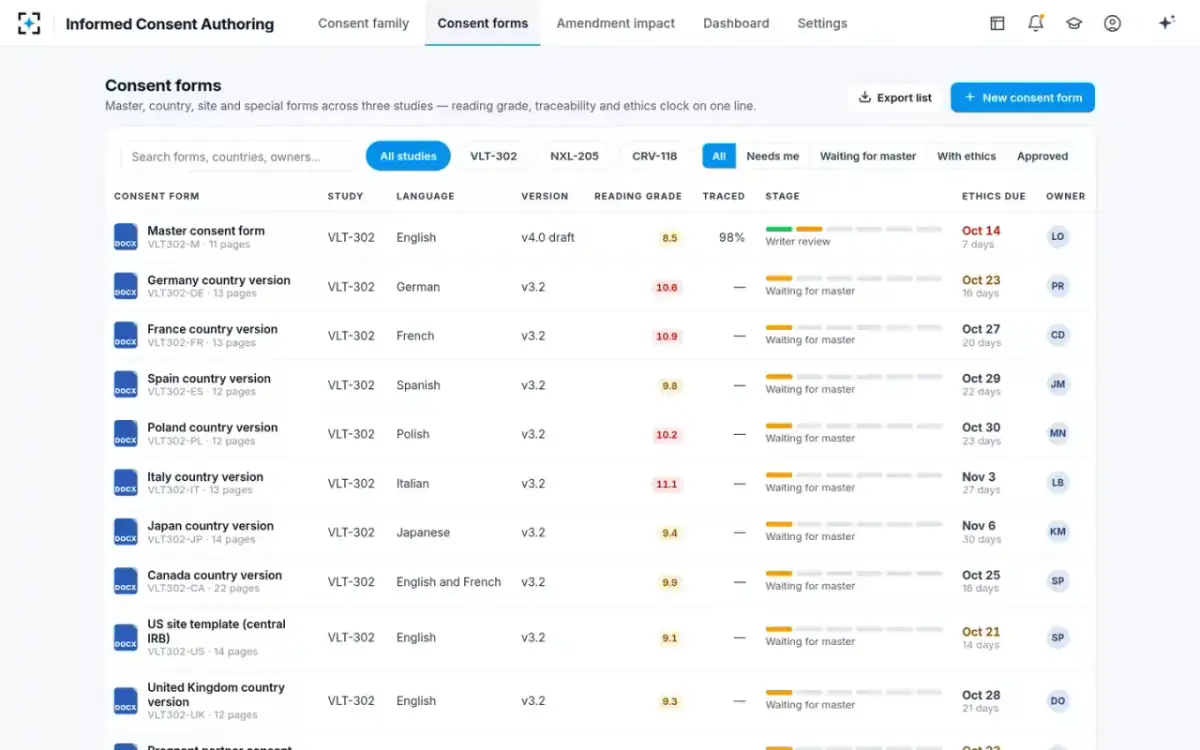
What the tool has to keep straight: three studies, four kinds of form, one line each
Twelve questions to put to a consent authoring vendor
Each of these has a good answer and a familiar bad one. The bad answers are not lies; they are the honest descriptions of a tool that does something adjacent to what you need.
Twelve evaluation questions for informed consent authoring software
- 1. Show me a sentence and open the passage it came from.
Worrying answer: "it reads the whole protocol." Reading is not citing. You need the link at the level of the sentence, on a protocol you brought.
- 2. I have changed a visit count in my amendment. What does the tool say?
Worrying answer: a cleaner draft. The tool should object, name the difference, cite the passage and refuse to release until a person decides.
- 3. How does a change reach the country versions?
Worrying answer: "it regenerates them." Regeneration overwrites local wording that previous committees asked for. Tracked changes limited to the master’s own change set is the only safe shape.
- 4. Whose rules decide what each country needs?
Worrying answer: "ours, built in." Country requirements change, and you will be asked where a rule came from. The list should be yours, with citations, and editable by your country study managers.
- 5. Which readability formula, and can we change the target?
Worrying answer: a single hidden score. Flesch-Kincaid and Gunning Fog disagree on the same text, and an assent form has a different target from a consent form. Both the formula and the target are study decisions.
- 6. What happens to wording a regulation prescribes exactly?
Worrying answer: "the model knows not to change it." A lock is a setting, not an instinct, and it has to hold through every rewriting pass.
- 7. What comes out, and in what format?
Worrying answer: a PDF. Your sites, translators and committees work in editable documents with tracked changes; an export that loses the changes loses the review.
- 8. What does the translation handover look like?
Worrying answer: "it translates." Certified translation and back-translation are procured services with their own evidence. The right answer is a clean handover of changed text with its sources.
- 9. Who signed what, and can I show it to an inspector?
Worrying answer: a version history. You need the decision, the person, the time and the meaning of each signature, on the document rather than in somebody’s inbox.
- 10. What does it need from us before it can draft anything?
Worrying answer: "nothing, just upload the protocol." A tool that needs no template and no country rules is writing from a generic template and generic rules.
- 11. What is the validation evidence, and what is left to us?
Worrying answer: "it is validated." Validation is of a system in a context of use. Ask what the supplier evidences and what your own quality team must still write.
- 12. What does it refuse to do?
Worrying answer: a long capability list with no limits in it. A tool with no stated limits has not thought about where a person must stay, and you will be the one explaining that to a committee.
Question eleven deserves its own paragraph, because quality teams are frequently handed a certificate and told the job is done. ICH E6(R3) frames computerised systems as a sponsor obligation and is specific about what the sponsor must be able to say: for systems it deploys, the sponsor should keep a record of the important computerised systems in a trial, describing each one's use, functionality, interfaces and validation status, and who is responsible for managing it. No supplier can write that record for you, because most of what it asks for are facts about how your organisation uses the system.
What you have to bring: template, country rules, protocol, brochure
This is the part of an evaluation that can derail a deployment, and it has nothing to do with the software. A consent authoring tool is a function of its inputs, and two of those inputs — the sponsor template and the country rules — frequently turn out not to exist in the form the tool needs. The template may exist as several slightly different Word files in different folders. The country rules may exist only in the heads of the people who have run those countries before.
Discovering that is not a failure of the evaluation; it is the most valuable thing the evaluation produces. Both documents are worth having whether or not you buy anything, and both are things only you can write.
What you bring to Informed Consent Authoring, what it gives back, and who owns each input
1
The sponsor master consent template
Medical writing, with privacy and legal counsel
A current version, with the prescribed passages marked as prescribed.
What it gives back
Every draft written to the template, section by section, with the template version named on the form.
2
The country rules for each country you run in
Country study managers, collectively
A written list with citations — insurer and policy, data-protection contacts, privacy authorization, bilingual versions, identifiers, payment rules.
What it gives back
Each country version checked against its own rules, and a named gap where one is unmet.
3
A current protocol and its amendments
Clinical development
The approved document, including the Schedule of Activities and the summary of changes.
What it gives back
Every factual statement tied to a section and page, and a list of which forms each change touches.
4
The Investigator’s Brochure
Pharmacovigilance or medical
The edition in force, with the adverse reaction tables and reference safety information.
What it gives back
Risks with their frequencies against placebo, written as "about N in 100 people" where that setting is on.
5
Your reading targets and signers
The study team, once
A target grade for consent and for assent, a scoring method, and a named person per signature.
What it gives back
A rewrite proposed for every sentence above target, and a release that waits for the right signatures.
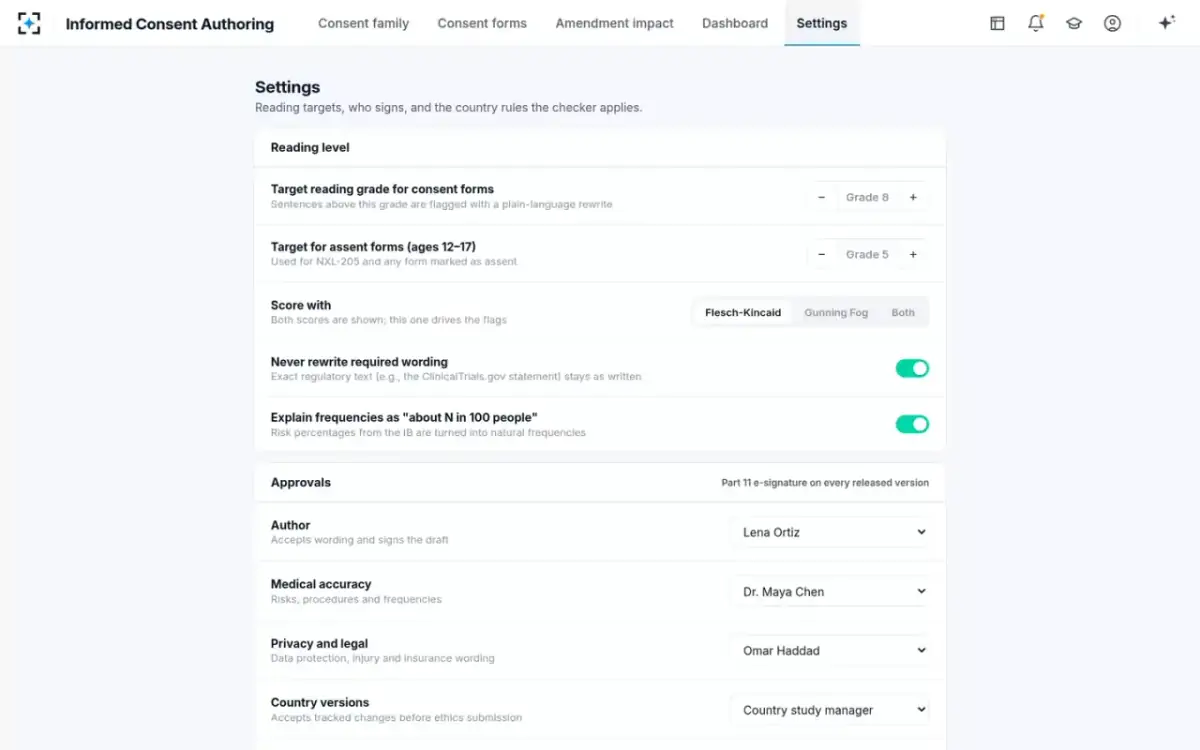
Two of those settings are worth deciding before a demonstration rather than during one, because they change what you will see. The scoring method matters: Flesch-Kincaid and Gunning Fog can differ by more than a grade on the same paragraph, and a vendor showing you one score has chosen for you. And the assent target matters if you run paediatric studies, because a grade-5 target rewrites far more of a document than a grade-8 one and is the harder demonstration to pass.
The settings a buyer configures once: targets, scoring, locks and signers
How to pilot it on one of your own amendments
Pilot on a real amendment that has already happened, not on a synthetic one and not on a live one. A completed amendment gives you the only thing a demonstration cannot: a known answer. You know which sentences changed, which committees queried what, and how long each step took, so every claim the tool makes can be checked rather than admired.
Pick a study with at least four country versions, because fan-out is the capability that fails quietly and one country proves nothing. Pick an amendment that changed a number — a visit count, a follow-up duration, a dose — because that is the comparison you want to watch. And bring the protocol and brochure as they were, not as they are now.
A four-week pilot on one amendment you have already shipped
- Load the master template and mark its prescribed passages2 d
- Write the country rules for four countries, with citations3 d
- Load the old documents1 d
- Draft the master; read every objection the tool raises2 d
- Compare its change list with what actually changed2 d
- Write the four versions1 d
- Check that nothing the master did not change has moved3 d
- Run the country rules1 d
- Measure against the real amendment’s dates and queries2 d
- Quality team writes what validation would still require2 d
- Decide, on the numbers1 d
There is a decision at the end of each week, and the first is the important one. A team that cannot assemble a current template and four countries' rules in a week has learned that its real bottleneck is upstream of any software, and that is worth knowing before a purchase order rather than after one.
Three behaviours that should disqualify a tool
Three behaviours should disqualify a tool regardless of how well it writes, and all three are easy to test for.
It must not produce a statement with nothing behind it. A consent form is derived from other documents, and a sentence with no antecedent is either an inference or an invention; from the outside those look the same. It must not rewrite wording a regulation prescribes exactly, and the lock has to survive every later pass, not just the first. And it must not send anything to an ethics committee. The FDA's guidance is unambiguous about where the authority sits: "The IRB must review and approve consent documents (long form or short form with written summary) that are to be used by investigators to document the informed consent of subjects (21 CFR 50.27(a) and 21 CFR 56.111(a)(4) and (5))." A tool that submits is standing between your sponsor and that review. What the rules allow an AI drafting tool to do, and who answers for it, works through the regulatory reasoning behind all three.
What to measure in the pilot
Measure against the amendment you already shipped, which means every number below has a known comparison. Resist the urge to measure quality by reading the draft and liking it; a fluent draft is the easiest thing in this category to produce and the least informative.
Seven measurements, how to take each, and what a good result looks like
| What to measure | How to take it | What a good result looks like |
|---|---|---|
| Statements with a source you can open | Sample 30 factual sentences from the draft master and try to open the passage behind each. | All 30. A single sentence with nothing behind it is a finding, not a rounding error. |
| Differences the tool found | Count the differences it raised against the ones you know the amendment introduced, plus the one you planted. | It finds the planted one. Missing it ends the pilot. |
| False objections | Count the flags a writer dismissed as wrong. | Low enough that writers still read them. A tool nobody trusts is a tool nobody reads. |
| Reading grade, before and after | Score the first draft and the accepted version with the same formula you will use in production. | A measurable fall, with every number and risk still present in the rewritten sentences. |
| Unexplained edits in country versions | Diff each country version against its previous version and account for every change. | Zero changes that the master did not make. This is the one that should stop a purchase. |
| Country rules met and gaps named | Run each country’s rules and check the named gaps against what that committee actually queried last time. | The gaps it names overlap with the queries you received. |
| Working days per step | Record the days for master update, medical and legal review, country fan-out and package assembly. | A fall in the first and third steps. Review time should not fall much — it is people reading. |
One measurement people ask for and should not rely on is a comprehension result. No document tool measures what a participant understood, and why readability and comprehension are different numbers sets out what the published evidence actually supports. A vendor who offers a comprehension score for a document is offering a readability score under a better name.
Where it sits beside your eTMF, CTMS and translation vendor
Authoring software is not a document repository and should not try to be one. The filed, approved form belongs in the trial master file with everything else; what the authoring tool holds is the working relationship between the protocol and the draft, which the repository has no way to represent. Expect the boundary to be an export of the approved version, and expect to be told what the tool keeps afterwards.
The study management system owns the committee calendar and the site list; the authoring tool needs the dates to be useful, which in a first deployment usually means they are entered once rather than integrated. That is acceptable for a pilot and a question for a contract.
The translation vendor keeps its work. A consent authoring tool that claims to translate is making a claim about certification that it cannot support; the useful handover is a clean set of changed sentences with their sources, so that a back-translation query can be settled against the protocol rather than against a recollection. In the sample solution this is explicit: the country adapter prepares text for certified translation and back-translation, and the translation itself stays with the vendor who certifies it. What each country adds to a master consent form covers the national requirements that make this handover more than a file transfer.
One more neighbour is worth naming because it affects the document itself. FDA and OHRP recommend, in their draft guidance on key information, "including a table of contents and page numbers (or hyperlinks for electronic documents) to cross-reference related topics." That is a small recommendation with a real production consequence: whatever produces the final document has to be able to generate and maintain those references through every amendment, which is a question for the export rather than for the drafting.
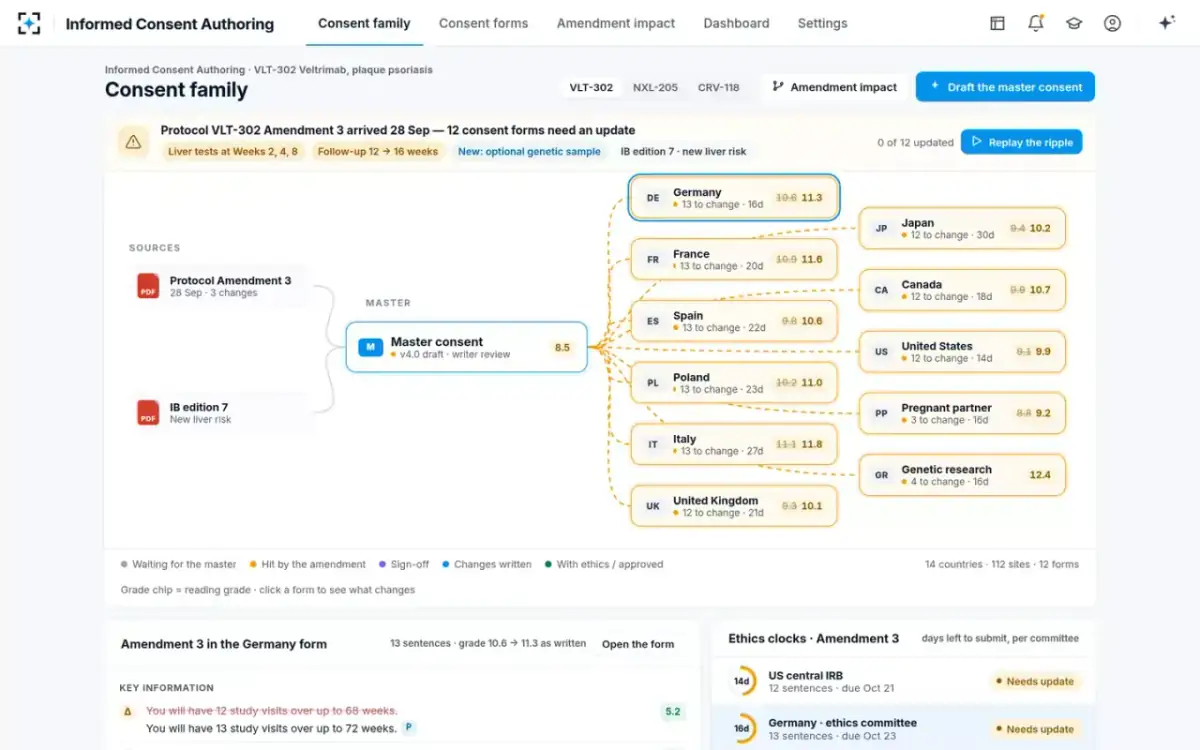
The screen that tells a buyer whether fan-out is real: one amendment against twelve forms
What a first study costs in setup time
Be sceptical of any week count a vendor gives, including a reassuring one, because the variable that dominates is whether your template and country rules exist. Where they do, a first study is days of configuration — targets, scoring, signers, template version — and the work begins on a real amendment. Where they do not, the schedule is however long it takes your own organisation to agree a master template, which is not a software question and is usually measured in months.
For Informed Consent Authoring the honest statement of go-live is that the solution is built and deployed from the buyer's own requirements and documents, and goes live once every quality check has passed. That is deliberately not a week count: a number invented to sound reassuring is the first thing a procurement team should distrust.
The costs worth modelling instead are the ones somebody already publishes. The United States health department's own clinical trial cost model builds per-study cost partly from "Cost Per Institutional Review Board (IRB) Approval × Number of IRB Approvals (per study); Cost Per IRB Amendment × Number of IRB Amendments (per study)" — two lines you can fill in from your own invoices. They will come out small. The large number is elsewhere, and what a protocol amendment actually costs works through where it sits.
The European timetable gives a second number that belongs in a business case, because it is a deadline rather than an estimate. Under Article 7 of the Clinical Trials Regulation, informed consent in a new application is assessed by each Member State for its own territory, and "Each Member State concerned shall complete its assessment within 45 days from the validation date"; for a later substantial modification the equivalent clock is 38 days. Either clock starts only from validation, so every day spent getting eleven forms ready is a day before it begins — which is the part of the calendar a document tool can actually move.
Finally, the question every evaluation ends on. The tool does not replace the medical writer; it removes the part of the writer's week that is proving and chasing rather than writing, and it makes a second reviewer's job possible by putting the evidence beside the sentence. The signatures stay human, the submission stays human, and the judgement about whether a kept sentence is defensible stays human. To see the whole chain on a sample amendment, start from Informed Consent Authoring.
Questions people ask
How is it different from a template library?
A template library gives you a starting document and leaves the relationship to the protocol in your head. Authoring software holds that relationship: each statement is linked to the passage it rests on, a change in the protocol produces a list of which sentences in which forms must change, and a difference between a sentence and its source is raised rather than waiting for a reviewer to notice. If a tool cannot do those three things, you are buying a template with a workflow around it.
How do you validate consent authoring software?
As a computerised system under ICH E6(R3), fit for purpose and risk-based. The guideline expects the sponsor to hold a description of each important system — its use, functionality, interfaces, validation status and who is responsible for managing it — so the work is partly the supplier's evidence and partly your own documentation. Scale the effort to consequence: a tool that writes the sentence telling a participant how many visits they will attend sits well above a spell-checker.
Does it replace the medical writer?
No. It removes the proving and the chasing — finding every instance of a changed number across a dozen forms, hunting for the protocol passage behind a sentence, re-reading a whole form to see what moved. The writing judgement, the decision to keep a sentence with a reason, and the signature all stay with people, and so does every submission to an ethics committee.
How does it fit with the eTMF and the translation vendor?
The trial master file keeps the filed, approved documents; the authoring tool keeps the working relationship between the protocol and the draft, and exports the approved version. The translation vendor keeps the translation and its certification. The useful handover from an authoring tool is the changed text with its sources, so a back-translation query can be settled against the protocol rather than against a memory of what was meant.
What do you have to bring before it can draft anything?
A current master consent template with its prescribed passages marked, a written list of country rules with citations, the protocol and its amendments, and the Investigator's Brochure edition in force. Teams often discover that the first two do not exist in a usable form. Both are worth producing whether or not any software is bought, and neither is something a supplier can produce for you.
How do you pilot it without risking a live study?
Run it on an amendment you have already shipped. You know which sentences changed, which committees queried what and how long each step took, so every claim can be checked against a known answer. Choose a study with at least four country versions and an amendment that changed a number, plant one wrong number, and watch whether the tool objects.