The key information section of an informed consent form is the opening the revised Common Rule has required since 2018: consent must begin with a concise and focused presentation of the key information most likely to help someone decide whether to take part. It is not a new heading to add to an existing form, and it is not a summary bolted on top. It is a rule about order and brevity, which makes the drafting question an unfamiliar one — not what to add to the first page, but what to leave off it. Botminds' Informed Consent Authoring writes the master consent form section by section from the protocol and the Investigator's Brochure with the key information first, keeps the source on every statement, and shows the opening as a participant will meet it, with the reading time for the whole form beside it.
The study, the medicine and the people in the screens and product figures on this page are fictional sample data in the solution. The regulation, its preamble and the agencies' guidance are quoted from their own text, linked where they appear.
Informed consent must begin with a concise and focused presentation of the key information that is most likely to assist a prospective subject or legally authorized representative in understanding the reasons why one might or might not want to participate in the research.
45 CFR 46.116(a)(5)(i)
What is the key information section of an informed consent form?
It is the beginning of the consent, not a part of it. The regulation says informed consent must begin with the concise and focused presentation, and adds that this part "must be organized and presented in a way that facilitates comprehension". Two things follow that writers often miss. The requirement is about the opening of the whole consent process, written and oral, not only about a box at the top of a document. And nothing in it says the opening must be labelled.
The agencies confirmed that explicitly in the draft guidance the FDA and the Office for Human Research Protections published jointly in March 2024: where the entire document is short enough to be the key information, "If the entire consent form is the key information section, it does not need to be labeled 'key information.'" A short, simple study with limited risks can satisfy the requirement with a form that is itself concise and focused throughout. A 25-page oncology consent cannot.
The companion requirement at 45 CFR 46.116(a)(5)(ii) is the one that keeps the rest of the form honest: consent as a whole "must present information in sufficient detail relating to the research, and must be organized and presented in a way that does not merely provide lists of isolated facts". So the opening may be brief, and the detail may not be abandoned. The two sentences together describe a form in tiers.
What must the key information section contain?
The regulation itself names nothing. It states a purpose — the information most likely to help someone understand why they might or might not want to take part — and leaves the content to judgement. The content comes from the preamble to the 2017 final rule, which set out what the rule-makers expected that opening to cover.
Those five factors are the nearest thing to a content list that exists, and they are worth quoting rather than paraphrasing, because the preamble's own framing is permissive: "As a general matter, a brief description of these five factors would encompass the key information most likely to assist a reasonable person (or legally authorized representative) in understanding the reasons why one might or might not want to participate in research" — followed immediately by the acknowledgement that the determination is fact-specific and that boards and institutions may require different or additional information.
The five factors the 2017 preamble names, and the sentence each one needs
- That consent is being sought for research, and that participation is voluntary
Two facts in one line. The voluntariness statement belongs here as well as wherever the form repeats it; the agencies recommend it as key information in their own draft guidance.
- The purposes of the research, the expected duration of participation, and the procedures to be followed
Duration means the whole commitment — treatment and safety follow-up — not the treatment period. It is the number most often inconsistent with the protocol.
- The reasonably foreseeable risks or discomforts
The most important risks, in the preamble’s own example, and not every reasonably foreseeable risk; the full description belongs later in the form.
- The benefits that may reasonably be expected
Including, where it is the truth, that there may be none. An opening that implies benefit where a protocol does not is an error a careful board will send back.
- Appropriate alternative procedures or courses of treatment
Including treatment outside the study. For a participant choosing between a trial and standard care, this is often the decisive line on the page.
The March 2024 draft guidance goes further than the preamble on two of the five. On voluntariness it is explicit: "A statement that consent for research is being sought and that participation is voluntary is a required element of informed consent, and we recommend that this element be included as key information." On risks it gives writers the permission they most often want and least often take — it may be appropriate in the opening "to present only the most important risks or discomforts based on frequency or magnitude, rather than listing all reasonably foreseeable risks" — while adding that for a study of an investigational product the possibility of unknown risks should generally be key information too.
It also asks for a comparison most consent forms never make. Where it applies, the degree to which the risks and potential benefits of taking part are likely to differ from those of ordinary clinical care should be key information. That is the question a patient choosing between a trial and standard treatment is actually asking, and it is a question a form assembled from a protocol will not answer unless a writer decides to answer it: the protocol has no reason to describe what happens to someone who stays with their usual doctor.
Note what is not on the list. Confidentiality is not one of the five, and the agencies' 2024 draft guidance leaves it out of the topics it addresses as key information, while adding that it may be key information for some study designs. Nor are costs, payment, contacts or the injury provisions. Those are required elements of the form. They are not, by default, part of the first page.
How long should the key information section be?
Short, and the regulators have been more specific about it than they are usually given credit for. Three statements set the range, and each attaches its length to a form size rather than to an absolute page count.
What the rule-makers and the agencies have said about length
| Source | What it says | What it means in drafting |
|---|---|---|
| 2017 final rule preamble, 82 FR 7149 | "In general, our expectation is that this initial presentation of the key pieces of information will be relatively short." | Relative to the form. The shorter the consent, the shorter its opening — and for a simple study the opening may be the whole thing. |
| 2017 preamble, on long oncology consents | For complicated cancer trials with 20- to 25-page consent documents, the expectation is that the concise and focused presentation "would be no more than a few pages". | A few pages out of twenty-five, not a proportional summary of everything that follows. |
| 2017 preamble, on what would fail | A 10-page description of elements such as potential risks "accompanied by lengthy and complex charts and graphs" would not satisfy the concise and focused requirement. | A long opening is not a safer opening. Length is itself the failure the rule is aimed at. |
| FDA and OHRP draft guidance, March 2024 | "We recommend that the key information section of a consent document be relatively short (e.g., generally no more than a few pages)." | Seven years later, the same answer, now in guidance a sponsor can cite to a reviewer. |
A practical corollary: if your opening is running past two pages, the cause is often not that the study is complicated but that required elements have migrated forward. Every sentence on the first page should be answering why someone might or might not take part. A sentence that is there because the element has to appear somewhere belongs in the body.
The five factors the 2017 preamble names
Worth stating in the preamble's own order, because the order is a reading order and not a filing order. Consent is being sought for research and taking part is voluntary. Then the purpose, the duration and the procedures. Then the risks, then the benefits, then the alternatives. A reader who stops after three sentences has the two facts that matter most — this is research, and you do not have to.
A key information page, annotated
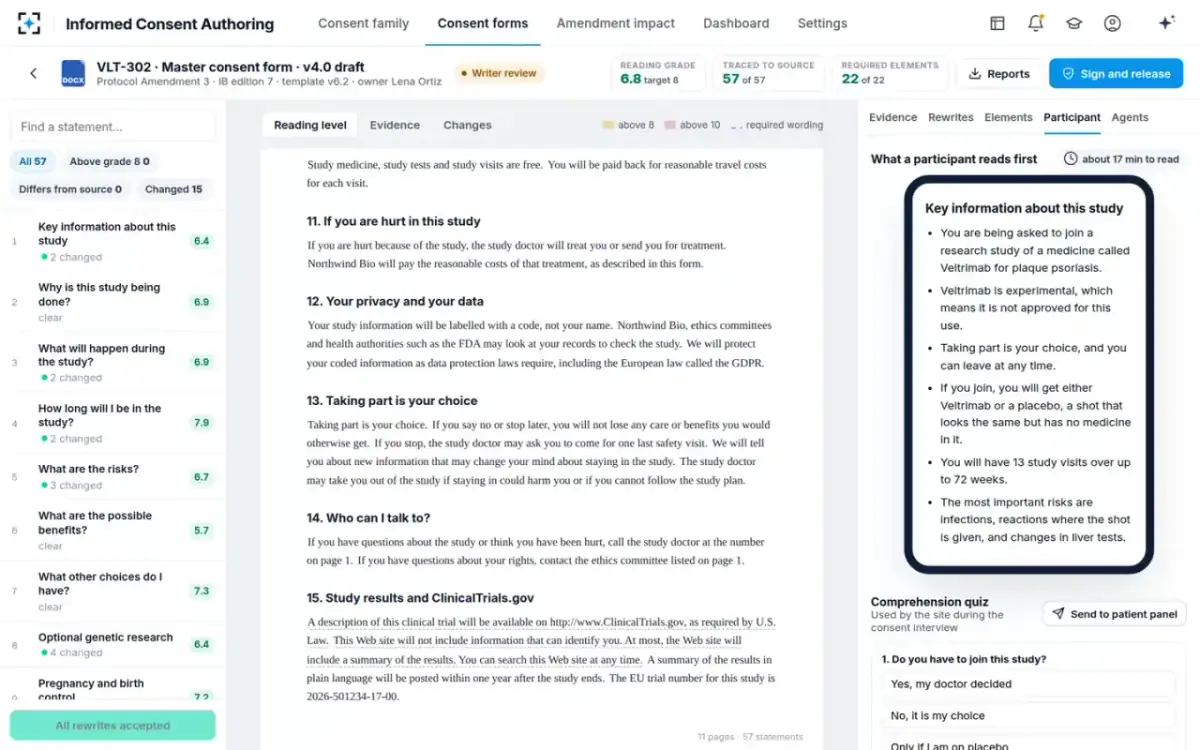
The common objection to all of this is that five factors cannot be fitted onto one page for a complicated trial. They can, because each factor needs one or two sentences and not a section. The opening below is six sentences long, answers all five, and belongs to a Phase 3 study with 640 participants in 14 countries — read in about a minute, against about 17 minutes for the form behind it.
A key information page, annotated: six sentences, five factors
You are being asked to join a research study of a medicine called Veltrimab for plaque psoriasis.
FactorFactor 1 · consent is being sought for research
NoteAlso meets the research-and-purpose element
Veltrimab is experimental, which means it is not approved for this use.
FactorFactor 2 · the purpose of the research
NoteNames what experimental means rather than using the word alone
Taking part is your choice, and you can leave at any time.
FactorFactor 1 · participation is voluntary
NoteThe voluntariness element, in the opening rather than at the end
If you join, you will get either Veltrimab or a placebo, a shot that looks the same but has no medicine in it.
FactorFactor 2 · the procedures to be followed
NoteRandomisation and placebo explained where the decision is made
You will have 13 study visits over up to 72 weeks.
FactorFactor 2 · the expected duration of participation
NoteTreatment and follow-up together, from the schedule of activities
The most important risks are infections, reactions where the shot is given, and changes in liver tests.
FactorFactor 3 · the reasonably foreseeable risks
NoteThe most important risks, not every risk — the full list follows later
Two of the five are carried by one sentence each, which is the usual pattern: benefits and alternatives are short on a placebo-controlled trial because the honest answer is short. What takes the space is the procedures line, and the discipline there is to give the shape of participation — what you get, how often, for how long — and to leave the visit-by-visit schedule to the body of the form.
Does the FDA require a key information section?
Not yet. The requirement lives in the Common Rule at 45 CFR 46.116(a)(5), which binds research conducted or supported by HHS and research at institutions that apply the Common Rule across the board. FDA regulations at 21 CFR part 50 contain no equivalent provision today. The FDA has proposed one: its notice of proposed rulemaking of 28 September 2022 would add identical language at 21 CFR 50.20(e)(1), and the agency has said it intends to exercise enforcement discretion for ongoing studies if the new requirements take effect.
Outside the United States the question changes shape again. The EU clinical trials regulation has no key information provision at all; it sets a different standard of plainness for the whole document and requires facts no US rule mentions, which travel as country requirements rather than as a first page. A sponsor running a master and a dozen country versions therefore cannot satisfy the key information rule once; it satisfies it in the master and then has to keep the opening intact through every adaptation and every amendment.
In practice the distinction often matters less than it looks. Many studies are FDA-regulated and also HHS-supported, or run at institutions that apply the Common Rule more widely under their own policies, so the requirement can arrive anyway. And a sponsor whose master template puts key information first is making a choice that costs nothing if the proposed rule is finalised and saves a template revision if it is. That is the position the solution takes: its master template opens with key information as a sponsor setting, not because the FDA compels it.
Formatting the agencies actually cite evidence for
Guidance about layout is usually taste. This guidance is not, and that is worth knowing when a reviewer argues about it. The FDA and OHRP recommend organising the key information inside bubbles — "rounded boxes creating a discrete unit of information" — with a separate bubble for each topic such as purpose, risks or alternatives, and they rest the recommendation on published research into how consumers comprehended alternative formats of prescription medicine information. That research found consumers understood more when the information was given in a simple format, grouped inside a defined border.
Alongside the bubbles the agencies suggest formatting text into two columns, using bullet points to break up long explanations, and leaving ample white space around each discrete unit. They are explicit that these are suggestions and that other formats may be used. But a sponsor arguing for a boxed, bulleted first page has an agency recommendation and a cited experiment behind it, which is a better position than arguing about house style.
The opening as a participant meets it, with the reading time for the whole form
Three tiers: key information, required elements, detail
The clearest way to hold the rule in mind while drafting is as three tiers, each with a different test. The first page answers why someone might or might not take part. The body contains everything the elements require, in enough detail to be useful. The appendices and addenda carry what only some readers need — the visit-by-visit schedule, the optional sub-study, the full adverse-reaction table.
The same facts, placed by tier
On the first page: What you get, how it is given, how often, and for how long — one or two sentences.
In the body or an addendum: The schedule of activities visit by visit. FDA guidance recommends moving procedural detail out of the form into an addendum precisely to keep the form short and readable.
On the first page: The most important risks, named in ordinary words.
In the body or an addendum: Every reasonably foreseeable risk with its frequency against placebo, which is the required element and is not what the opening is for.
On the first page: Usually nothing. The agencies say it is not among the topics they address as key information, though it may be key for some designs.
In the body or an addendum: The confidentiality element in full, including who may inspect records and what the data-protection wording requires.
On the first page: Nothing, unless a cost to the participant would change the decision to join.
In the body or an addendum: The compensation and treatment element, the costs element, and the reimbursement arrangements.
On the first page: Nothing.
In the body or an addendum: All three contacts the element requires: the study, participants’ rights, and a research-related injury.
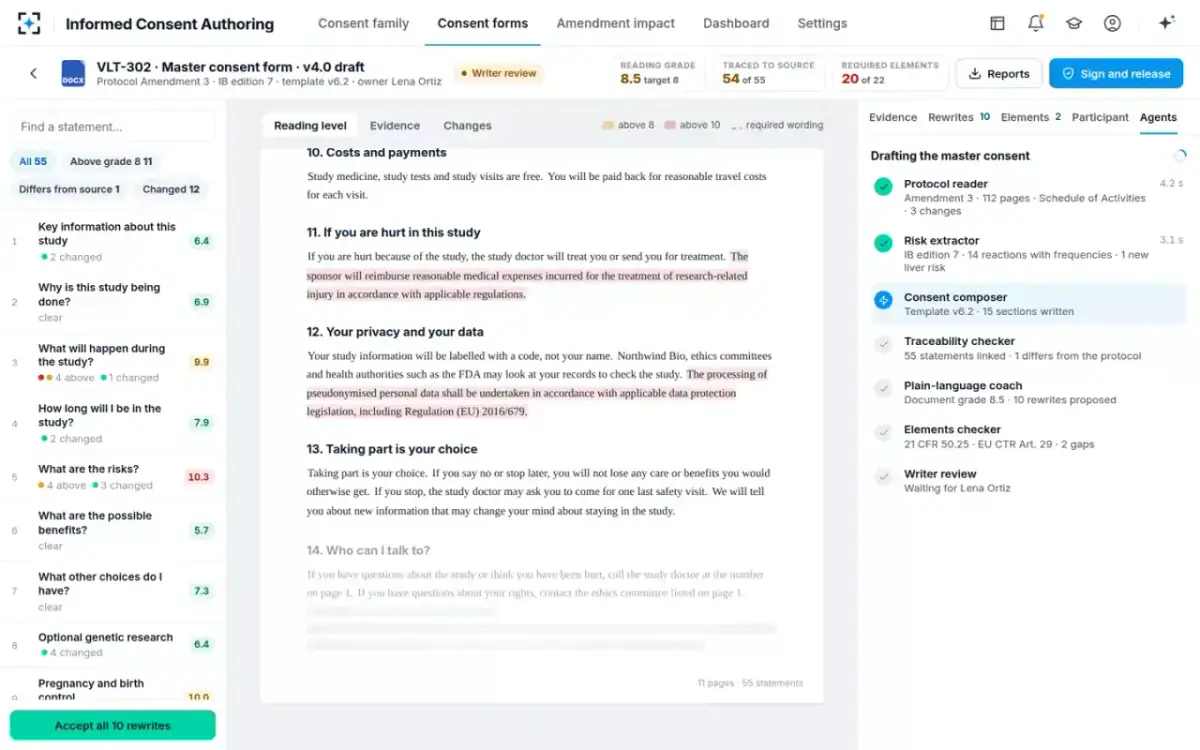
Writing in that order is also the cheapest way to get the first page right, because the alternative — writing the body and then extracting a summary — tends to produce an opening made of the first sentence of each section. That is a table of contents, not a concise and focused presentation. In the solution the composer writes the master in template order with key information first, which on the sample study came to 15 sections drafted from the sponsor's own template.
Writing the opening first, with every statement tied to its source
What reviewers send back
Nobody publishes a tally of key information queries, so take what follows as the shape of the problem rather than its frequency. Three patterns recur, and each one has a line in the regulation or the preamble behind it.
The first is the opening that is a summary of the document rather than a decision aid: every section represented, nothing the reader needs to decide. The regulation's test is the reasons why one might or might not want to participate, and a sentence that does not bear on that question is not key information however important it is elsewhere. The second is the opening that has grown — the preamble's own example of what would fail is a ten-page risks description with charts. The third is the opening that soft-pedals the honest answer: a placebo-controlled trial in which the benefits line implies personal benefit, or the duration line gives the treatment period rather than the whole commitment.
In the solution the opening is held to the same discipline as the rest of the form. Every statement in it carries the protocol or brochure passage it came from, a statement that differs from its source blocks release until a person decides, and the writer sees the opening as a participant will meet it before signing. That discipline matters most on the duration line, because it is assembled from the schedule of activities and moves with every amendment: on the fictional sample study the draft said twelve visits over about 68 weeks where the amended schedule had thirteen over up to 72 weeks, and an opening that disagrees with the body on the number of visits is worse than one that never gave it.
There is a fourth that belongs to the form rather than the opening. Moving the five factors forward does not license stripping the body: 46.116(a)(5)(ii) requires the consent as a whole to carry sufficient detail and not to read as lists of isolated facts. An opening that is excellent and a body that has been hollowed out to match fails the second sentence of the same paragraph. Keeping both true at once is the practical reason the element-by-element audit still has to run on a form that opens well, and the reason a plain opening is not the same thing as a form at grade 8 throughout.
Questions people ask
Where does the key information section go in the form?
First. The regulation says informed consent must begin with the concise and focused presentation, so it comes before the required elements and before any sponsor or institutional boilerplate. If a sponsor template opens with a title block, a version footer and an institutional preamble, those come before the consent begins, not inside the opening.
Can the whole consent form be the key information section?
Yes, for a short and relatively simple study. The 2017 preamble contemplates a consent that is itself relatively short, where the information at the beginning satisfies both the key information requirement and the elements, and need not be repeated later. The agencies' 2024 draft guidance adds that such a form does not need to be labelled key information. The approach only works where the form genuinely gives enough information to decide.
Does the key information section have to be labelled "key information"?
No. The requirement is about what the consent begins with, not about a heading. The draft guidance says in terms that a form which is entirely key information does not need the label. Many sponsors label it anyway, because a labelled opening is easier for a reviewer to find and easier for a site to point at during the consent discussion.
What does "concise and focused" mean in practice?
Concise is measured against the form: relatively short, and generally no more than a few pages even for a 20- to 25-page oncology consent. Focused means every sentence bears on whether to take part. The preamble's worked example of failure is a ten-page risks description with lengthy charts, which is both too long and insufficiently focused.
Does a key information section change the required elements?
No. The elements are unchanged; the rule adds a requirement about how the consent opens. Where a statement at the beginning satisfies both the key information requirement and an element, the 2017 preamble says it need not be repeated later in the form — which is how an opening makes a consent shorter rather than longer.
Does the key information rule apply to assent forms?
The requirement in 45 CFR 46.116(a)(5) is framed around informed consent from the participant or a legally authorised representative, and assent is governed separately under the subpart covering children. Many sponsors apply the same discipline to assent documents, at a lower reading target, because the argument for putting the decision facts first does not depend on which document carries them.