Can AI write informed consent forms? Yes — a draft is a draft, and nothing in United States or European law says a machine may not produce one. What no AI tool can do is make the draft a consent form, because a consent form is a document an ethics committee has approved and a named person has signed for. That distinction is the whole of the regulatory answer, and it is more useful than it sounds: once you accept that the approval and the responsibility cannot move, the questions that decide whether a tool is usable stop being about the model and start being about the plumbing around it. Botminds' Informed Consent Authoring is built to that answer — seven agents draft, trace, simplify and check, every statement carries the protocol or brochure passage it rests on, a statement that differs from its source blocks release, prescribed wording is locked, and three named people sign the master before any country version is written.
This page is for the sponsor document owner or head of medical writing evaluating a drafting tool, with quality assurance and the submission team reading over their shoulder. It quotes the regulators and the ICH guideline directly, and uses a fictional sample study in the solution — VLT-302, a Phase 3 psoriasis trial — for everything about the product. The companion question for regulatory submissions is a different one with different rules; this page answers the consent version only.
Can AI write an informed consent form?
It can write the text. It cannot complete the act. Documentation of informed consent in the United States turns on a document the IRB has approved and a person has signed: 21 CFR 50.27(a) requires that "informed consent shall be documented by the use of a written consent form approved by the IRB and signed and dated by the subject or the subject's legally authorized representative at the time of consent". Every word of that sentence survives automation untouched. Approval is an IRB act, signature is a participant act, and neither is something software performs.
ICH E6(R3), adopted by ICH at Step 4 on 6 January 2025, says the same thing from the investigator's side: "Prior to consenting and enrolling participants, the investigator should have the IRB/IEC's documented approval/favourable opinion of the informed consent materials and process". Materials and process, not just the form. However a draft was produced, the materials that reach a participant have been through a committee.
So the honest framing for a buyer is that an AI tool operates entirely inside the drafting window — between a protocol amendment arriving and a package going to a committee — and that window is the part of the work a tool can actually change. It is also where much of the risk sits, because a wrong number introduced there is a number an ethics committee may approve and a participant may rely on.
Does the FDA allow AI to draft a consent form?
The FDA has no rule on the question, and its informed consent guidance does not need one, because the control it relies on is placed earlier. The August 2023 guidance states the principle flatly: "All information given to subjects as part of the consent process is to be reviewed and approved by the IRB (21 CFR 56.109(a)-(b) and 56.111(a)(4)-(5))." Everything the participant will see is reviewed, whoever or whatever produced it.
That is a weaker constraint than many quality teams expect and a stronger one than vendors like to admit. It is weaker because no approval, validation or disclosure of a drafting tool is required before use. It is stronger because it makes the sponsor's internal process the only real control: an IRB reviews what it is sent, and it cannot see a number that was invented upstream unless the sponsor's own checking caught it. A tool that produces fluent, plausible, unsourced text puts the entire burden on a reviewer reading for errors they have no way to detect.
This is also why "the IRB approved it" is not an answer to a finding. An IRB reviews what it is sent; it is not positioned to check every number against the protocol and the brochure. The sponsor holds that one.
Who is responsible for an AI-drafted consent form?
The sponsor, and within the sponsor, the named people who sign. European regulators have put this in writing. The EMA's reflection paper on artificial intelligence in the medicinal product lifecycle, adopted by its human medicines committee on 9 September 2024, calls it a key principle that the trial sponsor, applicant, authorisation holder or manufacturer is responsible for making sure every algorithm, model, dataset and data processing pipeline it uses is fit for purpose and meets legal, ethical, technical, scientific and regulatory standards.
Read the list of nouns in that principle. Algorithms, models, datasets and data processing pipelines — the sponsor answers for all four, not for the output alone. A sponsor cannot discharge that by pointing at a supplier, and a supplier cannot accept it on the sponsor's behalf. What a supplier can do is make the obligation dischargeable: produce the evidence the sponsor needs to say what the tool did, on which inputs, under whose instruction, and what a person decided afterwards.
That is why the design question and the responsibility question are the same question. A tool whose output cannot be traced leaves the sponsor holding an obligation it has no way to meet. A tool that shows, for every sentence, the passage it came from and the person who accepted it, hands the sponsor exactly the evidence the principle demands.
The drafting chain in Informed Consent Authoring, step by step, and what never happens in it
Agent
Protocol readerReads the amended protocol and lists what changed, each fact with its section and page.
Never: Never infers a visit or a procedure that is not in the Schedule of Activities.
Agent
Risk extractorTakes the adverse reactions and their frequencies from the brochure and states them as natural frequencies.
Never: Never rounds a serious risk down; keeps the drug and placebo frequencies together.
Agent
Consent composerWrites the form section by section from the sponsor template, key information first.
Never: Never writes a statement without a source; prescribed wording is copied exactly.
Agent
Traceability checkerCompares every statement with the passage it cites and flags any difference, with the reason and a corrected sentence.
Never: Never clears its own flag — a flagged statement blocks release.
Agent
Plain-language coachProposes a rewrite for each sentence above the target grade, keeping every number and risk.
Never: Never changes locked wording, and never applies a rewrite on its own.
Agent
Elements checkerChecks the required elements and each country’s rules, and drafts a plain sentence for anything missing.
Never: Never applies a rule that is not in the study team’s approved list.
A person decides
AuthorAccepts, edits or rejects every proposed sentence, then signs as author: this text matches its sources.
Never: Nothing reaches the next signature without this step.
A person decides
Medical monitor and legal counselSign for medical accuracy and for the privacy, injury and insurance wording.
Never: Release is blocked while any statement differs from its source or a required element is missing.
A person decides
Country study managerAccepts the tracked changes for their country, then the team sends the package to the committee.
Never: Agents never submit to an ethics committee. People do.
What the EMA's reflection paper expects of a sponsor
Beyond the responsibility principle, the reflection paper makes one move that matters more for a consent tool than anything else in it: it refuses to create a separate regime. "The use of AI/ML within the context of clinical trials should meet applicable requirements in the ICH E6 guideline for good clinical practice (GCP)". There is no AI annex to satisfy and no AI exemption to claim. A drafting tool is assessed as part of GCP, like every other system in a trial.
The paper also ties the depth of scrutiny to risk and regulatory impact rather than to the technology, which is the line a quality team should use when sizing its own work. A model that suggests synonyms in a style guide and a model that writes the sentence telling a participant how many visits they will attend are the same technology at wildly different risk. The second changes what a person agrees to.
A useful consequence for buyers: a vendor who answers questions about regulatory fit by describing their model has misread the paper. The expectations land on the pipeline — the inputs, the processing, the outputs and the evidence that the whole thing is fit for its purpose — and a sponsor's quality team will be asked about all of it.
ICH E6(R3): computerised systems, fit for purpose
E6(R3) is where the practical requirements live, and it is deliberately technology-neutral. Its principle 9.3 asks that computerised systems used in clinical trials be fit for purpose — through risk-based validation where appropriate — with the factors critical to their quality addressed in how they are designed or adapted for trial use, so that the integrity of trial data is protected.
Three ideas in that principle carry the work. Fit for purpose means the question is what this system does in this trial, not what the category is called. Risk-based means the validation effort is scaled to consequence, so a consent drafting tool is not treated like a spell-checker and not treated like a randomisation system either. Design means the controls are expected to be in the product's architecture, not bolted on by the sponsor afterwards — which is precisely what distinguishes a tool built for this work from a general assistant pointed at a protocol.
The guideline also expects the sponsor to be able to describe its systems: what each is used for, its functionality, its interfaces, its validation status and who is responsible for managing it. If that list cannot be written for a drafting tool, the tool is not ready to be used on a real study — and the list is the same one an evaluation of informed consent authoring software should produce as a matter of course.
The four things an AI consent tool must never do
Read the FDA, EMA and ICH positions together and they converge on four prohibitions. None of them is written in those words anywhere; all four follow from rules that are.
One row per agent: what it may do, what it may not, and who decides
Protocol reader
MayRead the protocol and each amendment — synopsis, Schedule of Activities, design, procedures — and list what changed, every fact with its section and page.
NeverInfer a visit or a procedure that is not in the Schedule of Activities.
Who decidesNobody yet; its output is evidence for the steps below.
Risk extractor
MayPull adverse reactions from the Investigator’s Brochure with their frequencies against placebo, and express them as "about N in 100 people".
NeverRound a serious risk down, or separate the drug frequency from the placebo frequency.
Who decidesThe medical monitor, who signs for risks, procedures and frequencies.
Consent composer
MayWrite the form section by section from the sponsor template and the extracted facts, key information first.
NeverWrite a statement with no source, or retype prescribed wording in its own words.
Who decidesThe author, who accepts the draft before anyone else sees it.
Traceability checker
MayCheck every statement against the passage it cites and flag any number, visit, dose, duration or frequency that differs, with the reason and a corrected sentence.
NeverClear its own flag. A flagged statement blocks release.
Who decidesA person — correct it, or keep it with a reason for the medical monitor.
Plain-language coach
MayScore every sentence and propose a rewrite at or below the target grade that keeps every fact of the cited source.
NeverTouch locked wording, or drop a number or a risk to make a sentence shorter.
Who decidesThe author, rewrite by rewrite — accept, edit or keep the original.
Elements checker
MayCheck the form against 21 CFR 50.25, the key information rule, EU CTR Article 29 and each country’s rules, and draft a plain sentence for anything missing.
NeverApply a rule that is not in the study team’s approved list for that country.
Who decidesThe author for the master, the country study manager for a country version.
Country adapter
MayCarry master changes into every country, site and special version as tracked changes, and prepare text for certified translation and back-translation.
NeverChange text the master did not change. No silent edits.
Who decidesThe country study manager, who accepts their own version.
Never a statement without a source. A consent form is a derived document: every factual sentence in it restates something in the protocol, the brochure, the template or a regulation. A sentence with no antecedent is either a reasonable inference or a fabrication, and from the outside the two look identical. Requiring a source for every statement is not a quality nicety; it is the only mechanism that makes the difference visible.
Never a rewrite of prescribed wording. Some passages are prescribed exactly — the ClinicalTrials.gov statement at 21 CFR 50.25(c) is the familiar one — and a plain-language pass is exactly the operation most likely to damage them, because they read as dated or legalistic and score badly on readability formulas. A lock is the right control, and it has to survive every subsequent pass, not just the first.
Never a silent change in a country version. Eleven versions inheriting changes from a master is a situation built for drift. An adapter that may only write the changes the master actually made, as tracked changes, keeps inherited edits and local ones distinguishable forever after.
Never a submission. The act of sending a package to an ethics committee is a person's, and keeping it that way is not sentiment. It is the last point at which a human reads what is actually going out, and the only point at which the sponsor's responsibility becomes somebody's name.
What “traced to the protocol” has to mean to be worth anything
Traceability is a claim many tools in this space make, and it comes in three very different strengths. At the weakest, the tool lists the documents it read — true, and useless, because it tells a reviewer nothing about any particular sentence. In the middle, it cites a section number per paragraph, which narrows the search but still asks the reviewer to find the passage and judge the match. At the strongest, each statement is linked to the specific passage, the passage opens beside it, and the system itself compares the two and objects when they disagree.
Only the third version does any work, and the test for it is simple: introduce a difference and see what happens. On the sample study the master draft said "12 visits at the study site over approximately 68 weeks". The amended Schedule of Activities, section 1.3 on page 14, listed 13 on-site visits, with Weeks 60 and 68 replacing Week 64, and a maximum of 72 weeks. The checker flagged the sentence, showed the passage with the relevant visits highlighted, proposed a corrected sentence at a lower reading grade, and blocked release until a person chose. The writer could apply the correction or keep the original with a reason for the medical monitor to decide. What the writer could not do was release the form with the flag open.
A statement against the passage it cites, with release blocked until a person decides
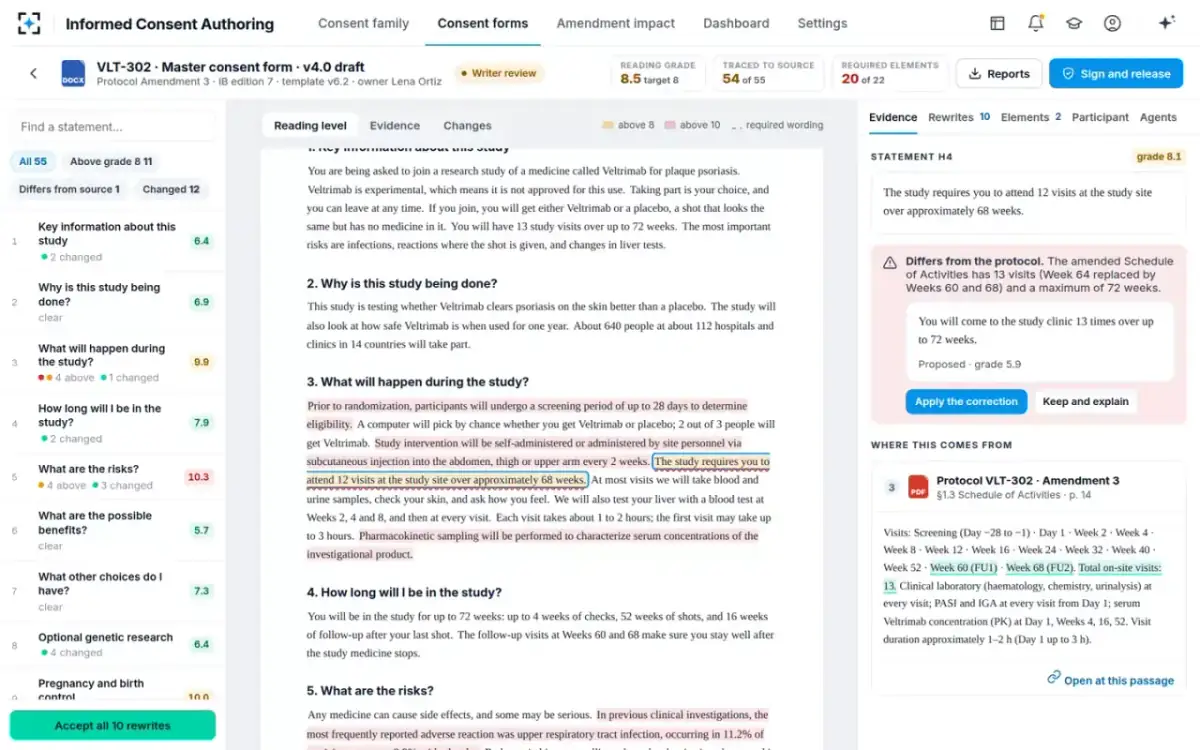
That is the behaviour to insist on in a demonstration, and it is easy to ask for: bring your own protocol, change a visit count in the amendment, and watch whether the tool notices. A tool that drafts beautifully and notices nothing is a faster way to produce an error.
One amendment through the chain on the sample study
112pages
of amended protocol read, in 4.2 seconds, each fact carrying its section and page
55
statements linked to the passage they rest on, of which one differed
10rewrites
proposed above the target grade; the writer accepted, edited or kept each one
3signatures
before release: author, medical monitor, privacy and legal counsel
A general chat assistant and a traced drafting tool, on the four questions that decide the answer
A general assistant given the protocol: Somewhere in the context it was given, or from the model. Nothing in the output distinguishes the two.
Drafting built for consent: A link from the statement to the passage, which opens beside it. A statement with no source is not written.
A general assistant given the protocol: Nothing. The reviewer has to notice, and the fluent sentence makes that harder.
Drafting built for consent: The difference is flagged with its reason and a corrected sentence, and release is blocked until a person decides.
A general assistant given the protocol: Easily rewritten, because it scores badly on readability measures.
Drafting built for consent: Locked. The rewriting step cannot touch it, and the lock survives every later pass.
A general assistant given the protocol: A chat history, outside the document, which nobody can reconstruct six months later.
Drafting built for consent: Every agent action and every human decision with the time and the person, and three signatures with their meanings.
A general assistant given the protocol: Regenerated, so local wording is silently rewritten along with the inherited change.
Drafting built for consent: Written as tracked changes that touch only what the master changed, accepted by the country study manager.
What to ask a vendor, and what to ask your own quality team
Two lists, and the second is the one that gets skipped. A sponsor can buy a tool that satisfies every regulator's expectation and still be unable to describe its own use of it, which is the thing an inspector will actually ask about.
Before an AI tool touches a consent form: the questions for the supplier, and the ones for your own quality team
- Show me one sentence and the passage it came from.
Not a document list, not a section number — the passage, opening beside the statement. Ask on your own protocol, not a demonstration set.
- Change a number in my amendment. What happens?
The tool should object, name the difference, cite the passage and stop the release. Silence here is disqualifying.
- Which passages are locked, and what happens if the rewriting step meets one?
Prescribed text such as the ClinicalTrials.gov statement must be untouchable, and the lock must hold through every later pass.
- Who accepted each change, and where is that written?
Every agent action and human decision with the time and the person. A signature should carry its meaning, not just a name.
- What does the tool do with participant data?
A consent authoring tool has no need for any. The sample solution takes documents only — protocol, brochure, template, country rules — and no participant data enters it.
- Can it submit anything, to anyone, by itself?
The answer should be no, and it should be a property of the design rather than a setting somebody could change.
- For our own quality team: what is our validation argument?
E6(R3) expects fit for purpose, risk-based. Write down the use, the functionality, the interfaces, the validation status and who manages the system — before first use, not at the inspection.
- For our own quality team: who signs, and for what?
Name the author, the medical signer and the privacy and legal signer, and write what each signature means. The tool should enforce the order you decide, not impose one.
Three signatures, each with its meaning, and a release that was blocked until now
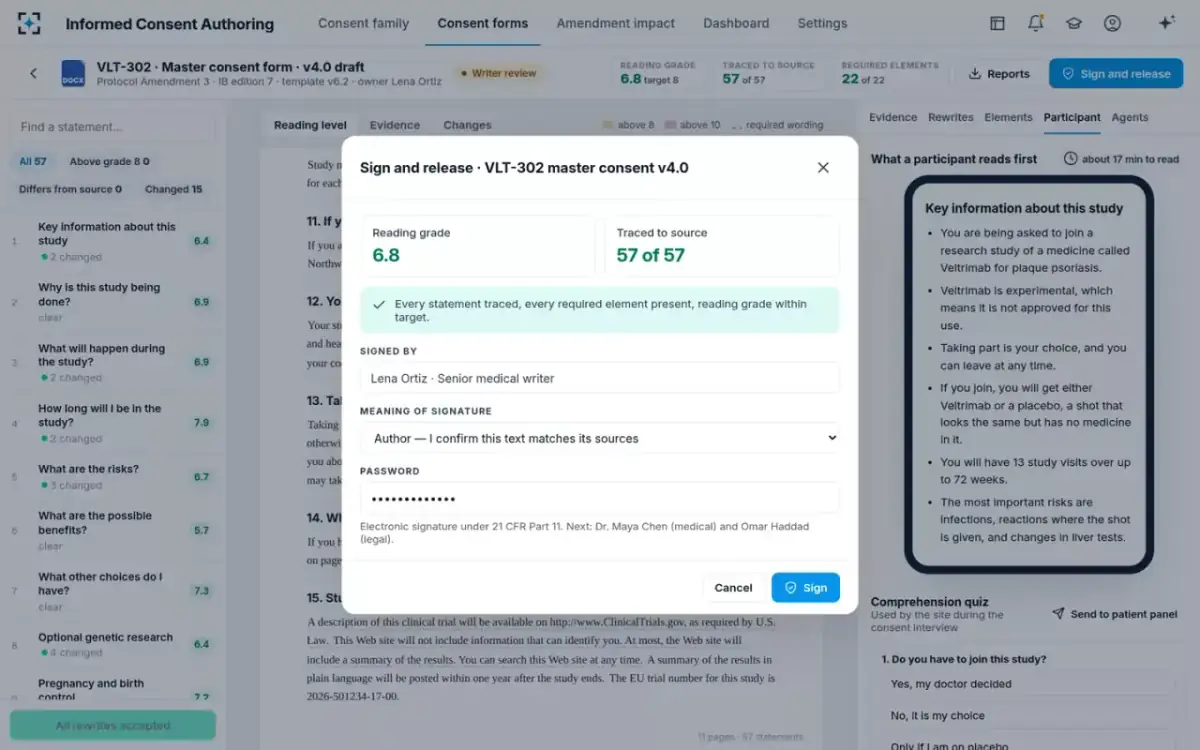
The last thing worth saying to a buyer is where this tool is not the answer. It does not establish that participants understood anything — comprehension is measured in the interview, not in the document — and it does not translate; it prepares text for certified translation and back-translation, which the sponsor still procures. Inside the drafting window it does the work a person cannot do reliably at eleven-form scale: compare every sentence with its source, every time. To see the chain from a protocol amendment to three signatures, start from Informed Consent Authoring.
Questions people ask
Does the FDA allow AI to draft a consent form?
There is no FDA rule on the question, and nothing prohibits it. The control the agency relies on sits elsewhere: all information given to subjects as part of the consent process is reviewed and approved by the IRB, and the form itself must be IRB-approved and signed by the participant under 21 CFR 50.27(a). An AI draft enters that process exactly where a human draft does, and the sponsor's own checking is what stops an error reaching the committee.
Does ICH E6(R3) cover AI tools?
Yes, as computerised systems. Principle 9.3 asks that systems used in clinical trials be fit for purpose, with risk-based validation where appropriate and quality-critical factors addressed in their design. The EMA's 2024 reflection paper confirms the same route, saying the use of AI in clinical trials should meet the applicable requirements of ICH E6. There is no separate AI regime to satisfy.
Who is responsible for an AI-drafted consent form?
The sponsor. The EMA's reflection paper puts the responsibility for algorithms, models, datasets and data processing pipelines being fit for purpose on the trial sponsor or marketing authorisation holder, not on the supplier. Within the sponsor, responsibility is held by whoever signs: in the sample solution the author, the medical monitor and privacy and legal counsel each sign the master with a stated meaning.
How do you stop an AI tool from inventing a risk or a visit number?
By requiring a source for every statement and by comparing the statement with that source automatically. On the sample study a sentence saying 12 visits over 68 weeks was flagged against a Schedule of Activities listing 13 visits over up to 72 weeks; the tool showed the passage, proposed a corrected sentence and blocked release until a person decided. Reviewing fluent prose for invented facts by eye is unreliable at the scale of a consent family.
Does an AI-drafted consent form need validation?
The form does not; the system does, to the extent its risk warrants. E6(R3) asks for fit-for-purpose systems with risk-based validation where appropriate, and expects the sponsor to be able to describe each important system's use, functionality, interfaces, validation status and who manages it. A consent drafting tool sits well above a spell-checker on that scale, because its output is what a participant agrees to.
What should an AI consent tool never do?
Four things: write a statement with no source; rewrite wording a regulation prescribes exactly, such as the ClinicalTrials.gov statement under 21 CFR 50.25(c); change text in a country version that the master did not change; and submit anything to an ethics committee. The first three follow from the rules on accuracy and prescribed text; the fourth keeps the sponsor's responsibility attached to a person's name.