The informed consent form reading level almost everyone works to is grade 8, and most forms miss it: in a 2024 analysis, 5,239 US trial consent forms averaged a Flesch-Kincaid grade of 10.99, and 91% read above grade 8. The number is a convention, not a rule — no FDA or Common Rule provision names a grade — but it is the convention review boards write into their own policies, so a medical writer is usually handed a target and a deadline. Getting there is sentence work, not document work, and the hard part is doing it without changing a frequency, a dose or a risk. Botminds' Informed Consent Authoring scores every sentence of a consent form against the study's target, proposes a plain rewrite for each one above it that keeps every fact of the source it cites, and leaves the accept-or-reject decision with the writer.
The study, the medicine and the people in the screens and product figures on this page are fictional sample data in the solution. The research figures come from a peer-reviewed analysis and from the regulators' own guidance, linked where they appear.
What 5,239 consent forms actually read like
10.99grade
mean Flesch-Kincaid grade level across the forms analysed
91%
read above grade 8 — 4,768 of 5,239
55.13
mean Flesch Reading Ease, which the authors place at a high-school level
13.95pages
average length, against the ten pages the authors treat as a suggested maximum
What reading level should an informed consent form be?
Grade 8 is the working answer for an adult consent form, and a lower target is usual for an assent form a child will read. Neither number comes from a regulation. They come from review board policies, from institutional templates, and from the general health-literacy convention that public-facing medical text should sit around grade 6 to grade 8. Because the target is institutional rather than statutory, the first thing to establish on any study is whose target applies: the sponsor's template may say one thing, the central board another, and a site's own institution a third.
What is not negotiable is the thing the grade is a proxy for. Both US rules require the information to be given in language the person can understand, and the FDA's August 2023 guidance puts a definition on the word: "'Understandable' means the information presented to prospective subject is in a language and at a level the subjects can comprehend (including an explanation of scientific and medical terms)". A grade score is evidence about that, and weak evidence at that. It is not the requirement.
Does any regulation require a grade level?
No. 21 CFR 50.20 requires that the information "be in language understandable to the subject or the representative", and 45 CFR 46.116(a)(3) says the same. Neither names a formula, a grade or a word count. The international guideline is the same shape: ICH E6(R3), adopted by ICH on 6 January 2025, asks that "the information should be as clear and concise as possible, use simple language and avoid unnecessary volume and complexity" — an instruction about writing, not about measurement.
Agencies have gone one step further without going as far as a number. The March 2024 draft guidance that the FDA and the Office for Human Research Protections published jointly says: "We recommend following plain language principles for the entire consent form. Plain language principles generally involve a combination of text-based and visual approaches (e.g., pictures and diagrams), including organizing information with the most important points first, breaking complex information into understandable groups, using simple language, and defining technical terms." That is a method. It is still not a grade, and the guidance is a draft, which means it carries recommendations and not requirements.
The practical consequence is worth stating plainly, because writers get caught by it both ways. A form at grade 10 is not unlawful. A form at grade 6 is not automatically compliant. What a board can be shown is a form whose hard sentences were found, rewritten and checked, with the originals and the reasons still beside them — which is a stronger answer than a single number on a cover sheet.
What Flesch-Kincaid, Gunning Fog and SMOG actually measure
All three are counting formulas, and all three count roughly the same two things: how long your sentences are, and how many long words are in them. None of them reads. None knows whether "placebo" is explained on the page before. That is why they agree with each other far more than any of them agrees with a participant.
Three readability formulas, what each counts, and where each misleads on a consent form
| Formula | What it counts | Where it misleads here |
|---|---|---|
| Flesch-Kincaid grade level | Average sentence length and average syllables per word, returned as a US school grade. | Treats every polysyllable alike, so a defined term you explained once ("randomised", "placebo") costs the same as a term you never explained. |
| Flesch Reading Ease | The same two inputs, returned as a 0–100 score where higher is easier. | A score in the fifties reads as "fairly difficult" and tells a writer nothing about which sentence to change. |
| Gunning Fog | Average sentence length plus the proportion of words of three or more syllables. | Counts drug names and anatomical terms as complexity even where the form cannot avoid them, so a study of a long-named medicine starts behind. |
| SMOG | Polysyllable counts over a fixed number of sentences; widely used for health materials and often stricter than the others. | A short sample means a single dense paragraph can move the whole document score. |
| Dale-Chall difficult-word share | The proportion of words outside a list of words familiar to young readers. | Closest to the real question, but the list is generic, and a trial form needs words no list contains. |
Two practical rules follow. First, pick one formula and one target and hold them for the whole study, because switching formulas mid-review produces arguments that have nothing to do with the reader. Second, never let the formula choose what to cut. A sentence can be driven below target by deleting the thing a participant most needs to know, and the score will improve.
How do you measure the reading level of a consent form?
Run the formula over the text a participant actually reads — which many reports do not. Three decisions change the answer more than the choice of formula does, and a report that does not state them is not reproducible.
The first is what you include. Signature blocks, HIPAA authorization text, page headers, version footers and the study title all score badly and none of them is prose a participant reads for meaning. Including them pushes a document score up; excluding them without saying so makes a report that nobody else can reproduce. The second is whether you score the document or the sentence. A document score is an average, and averages hide exactly what you are looking for: the sample study’s master averaged 8.5 while individual sentences in it scored 15.8 and 17.8. The third is the unit — our own figures below treat each numbered statement in a form as the unit, which is what makes a rewrite a decision rather than an edit.
Where the sentences sat before and after the plain-language pass
Master draft, before the pass · document grade 8.5
- 44 statements at or below grade 8 · 80%
- 11 above · 20%
Master released, after ten accepted rewrites · grade 6.8
- All 57 statements at or below grade 8 · 100%
In the sample study the sentences above target are a small minority, they are concentrated in procedures and risks, and they are the only sentences anyone needs to look at. A document average of 8.5 makes the problem look like a 3,000-word rewrite. It is eleven sentences, and ten of them are a writer’s to decide.
Why nine in ten forms read above grade 8
Not because writers cannot write plainly. Because of where the sentences come from. A consent form is assembled from three sources that are all written for someone else: the protocol, which is written for investigators and regulators; the Investigator's Brochure, whose adverse-reaction tables are written for clinicians; and the sponsor's master template, whose privacy, injury and rights paragraphs were written by lawyers and are reused unchanged across every study. Each source is correct. None was written at grade 8, and a sentence lifted from any of them arrives at its original reading level.
Length compounds it. The same analysis found the forms averaged 13.95 pages against a suggested ten, and the FDA has said in its own guidance that stripping procedural detail out of the form is what makes it shorter and more readable. The longer the form, the more sentences are lifted rather than written, and the more the document score reverts to the reading level of the documents it was assembled from.
The average grade level was 10.99 (SD = 2.45) exceeding the 8th-grade reading level recommended by IRB guidelines.
Zai, Faro and Allison, J Clin Transl Sci, 2024
One encouraging finding sits inside the same study: the share of forms above grade 10 fell significantly over the period studied, so the field is moving, slowly. Progress against the grade-8 line itself was not consistent. Twenty years of effort has moved consent forms from very hard to hard.
Seven sentence patterns that push the grade up
Scored sentence by sentence, the same constructions come back. None of them is a style preference; each one adds measurable length or syllables while removing nothing a reader needs.
- The nominalised verb. "Randomisation will occur" instead of "a computer will pick by chance". The action becomes a noun, and the noun is longer than the verb it replaced.
- The actorless passive. "Sampling will be performed" leaves the reader asking who does it to whom. "We will take" is shorter and answers the question.
- The protocol's noun stack. "Subcutaneous injection into the abdomen, thigh or upper arm" is three technical modifiers deep before the reader reaches a familiar word.
- The Latinate pair. "Prior to" for "before", "utilise" for "use", "discontinue" for "stop". Each swap costs syllables and gains nothing.
- The two-fact sentence. Joining a procedure and its purpose with a semicolon doubles sentence length, which is one of the two inputs every formula uses.
- The undefined acronym. Expanded once in section 2 and used in section 11, which is where a reader meets it first.
- The hedged risk. "May be associated with an increased incidence of" is six words doing the work of "can cause more".
Rewriting a risk sentence without losing the risk
This is the whole difficulty, and it is why a plain-language pass cannot be delegated to a general text simplifier. The rewrite must keep every number, every frequency, every comparison with placebo and every named organ, because those are the facts the medical monitor signed and the brochure supports. What it may change is the grammar and the vocabulary around them.
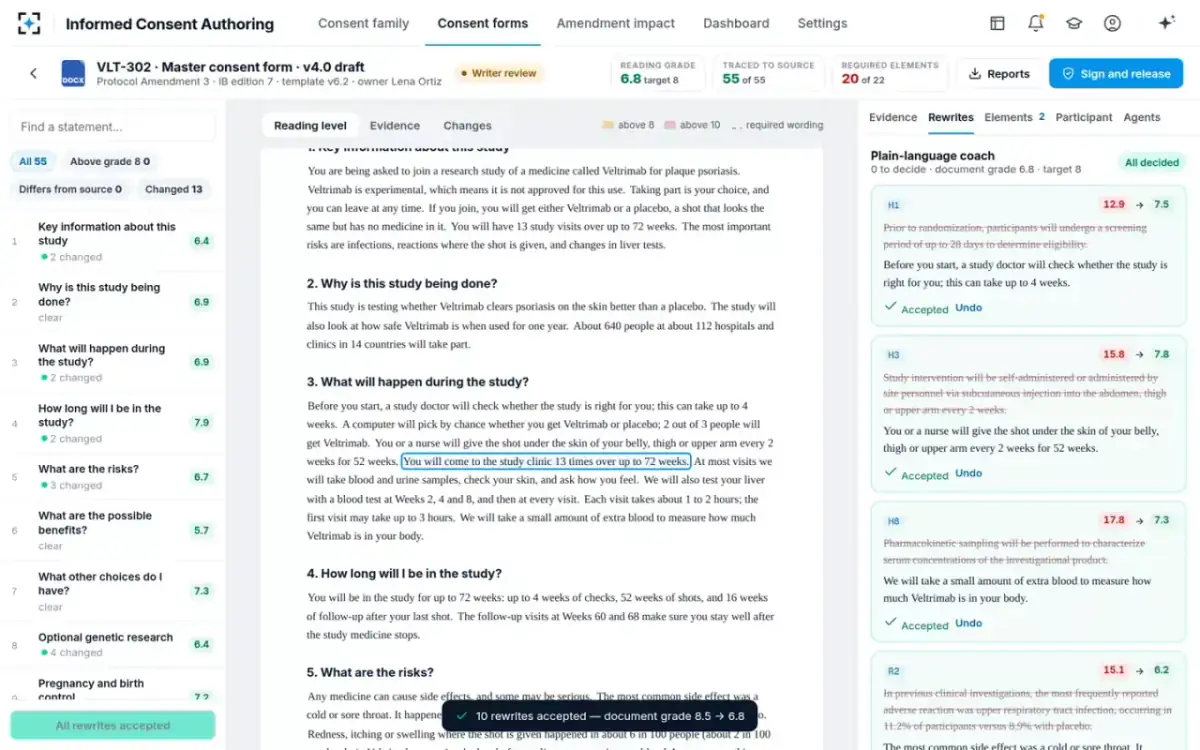
Four sentences, before and after, with the grade each one scored
As the protocol or brochure words it: "Prior to randomization, participants will undergo a screening period of up to 28 days to determine eligibility."
As a participant reads it: "Before you start, a study doctor will check whether the study is right for you; this can take up to 4 weeks." The 28 days survive as four weeks.
As the protocol or brochure words it: "Study intervention will be self-administered or administered by site personnel via subcutaneous injection into the abdomen, thigh or upper arm every 2 weeks."
As a participant reads it: "You or a nurse will give the shot under the skin of your belly, thigh or upper arm every 2 weeks for 52 weeks." Every site of injection is kept; the duration is added from the schedule.
As the protocol or brochure words it: "Pharmacokinetic sampling will be performed to characterize serum concentrations of the investigational product."
As a participant reads it: "We will take a small amount of extra blood to measure how much Veltrimab is in your body." The purpose survives; the word pharmacokinetic does not.
As the protocol or brochure words it: A brochure sentence naming upper respiratory tract infection as the most frequently reported reaction, with its rate against 8.9% on placebo.
As a participant reads it: A cold or sore throat named as the most common side effect, with both rates kept and expressed as a number of people in a hundred.
Two rules make this safe. The first is that the rewrite is proposed against the cited source, not against the old sentence, so a frequency cannot drift while the grammar changes. The second is that a person decides: the coach proposes, and the medical writer accepts, edits or keeps the original with a reason. A rewrite nobody looked at is a change nobody signed.
Every sentence above target, with its rewrite and both grades
What you may not simplify
A plain-language pass has a hard boundary and it is worth knowing before an editor starts, not after a reviewer finds it. One sentence in a US consent form is prescribed word for word by regulation. Two categories of wording are prohibited rather than prescribed, which means an edit can create a problem that was not there. And where a HIPAA authorization is combined with the consent form, that authorization has required elements of its own that a paraphrase can quietly destroy. In the solution, required wording is locked and the coach cannot rewrite it at all; the full list, and what you may add beside each locked passage, is the wording you may not change.
There is a softer boundary too. Numbers should not be rounded to make a sentence read better, frequencies should not be turned into words like "rare" when the brochure gives a percentage, and a risk should never lose its organ. "Changes in liver tests" is plainer than "elevated hepatic transaminases" and keeps the organ. "Some blood test changes" is plainer still and has thrown the information away.
How long a form takes to read, and why that number matters too
Grade level measures difficulty per sentence. It says nothing about how many sentences there are, and burden is the product of the two. A form at grade 7 that runs to twenty pages is not an easy form; it is a long one, and the person reading it is in a clinic room with a decision to make.
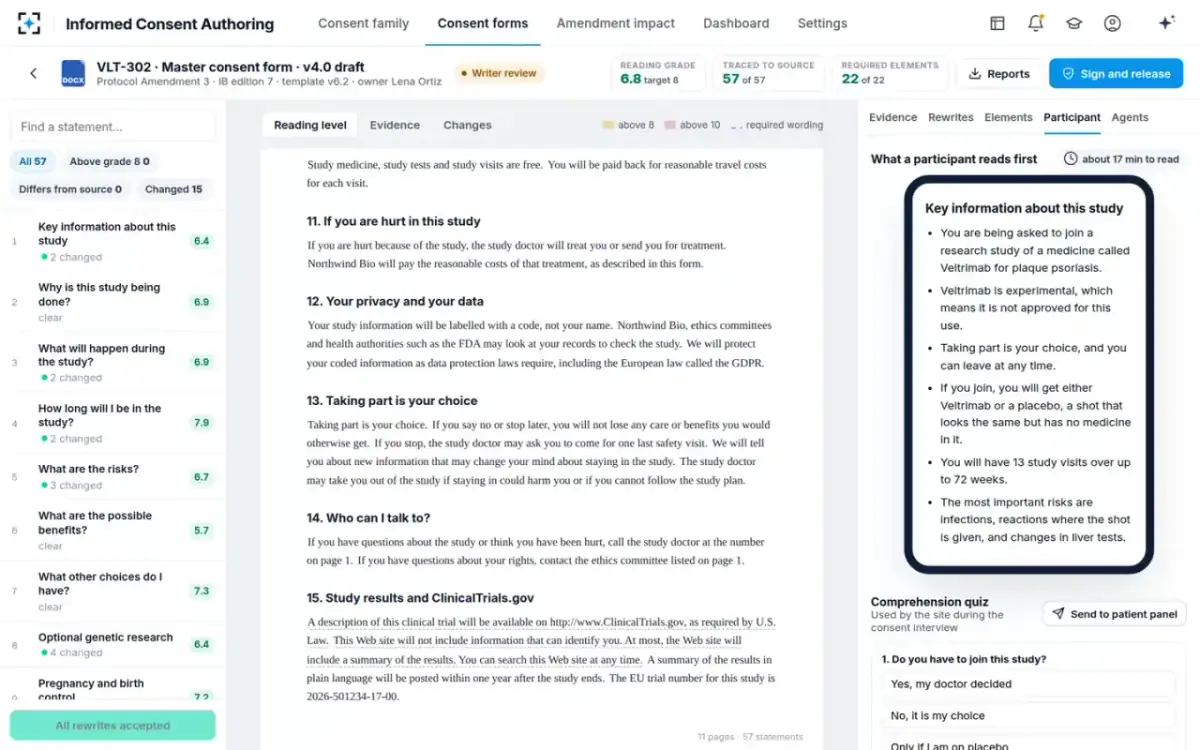
Reading time is the number a consent discussion can actually be planned around, and it is simple to produce: words divided by a reading rate. In the solution the released master runs to eleven pages and 57 statements and is shown to the writer as about 17 minutes to read, beside the key information page as a participant meets it. That number is what tells a study team whether the form can be read in the appointment or has to go home with the person first.
Where the grade actually lives: one draft, section by section
The order on that chart is the argument. The three worst sections are the three lifted most directly from the source documents, and the best are the ones somebody wrote. The key information page, at 6.4 before anyone touched it, is the part a participant is most likely to read in full, and it carries the five facts that decide whether to take part at all — which is why what belongs on the first page is a separate problem from the grade of the pages behind it. Getting a form to grade 8 also does not prove anyone understood it: comprehension is measured differently, and the gap between the two is larger than most study teams expect.
The reading time, beside the page a participant reads first
Reading level is where plain-language work starts and not where it ends. The form still has to contain everything the rules require, which is a separate audit: the required elements, element by element.
Questions people ask
Does the FDA require an 8th grade reading level for consent forms?
No. FDA regulations require the information to be in language understandable to the person, and FDA guidance defines understandable as a language and a level the person can comprehend, including an explanation of scientific and medical terms. No grade appears in the regulation or the guidance. The grade-8 target comes from review board policies and sponsor templates, which is why it varies between institutions.
What is the average reading level of a consent form?
In a 2024 analysis of 5,239 US trial consent forms posted on the federal trials register, the forms averaged a Flesch-Kincaid grade of 10.99 with a standard deviation of 2.45, and averaged 13.95 pages. The same study found a statistically significant fall over time in the share of forms above grade 10, so the average is improving — from very hard to hard.
How do you lower the reading level of a consent form?
Score it sentence by sentence, take only the sentences above target, and rewrite each one against the source it cites rather than against itself. In practice the work is replacing nominalised verbs, naming the actor in passive sentences, splitting two-fact sentences and swapping Latinate words for ordinary ones. Deleting content lowers the score too, and is the one method to refuse.
Is Flesch-Kincaid or Gunning Fog better for consent forms?
Neither is better; they disagree in predictable ways. Gunning Fog punishes long words harder, so a study of a medicine with a long generic name scores worse on it for a reason no reader cares about. Flesch-Kincaid is the formula many board policies name, which is usually the deciding argument. Scoring with both and reporting both is cheap, and it stops a form passing on one measure while failing badly on the other.
Can you simplify a risk sentence without changing the risk?
Yes, if the rewrite is checked against the source rather than the old sentence. Keep every number, every comparison with placebo and the organ or body part named; change the grammar and the vocabulary around them. The common failures are rounding a frequency, replacing a percentage with a word like rare, and dropping the organ — all three lower the grade and all three change what the person was told.
How long does it take to read a consent form?
Long enough that it matters to the appointment. Published analyses measure length in pages rather than minutes — the 5,239-form study averaged 13.95 pages against a suggested maximum of ten — and a form of that length does not get read in a clinic room. Computing reading time from the released text is simple and makes the trade-off visible: in the sample study used here, an eleven-page form came to about 17 minutes.