When a protocol is amended, every informed consent form written from that protocol is potentially out of date — the master first, then each country, site and special version behind it, each with its own ethics committee and its own clock. The rewriting is not what makes this expensive. The fan-out is: on a published benchmark, the average amendment takes 260 days from the moment a sponsor identifies the need to amend to the last oversight approval, and for 215 of those days investigative sites are running different versions of the protocol. What compresses it is knowing, on the day the amendment lands, which sentences in which forms must change and what each one rests on. Botminds' Informed Consent Authoring reads the amendment and the Investigator's Brochure, maps every change to every section of every form, and writes the country versions as tracked changes once a named person has released the master.
The study, the medicine and the people in the screens and product figures on this page are fictional sample data in the solution. The benchmark figures come from a peer-reviewed study, linked where they appear, and are not the solution's own measurements.
What amendments cost the industry, measured across 950 protocols
76%
of protocols in phases I–IV now carry at least one amendment, up from 57% in 2015
3.3
amendments per protocol on average, up 60% from 2.1
260days
from identifying the need to amend to the last oversight approval
215days
mean time during which sites run different versions of the protocol
What happens to the consent form when the protocol is amended?
Three things, in order, and the order is the whole problem. The master consent form is updated from the amended protocol and the current Investigator's Brochure. The updated master is reviewed and released — medically, legally and by its author. Only then can each country, site and special version inherit the change, be adapted to its own national requirements, be accepted by whoever owns it locally, and be submitted to its own committee.
Nothing downstream can start before the master is released, which makes the master a single point of delay for every site in the study. And nothing can be used anywhere until its own committee has approved it. In between sits the work almost nobody budgets for: deciding, form by form, which sentences actually change. A protocol amendment that adds a blood test at three visits does not change the same sentences in a 25-page country form as in a three-page pregnant-partner form, and the country form that happens to be the only one carrying a national requirement changes for a reason no other version shares.
One amendment, three changes, and how far each one reaches
| What the amendment changed | Where it came from | How far it reaches |
|---|---|---|
| Liver tests at Weeks 2, 4 and 8 | Investigator’s Brochure edition 7, which reports raised liver enzymes in 1.8% of participants against 0.6% on placebo | 3 sections, 11 forms |
| Safety follow-up extended from 12 weeks to 16 | Protocol Amendment 3: visits at Weeks 60 and 68 replace Week 64, making 13 visits over up to 72 weeks | 2 sections, 11 forms |
| An optional genetic sample | Protocol Amendment 3: one 6 mL blood sample, stored for up to 15 years, which needs a consent of its own | 1 section, 10 forms, plus one new form |
Do participants have to re-consent after a protocol amendment?
Not automatically, and the decision is a judgement rather than a rule. ICH E6(R3) frames it as an assessment: "New information that could impact a participant's willingness to continue participation should be assessed to determine if re-consent is needed (e.g., depending on the stage of the trial, consideration should be given to whether the new information is relevant only to new participants or to existing participants)." Where re-consent is needed, the guideline adds, the new information should be clearly identified in the revised materials, and those materials must have the committee's approval in advance of use.
That last clause is the one that catches sites. An amendment that affects only people who have not yet enrolled still produces a revised form, and the revised form still cannot be used until it is approved — so the submission is on the critical path either way. The difference is whether the study team also has to bring back everyone already enrolled.
On the sample study the three changes fall on both sides of that line. A new liver risk and a new blood test at three visits are information an enrolled participant would want, and a longer follow-up changes what they agreed to. An optional genetic sample is a new offer, which needs its own consent rather than a re-consent to the main form. Deciding which is which is the medical monitor's call, and it is made from the brochure passage and the protocol section, not from the amendment summary.
The sentence-to-source map, and how to build one
The single artefact that makes an amendment cheap is a map from each sentence of each form to the passage it rests on. Build it once, maintain it as you write, and the question "which forms change?" becomes a lookup instead of a reading exercise. Build it never, and every amendment means twelve people re-reading twelve documents against a redline.
A usable map has four columns: the statement, the form it lives in, the source passage with its section and page, and the reason the statement is there — a required element, a country rule, a sponsor template clause. The fourth column is the one teams skip and the one that pays. It is what tells you that the EU trial number sentence rests on an EU rule and not on the protocol, so it belongs in the master and the European forms and in no others, whatever the amendment says.
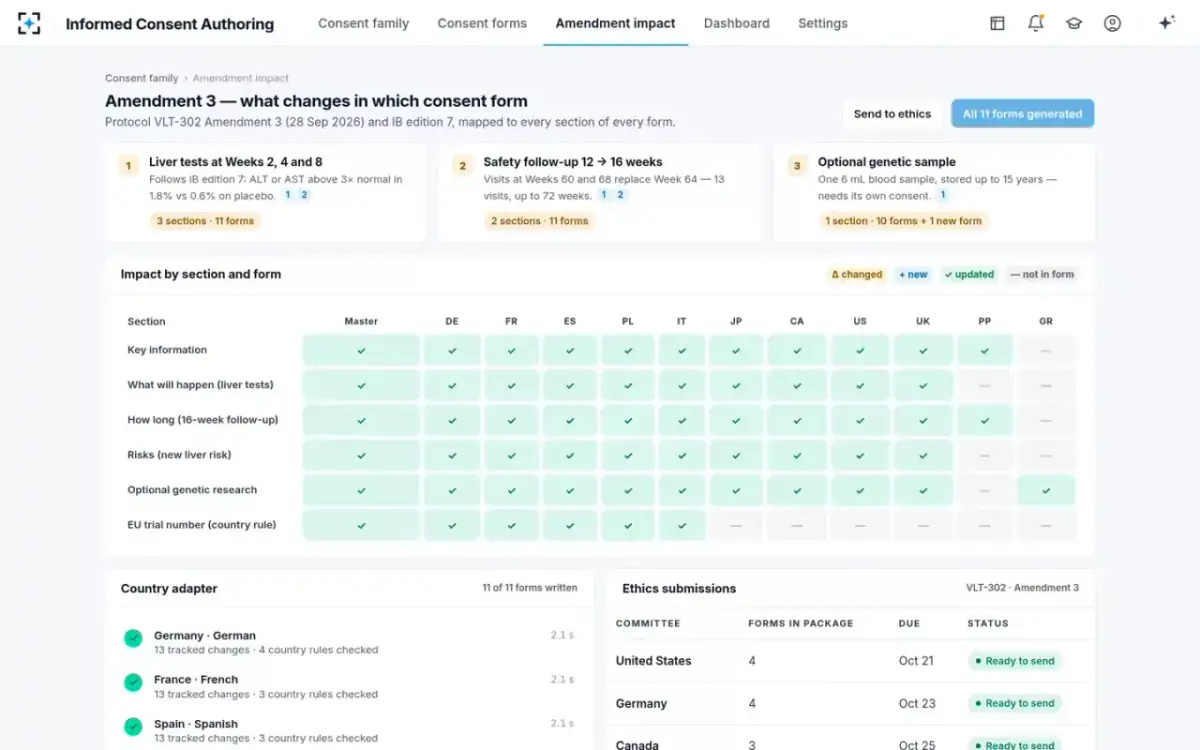
The impact matrix: six sections of the form against twelve forms in the family
Two rows in that matrix carry the argument. The bottom row — the EU trial number — changes in the master and the five European forms and in none of the others, because it rests on an EU rule rather than a protocol fact: the elements check found it missing in this version, and the map shows at once which forms inherit it. A team without a map re-reads every form to discover that. And the right-hand column is a form that did not exist before this amendment, which no row of any previous map could have predicted.
Who waits on whom: five seats and one queue
An amendment passes through five pairs of hands, and each one waits on the last. Naming them is not an organisational nicety; it is the only way to see that four of the five are idle for most of the elapsed time and then all become urgent at once.
The five seats an amendment passes through
Today
Reads the amendment and the brochure against a dozen forms, searching for every instance of a number that changed, and hoping every instance was found.
With agents
Opens a master already drafted from the amendment, with every statement beside the passage it rests on and any difference from the protocol flagged.
Still theirs: Signs the master as author, confirming the text matches its sources.
Today
Reviews changed wording with the protocol open in another window and the brochure in a third.
With agents
Sees each statement next to the protocol or brochure passage it cites, and decides any statement the writer kept with a reason.
Still theirs: Signs for medical accuracy — risks, procedures and frequencies.
Today
Re-reads the whole form to be sure the plain-language pass has not touched the injury, insurance or data-protection wording.
With agents
Knows required wording was locked and could not be rewritten, and reviews only what changed.
Still theirs: Signs for privacy and legal, third and last on the master.
Today
Waits for the master, then re-reads the whole country form to find what moved.
With agents
Receives the country form as tracked changes with the national rules already checked, and accepts them.
Still theirs: Accepts the country version before it is submitted — people submit, not agents.
Today
Keeps a spreadsheet of committee dates and chases forms that are nearly ready.
With agents
Sees every committee’s package, its forms and its due date in one table, and which are ready to send.
Still theirs: Owns the submission, and the relationship with each committee.
The queue behind them is the part that does not compress. On the sample study eleven committees are waiting on one amendment, and their dates are spread across sixteen days — not because anyone is slow, but because committees meet when they meet.
Eleven committees, one amendment: days left to submit
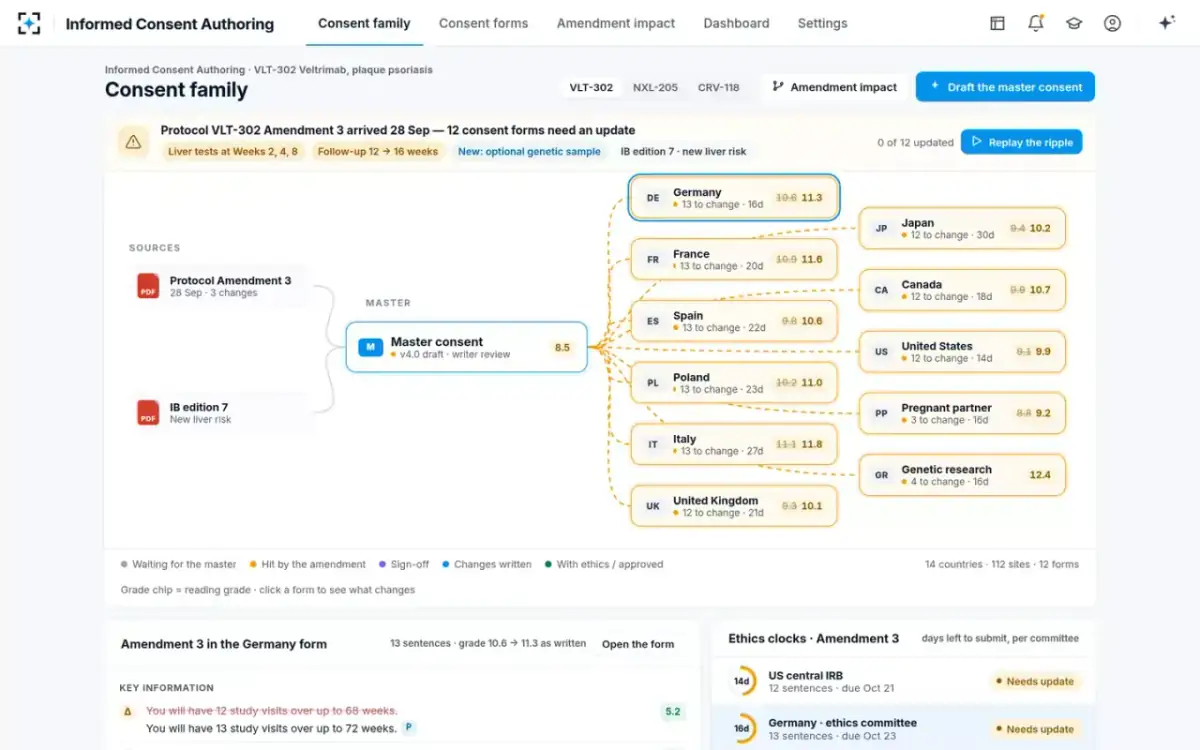
The whole consent family, and the ripple across it
What the committee must approve before anything is used
The rule is short and absolute. The FDA's informed consent guidance states it: "When new information or changes in the clinical investigation warrant revisions of the consent form (and any accompanying changes to the protocol), such revisions must be reviewed and approved by the IRB before the revisions are initiated, except when necessary to eliminate apparent immediate hazards to subjects (21 CFR 56.108(a)(3)-(4))." ICH E6(R3) says the same for trials run to the international guideline: revised materials should have the committee's approval in advance of use.
The narrow exception is worth knowing precisely, because it is often remembered loosely. It covers changes necessary to eliminate apparent immediate hazards to participants — not changes that are urgent, commercially important or administratively convenient. Everything else waits for an approval, which is why the submission date rather than the drafting date is the one a study team should be managing to.
There is a matching obligation on the other side of approval. Once a revised form exists, the previous version must stop being used, and the FDA's guidance asks boards to make sure a revised form can be identified so that continued use of a superseded version does not occur — noting that date stamps are one way to do it, though the regulations do not require them. The consequence of getting this wrong is visible in the agency's own inspection data: among the clinical investigator observation themes the FDA published for fiscal year 2024, from 692 inspections of which 156 produced a 483, the consent sub-themes include "Revised Consent Not Obtained/Timely".
Can a committee review a consent change by expedited review?
Sometimes, and it is worth asking rather than assuming. The FDA's guidance notes that some changes may be reviewed and approved by expedited means under 21 CFR 56.110, giving as an example changes to the consent form that reflect minor changes in the protocol or the recruitment plan. The decision belongs to the board, and where a reviewer is unsure whether a change qualifies the agency recommends they consult.
Expedited review is not a shortcut a sponsor can elect. What a sponsor can do is make the decision easy: a submission that shows exactly which sentences changed, what each change rests on, and that nothing else in the document moved is a submission a reviewer can classify quickly. A submission that is a new clean copy of a 25-page form is not, however small the change inside it.
The EU clock: 38 days, and 31 more if they ask a question
In the European Union the timetable for a substantial modification is written into the regulation rather than into a committee's calendar, which makes it the one part of an amendment a sponsor can actually plan. Under Article 22(1), each member state concerned assesses the part of the modification covered by Part II of the assessment report and reports "to the sponsor within 38 days from the validation date". If it asks for more information, Article 22(3) lets it extend that period by up to 31 days — and inside that extension the sponsor has a period set by the member state, not exceeding 12 days, to answer, after which the state completes its assessment within a maximum of 19 days. The notification of the decision follows within five days of the reporting date or the end of the assessment period, whichever is later.
So the planning numbers are 38 days clean, up to 69 with a question, plus five for the decision, and all of it measured from validation rather than from submission. A sponsor that answers in three days rather than twelve saves at most nine of those days; the member state still has up to nineteen after the answer. What saves the most is not getting the question, which depends on how clearly the submission shows what changed.
Where the document days go, by hand and as a design target
- Update the master from the amendment and the brochure9 d
- Medical and legal review of the changed wording6 d
- Carry the changes into every country, site and special form6 d
- Assemble each committee’s package3 d
- Update the master
- Medical and legal review3 d
- Carry into every form2 d
- Assemble each package
Why sites run two versions of the protocol for seven months
Because approval arrives country by country. The published mean — 215 days during which investigative sites operate with different versions of the same protocol — is not simply a measure of inefficiency; much of it is the arithmetic of many committees with many calendars. The first site to be approved starts working to the new protocol while the last site is still working to the old one, and the gap between them is the spread of the queue.
For a consent form this is more than an inconvenience. During the overlap, two versions of a form are both current, each at a different site, and the version a participant signs has to be the one approved for that site on that date. A monitor arriving at a site that has started using a revised form before its own committee approved it is looking at a finding, not a process improvement. The consent sub-themes in the FDA's fiscal year 2024 inspection data are exactly this shape: consent not obtained per the investigational plan, revised consent not obtained or not obtained in time, consent not obtained before screening, re-consent or dosing.
The practical defence is to make the overlap visible rather than to pretend it away. Every form needs its own approval date and its own in-use-from date, both held against the site rather than against the study, and anyone looking at a form needs to see which version that site is on today.
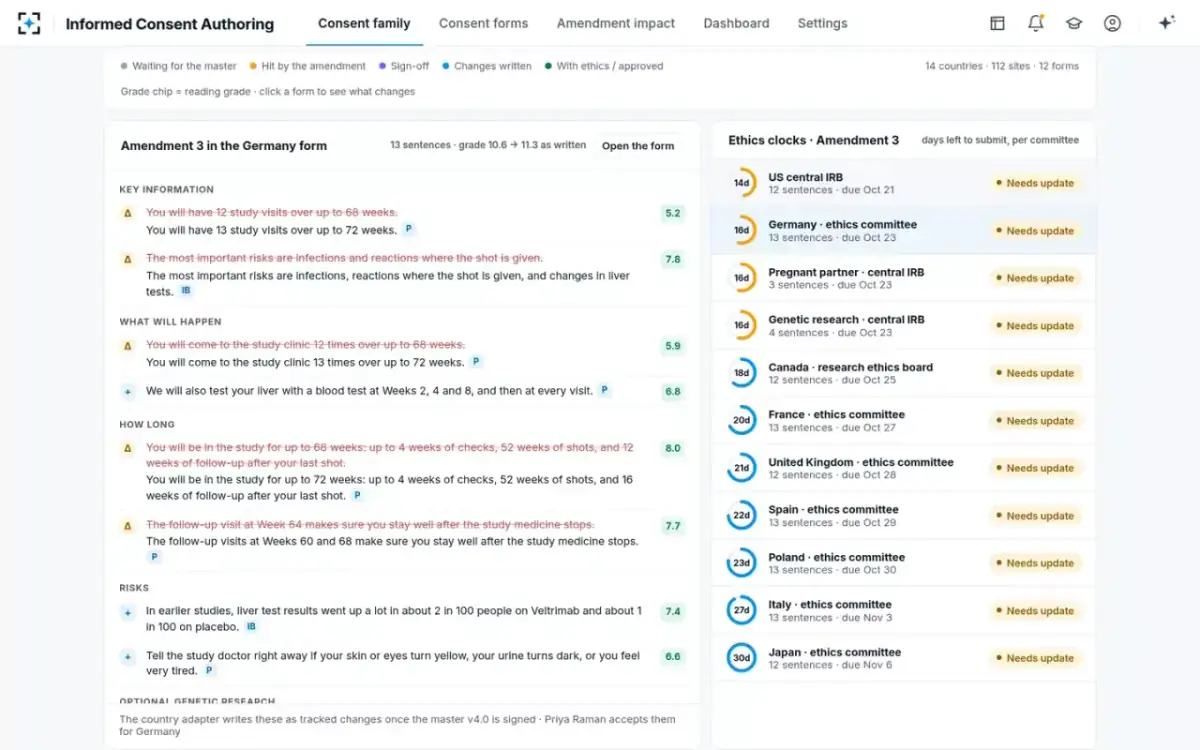
Which sentences change in one country form, and what each one rests on
The amendment a site never sees
Most of the attention in an amendment goes to the main country forms, because that is where the participants are. The forms that get lost are the special ones: a pregnant-partner consent, an assent for adolescents, a sub-study form, an optional sample consent. They are short, they belong to nobody in particular, and a site may go a whole study without opening one.
They are also the forms where an amendment behaves differently. On the sample study the pregnant-partner form changes in three sentences out of a form that is mostly about something else, and its committee date is the same week as Germany's. The new genetic-research consent is a form that did not exist before the amendment, drafted from one section of the protocol, with no previous version to compare against and a reading grade of 12.4 the first time anyone scores it — the worst-reading document in the family precisely because it is the newest.
Two habits deal with this. Give every special form a named owner, the way a country form has a country study manager. And put the special forms on the same impact map as the main ones, so a change that reaches three sentences in a form nobody reads is as visible as a change that reaches thirteen in Germany's. A new form drafted from the protocol still needs every required element checked from scratch and still has to be written plainly, and it arrives with the least time of any form in the family.
Every section against every form, and every committee's package
The amendment is also where a reading target quietly slips. Every form in the sample study would get worse if the changes went in as the protocol words them — Germany from 10.6 to 11.3, Italy from 11.1 to 11.8, the United States from 9.1 to 9.9 — because protocol prose is protocol prose in any language. Holding the grade through an amendment is the same work as reaching it in the first place, done again, under a committee deadline. And what an amendment costs in money rather than days is its own question.
Questions people ask
How long does it take to get an amended consent form approved?
There is no single figure, and the parts have very different clocks. In the EU the regulation fixes the assessment of a substantial modification at 38 days from validation, extendable by up to 31 days if the member state asks a question, with the decision notified within five days after that. Elsewhere it is the board's calendar. A published benchmark for the whole journey — need to amend to last oversight approval, across all countries — averages 260 days.
Who approves a revised consent form?
The institutional review board or ethics committee that approved the original, for each site it covers. A sponsor's internal review — medical, legal, the author — comes first and is not approval; it is what makes the document submittable. Nothing revised may be used with a participant until the committee responsible for that site has approved it, except where a change is necessary to eliminate an apparent immediate hazard.
Which sentences in a consent form have to change after an amendment?
Only those whose source changed. That is why the sentence-to-source map matters: a sentence that rests on a country rule is untouched by a protocol amendment, and a sentence that rests on the schedule of activities changes whenever the schedule does. On the sample study one amendment changed 13 sentences in the German form, 12 in the US form and 3 in the pregnant-partner form, out of forms that are otherwise identical in purpose.
Why do sites use two versions of the protocol at once?
Because approvals arrive at different times in different countries, and a site works to the version its own committee has approved. The published mean for this overlap is 215 days. It is not avoidable by a sponsor acting alone; what is avoidable is losing track of which site is on which version, which is where inspection findings about consent come from.
Does an amendment always mean re-consenting everyone?
No. The test is whether the new information could affect a participant's willingness to continue, and the assessment considers whether the information is relevant only to new participants or to existing ones as well. New safety information usually reaches everyone; an administrative change usually reaches nobody. Either way the revised document itself still needs approval before use.
Can an amendment be carried into country forms before the master is signed?
It can be drafted but not released, and the distinction is worth enforcing. If country versions are edited from an unreleased master, any late change to the master has to be chased through every one of them by hand. In the solution the country adapter writes tracked changes only after the master is released, never touches text the master did not change, and leaves each country version for its country study manager to accept.