IRB fees in clinical trials are real but small. On the clinical trial cost model published by the US health department's Office of the Assistant Secretary for Planning and Evaluation (ASPE), the IRB approvals a study needs cost from $11,962 in phase 1 to $137,813 in phase 4, driven by the number of sites, and a single IRB amendment costs between $1,094 and $1,919 depending on phase. Set beside what an amendment itself costs, the review fee hardly registers: a peer-reviewed study of 52 protocols put the median direct cost to implement one substantial amendment at $141,000 for a phase II protocol and $535,000 for a phase III. The money is in the calendar. The cycle from deciding to amend to the last oversight approval now averages 260 days, and the number that should trouble a programme head most is the 215 days during which investigative sites are working from different versions of the protocol. Botminds' Informed Consent Authoring is aimed at one slice of that calendar — the consent documents and the ethics package — and this page is about sizing that slice honestly against the published benchmarks.
It is written for the clinical operations lead or programme head who has to defend a document automation budget, with finance asking what the saving actually is. The published figures come from peer-reviewed studies and from government cost models, linked where they appear. The product figures come from a fictional sample study in the solution and are labelled as estimates or design targets, never as a customer's measured result.
One substantial amendment, in published numbers
$141K
median direct cost to implement one substantial amendment, phase II
$535K
median direct cost, phase III
215days
mean period during which sites work from different versions of the protocol
$1,919
cost of one IRB amendment in a phase III study, on the ASPE cost model
What does an amendment cost beyond the IRB fee?
The best available direct answer comes from a Tufts Center for the Study of Drug Development study of 836 protocols and 136 randomly selected amendments, with the cost estimates drawn from 52 protocols. It put the median direct cost to implement a single substantial amendment at US$141,000 for a phase II protocol and $535,000 for a phase III protocol.
Three cautions belong next to that number before anyone puts it in a slide. It is a median, and the distribution around it is wide, because protocols of very different size and reach sit in the same sample. It is a direct cost, so it counts the work of implementing the amendment and not the value of the time lost. And it is a cost per substantial amendment, which is not the same as a cost per protocol: later work found a mean of 3.3 amendments per protocol, so a phase III programme is rarely paying this once.
What the figure does not contain is the part most organisations actually feel. The cost of a site unable to enrol for a month, of participants who must be re-consented before their next visit, and of a database locked a quarter later than planned, are all outside the measured direct cost — and all of them scale with the days rather than with the document.
How long does a protocol amendment take to reach every site?
On the most recent benchmark, an average of 260 days from the moment the need to amend is identified to the last oversight approval. That figure comes from a 2024 Tufts CSDD study of 950 protocols and 2,188 amendments contributed by sixteen companies, which also reports that the total average duration to implement an amendment has nearly tripled over the past decade (Getz et al., Therapeutic Innovation & Regulatory Science, 2024).
Two hundred and sixty days is eight and a half months, and the instinct is to blame the regulators. The regulatory clocks alone do not explain it. In the European Union a substantial modification affecting informed consent is assessed in 38 days where nothing is asked, and the extension for a single request for information is capped at 31 days. The benchmark does not split the remaining time between the sponsor, its sites and the committees, but the sponsor's own share is the part it can act on without asking anyone's permission.
How much are IRB fees in clinical trials?
Small next to everything else, on a public federal model that prices them by phase. The ASPE cost model builds a study's per-study cost partly from the price of ethics review, and separates the cost of the approvals a study needs at the start from the cost of each amendment. The gap between the two is instructive.
What ethics review costs per study, and what an amendment to it costs
A phase III amendment costs the sponsor $1,919 in ethics fees, against $114,118 for the approvals the study needs in the first place, and against a median $535,000 to implement the amendment. Fees are 0.4% of the implementation cost. An organisation negotiating committee fees to reduce amendment cost is optimising the smallest line on the bill.
The same cost model is explicit about where money does go, listing the components that dominate across all phases: "Overall, the factors that contribute the most to costs across all trial phases include Clinical Procedure Costs (15 to 22 percent), Administrative Staff Costs (11 to 29 percent), Site Monitoring Costs (nine to 14 percent), Site Retention Costs (nine to 16 percent), and Central Laboratory Costs (four to 12 percent)." Every one of those is a per-month or per-visit cost that keeps running while an amendment works its way to the last committee. That is the mechanism by which a document delay turns into money.
The three places the 260 days go
Split the cycle and the days land in three buckets. The first is the sponsor's own drafting: updating the protocol, updating the master consent form, getting medical and legal agreement on the changed wording. The second is the fan-out: carrying the agreed changes into every country, site and special consent version, with their national requirements, and preparing text for translation. The third is the queue: each committee's calendar, the submission window and any question it asks.
Only the third is outside the sponsor's hands. The first two are internal work, which is why a document-side intervention has anything to offer at all. The chart below is the solution's own estimate of how one amendment's working days divide across the master and its country forms, by hand and with agents doing the mechanical part.
Where one amendment's document days go, by hand and as Informed Consent Authoring is designed to run
By hand: about 24 working days
- Update the master from the amended protocol and brochure · 9 d · 37.5%
- Medical and legal review of the changed wording · 6 d · 25%
- Carrying changes into every country, site and special form · 6 d · 25%
- Assembling each committee’s package · 3 d · 12.5%
Design target: about 7 working days
- Master · 1 d · 14.3%
- Medical and legal review · 3 d · 42.9%
- Country forms · 2 d · 28.6%
- Packages · 1 d · 14.3%
Read the second bar for what it does not claim. Review barely moves, and it should not: a medical monitor reading a changed risk sentence is the control the whole process exists for. What falls is the mechanical work on either side of that reading — finding every instance of a changed number across a dozen documents, and writing the agreed change into eleven versions without disturbing anything else. Those are the two jobs where a careful person is slow and a consistent machine helps most. The arithmetic is 24 working days to 7, which against a 260-day cycle is well under a tenth — real, worth having, and nothing like a solution to the 260 days on its own.
What one request for information costs in the EU
Here the regulation gives an exact price, which is rare. Under Article 22 of the Clinical Trials Regulation, each Member State assesses the Part II aspects of a substantial modification — the ones that include informed consent — within 38 days of validation. If it asks a question, paragraph 3 fixes what that costs: the Member State "may extend the period referred to paragraph 1 by a maximum of 31 days. The sponsor shall submit the requested additional information within the period set by the Member State concerned which shall not exceed 12 days from the receipt of the request." On receipt, the Member State completes its assessment within a maximum of nineteen further days.
A European substantial modification, with and without one question about the consent form
- Member State assesses Part II38 d
- Assessment, until the question is raisedup to 38 d
- Sponsor answersup to 12 d
- Member State completesup to 19 d
The last clause of that caption is the one worth repeating in a start-up meeting. Where a sponsor does not provide the requested additional information within the period set, the application is deemed to have lapsed in that Member State. The penalty for a slow answer is not a longer review; it is starting again.
Put a price on it the way clinical operations prices everything else. If a question about one country's consent form adds up to 31 days in that country, and that country holds a fifth of a phase III study's sites, the cost is a fifth of the study's per-month running cost for a month — against a committee fee of under $2,000 and a document correction that would have taken an afternoon to get right. This is the clearest case in the whole amendment calendar for getting the consent documents right before submission rather than after a query, and what each country adds to a master consent form covers the rules those queries are usually about.
The cost nobody books: 215 days of two live protocol versions
Of the 260-day cycle, the 2024 benchmark puts the mean period during which investigative sites operate with different versions of the clinical trial protocol at 215 days. That is seven months in which some sites are running the amended study and others are not, and it is the line that never appears on an amendment's budget because no invoice carries it.
Its costs are real and mostly fall on quality. Data collected under two versions has to be reconciled. Monitoring visits must establish which version a site was on when. A participant consented under version 3.2 whose site has moved to 4.0 needs re-consenting at their next visit, and a participant at a site still on 3.2 must not be. Protocol deviations rise, because a coordinator working from last quarter's visit schedule is deviating from a protocol they have not yet received.
Nothing in a consent authoring tool shortens a committee queue, and it would be dishonest to imply otherwise. What a shorter document cycle does is shift where the sponsor's own days sit in that 215: a package that is ready on day 7 instead of day 24 enters the queue seventeen days earlier in every country at once, and the countries at the back of the queue are the ones that set the 215.
What is avoidable, and what is not
This is where the evidence has moved, and a business case built on the older figure will be challenged. The 2016 study found that 57% of protocols carried at least one substantial amendment, and that 45% of those amendments were judged avoidable. That 45% was quoted widely for a decade, usually in support of better protocol design.
The 2024 follow-up points the other way: "A much higher percentage of amendments-77%-were deemed unavoidable with regulatory agency requests and changes to the study strategy as the top reasons cited for amending a protocol." Three quarters of amendments are now judged unavoidable, and the top reasons are a regulator asking and the strategy changing — neither of which better protocol writing prevents.
That reversal changes which investment makes sense. If nearly half of amendments were avoidable, the rational spend was on protocol design review. If three quarters are unavoidable, the rational spend moves to execution: amendments are going to happen, several times per protocol, so the question is how fast each one reaches every site. Avoidance has a ceiling now. Speed does not.
Days per step and days to ethics by country, on the sample study
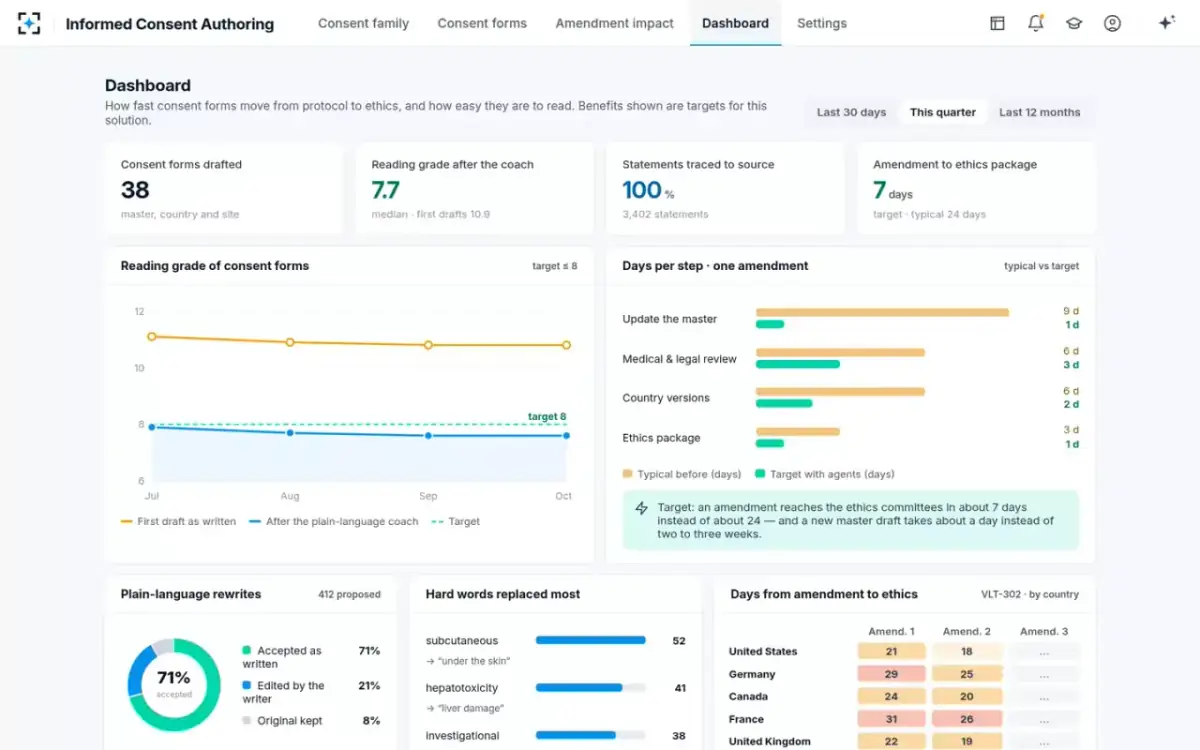
The country table in the corner of that screen is the number a programme head should ask for from their own data, whatever software they use. Days from amendment to ethics submission, per country, per amendment, is a measurement the published benchmarks do not give and every sponsor can take from its own files. It is also the only number that will tell you whether a change you made worked.
Pricing a week of consent-form time for your own study
Published medians do not fund a project; your own arithmetic does. The frame below is the one that survives a finance review, because every input is a number the organisation already holds and none of it depends on a vendor's claim.
A per-week cost line a programme head can fill in from their own numbers
Sites standing still
sites × monthly site cost ÷ 4.3 × weeks
Coordinator time, site overhead and retention payments that run whether or not a site can work to the current version.
Clinical operations, from the site budget
Enrolment pushed right
planned enrolment per week × weeks × cost per patient
Only counts where the amendment stops or slows screening. Where it does not, leave this term at zero rather than arguing for it.
The enrolment plan
Re-consent effort
participants to re-consent × minutes × site hourly rate
Rises with every week the versions diverge, because more participants reach a visit before their site has the new form.
Site contracts
Document and review days
working days × fully loaded day rate
The writers, country study managers and submission specialists. This is the term a document tool moves directly, and often the smallest of the four.
Medical writing
Run it once and the shape of the answer is often the same. The document days tend to be the smallest term and the only one anybody budgets; the sites standing still are often the largest term and belong to nobody's line. That is why amendment cost gets discussed as a document problem and experienced as an operations problem, and why a case for document automation should be argued on the weeks it removes from the front of the queue rather than on the writer-days it saves.
Two honesty rules make such a case survive scrutiny. Never mix the published benchmark with a product target in the same sentence: 260 days is what the industry measured, 7 days is what this solution is designed to achieve for the document step, and they are different measurements of different things. And never claim a saving that has not been measured in your own study — the right form of the claim before a pilot is a target, and the right form after one is your own number. How to evaluate informed consent authoring software sets out how to produce that number in four weeks.
What is ready to send, and to whom: the package view at the end of an amendment
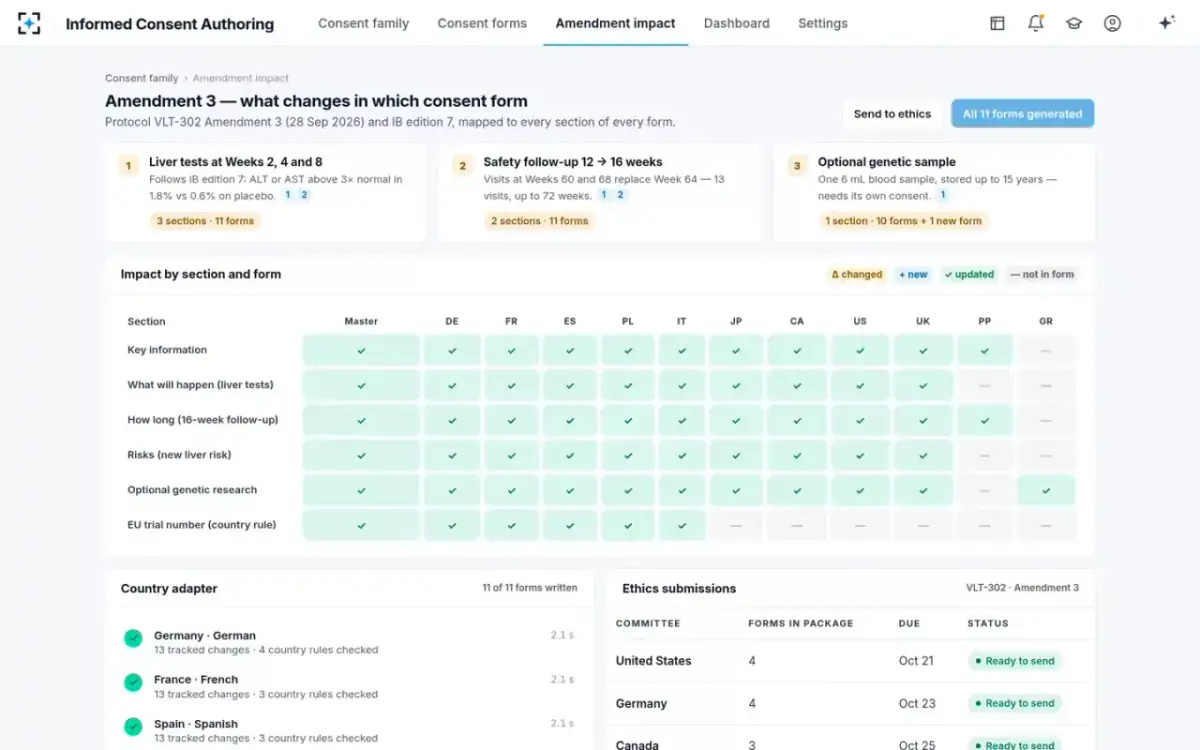
The last point is the one to leave with finance. An amendment's cost is dominated by time, and some of that time is the sponsor's own. The published numbers say the cycle is 260 days, that three quarters of amendments cannot be designed away, and that for 215 days sites disagree about the protocol. Nothing about the consent documents fixes that. Getting them out of the way in a week instead of a month moves the one part of it that is entirely yours. Which consent forms a protocol amendment changes, and who signs each one, walks through the step itself; to see it on a sample amendment, start from Informed Consent Authoring.
Questions people ask
How much does an IRB charge for an amendment?
On the ASPE clinical trial cost model, the cost of a single IRB amendment is $1,094 in phase 1, $1,698 in phase 2, $1,919 in phase 3 and $1,636 in phase 4 — against $114,118 for the IRB approvals a phase 3 study needs in total. Review fees are a rounding error next to the $535,000 median direct cost of implementing a phase III amendment, so negotiating them is not where an amendment budget is won.
What percentage of protocol amendments are avoidable?
The answer has changed, and the newer figure is the one to use. A 2016 Tufts CSDD study found 45% of substantial amendments were deemed avoidable. The 2024 follow-up, covering 950 protocols and 2,188 amendments, found 77% were deemed unavoidable, with regulatory agency requests and changes to study strategy the top reasons for amending. Better protocol design has a smaller ceiling than the older figure suggested.
What does a request for information cost in the EU?
Up to 31 days in that Member State. Article 22(3) of the Clinical Trials Regulation lets a Member State extend its assessment of a substantial modification by a maximum of 31 days to obtain and review additional information; the sponsor has no more than 12 days to answer, and the Member State then has up to 19 days to complete. A sponsor that misses the answer window has its application deemed lapsed in that country.
Which part of an amendment costs the most?
The waiting, not the work. The document steps — updating the master, review, country versions, package assembly — are a few dozen working days. The 260-day cycle and the 215 days of divergent protocol versions are what carry per-month site, monitoring and retention costs, which the ASPE model shows dominating trial spend across all phases. Any cost case should price the weeks, not the writer-days.
How do you reduce the cost of an amendment?
Three levers, in descending order of what the evidence supports. Shorten the sponsor's own portion of the calendar, because it is the only part you control outright. Submit right the first time, since one question in one European country can add up to 31 days there. And bundle changes where the protocol allows, because the mean is now 3.3 amendments per protocol and each one restarts every committee's clock.
What does a day of trial delay cost?
No single published figure fits every study, because it depends on the study's size, phase and site footprint. Build it instead: sites multiplied by monthly site cost, plus enrolment pushed right, plus re-consent effort, plus the document and review days. Every input is a number a sponsor already holds, and the site term is often the largest.