Informed consent comprehension is how much of a trial a participant can actually explain back, and it is not what a reading-level score measures. A form can hit grade 8 on every sentence and still leave a participant believing the doctor chose their treatment, that the placebo arm is a kind of medicine, or that stopping early will cost them their usual care. The pooled evidence says this is normal rather than exceptional: in a meta-analysis of 103 studies, about half of participants understood randomisation and placebo. Botminds' Informed Consent Authoring scores the reading grade of every sentence and ties every statement to the protocol passage it came from — and those are the two things it measures. Whether the person in the chair understood is settled in the consent interview, which is why the solution writes a short set of questions for that conversation rather than claiming the conversation's result.
This page is for the IRB member or sponsor quality lead who has to judge whether a readable form is an understood one, and for the writer being asked to prove a rewrite worked. The research figures come from peer-reviewed meta-analyses and from regulators, linked where they appear. The product figures come from a fictional sample study in the solution and are labelled as such.
What three decades of research on understanding found
103studies
pooled in a meta-analysis of participant understanding, covering 135 cohorts
52.1%
understood randomisation — the least-understood component of all
53.3%
understood placebo, the second least understood
Norise
in the proportion who understood, across 30 years of consent reform
Do participants understand the informed consent form?
Partly, and the part they miss is the part that makes a trial a trial. The Tam meta-analysis pooled 103 studies evaluating 135 cohorts and measured understanding component by component. Its finding, in its own words: "The pooled proportion of participants who understood components of informed consent was 75.8% for freedom to withdraw at any time, 74.7% for the nature of study, 74.7% for the voluntary nature of participation, 74.0% for potential benefits, 69.6% for the study's purpose, 67.0% for potential risks and side-effects, 66.2% for confidentiality, 64.1% for the availability of alternative treatment if withdrawn, 62.9% for knowing that treatments were being compared, 53.3% for placebo and 52.1% for randomization."
Read that list as a ranking and it stops being a list of percentages. The things people understand best are the things that resemble ordinary medical care: what this is, that it is voluntary, that they can stop, what it might do for them. The things they understand worst are the things that make research different from care — that two treatments are being compared, that one of them may be inert, and that a machine, not a doctor, will decide which they get. The therapeutic misconception is not a failure of attention; it is the default reading of a document that looks like a hospital form.
The second finding is the one that should change how a sponsor plans. The same analysis reports that subgroup and meta-regression analyses "indicated that the proportion of participants who understood informed consent had not increased over 30 years". Thirty years of plain-language guidance, template reform and readability scoring, and the measured outcome did not move. Any claim that a new form or a new tool has solved comprehension is arguing against that line, and should be asked for its numbers.
What do participants understand least about a trial?
Randomisation, at 52.1%, and placebo, at 53.3%. Both numbers sit close enough to a coin toss that they are worth stating that way to a study team: on the pooled evidence, you cannot assume the person in front of you knows how their treatment will be chosen. Knowing that treatments were being compared is barely better, at 62.9%.
Pooled understanding, component by component: what gets through and what does not
Two practical consequences follow for anyone writing or reviewing a form. The first is that the sections nobody argues about in review — purpose, voluntariness, withdrawal — are already the strongest, so a rewrite that polishes them is spending effort where the return is smallest. The second is that the two weakest components are often explained by the same two stock sentences, and those sentences tend to be abstractions. "You will be randomly assigned in a 2:1 ratio to Veltrimab or placebo" passes a reading-grade check at a respectable number and still leaves both of the least-understood ideas untouched.
Why a grade-8 form can still fail
A readability formula counts syllables, words and sentences. It does not know what a word means, whether an idea is familiar, or whether the sentence it just scored is the one that matters. "You may be assigned to the control arm" is eight short words with a low syllable count and a comfortable grade score; it is also, for a reader who does not already know what a control arm is, no information at all. Short does not mean concrete, and concrete is what the two weakest components need.
The measurement literature shows the same split from the other side. A 2024 analysis of United States consent forms posted on ClinicalTrials.gov scored them on several formulas at once and found them consistently above the recommended level — of the Gunning Fog results it reports that "The mean score of 10.91 (SD = 2.80) is equivalent to almost a high school junior-level grade and may be too complex for a general audience." That is a real finding about the documents, and it is a finding about difficulty, not about understanding: the analysis scored text and did not test what participants could explain back.
So the honest statement of the relationship is this: a high reading grade is good evidence that a form will not be understood, and a low one is weak evidence that it will. Lowering the grade removes a known obstacle. It does not establish comprehension, and a team that treats a grade number as a comprehension result has quietly swapped one measurement for another. What a reading level actually measures, and how to get a form to grade 8, is worth reading alongside this page for exactly that reason.
A readability score and a comprehension check answer different questions
What a readability score measures: A sentence, or a document, scored on word and syllable counts.
What a comprehension check measures: A person, scored on what they can state back about this study.
What a readability score measures: Instantly, before anyone has read the form. It is a property of the text.
What a comprehension check measures: Only in or after the consent conversation. It is a property of the exchange.
What a readability score measures: That one known obstacle — difficult prose — has been removed.
What a comprehension check measures: That this participant understood these points, on this day, with this person.
What a readability score measures: Abstraction, unfamiliar concepts, and whether the hard ideas were explained at all.
What a comprehension check measures: Nothing about the document; a person can answer well after a good conversation about a poor form.
What a readability score measures: The writer, as a target to hit before submission.
What a comprehension check measures: The site, as a prompt during the interview — and never as a hurdle the participant must clear.
How do you measure comprehension of informed consent?
You ask, in the interview, and you write down what you asked. In the European Union this is not optional: Article 29(5) of the Clinical Trials Regulation says that in the prior interview "it shall be verified that the subject has understood the information". The Regulation sets the obligation and leaves the method entirely open, which is the right division of labour — the method has to suit the population — but it does mean the sponsor has to choose one and be able to describe it.
Three methods are in common use, and they differ mainly in how much they resemble an examination. The weakest is the closed check: "Do you have any questions?" It tends to produce the answer no. The most searching is teach-back, where the participant explains the study in their own words and the person taking consent listens for the specific components rather than for fluency. In between sits a short set of questions with answer options, used as a prompt rather than a test — the form most studies can actually run at scale.
Whichever is used, three rules keep the measurement honest. Ask about the components that are known to fail, not the ones that are easy. Record the result as a prompt for the conversation, not as a pass mark the participant has to reach. And never let a wrong answer end the enrolment — a wrong answer is a finding about the explanation, and the next step is to explain it again.
The 54-intervention evidence: what actually improved understanding
The strongest evidence on what works is a systematic review of 54 interventions tested in randomised controlled trials of the consent process itself, drawn from 39 of 1,523 screened articles. Twenty-two of them could be pooled, in three categories, and the results separate sharply: "Meta-analysis of multimedia approaches was associated with a non-significant increase in understanding scores (SMD 0.30, 95% CI, -0.23 to 0.84); enhanced consent form, with significant increase (SMD 1.73, 95% CI, 0.99 to 2.47); and extended discussion, with significant increase (SMD 0.53, 95% CI, 0.21 to 0.84)."
Two things in that sentence deserve a study team's attention. Multimedia did not reliably beat the control, and its confidence interval crosses zero — so a video, often the first idea when a sponsor decides to "do something about comprehension", has the weakest pooled evidence of the three. The enhanced form has by far the largest pooled effect, and a better conversation has a solid, smaller one. The review's conclusion puts it plainly: "Enhanced consent forms and extended discussions were most effective in improving participant understanding. Interventions of all categories had no negative impact on participant satisfaction or study accrual."
That last clause answers the objection that always arrives next. The fear that a longer, more careful consent conversation will cost enrolment is not supported by the review: across all five categories of intervention, it found no negative impact on accrual or satisfaction. More time on the two components people get wrong is not, on that evidence, a recruitment risk.
Two interventions worth the money, one that is not
Enhanced consent form
1.73
95% CI 0.99 to 2.47
A rewritten, better-organised document. The largest pooled effect of the three pooled categories, and the one a sponsor controls completely.
Extended discussion
0.53
95% CI 0.21 to 0.84
More time with a person. Smaller than the rewrite, solidly positive, and the only one that can repair a misunderstanding on the day.
Multimedia
0.30
95% CI −0.23 to 0.84
Video and interactive material. The interval crosses zero, so the pooled result does not establish an effect at all.
Set that evidence beside the Tam finding that understanding has not improved in thirty years and an uncomfortable reading suggests itself: we know two things that work, and we have not done them at scale. Rewriting a form properly is slow, and a longer conversation costs site time that nobody budgets. Both are cheaper than they look next to the cost of a trial, and one of them is the part a document tool can genuinely help with — which is the honest claim to make for software here, and the limit of it.
Writing a comprehension check that is not a test of the reader
A comprehension check written badly becomes an examination, and an examination at the consent table changes the relationship. The participant is being asked to prove they deserve to join, which is the opposite of what the conversation is for. Four rules keep a check on the right side of that line.
First, every question tests a statement that is actually in the form, so a wrong answer points at a sentence somebody can go back to. Second, the questions cover the components the research says fail — choice, visits, placebo, randomisation, withdrawal — rather than the ones that are easy to score. Third, the answer options are written in the participant's words, including the plausible wrong one, because an option nobody would pick teaches nothing. Fourth, the wrong answer has a defined next step for the person taking consent, and that step is always to explain again.
Five questions, the statement each one tests, and what a wrong answer changes
| The question | The statement it tests | What a wrong answer should change |
|---|---|---|
| Do you have to join this study? | Taking part is your choice, and you can leave at any time. | Go back to the voluntary-participation paragraph before anything else. A participant who believes the doctor decided has not consented. |
| How many study visits will you have? | You will have 13 study visits over up to 72 weeks. | Walk the visit schedule again with the calendar. After an amendment this answer is easy to get wrong, because the number changed. |
| Will everyone in the study get the medicine? | You will get either the study medicine or a placebo, a shot that looks the same but has no medicine in it. | Explain the placebo and the chance of being assigned to it. Pooled across the published studies this is one of the two least-understood ideas in a trial. |
| Who decides which one you get? | A computer will pick by chance whether you get the study medicine or placebo. | Explain randomisation in the participant’s own words and check it again. It was the least-understood component in the pooled meta-analysis. |
| What happens if you want to stop? | If you stop, the study doctor may ask you to come for one last safety visit. You will not lose any care or benefits you would otherwise get. | Re-read the withdrawal paragraph. A participant who thinks stopping costs them their usual care is not free to leave. |
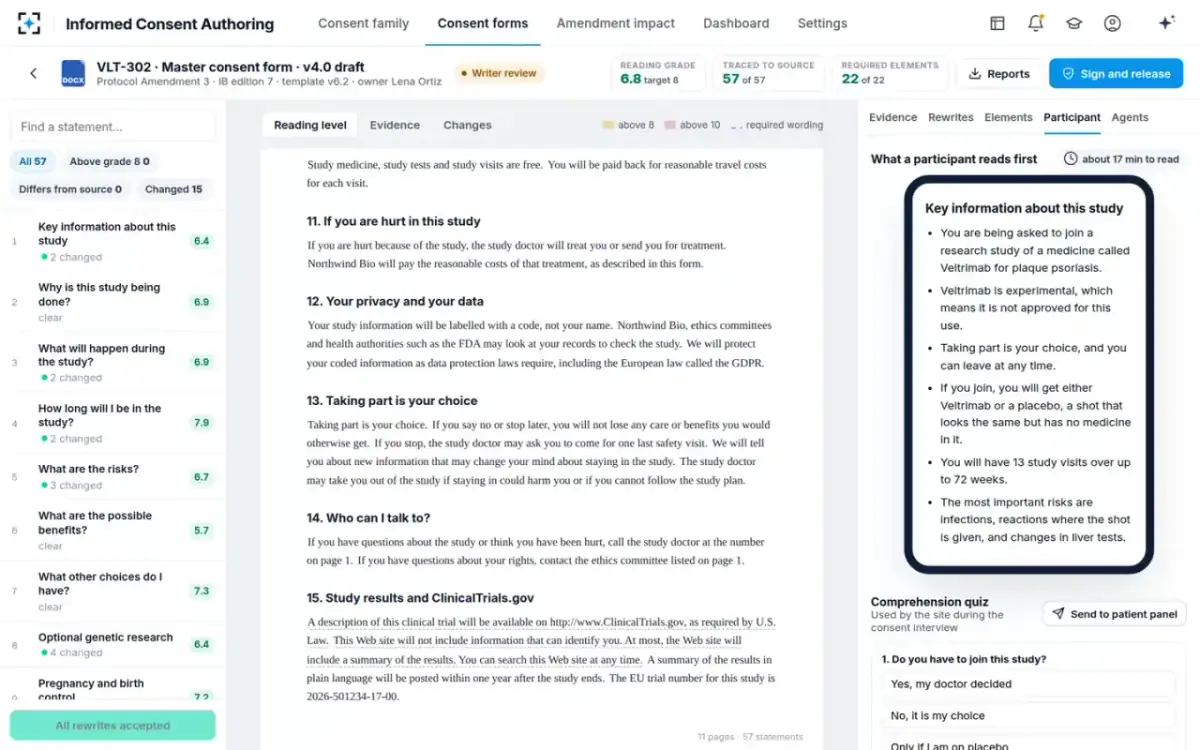
The check written against the statements it tests, beside what a participant reads first
Who should read the form before the committee does
Somebody who does not already know the study. This is cheap comprehension work and easy to skip, because everyone in the review chain is an expert by the time the form reaches them. The FDA and the Office for Human Research Protections say so directly in their draft guidance on key information: "Although not required, one possible way to evaluate whether the information is presented in a way that facilitates understanding is to have the information reviewed by individuals unfamiliar with the research. This may be particularly helpful for forms translated into additional languages." The guidance suggests patient advocacy groups or a sample of people from the population the study will recruit.
The sentence about translations is worth pausing on. A translated form has been read closely by a translator, a back-translator and a reviewer, all of whom were checking equivalence to the English rather than whether the result is comprehensible in the target language. Those are different questions, and only a reader from the population answers the second.
In the solution a patient panel review is a setting rather than a step somebody has to remember: the key information page and the question set can be sent to a named reviewer — Dana Okafor on the sample study — and the setting can equally be put to "Not required", which is the honest option for a study where no panel exists. The value of making it a setting is that the answer is recorded either way, so a quality plan can say what the study did rather than what it intended.
Reading level, reading time and understanding are three different numbers
A consent programme that reports one number usually reports the wrong one. Three are worth keeping apart, because each is produced by a different mechanism and each fails in a different way.
A comprehension practice a study team can run, and what Informed Consent Authoring contributes to each step
- Score the document, before anybody reads it
Reading grade per sentence against a target the study sets. The solution does this and proposes a rewrite for each sentence above the target, keeping every number and risk; a named writer accepts, edits or keeps each one.
- Measure the reading time, not just the grade
A grade-7 form that takes 40 minutes to read is still a form nobody finished. On the sample study the participant view reports about 17 minutes for the whole document.
- Send the key information page to a reader from the population
The step the agencies suggest in their draft guidance. A patient panel reviewer is a setting in the solution, and can be set to "Not required" where no panel exists.
- Write the questions against the released statements
Five questions tied to sentences that are actually in the form, covering choice, visits, placebo, randomisation and withdrawal.
- Use the questions as a prompt, never as a pass mark
A wrong answer is a finding about the explanation. The next step is to explain it again, and enrolment is not conditional on the score.
- Budget the conversation
Extended discussion is one of the two pooled categories with a significant positive effect, and the review found no negative impact on satisfaction or accrual.
- Report the three numbers separately
Reading grade, reading time and what the interview found. Collapsing them into one figure is how a readability result ends up quoted as a comprehension result.
Reading grade and days to ethics, measured; understanding, not claimed
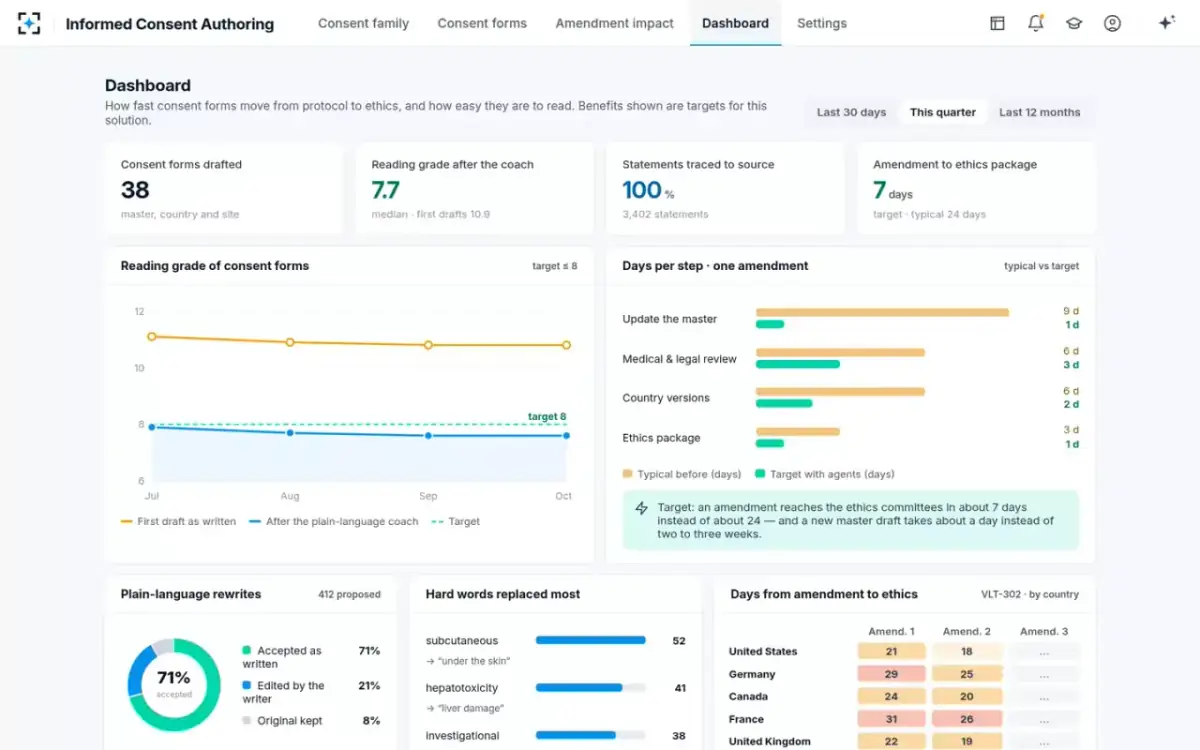
That is the boundary worth being explicit about when a tool is being evaluated. Software can lower a reading grade, prove that every sentence rests on the protocol, time the document and draft the questions. It cannot sit in the consent interview. The published evidence says the two things that move understanding are a better document and a longer conversation, and a document tool can only buy the first — which is worth buying, since it has the larger measured effect, but is half the job. What the rules allow an AI tool to draft, and who answers for it sets out the other limits, and Informed Consent Authoring shows the form, the grades and the questions on one screen.
Questions people ask
Does a lower reading level improve understanding?
The evidence points that way without proving it directly. The intervention with the largest measured effect on understanding in the 54-intervention review was an enhanced consent form, at a standardised mean difference of 1.73, and rewriting for plainness is much of what an enhanced form does. What no study shows is a clean dose-response between a grade number and a comprehension score, so a form that reaches grade 8 has removed an obstacle rather than demonstrated a result.
Should you quiz a participant before enrolling them?
Ask, but do not grade. A short set of questions used as a prompt during the consent interview is good practice and, in the European Union, verification of understanding in that interview is required by Article 29(5) of the Clinical Trials Regulation. Treating the answers as a pass mark turns consent into an entrance examination and gives the participant a reason to guess rather than to say they are unsure.
What interventions improve informed consent understanding?
Two, on the pooled evidence: a rewritten consent form (SMD 1.73) and a longer discussion (SMD 0.53). Multimedia approaches did not reach significance when pooled, with a confidence interval from −0.23 to 0.84. The same review found that interventions of all categories had no negative effect on participant satisfaction or on study accrual, which answers the usual objection to spending more time.
Has informed consent understanding improved over time?
Not measurably. The meta-analysis of 103 studies reports that the proportion of participants who understood informed consent had not increased over 30 years; its subgroup and meta-regression analyses also found that age, education, critical illness, study phase and location affected understanding. Reading levels of the documents themselves have improved in recent years; understanding, as measured in these studies, has not followed.
Who should read a consent form before it is submitted?
Someone unfamiliar with the research. FDA and OHRP suggest in draft guidance that having the information reviewed by individuals unfamiliar with the study is one way to evaluate whether it facilitates understanding, and note it is particularly helpful for translated forms. In practice that means a patient advocacy group or a few people from the population the study will recruit — not another reviewer who already knows the protocol.
Can software measure whether a participant understood?
No, and a tool that claims to is measuring something else. Document software can score reading grade, show the reading time, check that every statement rests on a source and draft the questions for the interview. Understanding is established in a conversation between two people, and the record of it belongs to the site. Keeping the two apart is what lets a quality plan say honestly which was measured.