Informed consent requirements differ by country in a narrow but expensive way. The science, the risks, the visit schedule and the privacy story are the same everywhere, so most of a country consent form is the master form carried across and translated. What changes is a short list of national rules: who is allowed to hold the consent interview, which compensation or insurance system has to be named, which privacy permission is attached, which language the ethics committee reads, and which identifiers the form must carry. That list is short enough to look trivial and specific enough that a reviewer working from memory gets it wrong, which is why a single country version can come back from its committee while ten others pass. Botminds' Informed Consent Authoring writes the master once, carries every change into each country, site and special version as tracked changes, and runs each version against the rules held for that country, so the national layer is checked by rule rather than recalled.
The worked examples below come from a fictional sample study in the solution: VLT-302, a Phase 3 trial of a medicine called Veltrimab in plaque psoriasis, with 640 participants at 112 sites in 14 countries, and eleven country, site and special consent forms hanging off one master. The people, the sponsor and the medicine are invented. The law is real, and every rule is linked to the article it comes from.
Do informed consent requirements differ by country?
Yes, and they differ at four levels at once, which is what makes the question harder than it looks. The first level is the international one: ICH Good Clinical Practice sets the shape of the consent process everywhere it is adopted. The second is regional: in the European Union, Regulation (EU) No 536/2014 — the Clinical Trials Regulation — fixes what the information must contain and how it must be given, and in the United States the same ground is covered by 21 CFR part 50 for FDA-regulated research and by the Common Rule at 45 CFR part 46 for federally supported research. The third level is national law, which supplements the regional rule rather than replacing it: Germany's Medicinal Products Act adds conditions to EU Article 29 and does not restate it. The fourth level is the committee itself, which has its own template preferences, and which no published source will tell you about.
Only the middle two levels can be written down as rules a checker applies. The first is too general to fail a form, and the fourth is local knowledge. A country rules library is therefore a working document that holds the national requirements with their citations, and absorbs the committee habits as a team learns them — which is different from a reviewer's recollection in exactly one way that matters: it can be read, dated and argued with.
The European baseline beside the United States baseline, row by row
European Union · Regulation (EU) No 536/2014: A prior interview with a member of the investigating team who is "appropriately qualified according to the law of the Member State concerned" (Art. 29(2)(c)) — so the qualification itself is national.
United States · 21 CFR 50 and 45 CFR 46: No federal rule names the person. The IRB approves the process and every document used in it, and the investigator remains responsible for it.
European Union · Regulation (EU) No 536/2014: Article 29(5) makes checking that the participant has understood part of the interview itself — a required step, not a recommendation.
United States · 21 CFR 50 and 45 CFR 46: No equivalent requirement. Understanding is pursued through the form itself and the key information section that opens it.
European Union · Regulation (EU) No 536/2014: The applicable damage compensation system and the EU trial number, both named in Art. 29(2)(d) and (e).
United States · 21 CFR 50 and 45 CFR 46: The elements of 21 CFR 50.25, including the ClinicalTrials.gov statement at 50.25(c) in words the regulation prescribes exactly.
European Union · Regulation (EU) No 536/2014: National annexes: the insurer and policy, the data-protection contacts, and whatever the Member State adds.
United States · 21 CFR 50 and 45 CFR 46: A privacy authorization under 45 CFR 164.508, which the rule allows to be combined with the consent to participate.
European Union · Regulation (EU) No 536/2014: Consent is a Part II question assessed by each Member State for its own territory, within 45 days of validation (Art. 7).
United States · 21 CFR 50 and 45 CFR 46: The IRB, on its own meeting calendar. No federal clock sets a date by which it must answer.
Read down the left column and a pattern appears. The European requirements are mostly about the conversation: who holds it, that it happens before signature, that understanding is checked in it. The United States requirements are mostly about the document: which statements it contains, in which order, in whose words. A sponsor that treats the two as the same list, translated, will satisfy neither fully — and the element-by-element reading of the required elements is the place to start on the American half.
The EU baseline: Article 29, in plain words
Article 29 of the Clinical Trials Regulation is short, and almost every country rule in Europe is an addition to it. Paragraph 1 says the consent must be written, dated and signed by the person who performed the interview and by the participant, and that adequate time must be given to consider the decision. Paragraph 2 is the substance. The information must let the participant understand the nature, objectives, benefits, risks and inconveniences of the trial, their right to refuse and to withdraw at any time, the conditions and expected duration of participation, and the treatment alternatives.
Two sub-paragraphs of 29(2) then do most of the work of making national versions different. The information must "be kept comprehensive, concise, clear, relevant, and understandable to a layperson", and it must "be provided in a prior interview with a member of the investigating team who is appropriately qualified according to the law of the Member State concerned". The second phrase is the hinge: the Regulation refuses to say who may hold the interview and hands the question to each Member State. A sponsor cannot answer it from the Regulation, only from national law.
The remaining two sub-paragraphs name two things the form must carry. Article 29(2)(d) requires information about the applicable damage compensation system referred to in Article 76(1), and 29(2)(e) requires the EU trial number and information about where the results will be available. Both are country-flavoured in practice: the compensation system is national, and the EU trial number exists only for trials authorised under the Regulation, which is why it belongs in the European versions of a global study and in none of the others.
One study, four rulebooks: what each requires of the same consent form
European UnionRegulation (EU) No 536/2014
Who informsA prior interview with a member of the investigating team, qualified under the law of the Member State concerned — Art. 29(2)(c)
What must be namedThe damage compensation system of the Member State, and the EU trial number — Art. 29(2)(d) and (e)
Attached or filedNothing EU-wide. Each Member State adds its own annexes.
SignedWritten, dated and signed by the person who held the interview and by the participant — Art. 29(1)
GermanyArzneimittelgesetz, §§ 40, 40a, 40b
Who informsThe interview must be held by an investigator who is a physician, or a physician on the investigating team — § 40b(2)
What must be namedTrial insurance that pays even where no one is liable, with at least €500,000 available per death or permanent occupational disability — § 40a sentence 1 no. 3
Attached or filedThe participant-facing documents go to the authority in German — § 40(2)
SignedAs the EU Regulation, with electronic signature under Regulation (EU) No 910/2014 — § 40b(1)
United States · FDA21 CFR 50
Who informsNo rule names the person; the IRB approves the process and every document used in it
What must be namedThe elements of 21 CFR 50.25(a), (b) and (c), opening with the key information the Common Rule requires at 45 CFR 46.116(a)(5)
Attached or filedNothing federal. Institutions add their own language on billing, injury and state law.
SignedSigned and dated by the subject or the legally authorized representative at the time of consent — 21 CFR 50.27(a)
United States · privacy45 CFR 164.508
Who informsNot an interview rule: an authorization for the use of health information, with its own elements
What must be namedWho may use the information, who may receive it, for what purpose, and when the permission ends — § 164.508(c)(1)
Attached or filedMay be a separate page or folded into the consent form, because the rule allows the two to be combined
SignedSignature of the individual and date — § 164.508(c)(1)(vi)
What does Germany add to the EU consent requirements?
Germany adds three things, and each one changes a sentence or a cover page rather than the body of the form. The German Medicinal Products Act is explicit that it is adding rather than replacing: "Supplementing Article 29 of Regulation (EU) No. 536/2014, the conditions pursuant to subsections (2) to (5) apply to the consent of the person concerned", as Section 40b(1) puts it in the Federal Ministry of Justice's own English translation.
The first addition is the interview. Where the Regulation asks only for someone appropriately qualified, Section 40b(2) says the participant "is to be informed by an investigator who is a physician, or in the case of a dental trial, a dentist", or by a physician on the investigating team. A consent process that allows a study nurse to take consent, perfectly lawful in some jurisdictions, is not lawful here, and the form's signature block has to reflect that.
The second is insurance. Section 40a sentence 1 no. 3 requires, for death or injury during the trial, "an insurance policy that provides benefits, even when no one else is liable for the damage", taken out "in favour of the person concerned in a clinical trial" with a carrier authorised in the EU or EEA, and sized so that at least €500,000 is available for every case of death or permanent occupational disability. This is why German consent forms name an insurer and a policy number while American ones do not: the policy exists for the participant's benefit, so the participant is told whose it is and how to claim on it.
The third is language. Section 40(2) allows the application itself to be submitted in German or English, but requires that the documents intended for the participant or their legal representative be submitted in German. The German version is not a courtesy translation of the real form; it is the filed document.
"My committee wants the insurer named and the EU trial number — every time."
Priya Raman, the sample study's country study manager for Germany
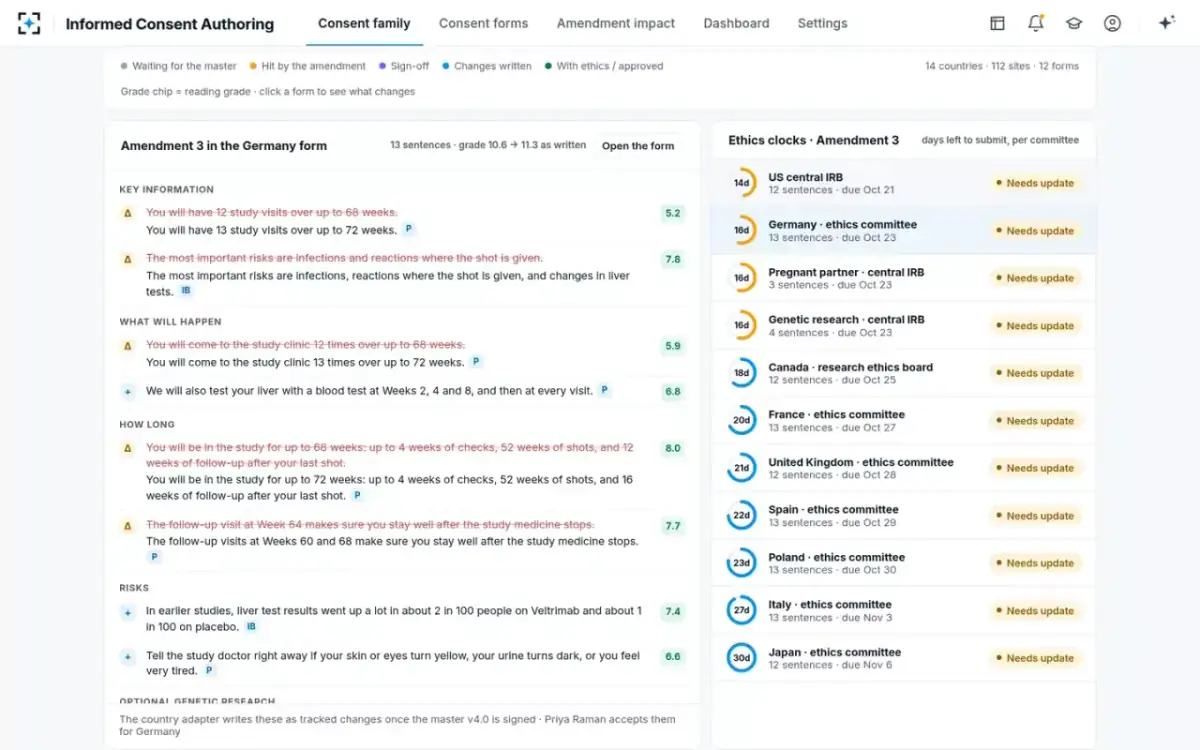
Thirteen sentences, sixteen days: the German version of one amendment
Insurance and compensation: the sentence that changes in every country
The compensation sentence is among the most country-specific paragraphs in a European consent form, and the Regulation makes it so deliberately. Article 76(1) requires that "Member States shall ensure that systems for compensation for any damage suffered by a subject resulting from participation in a clinical trial conducted on their territory are in place in the form of insurance, a guarantee, or a similar arrangement" appropriate to the nature and extent of the risk. The Regulation does not say what the system is; it says each Member State must have one. Article 29(2)(d) then requires the consent form to describe whichever one applies.
So the sentence has to be rewritten, not translated. In Germany it names a policy and a minimum sum fixed by statute. In another Member State it may describe a sponsor guarantee or a national scheme. In the United States neither applies: there is no federal compensation system to describe, and the consent form instead explains whether any treatment or compensation for injury is available, and from whom — a statement required only where the research involves more than minimal risk. Three jurisdictions, three different paragraphs, none of them a translation of another.
Article 76(3) adds a useful exemption that saves work on low-intervention trials: Member States may not require additional use of the compensation system where any possible damage is already covered by the applicable scheme in place. A rules library should hold that exemption next to the requirement, because the alternative is a study team writing an insurance paragraph into a form that does not need one and defending it to a committee that knows better.
The United States: 21 CFR 50.25 and the HIPAA authorization
An American consent form answers to two rulebooks that were written for different purposes and do not cross-reference each other. The first is the research rulebook: 21 CFR part 50 for anything FDA-regulated, 45 CFR part 46 for federally supported research, which between them set the elements the form must contain, the key information section that must open it, and the requirement that the IRB approve everything the participant sees.
The second is the privacy rulebook. Using identifiable health information for research needs the participant's authorization under 45 CFR 164.508, which carries its own list of required elements: what information is used, who may use it, who may receive it, for what purpose, when the permission ends, and the individual's signature and date. None of those is in 21 CFR 50.25, and none of 50.25's elements is in 164.508.
Teams argue about whether the authorization is a separate document, and the rule itself settles it. Authorizations may not generally be combined with other documents, but research is the exception: "An authorization for the use or disclosure of protected health information for a research study may be combined with any other type of written permission for the same or another research study", including a consent to participate in research. Either shape is lawful. What is not lawful is leaving out an element of one because it appears in the other, and that is the mistake a combined document invites — which is the argument for checking the privacy elements as a list of their own, whichever page they sit on.
What one amendment changes in each version of the same study
That one-sentence gap between 13 and 12 is the whole argument of this page in miniature. Twelve of the thirteen changes are the protocol talking, and they land identically in every language. The thirteenth is jurisdiction, and it comes from the EU rule rather than from the amendment. A reviewer comparing the English master with the German draft will see twelve matching changes and judge the work done.
Language: who may translate, and what the committee reviews
Translation is a regulated step, not a clerical one, and the rules are about who does it and who checks it rather than about the words. The FDA's position is that the IRB owns the question: "When translation and interpretation are needed for written and oral information that is to be presented to subjects, FDA recommends that the IRB review, and if appropriate, approve reasonable procedures for ensuring that the translations will be prepared by a qualified individual or entity, and that interpretation assistance is available." The IRB is not asked to certify the translation; it is asked to approve the procedure that produced it.
In Germany the question is answered a step earlier, because the German text is the submitted document rather than a derivative of an English one. The practical consequence is a sequencing rule worth learning early: the master has to be finished, not nearly finished, before translation starts, because a certified translation and its back-translation price and schedule each round separately. A late English correction after translation has begun does not cost a sentence; it costs a cycle.
Informed Consent Authoring stops short of the translation itself, and the distinction is worth stating plainly because it decides what a buyer still has to procure. The solution prepares the text for certified translation and back-translation — the changed sentences, their sources and the country wording that goes with them — and the translation vendor and the certification remain the sponsor's. What the solution does own is the state of the text handed over: a form whose statements are each tied to the passage they came from, so a back-translation query can be settled against the protocol rather than against an opinion.
What a country version actually contains
Laid out as layers rather than as a document, a country version stops being mysterious. Each layer has a different owner, a different reason to change and a different review path, and most of the trouble in global consent work comes from treating all four as one file.
The four layers of a country consent form, and who owns each
| Layer | What it is | When it changes | Who answers for it |
|---|---|---|---|
| The master body | Purpose, procedures, visits, risks, benefits, alternatives, withdrawal — everything that comes from the protocol and the Investigator’s Brochure. | Every protocol amendment and every brochure edition. | The medical writer, with the medical monitor signing for accuracy. |
| Sponsor standard wording | Privacy, injury, rights and publication language from the sponsor template, plus any wording a regulation prescribes exactly. | When the template version changes, or the prescribed text does. | Privacy and legal counsel. |
| Country rules | Insurer and policy, data-protection contacts, the privacy authorization, bilingual versions, trial identifiers, payment and burden-reduction rules. | When national law or the committee’s expectation changes — rarely, and never in step with the protocol. | The country study manager, from the study team’s rules for that country. |
| Site and committee wording | The institution’s own paragraphs: billing, local contacts, state or regional law, the committee’s preferred template. | When the site or the committee says so. | The site, with the ethics submission specialist tracking it. |
The third layer is where this page began, and it has a property the other three do not: it is the only layer that changes for reasons that have nothing to do with the study. A protocol amendment does not alter German insurance law. A new brochure edition does not alter who may hold a consent interview. Country rules are therefore worth holding as a list with citations and dates rather than as sentences inside eleven documents, because the day a rule changes, the question is which forms carry it — and that question is unanswerable if the rule exists only as prose.
Keeping eleven forms from drifting apart
Drift is the failure mode of a consent family, and it is quiet. One country version gets an urgent correction that never goes back into the master. Another is rebuilt from the previous amendment's file because that one was to hand. A third has a paragraph the committee asked for two years ago that nobody can now trace to a rule. Nothing fails until an inspector or a new study manager lines the forms up, and by then the forms disagree about the study.
Three habits stop it, and none of them needs software to begin. Changes go into the master first and reach country versions only from there. Every country-specific sentence carries the rule it exists for, so a sentence nobody can source is a candidate for removal rather than a mystery to preserve. And the acceptance of a country version is a named person's act, because an inherited change nobody signed for is an inherited change nobody read.
Eleven versions on one line each: language, grade, traced and the committee's date
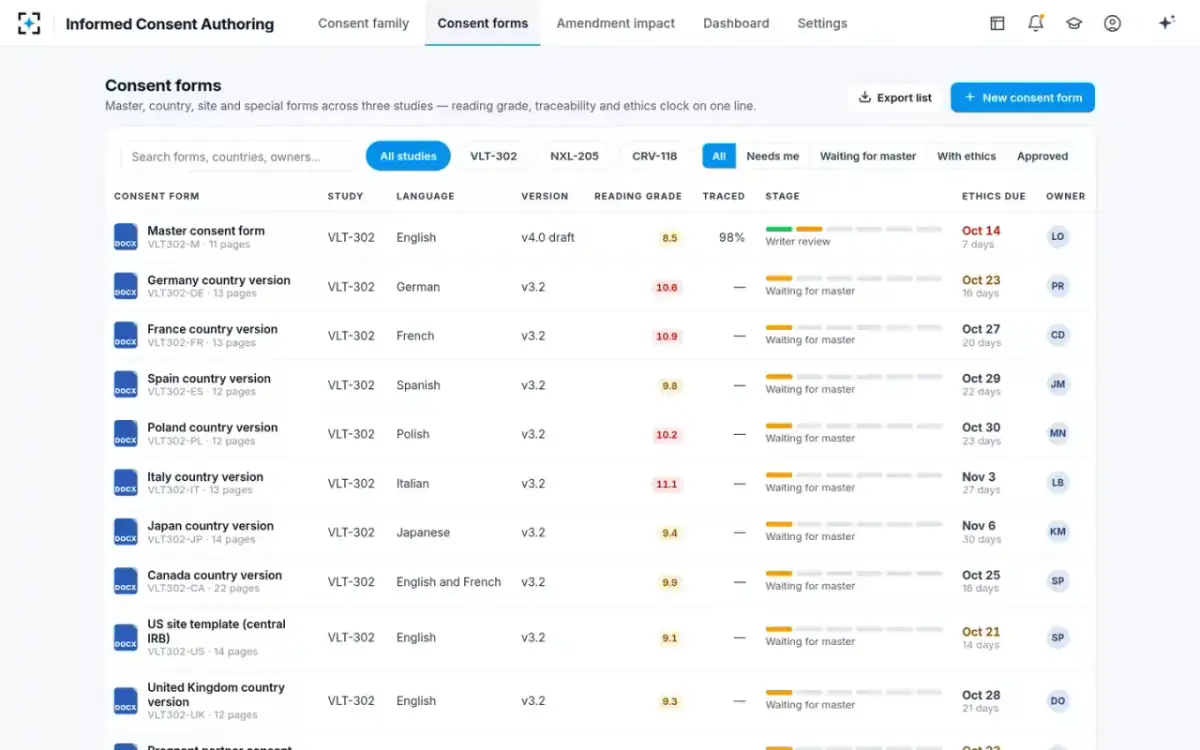
What the solution adds to those habits is mechanical rather than clever. The country adapter carries master changes into every country, site and special version as tracked changes and never touches text the master did not change, so an inherited change and a local one are always distinguishable. The elements checker then runs each version against the rules held for its country — on the sample study, Germany's version is checked against four country rules, including the participant insurer and its policy number — and those rules come only from the study team's approved list, so a rule that is not written down is not applied. Nothing is submitted by the solution: the country study manager accepts the tracked changes for their country, and people send the package to the committee.
The country pass Informed Consent Authoring runs, and a team can run by hand
- Is the compensation or insurance paragraph the right one for this country?
Article 76(1) leaves the system to each Member State, so the paragraph is rewritten per country rather than translated. In Germany it names an insurer, a policy and a statutory minimum.
- Does the form say who holds the consent interview, and is that person allowed to?
The EU Regulation hands the qualification to national law; Germany requires a physician. A signature block that allows anyone else is a finding.
- Is the trial identifier the right one for this jurisdiction?
The EU trial number belongs in European versions and in no others. On the sample study it is the single sentence that separates the five EU forms from the four outside it.
- Is the privacy permission complete in its own right?
Whether the authorization is a separate page or folded into the consent, every element of 45 CFR 164.508(c)(1) has to be present somewhere in it.
- Is the submitted language the one the authority reads?
In Germany the participant-facing documents are filed in German, so the German text is the document rather than a translation of it.
- Does every country sentence carry the rule it exists for?
A paragraph nobody can trace to a rule is often a committee request from a previous study, and it will be defended by nobody when it is queried.
- Has a named person in that country accepted the changes?
Inheritance is not acceptance. The country study manager signs for the version that goes to their committee.
Where this sits in the wider job is worth saying plainly. The country pass is the last step of an amendment, not the whole of it; which consent forms a protocol amendment changes, and who signs each one covers the steps before it, and how to evaluate informed consent authoring software sets out what a buyer has to bring before any of it can run — a written list of country rules being an input many teams discover they do not have. To see the eleven versions of one study together, start from Informed Consent Authoring.
Questions people ask
Does the consent form have to name the trial insurer?
It depends on the country, because the EU Regulation requires the form to describe the applicable damage compensation system and leaves each Member State to decide what that system is. In Germany it is insurance: Section 40a of the Medicinal Products Act requires a policy that pays even where no one is liable, taken out in the participant's favour, with at least €500,000 available for each death or permanent occupational disability — so the German form names the insurer and the policy. In the United States there is no equivalent federal system to name.
Does the EU trial number have to be in the consent form?
Yes, for a trial authorised under Regulation (EU) No 536/2014. Article 29(2)(e) requires the information given to the participant to include the EU trial number, alongside information about where the results will be available. It has no place in a form for a country outside that framework, which is why a global study's European and non-European versions differ by at least this one sentence.
Who may translate a consent form?
No rule names a profession, but the procedure is reviewable. The FDA asks the IRB to review and, if appropriate, approve reasonable procedures for ensuring that translations are prepared by a qualified individual or entity and that interpretation help is available. Many sponsors use certified translation with an independent back-translation, and the committee sees the procedure rather than judging the translation itself.
What is the difference between US and EU informed consent requirements?
The clearest way to put it is that the European rules govern the conversation and the American rules govern the document. Europe requires a prior interview with a qualified member of the investigating team and requires that understanding be verified in it; the United States requires a specific list of elements, a key information section at the front, and IRB approval of everything the participant sees. Both require a written, signed, dated form, and both insist on plain language.
What is in a country version of a consent form?
Four layers: the master body from the protocol and the brochure, the sponsor's standard privacy, injury and rights wording, the country rules, and whatever the site or committee adds. The first two are the same everywhere and change with every amendment. The last two change for reasons that have nothing to do with the study, which is why they are worth holding as a list with citations rather than as sentences inside eleven files.
How many country forms does one study usually need?
Rarely exactly one per country. The sample study here runs in 14 countries and carries eleven forms behind one master: some countries are covered by a shared language version or a site template, a bilingual country may need its form in two languages, and sub-studies — an optional genetic sample, a partner-pregnancy consent — each need a form of their own. Count forms, not countries, when planning start-up.