The ClinicalTrials.gov statement is the one passage of an informed consent form that US regulation writes for you: for an applicable clinical trial, 21 CFR 50.25(c) prints the sentence between quotation marks and requires it to be provided to each participant in the consent documents and the consent process. It is not a model sentence or a recommended form of words. It is the words. Around it sit three other kinds of wording a rewrite has to respect — language that is prohibited rather than prescribed, content a combined HIPAA authorization must keep, and facts the EU requires — and together they are the boundary every plain-language pass runs into. Botminds' Informed Consent Authoring keeps that boundary as a setting rather than as a reviewer's memory: required wording is locked, the plain-language coach cannot rewrite it, and privacy and legal counsel signs the data-protection, injury and insurance wording before a version is released.
The study, the people and the screens on this page are fictional sample data in the solution. The regulations are quoted from their own text, linked where they appear. Nothing here is legal advice; where a sentence is locked by a sponsor rather than by a rule, the page says so.
What is the ClinicalTrials.gov statement in a consent form?
It is a notice, required by regulation, telling the person in front of you that information about the trial has been or will be submitted to the federal clinical trial registry databank. The requirement arrived with the 2007 amendments to the Public Health Service Act and was written into the FDA's consent regulations in 2011. Paragraph (c) of 21 CFR 50.25 introduces it, explains what it is for — to notify the participant that trial information goes to the registry under section 402(j) of the Act — and then says, flatly, "The statement is:".
Everything turns on that colon. The fourteen elements around it describe information to be conveyed, which a writer conveys in the sponsor's own words at the sponsor's own reading level. This one supplies the sentence.
Two things the statement is not. It is not the registration itself: the duty to submit trial information to the register belongs to the responsible party under the statute, and a consent form carrying the sentence discharges none of it. And it is not a promise about what will be posted. The sentence says the site will include at most a summary of the results and nothing that identifies the person; it does not commit the sponsor to posting results on any particular timetable, which is a separate obligation with its own deadlines. Sponsors who add a line about when a plain-language summary will appear are going beyond the sentence, which is allowed and often welcome to a committee.
The exact text 21 CFR 50.25(c) prescribes
“A description of this clinical trial will be available on http://www.ClinicalTrials.gov
21 CFR 50.25(c), as required by U.S. Law. This Web site will not include information that can identify you. At most, the Web site will include a summary of the results. You can search this Web site at any time.”
Four sentences, 48 words, written in the style of 2011: the capitalised "Web site" and the bare, unsecured address have not been amended since. That is uncomfortable in a form written at grade 8, and it is not a reason to touch it. A rewritten version of this passage is not a plain-language improvement; it is a form that no longer contains the statement the regulation requires.
Two practical details are easy to get wrong. The regulation requires the statement "in informed consent documents and processes" — so it belongs in the consent discussion as well as on the page, which matters where a site uses a short form plus an oral presentation. And it must be provided to each clinical trial participant, which means it travels into every version of the form a US participant will sign, not only the master.
Which trials it applies to
Only to an applicable clinical trial, a term the regulation does not define itself: it points at 42 U.S.C. 282(j)(1)(A), where "the term 'applicable clinical trial' means an applicable device clinical trial or an applicable drug clinical trial". Each of those has its own statutory definition, and between them they draw a line most study teams can apply from the protocol synopsis alone.
Which studies carry the statement, from the statutory definition
| Study | In the statute | Carries the 50.25(c) statement |
|---|---|---|
| A controlled investigation of a drug or biological product, other than phase 1 | An applicable drug clinical trial means "a controlled clinical investigation, other than a phase I clinical investigation, of a drug subject to section 355 of title 21 or to section 262 of this title". | Yes |
| A phase 1 study of a drug | Excluded in terms by the words "other than a phase I clinical investigation", with phase I taking its meaning from 21 CFR 312.21. | No |
| A prospective study of health outcomes comparing a device against a control | An applicable device clinical trial, for devices subject to section 360(k), 360e or 360j(m) of title 21. | Yes |
| A small study to determine whether a device is feasible, or a prototype test | Excluded by the parenthesis in the device definition, where the primary outcome relates to feasibility rather than health outcomes. | No |
| A paediatric postmarket surveillance required of a device | Named as an applicable device clinical trial in its own right. | Yes |
| An observational study, or a study with no FDA-regulated product | Outside both definitions, which are about drug and device investigations. | No |
The overlap with registration is the useful shortcut. If the responsible party is registering the trial because the statute requires it, the consent form carries the statement. If registration is voluntary — a phase 1 study a sponsor posts anyway — the regulation does not require the sentence, though many sponsors include it for consistency across a programme. Including it where it is not required is a choice, not a breach.
What is exculpatory language in informed consent?
It is wording that makes a participant give up, or appear to give up, a legal right — or that releases, or appears to release, the investigator, sponsor or institution from liability for negligence. Unlike the ClinicalTrials.gov statement, this is a prohibition rather than a prescription: no sentence is specified, and any sentence with that effect is barred. 21 CFR 50.20 states it, 45 CFR 46.116(a)(6) states it for the Common Rule, and ICH E6(R3) states it for trials run to the international guideline. Three rules, one prohibition, no exceptions and no waiver: a review board may waive elements of consent, but it may not waive this.
ICH E6(R3) draws the net wider than either US rule in two ways worth noting if your study runs to the international guideline. It covers "None of the information provided to the participant" during the consent process rather than the consent form alone, so a handbook or leaflet handed over in that process is inside the prohibition. And it extends the list of parties who may not be released from liability to the sponsor’s service providers, which the US regulations do not name. A sponsor whose template was written against 21 CFR 50.20 alone can therefore carry a sentence that is lawful in the United States and a finding against the guideline.
The FDA's definition is broader than most writers expect — it considers exculpatory language to be "language that has the general effect of freeing or appearing to free an individual or an entity from malpractice, negligence, blame, fault, or guilt" — and the agency's own guidance supplies worked examples on both sides of the line, which is rarer and more useful than another statement of the rule.
The agency's own examples, on both sides of the line
| Wording | Verdict | What makes the difference |
|---|---|---|
| "I waive any possibility of compensation, including any right to sue for injuries that I may receive as a result of being in this study." | Exculpatory — cannot appear in a consent form | The participant is made to give up a right. The first person makes it worse: the form has the person say it. |
| "If you suffer an injury as a result of being in this study, neither the institution nor the investigator can assume financial responsibility or liability for the expenses of treatment for such injury." | Exculpatory — cannot appear | It reads as a release from liability rather than as a description of who pays, which is what the injury element asks for. |
| "You do not give up any of your legal rights by being in this study, and you may choose to pursue legal action if you are injured by being in the study." | Not exculpatory | It states the position rather than altering it. |
| "If you are injured as a result of being in this study, paying for the cost of your medical care will be your responsibility or that of your health insurance company. However, signing this form does not stop you from pursuing legal action for the injury." | Not exculpatory | The same financial fact, said as information and paired with an explicit preservation of rights. The second sentence is what saves the first. |
The third and fourth rows are the ones to take back to a template. The difference between the forbidden and the permitted version of the same financial fact is roughly one added sentence. A form that explains who pays, and then says that signing changes no legal right, has satisfied the injury element without touching the prohibition.
The HIPAA authorization elements that cannot be paraphrased
Where a HIPAA authorization is combined with the consent form — which the privacy rule expressly permits for research — the authorization brings its own content rules. A valid authorization "must contain at least the following elements": a description of the information to be used or disclosed that identifies it "in a specific and meaningful fashion", who may make the disclosure, to whom, the purpose, an expiration date or event, and the individual's signature and date. Three further statements are required on top: the right to revoke and how, whether treatment or benefits may be conditioned on signing, and the possibility that information disclosed may be redisclosed and lose its protection.
The common error is to treat all of this as untouchable legal text. It is not. 45 CFR 164.508(c)(3) says the authorization "must be written in plain language", so a plain-language pass over it is required rather than forbidden. What may not happen is an edit that drops an element or blurs one: a description of the data that stops being specific and meaningful, an expiration that disappears, a redisclosure statement condensed out of existence. The privacy rule even gives research a concession on the hardest of them — for a research use, "The statement 'end of the research study,' 'none,' or similar language is sufficient" as the expiration.
One structural rule is worth knowing before an editor merges documents. An authorization may generally not be combined with any other document, but research is the exception: it may be combined with another written permission for the same or another research study, including a consent to participate in research. Where a provider has conditioned research-related treatment on one of the authorizations, the combined document "must clearly differentiate between the conditioned and unconditioned components" and give the person a chance to opt in to the unconditioned part — which is why an optional sub-study buried in a single block of consent text is a privacy-rule problem as well as a drafting one.
The EU's required facts: the trial number and the compensation system
The EU clinical trials regulation prescribes no sentence at all. What it prescribes is facts, at Article 29(2), and they are facts no US list contains. The information given to the participant must "include information about the applicable damage compensation system referred to in Article 76(1); and ... include the EU trial number and information about the availability of the clinical trial results".
Article 76(1) is what gives the first of those its content: member states must ensure that systems for compensating damage suffered by a participant are in place, "in the form of insurance, a guarantee, or a similar arrangement". So the consent form has to say which arrangement covers this trial in this country — the insurer, the policy, or the national scheme. That is country-specific by construction, which is why it is easy to miss in a master consent form written in the United States and adapted outwards.
The EU trial number is the opposite kind of problem: trivial to add, easy to overlook for a writer who has never submitted through the EU portal, and an obvious query when it is absent. In the fictional sample study the released master carries it in the study-results section, beside the ClinicalTrials.gov statement and a sentence promising a plain-language summary of the results within a year of the study ending. The rest of what changes country by country is a separate map.
What may be simplified, and what may only be explained beside the required words
Three different operations get confused under the single word "simplify", and keeping them apart is most of the skill.
Three passages, and what an editor may do to each
What you may not do: Reword it, shorten it, modernise "Web site", or replace the address with a link. The regulation gives the words.
What you may do instead: Keep the sentence exactly and add a plain line beside it: what the register is, that a summary of results will appear there, and that nothing identifying the person is posted.
What you may not do: Tighten it into a statement that the sponsor accepts no liability — which turns an element into prohibited wording.
What you may do instead: Say plainly who treats an injury and who pays, then state that signing does not take away any legal right. Both halves are needed.
What you may not do: Summarise it. Dropping the redisclosure statement or the expiration makes the authorization invalid, however much better it reads.
What you may do instead: Rewrite it in plain language, which the privacy rule requires, keeping each core element and each required statement identifiable as itself.
What you may not do: Carry the master’s wording into every country unchanged, which is how a form ends up naming the wrong scheme.
What you may do instead: Write the fact for the country: the arrangement that applies there, named, with the insurer or scheme the local submission needs.
The pattern across all four rows is the same. Where wording is prescribed, you add beside rather than edit. Where wording is prohibited, you remove rather than soften. Where content is required, you may rewrite freely as long as every required item survives the rewrite as a thing a reviewer can point at.
Who decides which sentences are locked
Three different people, and a form that does not know which is which will lose an argument with one of them. The regulation decides the prescribed sentence and the two prohibitions; nobody may override those. The sponsor's privacy and legal counsel decides the injury, insurance, indemnity and data-protection wording, which is locked by agreement rather than by rule and can be changed — by them. The country study manager decides any national wording a committee requires verbatim, which is why country text needs their acceptance before submission rather than after.
In the solution those three roles are visible in one place. Required wording is a switch — "Never rewrite required wording", on by default, with the ClinicalTrials.gov statement as its worked example — so the plain-language coach never proposes a rewrite for a locked passage, even when that passage scores above the target grade. Privacy and legal counsel is a named signer on every released version, signing specifically for data protection, injury and insurance wording. And the country study manager accepts each country version's tracked changes before it goes to its committee.
The wording lock as a setting, not a convention
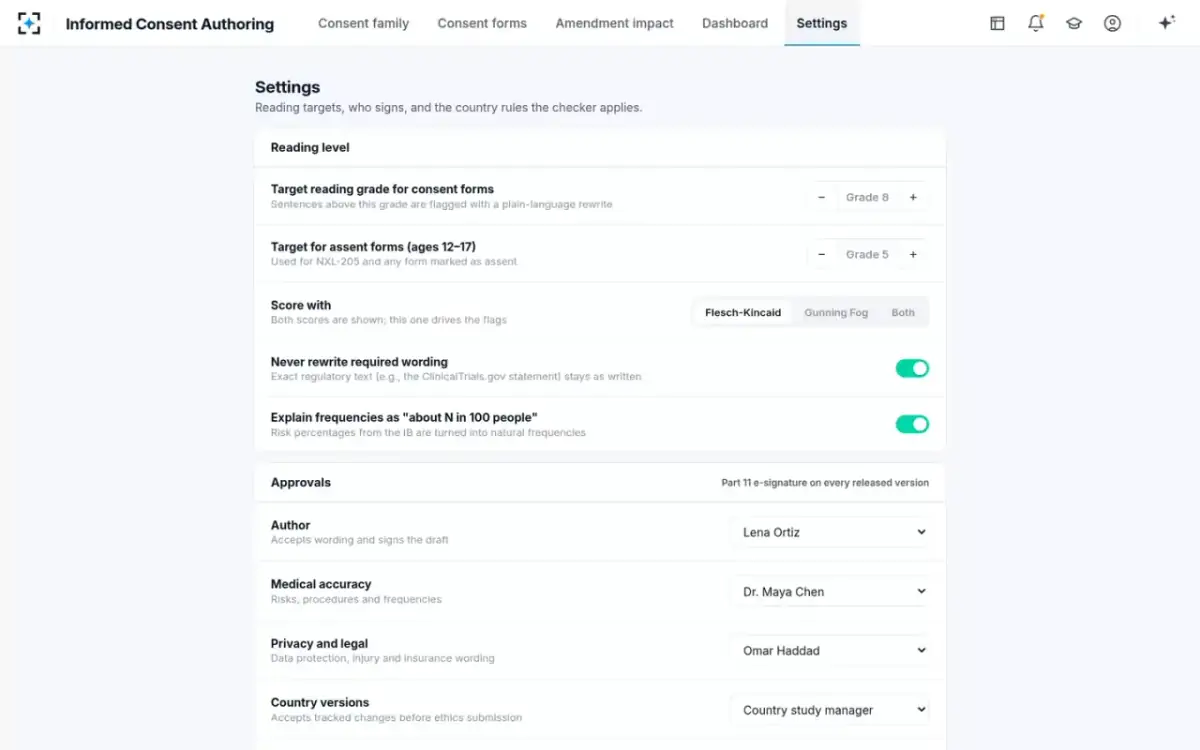
A lock list for your master template
The lock list below is the artefact worth building once per sponsor rather than per study. Every row names a passage, the rule that prescribes or prohibits it, and whether a plain explanation may stand beside it. The first seven rows come from regulation and are the same for every sponsor. The last two are yours.
One row per locked passage: the rule, the kind of lock, and whether you may explain beside it
The ClinicalTrials.gov statement
Rule21 CFR 50.25(c)
KindPrescribed
Explain beside?Yes — explain it in your own words beside the prescribed sentence
Who may change itThe regulation
Any wording that waives, or appears to waive, a legal right
Rule21 CFR 50.20 · 45 CFR 46.116(a)(6) · ICH E6(R3) 2.8.4
KindProhibited
Explain beside?Not applicable — the wording must go, not be explained
Who may change itThe regulation
Any wording releasing the investigator, sponsor or institution from liability for negligence
Rule21 CFR 50.20 · 45 CFR 46.116(a)(6)
KindProhibited
Explain beside?Not applicable
Who may change itThe regulation
The six core elements of a HIPAA authorization, where one is combined with the form
Rule45 CFR 164.508(c)(1)
KindRequired content
Explain beside?Yes — and the authorization itself must be in plain language
Who may change itThe privacy rule
The three required statements of a HIPAA authorization: revocation, conditioning, redisclosure
Rule45 CFR 164.508(c)(2)
KindRequired content
Explain beside?Yes
Who may change itThe privacy rule
The EU trial number and the availability of results
RuleEU CTR Article 29(2)(e)
KindRequired content
Explain beside?Yes — the facts are fixed, the sentence is yours
Who may change itThe regulation
Information about the applicable damage compensation system
RuleEU CTR Article 29(2)(d), with Article 76(1)
KindRequired content
Explain beside?Yes
Who may change itThe regulation
Injury, insurance and indemnity wording agreed by the sponsor
RuleSponsor template, not regulation
KindLocked by the sponsor
Explain beside?Only with counsel’s agreement
Who may change itPrivacy and legal counsel
National wording a country requires verbatim
RuleNational law or the committee’s own template
KindLocked by the country
Explain beside?Only with the country study manager’s agreement
Who may change itThe country study manager
The lock audit to run after every plain-language pass
- Compare the ClinicalTrials.gov sentence character for character
Not by eye. A single changed word — Web site to website, http to https — is a changed regulatory statement.
- Confirm it is there at all, and only where it should be
Present in every form a US participant signs if the study is an applicable clinical trial; a deliberate inclusion, not an accident, if it is not.
- Re-read the injury paragraph against the two agency examples
The test is whether it reads as a release. If it does, add the sentence that preserves legal rights rather than deleting the financial fact.
- Point at each HIPAA core element and required statement in the rewritten text
Six elements and three statements. If you cannot point at one, the rewrite dropped it.
- Check the EU trial number and the compensation arrangement in each EU version
The number is one line and easy to leave out; the compensation arrangement has to name what applies in that country, not in the master.
- Re-run the element audit after the pass, not before
A rewrite can satisfy a grade target and break an element in the same edit, so the element audit belongs after the plain-language pass.
- Have the lock reviewed by the person who owns it
Counsel for injury, insurance and data protection; the country study manager for national wording. A locked passage with no named owner is a passage nobody can unlock when it needs to change.
Required wording, checked as an element rather than remembered
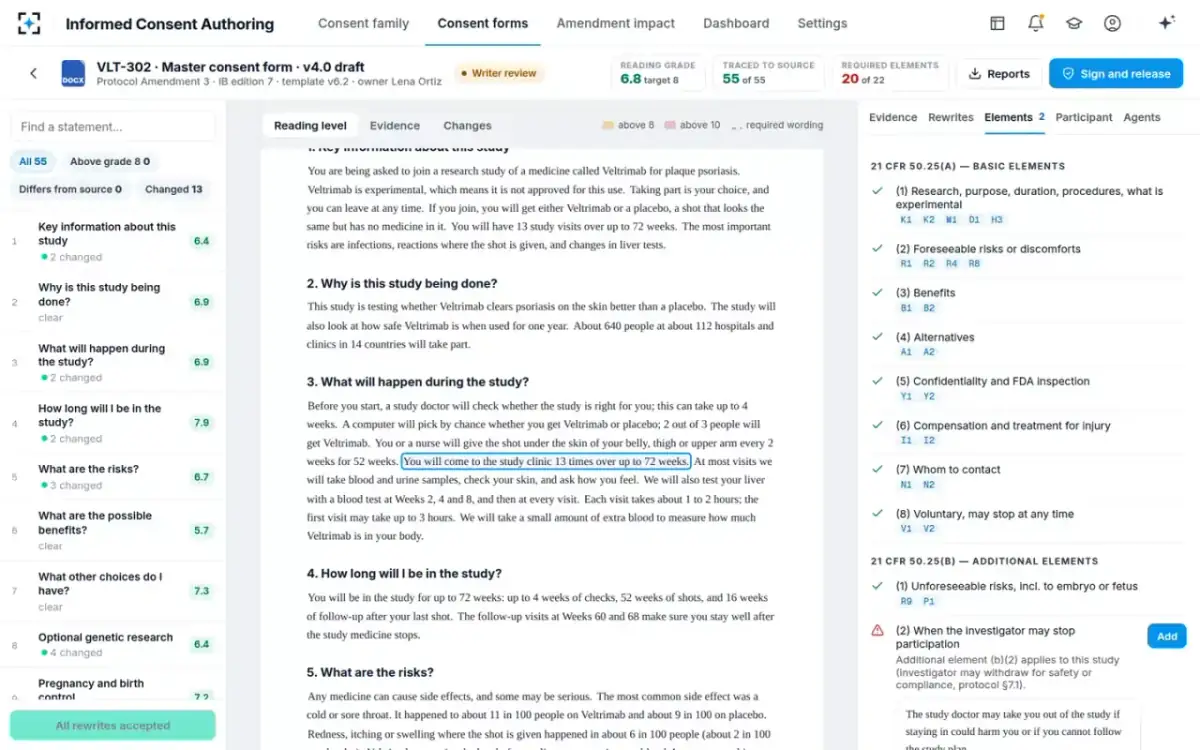
The boundary this page draws is the reason a plain-language pass is safe to run at all. Everything outside it can be rewritten freely, which is where the real gain is: getting a consent form to grade 8 is sentence work on the text the locks do not cover, and the element audit is what proves the rewrite kept everything the rules require.
Questions people ask
Can you reword the ClinicalTrials.gov statement?
No. 21 CFR 50.25(c) prints the statement and requires that it be provided to each participant, so the words themselves are the requirement. You may add a plain explanation beside it, and many sponsors do — what the register is, that a results summary will appear there, and that nothing identifying the person is posted. The prescribed sentence stays as written, capitalised "Web site" and all.
Which trials need the ClinicalTrials.gov statement?
Those that meet the statutory definition of an applicable clinical trial: controlled investigations of a drug or biological product other than phase 1, and prospective health-outcome studies of certain devices, plus paediatric postmarket device surveillance. Phase 1 drug studies and small device feasibility studies are excluded in terms. The simplest working test is that a trial the statute requires to be registered is a trial whose consent form carries the sentence.
Can you paraphrase the HIPAA authorization in a consent form?
You can and should rewrite it plainly — 45 CFR 164.508(c)(3) requires the authorization to be in plain language. What you cannot do is lose anything: six core elements and three required statements have to survive the rewrite as items a reviewer can point at. For research, the privacy rule accepts "end of the research study" or "none" as the expiration, which removes the hardest of them from the argument.
Is the required wording the same in every country?
No. The prescribed sentence is a US requirement and has no EU equivalent; the EU instead requires facts — the trial number, the availability of results, and the damage compensation arrangement that applies in that member state — and leaves the sentences to you. National law can add verbatim wording of its own on top. A master template therefore carries a US lock list and a per-country one.
Who decides which sentences are locked?
The regulation decides the prescribed statement and the two prohibitions, and nobody can override those. Sponsor privacy and legal counsel owns the injury, insurance and data-protection wording, which is locked by agreement and can be changed by them. A country study manager owns any national wording a committee requires verbatim. Writing the owner next to each lock is what makes the list usable a year later.
Does the lock stop a readability target being met?
Rarely, and the arithmetic is worth checking before anyone argues about it. In the sample study used here, eleven statements in the draft sat above the grade-8 target and ten rewrites were proposed, because the coach does not propose a rewrite for required wording. A locked passage raises a document average slightly; it does not stop the other sentences from being plain, and the prescribed sentence is one a reviewer expects to see.