The Rule 3002.1 changes that took effect on December 1, 2025 are the largest since the Chapter 13 mortgage rule was adopted in 2011. For a mortgage servicer they come down to five things: the rule now covers mortgages paid under the plan on modified terms and reverse mortgages; a late notice of a payment increase no longer takes effect on time, so the servicer cannot collect the increase in between; a home-equity line of credit may use an annual notice; the trustee or debtor can ask the court to determine the status of the mortgage at any point in the case; and the end of the case runs on a new notice, response and motion, each on an Official Form. Every one of those is a deadline a servicer must count from a date it does not always control. Botminds' Foreclosure and Bankruptcy Management counts them for each case, prepares the notices for counsel to file, and puts them on the same timeline as the foreclosure and loss mitigation files.
The rule as amended from 1 December 2025, in four numbers
180
days after a fee is incurred: the deadline to give notice of it on Form 410S2, unchanged
21
days' notice still required before a new payment is due; a late increase waits until 21 days after filing
28
days for the claim holder to respond to a status motion, the trustee's notice or a final cure motion
6
new Official Forms for status and end-of-case determinations, plus an amended Form 410S1
What changed in Rule 3002.1 on December 1, 2025?
Six things changed, according to the Committee Note and the National Consumer Law Center's guide circulated by the U.S. Bankruptcy Court for the District of Delaware: broader coverage, a HELOC procedure, a sanction for late payment change notices, a mid-case status determination, a revised end-of-case procedure, and a clarification that the court may use any remedy the rule authorizes on top of the listed sanctions (NCLC guide). The Committee Note states the purpose: the rule "is amended to encourage a greater degree of compliance with its provisions and to allow assessments of a mortgage claim's status while a chapter 13 case is pending in order to give the debtor an opportunity to cure any postpetition defaults" (Committee Note, 2025).
Rule 3002.1 before and after December 1, 2025, for the claim holder
Before: Claims on the principal residence where the plan provides for "contractual installment payments".
Since 1 December 2025: Any such claim the plan provides for the trustee or debtor to pay, including modified mortgages paid in full during the plan and reverse mortgages.
Before: Possible sanctions after notice and a hearing.
Since 1 December 2025: Automatic: an increase takes effect only on the first due date at least 21 days after the late notice; a decrease applies from its actual due date.
Before: A notice for every change, often small.
Since 1 December 2025: Optional annual notice with a reconciliation amount; a monthly change over $10 still needs its own notice.
Before: No set procedure.
Since 1 December 2025: Trustee or debtor may move to determine the claim's status any time; the holder responds in 28 days on Form 410C13-M1R.
Before: Trustee's notice of final cure within 30 days; holder's statement in 21 days.
Since 1 December 2025: Trustee's Notice of Disbursements Made within 45 days; holder responds in 28; either may then move for a final cure determination.
Before: Motion within one year of the fee notice.
Since 1 December 2025: Same, but the court may shorten the period on request, for example late in the case.
Why Rule 3002.1 exists: the Chase and Wells Fargo record
The rule was "adopted in 2011 in response to long-standing problems with mortgage servicing in chapter 13 cases", in NCLC's words, so that a debtor who completes a cure plan does not emerge "surprised by undisclosed fees and payment amounts" (NCLC guide). Its enforcement history explains why the 2025 amendment added an automatic sanction.
The U.S. Trustee Program's settlement with JPMorgan Chase began with one couple: "a payment change notice (PCN) that tripled their mortgage payment from about $500 to $1,700 per month". The employee whose name was on it had left the bank before it was filed. Chase "acknowledged that it filed in courts throughout the country more than 50,000 PCNs that were not signed by an employee who could attest to the accuracy of the information", and that "thousands of other PCNs were inaccurate, missing, or untimely". The settlement paid more than $50 million, over $43 million of it to upwards of 25,000 homeowners (Director of the U.S. Trustee Program, remarks, 2015).
Wells Fargo's settlement the same year concerned timeliness: it acknowledged failing to file payment change notices and perform escrow analyses on time for Chapter 13 homeowners, and the independent reviewer later found a mailing vendor serving notices late (Final Report, 2018). The lesson for 2026 is that signing, filing and serving are three separate steps, and each needs its own evidence.
What happens if a payment change notice is late?
A late notice of a payment increase takes effect only on the first payment due date at least 21 days after the notice is filed and served, so the servicer cannot collect the increase for the months in between. A late notice of a decrease takes effect on the actual due date, even if that is before the notice (Rule 3002.1(b)(3)). The Committee Note puts the consequence bluntly: "The claim holder will not be permitted to collect the increase for the interim period."
Take a fictional sample case from Foreclosure and Bankruptcy Management: Leon and Marcy Harmon, Chapter 13 in the Northern District of Georgia, whose escrow analysis raises the payment from $1,642.18 to $1,817.55. A notice filed on time keeps the $175.37 increase. Filed late, the increase waits for the first due date at least 21 days after filing, and every payment due before that is collected at the old amount, with no later catch-up under the rule.
Since December 2025 a late payment change notice is no longer a filing problem. It is a revenue problem, one month at a time.
The fix is upstream. The notice depends on an escrow analysis or a rate change being done early enough to leave 21 days, plus time for counsel to review and file, plus service. In the solution, the lead time is a servicer setting (21, 28 or 35 days ahead of the due date), and the notice is prepared for counsel rather than filed by software.
Do HELOCs need payment change notices in Chapter 13?
Yes, but the amended rule offers an annual option. A HELOC claim holder may file a notice either under the normal 21-day rule or "within one year after the bankruptcy-petition filing, and then at least annually", stating the current payment and a reconciliation amount for any overpayment or underpayment in the prior year. The first payment due at least 21 days after the annual notice is adjusted by the reconciliation amount. If the payment changes by more than $10 in any month, the holder must also file a regular notice for that month (Rule 3002.1(b)(2)).
Form 410S1 was amended to carry this: a new Part 3 asks for the current HELOC payment, the reconciliation amount, the next payment including it, and the payment thereafter without it (Committee Note). The data a HELOC servicer needs is therefore a year's reconciliation per case, not just the next payment.
What is Official Form 410C13-M1, and the other new forms?
Official Form 410C13-M1 is the trustee's or debtor's Motion Under Rule 3002.1(f)(1) to Determine the Status of the Mortgage Claim. It can be filed at any time after the order for relief until the trustee files the end-of-case notice. The motion states what has been disbursed on prepetition and postpetition arrears, on noticed fees, and on ongoing payments, and asks the court to determine the claim's status. If the servicer disagrees with any of it, it must respond within 28 days on Form 410C13-M1R; if it does not respond, the court may enter an order on the motion's facts.
The forms map: who files what, and when, under the amended rule
410S1
Notice of Mortgage Payment Change
Filed by Claim holder
When At least 21 days before the new payment is due; new Part 3 for annual HELOC notices
Rule 3002.1(b)
410S2
Notice of Postpetition Mortgage Fees, Expenses, and Charges
Filed by Claim holder
When Within 180 days after each fee is incurred
Rule 3002.1(c)
410C13-M1new
Motion to Determine the Status of the Mortgage Claim
Filed by Trustee or debtor
When Any time after the order for relief, until the trustee's end-of-case notice
Rule 3002.1(f)(1)
410C13-M1Rnew
Response to the status motion
Filed by Claim holder
When Within 28 days after service, if it disagrees with the motion
Rule 3002.1(f)(2)
410C13-Nnew
Trustee's Notice of Disbursements Made
Filed by Trustee
When Within 45 days after the debtor completes plan payments
Rule 3002.1(g)(1)
410C13-NRnew
Response to the Trustee's Notice
Filed by Claim holder
When Within 28 days after service; filed as a supplement to the claim
Rule 3002.1(g)(3)
410C13-M2new
Motion to Determine Final Cure and Payment
Filed by Trustee or debtor
When Within 45 days after the response, or after the notice if none
Rule 3002.1(g)(4)
410C13-M2Rnew
Response to the final cure motion
Filed by Claim holder
When Within 28 days after service, if it disagrees
Rule 3002.1(g)(4)(B)
The response forms ask for more than a yes or no. The Committee Note says the claim holder "must indicate whether the debtor has paid the full amount required to cure any arrearage and whether the debtor is current on all postpetition payments", "must provide a payoff statement, and, if the claim holder says that the debtor is not current on all payments, it must attach an itemized payment history for the postpetition period" (Committee Note). A servicer that cannot produce a clean postpetition history in 28 days, reconciled to the trustee's disbursements, will lose the argument by default.
The end of the case: notice, response and final cure
Within 45 days after the debtor completes all plan payments to the trustee, the trustee must file a Notice of Disbursements Made (Form 410C13-N), stating what was paid to cure the default, what was paid on postpetition obligations, and whether each is current. The claim holder must respond within 28 days on Form 410C13-NR, filed as a supplement to its proof of claim. Either the debtor or the trustee may then move, within 45 days, for a determination of final cure and payment (Form 410C13-M2); the holder has 28 days to respond if it disagrees (Form 410C13-M2R).
The trustee's notice is a deadline the servicer does not set and cannot predict to the day. That is the case for a court feed that reads trustee filings, not just petitions and dismissals: the 28-day response clock starts on service, and a servicer that learns of the notice from a weekly report has lost a quarter of it.
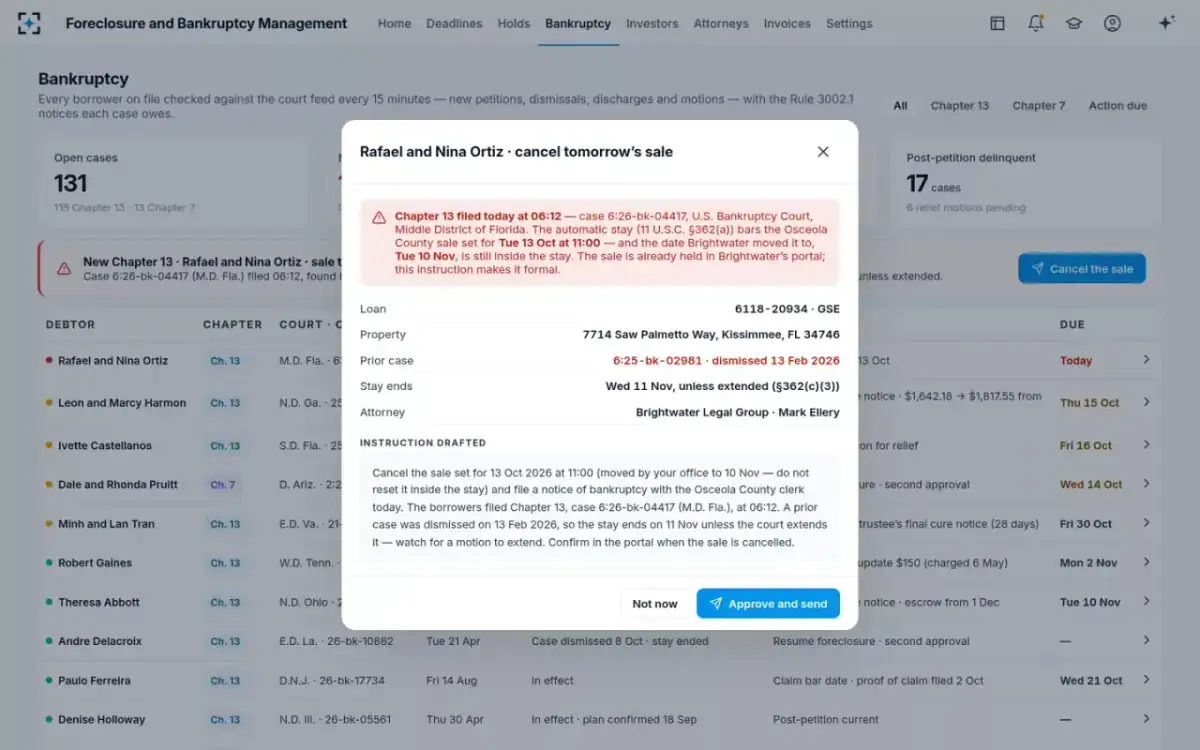
Foreclosure and Bankruptcy Management shows each Chapter 13 case with the Rule 3002.1 step it owes next
Notice of mortgage payment change in Chapter 13: filling Form 410S1
Form 410S1 is filed as a supplement to the proof of claim "at least 21 days before the new payment amount is due", and the date of the payment change "must be at least 21 days after date of this notice" (Official Form 410S1). It has five parts: an escrow change, with the escrow statement attached; an interest rate change, with the rate change notice attached; the annual HELOC notice; any other change, such as a modification, which may need court approval; and the signature.
The signature is where Chase went wrong. The signer declares "under penalty of perjury that the information provided in this claim is true and correct to the best of my knowledge, information, and reasonable belief", as the creditor or its authorized agent. A process in which the notice is prepared by a system and signed by someone who has not seen the escrow analysis behind it is the process the 2015 settlement described. In the solution the notice is drafted with its source attached, and a person at counsel or the servicer reviews and signs it.
A readiness list for servicers under the amended rule, and where Foreclosure and Bankruptcy Management helps
Most of the work is in data and timing, not forms. The table maps each change to what a servicer's bankruptcy operation has to do differently.
Each 2025 change, and what a mortgage servicer has to do about it
| Change | What to do | What to measure |
|---|---|---|
| Broader coverage | Add modified mortgages paid under the plan and reverse mortgages being cured to the notice population | Cases newly covered, and whether each has its notices |
| Late-notice sanction | Run escrow analyses and rate changes early enough to leave review, filing and service inside 21 days | Days between filing and due date on every notice; any under 21 |
| HELOC annual option | Decide per portfolio: monthly notices or annual with reconciliation; track changes over $10 | Months with a change over $10 and no separate notice |
| Status motion (410C13-M1) | Be able to produce a payoff and an itemized postpetition history, reconciled to the trustee, inside 28 days | Response time; responses with a history attached |
| End of case (410C13-N, -NR) | Read trustee filings in the court feed; respond in 28 days as a claim supplement | Days from service to response |
| Fee notices (410S2) | Count 180 days from the date each fee was incurred, not the invoice date | Fees noticed late or not at all |
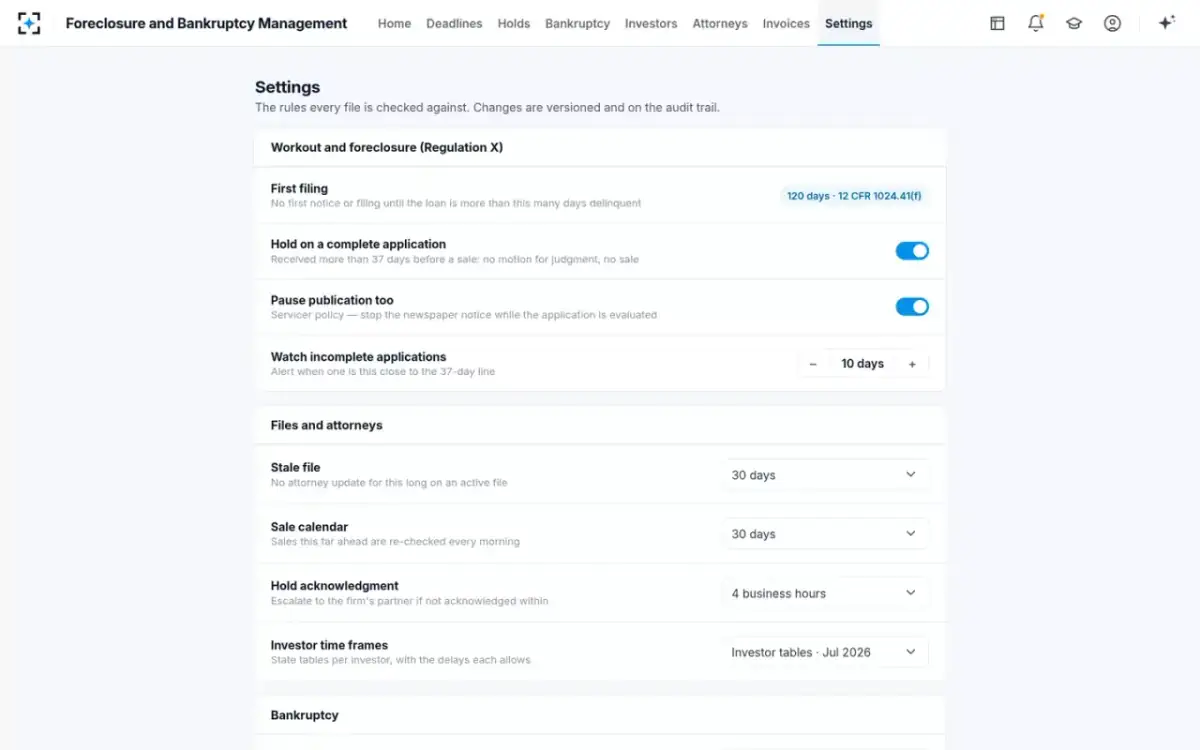
Lead times and approvals are servicer settings, versioned
The rest of a bankruptcy desk's go-live list, from court feeds to prior filings, is in what to bring to bankruptcy case management software, and the stay rules that decide whether a foreclosure may resume are in the guide to relief from stay in Chapter 13.
Questions people ask
When did the Rule 3002.1 changes take effect?
On December 1, 2025, with the new Official Forms 410C13-M1, -M1R, -N, -NR, -M2 and -M2R and an amended Form 410S1. The amendments were approved on April 23, 2025.
What happens if a mortgage payment change notice is filed late?
For an increase, the new amount takes effect only on the first payment due at least 21 days after the late notice is filed and served, and the holder cannot collect the increase for the interim. For a decrease, it applies from the actual due date, even retroactively.
Do HELOCs need a notice of payment change in Chapter 13?
Yes. The holder may give notice of each change, or file within a year of the petition and then at least annually with a reconciliation amount. A change of more than $10 in a single month still requires a separate notice.
What is Official Form 410C13-M1?
The trustee's or debtor's motion to determine the status of the mortgage claim at any point in the Chapter 13 case before the trustee's end-of-case notice. If the holder disagrees, it must respond within 28 days on Form 410C13-M1R with a payoff statement and, if the debtor is not current, an itemized postpetition history.
Does Rule 3002.1 apply to reverse mortgages?
Yes, since the amendment. The word "installment" was deleted so that the rule applies where a debtor is curing a default on a reverse mortgage under the plan, and "contractual" was deleted so it covers mortgages paid on modified terms.
How long does a servicer have to give notice of postpetition fees?
180 days after the fee, expense or charge is incurred, on Form 410S2 filed as a supplement to the proof of claim. A party in interest then has a year to ask the court to decide whether the fees are owed, which the court may now shorten.