A foreclosure timeline by state is set by two different authorities. State law sets the floor: how much notice the borrower gets, whether a court must enter judgment, how soon after judgment or notice a sale may be held, and whether the borrower can redeem afterwards. The investor sets the ceiling: FHA, VA, Fannie Mae, Freddie Mac and private trusts each expect foreclosure to start within a set time of default and to finish within a time frame for that state. Real files run past both, mostly in judicial states: the CFPB found the median foreclosure in judicial states took about 30 months from the last paid installment to sale at the start of 2013. Botminds' Foreclosure and Bankruptcy Management keeps every file against its state rules and its investor's time frame each morning, with Regulation X and any bankruptcy stay on the same timeline, so a servicer sees which days are the state's, which are the court's and which are its own.
In judicial states the median foreclosure went from 12 months to about 30
How long does foreclosure take?
It depends more on the state's process than on anything else, and the published medians are old. The CFPB's assessment, the most careful public study, found that "in judicial states, the median foreclosure took about 12 months in the earliest years shown. Median foreclosure times increased beginning in 2009, reaching about 30 months at the start of 2013 and remaining near that level before declining after mid-2015", and that "for most of the 2014 to 2017 period, more than 25 percent of foreclosures completed in judicial states took longer than four years" (CFPB, 2019). Non-judicial states were shorter, with the same pattern of a rising median and a longer tail.
The volumes are rising again. Foreclosure starts on Fannie Mae and Freddie Mac loans rose to 25,908 in the second quarter of 2026, and about 55,000 people had a new foreclosure on their credit report that quarter. A servicer that last staffed its foreclosure desk for 2021 volumes will feel every month of a state's timeline.
Foreclosure activity in the second quarter of 2026
0.67%
of loans in the foreclosure process, 19 basis points higher than a year earlier
25,908
foreclosure starts on GSE loans, up from 25,413 the quarter before
3,894
completed third-party and foreclosure sales on GSE loans
55,000
people with a new foreclosure on their credit report
Judicial vs non-judicial foreclosure timeline
In a judicial state the servicer files a lawsuit and needs a judgment before a sale; in a non-judicial state a trustee sells under a power of sale in the deed of trust after statutory notice. The difference in time comes from the court: service of process, answers, motions, mediation programs where they exist, and the court's own calendar. Some states allow both routes, and the servicer's choice is often set by the investor or the security instrument.
Where the time goes in each kind of foreclosure
Judicial: Complaint or petition filed with the court; that filing is usually the first legal action.
Non-judicial (power of sale): Notice recorded, published or served under the statute; the earliest such document is the first legal action.
Judicial: Service, answer period, motions, any mediation, then judgment. Each step depends on the court's calendar.
Non-judicial (power of sale): Statutory waiting periods between notice and sale, run by the trustee.
Judicial: Set by the judgment, often within a statutory window.
Non-judicial (power of sale): Set by the notice of sale, sometimes on fixed days.
Judicial: Court backlog, service of process, contested motions, mediation.
Non-judicial (power of sale): Title issues, notice defects, postponements.
Judicial: No dispositive motion while a protected application is evaluated.
Non-judicial (power of sale): No sale while a protected application is evaluated.
Foreclosure first legal action by state: what counts
The first legal action is the first step the state's procedure requires to start a foreclosure, and Regulation X's commentary gives the test. In a judicial state it is "the earliest document required to be filed with a court or other judicial body to commence the action or proceeding (e.g., a complaint, petition, order to docket, or notice of hearing)". Under a power of sale it is "the earliest document required to be recorded or published to initiate the foreclosure process". Where neither applies, it is "the earliest document that establishes, sets, or schedules a date for the foreclosure sale" (comment 41(f)-1).
That test decides two clocks at once. Regulation X forbids the first legal action until the loan is more than 120 days delinquent (1024.41(f)(1)). FHA requires it, or loss mitigation action, within six months of default, and defines the first legal action for each state in Appendix 6.0 of Handbook 4000.1, "First Legal Actions to Initiate Foreclosure and Reasonable Diligence Time Frames" (HUD ML 2025-12). A servicer that reads the state's first legal action differently from HUD's list can meet one clock and miss the other.
Three states' statute floors, read from the statutes
Statutes give minimums, not durations. The three below show how different the floors are, and why any table of "days to foreclose" by state should say whether it is a floor, a median or an investor allowance.
Statutory minimums in three states, quoted from the codes
| State and process | What the statute requires | What it means for the timeline |
|---|---|---|
| Texas, non-judicial (Property Code 51.002) | Notice of default with at least 20 days to cure before notice of sale; notice of sale at least 21 days before; sale between 10 a.m. and 4 p.m. on the first Tuesday of a month | About six weeks minimum from the default notice; a missed first Tuesday costs a month |
| Virginia, non-judicial (Code 55.1-321) | For owner-occupied homes, notice of the sale mailed to the owner no less than 60 days before it; 14 days for other property | Two months between notice and sale on a home |
| Florida, judicial (Statutes 45.031) | The final judgment sets a sale not less than 20 or more than 35 days after it, unless the plaintiff consents to later | The sale is close to judgment; the time is in reaching judgment |
A national servicer has fifty versions of this table, plus the District of Columbia and territories, plus the investor's view of each. Investors and HUD publish their own state lists, and those are the lists the claim is measured against; a servicer should load them from the current investor guide rather than from any summary, including this one.
HUD foreclosure timeline by state: reasonable diligence
HUD measures the second half of an FHA foreclosure with a state-by-state reasonable diligence time frame. The regulation requires the mortgagee to "exercise reasonable diligence in prosecuting the foreclosure proceedings to completion and in acquiring title to and possession of the property", and says that a time frame the Secretary determines to be reasonable diligence "for each State is made available to mortgagees" (24 CFR 203.356(b)). That list sits in Appendix 6.0 alongside the first legal actions.
Missing it has a cost: HUD computes the claim's interest only to the date the step should have been completed, the rule set out in the guide to what a late FHA first legal costs. The diligence clock runs from the first legal action, and the six-month clock before it is separate, so a late start is never made up at the end.
FHA foreclosure timelines, step by step
An FHA foreclosure runs on three linked deadlines: loss mitigation action or first legal action within six months of default; the first legal action defined for the state; and the state's reasonable diligence time frame from first legal to title and possession. Two special cases change the start. A vacant or abandoned property must go to foreclosure within the later of 120 days after it became vacant or 60 days after it was or should have been discovered vacant, but no later than the general deadline. And where bankruptcy law stops a foreclosure, the servicer must start or restart within 90 days after the prohibition ends (24 CFR 203.355(b), (c)).
An FHA foreclosure as three clocks, from default to title
- Regulation X: no first filing120 days
- FHA windowto month 6
- Reasonable diligence time frame for the state, first legal to title and possessionvaries by state
- Loss mitigation reviewReg X and FHA
- Bankruptcy stay, then 90 days203.355(c)
Why one number per state misleads
Because most of the time in a long foreclosure belongs to events that are not in the statute: a court backlog, a title defect, a borrower who cannot be served, a mediation program, a bankruptcy. Investors allow many of those delays, but only with evidence. The useful timeline for a servicer is therefore not "Florida takes N months" but, for each file, how many days the state's process used, how many the court or the borrower added with a document to show it, and how many the servicer or its firm lost.
Take a fictional sample servicer, Copperline Loan Servicing, with 286 foreclosures in 23 states, as it runs through the solution on 12 October 2026. Nineteen files were past their investor time frame by 786 days in all. Title curative accounted for 214 of those days, court backlog and continuances for 188, service of process for 167, mediation programs for 121, and no attorney activity at all for 96.
Foreclosure and Bankruptcy Management shows days past each investor's time frame, by state and cause
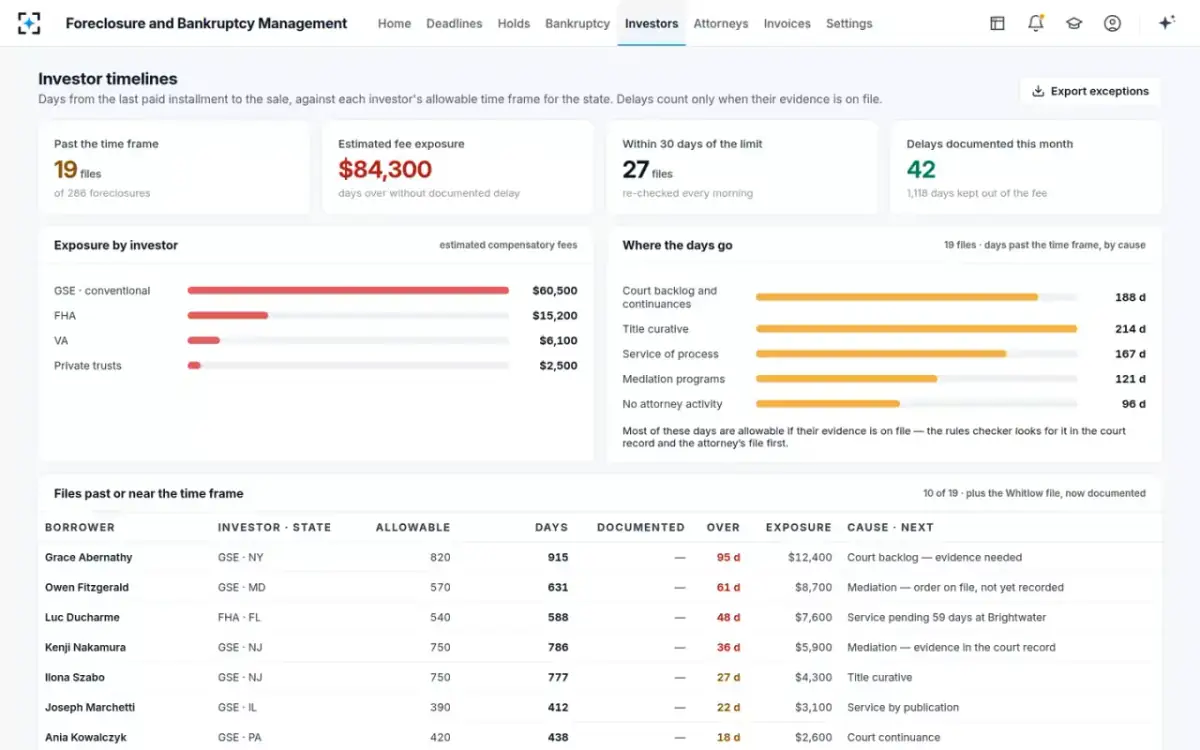
The shape matches the CFPB's: the files furthest over are in judicial states such as New York, New Jersey and Florida. The useful difference is that every day has a cause, and the rules checker looks for the court order, the title report or the return of service that makes it allowable before anyone has to argue about it at claim.
Each file's next state deadline and investor clock in Foreclosure and Bankruptcy Management
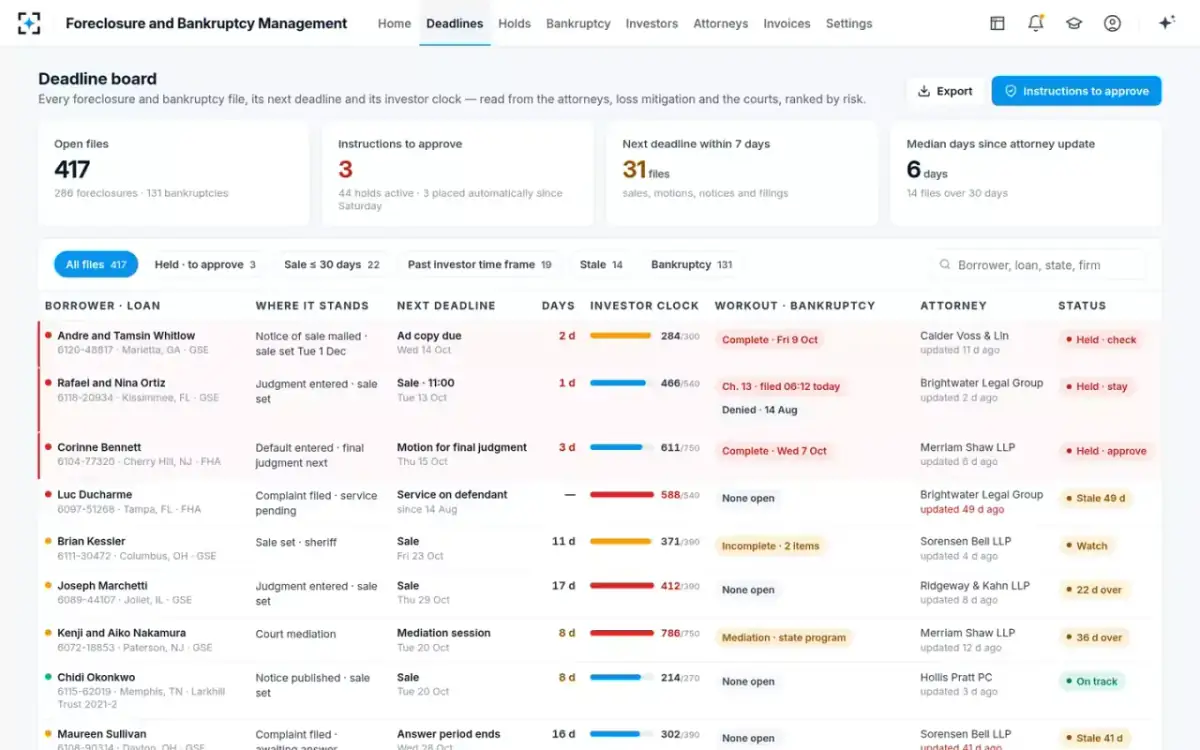
Foreclosure process timeline: where Regulation X and bankruptcy cut in
Two federal rules interrupt any state's timeline. Regulation X stops the dispositive motion and the sale while a complete application received more than 37 days before the sale is evaluated, and a bankruptcy petition stops everything from the moment of filing. Neither depends on the state, and both reset the investor clock only if the servicer documents them. How those interruptions collide with a scheduled sale is shown in the dual tracking pre-mortem, and the bankruptcy side in the guide to relief from stay.
Questions people ask
Which states are judicial foreclosure states?
States whose law requires, or in practice uses, a court action to foreclose, such as Florida, New York and New Jersey; non-judicial states such as Texas and Virginia allow a trustee's sale under a power of sale. Several states allow both, so check the state statute and the security instrument for each loan.
How long does foreclosure take in a judicial state?
The CFPB found the median, from last paid installment to sale, rose from about 12 months to about 30 months by the start of 2013, and that for most of 2014 to 2017 more than a quarter took over four years. More recent official medians by state have not been published in a comparable form.
What is the first legal action in foreclosure?
The earliest document the state's procedure requires to start the foreclosure: the first court filing in a judicial state, the first recorded or published notice under a power of sale, or otherwise the first document that sets a sale date. HUD lists the first legal action for each state in Handbook 4000.1, Appendix 6.0.
Where is HUD's foreclosure timeline by state?
In Appendix 6.0 of HUD Handbook 4000.1, which lists the first legal action and the reasonable diligence time frame for each state, under 24 CFR 203.356(b). Use the current version of the handbook; time frames have been revised over the years.
Does bankruptcy pause the FHA foreclosure clock?
The time during which bankruptcy law prohibits the foreclosure is excluded: the servicer must start or restart within 90 days after the prohibition ends, under 24 CFR 203.355(c). The stay's end date therefore becomes a deadline.
Is there a minimum time before a foreclosure can start?
Yes, federally: Regulation X bars the first notice or filing until the loan is more than 120 days delinquent, with narrow exceptions for due-on-sale and joining another lienholder's action. State law may add notice and cure periods on top.