Foreclosure software for lenders and servicers earns its cost in days. A loan in foreclosure is the most expensive loan a servicer holds, the investor sets a deadline for every stage, and each day past it is a day the servicer may not be reimbursed for. FHA makes the rule explicit: the servicer must take loss mitigation action or start foreclosure within six months of default, and if it misses that or the state's diligence time frame, HUD computes the claim's interest only to the date the action should have happened. Regulation X meanwhile forbids the first filing before the 121st day of delinquency, and FHA dates default 30 days after the missed payment, so the window is about three months, from day 121 to near day 210 of delinquency. Botminds' Foreclosure and Bankruptcy Management measures every file against the investor's time frame each morning, looks for the evidence that makes a delay allowable, and holds the steps that must not happen, so the days that cost money are seen while they can still be saved or documented.
A loan in FHA or VA foreclosure costs about 50 times a performing loan to service
Why foreclosure software for lenders is a question about days
Because almost every cost in a foreclosure scales with time. The Federal Reserve economists behind the figure above found that the typical bank "spends about 50 times as much servicing a loan in foreclosure as a performing loan" for FHA or VA loans, against 17 times for loans serviced under a Fannie Mae or Freddie Mac contract (FEDS 2018-016). FHA's claim rules then decide how much of that cost comes back, and they are written in deadlines.
The volumes make this concrete in 2026. FHA's delinquency rate stood at 11.79% in the second quarter, and the share of all mortgages in the foreclosure process rose 19 basis points in a year to 0.67% (MBA National Delinquency Survey). A servicer whose default book doubles does not get twice the staff, so the question shifts from whether files are worked to whether they are worked on time.
What is the FHA first legal deadline?
FHA requires the servicer, within six months of the date of default, to decide whether the borrower can pay and either take loss mitigation action or start foreclosure. In HUD's words, the mortgagee "must determine the Borrower's ability to make monthly Mortgage Payments and take loss mitigation action or commence foreclosure, if loss mitigation is not feasible, within six months of the date of Default, or within such additional time approved by HUD" (Mortgagee Letter 2025-12). The regulation behind it says the same: one of the listed actions "within six months of the date of default" for loans defaulting since February 1998 (24 CFR 203.355(a)).
What counts as starting foreclosure is the state's first legal action, which HUD lists state by state: the mortgagee "must perform the first legal action to initiate foreclosure for each state as provided in Appendix 6.0" of Handbook 4000.1, and must tell HUD within 30 days by reporting the status in the monthly default report. After that, a second clock, the state's reasonable diligence time frame, runs from the first legal action to title and possession (24 CFR 203.356(b)).
Regulation X and FHA leave about three months for a timely first legal action
- No first notice or filing: Regulation Xdays 1–120
- Window for first legaldays 121–210
- Same deadline, near day 210about 210 days
- Automatic extension90 days
What are FHA automatic 90-day extensions?
They are extensions HUD grants without a request, when the servicer did the loss mitigation work in time. HUD "provides automatic 90-Day extensions to the deadline to complete a Loss Mitigation Option or to perform the first legal action initiating foreclosure, provided the Mortgagee has: evaluated and approved the Borrower for a Loss Mitigation Option prior to the expiration of the initial six-month period to initiate foreclosure … reported the Loss Mitigation Option via SFDMS; and initiated foreclosure action after reviewing the Borrower for other Loss Mitigation Options" when the borrower defaulted on the option or a trial plan failed (ML 2025-12).
Everything else goes through HUD's extension system, EVARS, and needs a request. The operational lesson is that an extension is earned by evidence before the deadline: an approval date inside the six months, a reported option, a documented re-review. Software that finds the file on day 195 of delinquency can still help; software that finds it on day 220 can only explain it.
Bankruptcy has its own rule. If federal bankruptcy law does not permit the foreclosure to start within the time limit, or requires it to stop, the servicer must start or restart it within 90 days after the prohibition ends (24 CFR 203.355(c)). That makes the date a stay ends, by relief, dismissal or by law, a deadline in its own right.
What happens if FHA's first legal deadline is missed?
HUD cuts the interest it pays on the claim back to the date the action should have happened. The regulation is plain: when the mortgagee "fails to meet any one of the applicable requirements of §§ 203.355, 203.356(b) … within the specified time and in a manner satisfactory to the Secretary (or within such further time as the Secretary may approve in writing), the interest allowance in such cash payment shall be computed only to the date on which the particular required action should have been taken or to which it was extended" (24 CFR 203.402(k)(1)(i)). Servicers call this curtailment.
The size of the loss depends on the loan balance, the debenture rate and how late the file was, and HUD's claim forms do the arithmetic; no public source gives an industry average, and this guide does not invent one. What is fixed is the shape: every day past the first-legal deadline or the diligence time frame is a day of interest the servicer carries and HUD does not repay, on a loan that already costs about fifty times a performing one to service.
Other investors use their own mechanisms. Fannie Mae and Freddie Mac assess compensatory fees under their servicing guides when a foreclosure runs past their state time frames without an allowable delay; the rates are set in those guides and are not reproduced here.
How much does a foreclosure cost a servicer?
The best public figures are per loan per year: $1,573 to service a non-performing loan in 2024 against $176 for a performing one, from MBA's study of in-house servicers covering about 60% of the single-family market (MBA). The non-performing figure includes "collections, loss mitigation, bankruptcy, foreclosure and post-sale, unreimbursed foreclosure and real estate owned (REO) losses". The Federal Reserve paper adds that VA reimbursement is capped, generally at 25% of the original balance, and cites earlier research that legal fees, sales commissions and maintenance alone can exceed 10% of the balance.
What delay costs, from four public sources
$1,573
yearly cost to service a non-performing loan, 2024, against $176 performing
50×
cost of an FHA or VA loan in foreclosure relative to a performing loan, typical bank
26,000
foreclosures the CFPB estimates the 2013 rules prevented among 2014 delinquencies
$30,100
minimum benefit to a borrower of avoiding foreclosure, 2023 dollars (CFPB)
Speed is not the goal: the 120-day rule prevented foreclosures
A tool that only made foreclosures faster would be the wrong tool. The CFPB's assessment of its 2013 servicing rules found that in 2015 "servicers initiated foreclosure within the first 120 days far less often compared to 2012 (pre-Rule). The decrease in foreclosures initiated during that period was not offset by an increase in foreclosures initiated within the next several months", and said these facts suggest the 120-day bar "prevented rather than delayed foreclosures" (CFPB, 2019). It estimated at least 26,000 fewer foreclosures among borrowers who became delinquent in 2014.
The economics therefore point two ways at once. Days lost to a stale attorney file, an undocumented title problem or a missed extension are pure waste. Days spent evaluating a borrower who can be kept in the home are often the cheapest days in the file, for the investor as well as the borrower. Good software separates the two: it chases the first and protects the second.
Foreclosure software ROI: a method you can run on your own book
Price the return as days and dollars recovered, minus what the software and its upkeep cost. The four terms below can each be measured from a servicer's own data in a pilot; none needs an industry benchmark.
A return on foreclosure software, written as a sum
Investor days saved
days past time frame avoided × cost per day
Curtailed debenture interest on FHA claims; compensatory fees under GSE guides; carrying cost.
Default finance
Delays documented
allowable days with evidence on file
Court backlog, title curative, service, mediation: days that count only with the document behind them.
Foreclosure team
Fees not paid
invoice lines held for steps not reached
Publication not run, sale not held, duplicate title work.
Attorney network manager
Cost of the system
licence + integration + review time
Including the people who approve instructions and release holds.
Operations and IT
Take a fictional sample servicer, Copperline Loan Servicing, as it runs through the solution. On Monday 12 October 2026, 19 of its 286 foreclosures were past their investor's time frame. Measured against the sample's own investor tables, the solution estimated $84,300 in exposure if none of the days over were documented: $60,500 on GSE loans, $15,200 FHA, $6,100 VA and $2,500 private. Most of those days had a cause the investor may allow, if the evidence is on file.
Foreclosure and Bankruptcy Management: days past each investor's time frame, by cause and investor
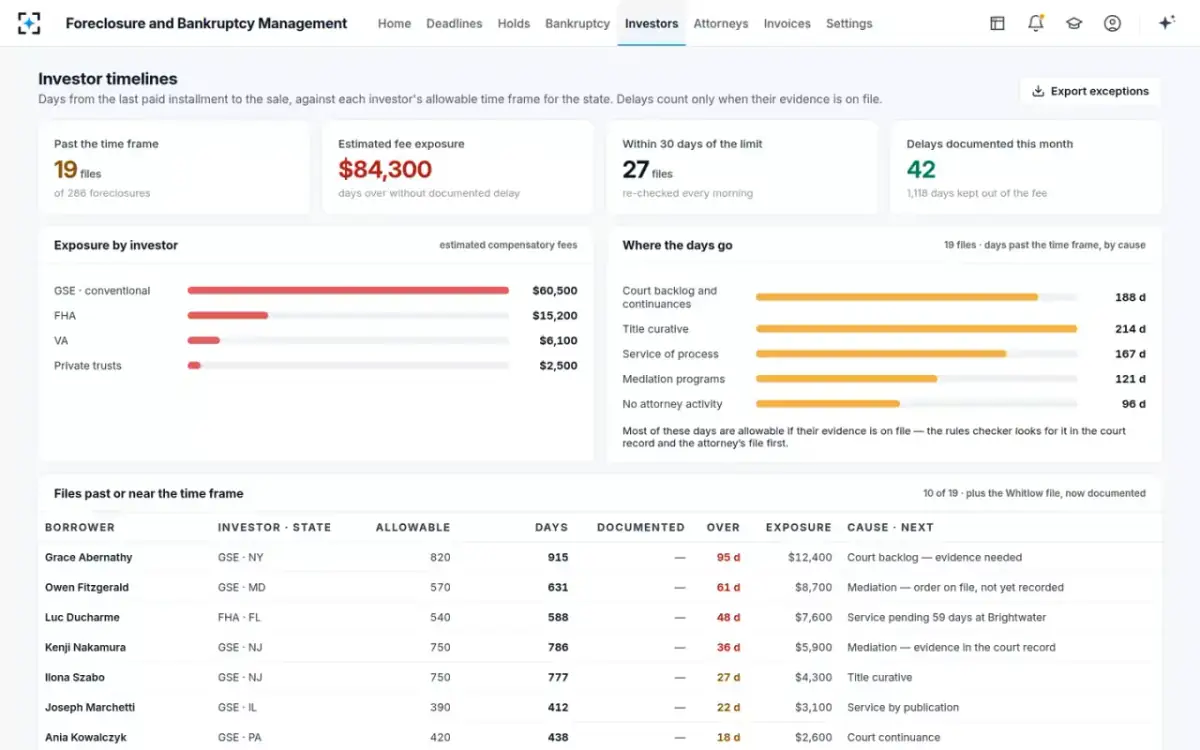
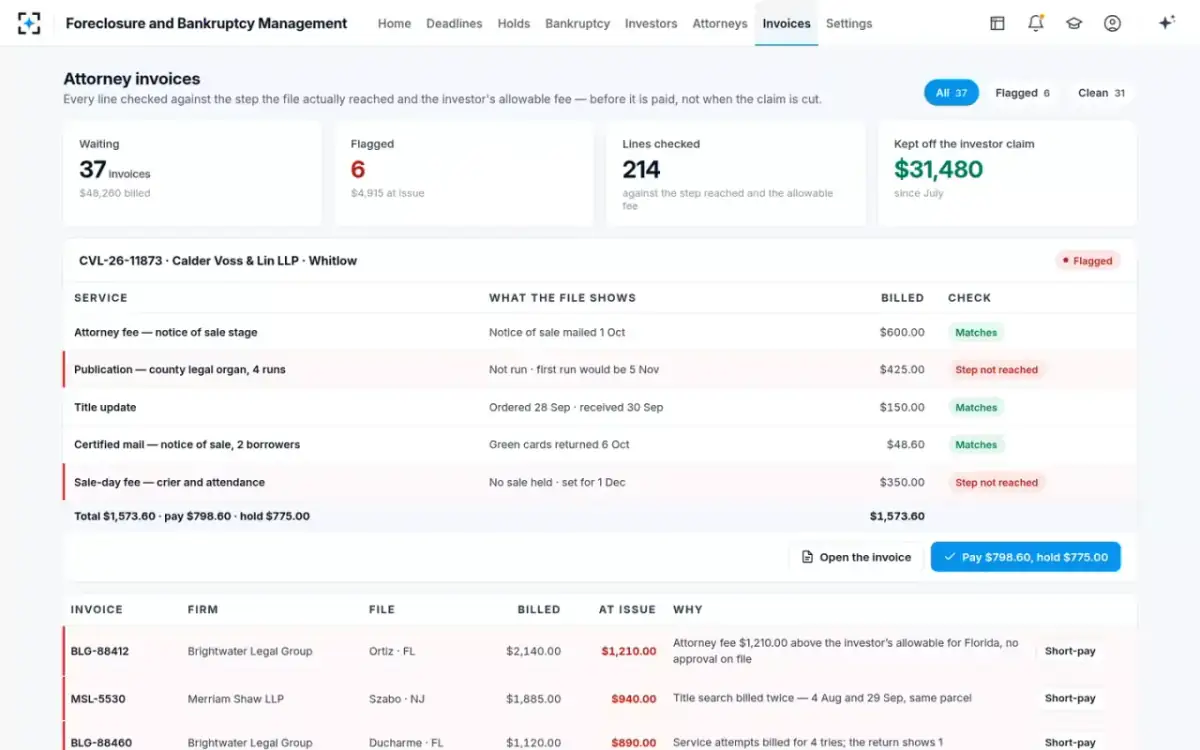
The cause bars are the useful part. Of 786 days over across the 19 files, 690 had a cause that is usually allowable with evidence: title curative, court backlog, service of process, mediation. The other 96 had no attorney activity at all; those are the days software cannot argue away and a stale-file alert is meant to prevent. The invoice side is smaller and more certain. In the sample, one invoice billed $425 for publication that had not run and $350 for a sale-day fee with no sale; $775 was held until the work is done.
Each invoice line checked against the step the file has reached
What to look for in foreclosure software for lenders
Look for software that measures every file against the right investor clock every day, finds the evidence for allowable delays in the court and attorney record, and checks fees before they reach the claim. The table sets out what each capability is worth and how to test it in a pilot.
Capabilities that move the arithmetic, and how to test each one
| Capability | Why it pays | How to test it in a pilot |
|---|---|---|
| Daily investor clock on every file | Days over are seen while they can be prevented or documented | Compare its list of files past the time frame with your last claim review |
| Evidence for allowable delays | A delay counts only with a document from the court, attorney or investor | Pick ten files with known delays; check it finds the evidence and the dates |
| FHA six-month and extension tracking | Curtailment runs from the date the action should have happened | Load files near day 210 of delinquency; check it knows which qualify for the automatic extension |
| Stale-file alerts on attorney activity | Days with no activity are the hardest to justify | Compare its stale list with firms' own reports |
| Invoice lines against the step reached | Fees for work not done end up on the claim | Run three months of paid invoices through it |
| Holds that protect borrowers | Avoided violations and the redress that follows | Feed it complete applications near a sale and a dawn petition |
Where Foreclosure and Bankruptcy Management fits, and where the numbers will not work
The solution fits servicers with enough FHA, VA and GSE foreclosures across enough states that a weekly spreadsheet cannot keep each file against its time frame: it re-checks every file each morning, looks for the court backlog, title, service or mediation evidence first, and shows exposure by investor and cause. Its six agents also hold steps that would breach a stay or a protected review, which is the part of the value that does not fit in a formula.
It will not pay for itself on a small, single-state book with one firm and few FHA loans; a well-kept calendar does most of the job. It does not file claims with HUD or calculate curtailment for a specific claim, and it does not change investor time frames, which come from the servicer's own tables. Where time frames differ by state is set out in foreclosure timelines by state, and the people who carry these files in the guide to default servicing.
Questions people ask
What is the FHA six-month deadline?
FHA requires the servicer to take loss mitigation action or start foreclosure within six months of the date of default, unless HUD grants more time. It comes from 24 CFR 203.355 and Mortgagee Letter 2025-12, now part of Handbook 4000.1.
What counts as the first legal action for FHA?
The first legal step the state requires to start foreclosure, as listed state by state in Appendix 6.0 of HUD Handbook 4000.1. The servicer must report the start to HUD within 30 days through its monthly default report.
When does FHA grant an automatic 90-day extension?
When the servicer evaluated and approved the borrower for a loss mitigation option before the six months ran out, reported it to HUD, and started foreclosure only after reviewing the borrower for other options once the option or trial plan failed. Other extensions must be requested through EVARS.
What is curtailment on an FHA claim?
When a servicer misses a deadline in 24 CFR 203.355 or the diligence time frame in 203.356(b), HUD computes the claim's interest allowance only to the date the action should have been taken. The servicer bears the interest for the days after that.
Does the 120-day rule just delay foreclosure?
The CFPB's 2019 assessment found it did not: early foreclosure starts fell after 2014 without a later catch-up, and the Bureau estimated at least 26,000 fewer foreclosures among 2014 delinquencies.
How do you measure ROI on foreclosure software?
In a pilot on your own files: days past investor time frames avoided or documented, invoice lines held for work not done, and staff hours, against the cost of the system and the people who review its instructions. Leave avoided violations out of the sum; count them separately.