Bankruptcy case management software for a mortgage servicer tracks every borrower in bankruptcy from the petition to discharge or dismissal: the automatic stay, the proof of claim, the Chapter 13 plan and the payments it requires, the notices of payment changes and fees that Bankruptcy Rule 3002.1 demands, motions for relief, and the end-of-case cure. The software is the easy part to buy. The hard part is what a servicer brings to it, because every deadline it counts depends on data that sits in a court feed, a claims file, an escrow system or a trustee's records. Botminds' Foreclosure and Bankruptcy Management uses that data to search the court feed every 15 minutes for every borrower and co-borrower, work out when a stay ends, count the Rule 3002.1 deadlines, and hold any foreclosure step that lands on a stay. This guide is the list to assemble first.
More cases, and a record of what late notices cost
215,490
Chapter 13 filings in the year to 30 June 2026, up 7.6% on the year before
137,000
consumers with a new bankruptcy notation on their credit report in Q2 2026
21days
minimum notice before a new mortgage payment is due in Chapter 13, under Rule 3002.1(b)
$7.69M
extra remediation ordered at Wells Fargo after its mailing vendor served payment change notices late
What is bankruptcy case management software for a mortgage servicer?
It is the creditor's side of a bankruptcy case, not the debtor's. Petition-preparation software helps a debtor's lawyer file; a court's own system dockets the case; a servicer's bankruptcy system follows the secured claim through the case and makes sure the servicer files what it must, on time, and does nothing the stay forbids. Searches for "bankruptcy management software" mix all three, so a buyer should be clear which one is meant.
For a mortgage servicer the work concentrates in Chapter 13. A Chapter 13 plan may cure a default on the borrower's home "within a reasonable time" while maintaining the regular payments during the case (11 U.S.C. 1322(b)(5)), which means the servicer's numbers are tested by the trustee, the debtor's lawyer and the court for three to five years. Chapter 7 cases are shorter but still stay the foreclosure until relief, discharge or dismissal.
How do servicers track Chapter 13 cases from petition to discharge?
A servicer tracks a Chapter 13 case as a series of filings and deadlines, most of them set by the Bankruptcy Rules. The timeline below shows the ones that fall on the mortgage creditor, from the stay that starts on the petition to the response it owes when the trustee files the end-of-case notice.
The mortgage creditor's deadlines in a Chapter 13 case, start to finish
- Stay on filingday 0
- Proof of claim with Form 410A and escrow statementclaim
- Plan confirmedplan
- Payment change notices, 21 days aheadPCN
- Fee notices within 180 daysfees
- Status motion: respond in 28 daysM1R
- Trustee's notice within 45 daysnotice
- Response in 28 daysNR
- Final cure motion: respond in 28 daysM2R
Every one of those deadlines is a date the software must count from something else: the petition date, the date a fee was incurred, the date a new payment is due, the date a motion was served. That is why the inputs matter more than the screens. A system with the right clock and the wrong start date is confidently wrong.
What data does a bankruptcy team need before go-live?
Ten inputs cover almost everything a mortgage bankruptcy desk has to count. Several of them are not in the servicing system at all; they come from the court, the trustee or the attorney, and the work of a go-live is mostly the work of connecting them.
Ten inputs to bring to bankruptcy case management software
- A court feed covering every obligor
Borrowers, co-borrowers and, in Chapter 13, co-debtors: the stay can protect a co-signer on a consumer debt (11 U.S.C. 1301).
- Prior cases for each obligor, at least the past year
One dismissed case ends a new stay on day 30; two mean no stay arises at all (11 U.S.C. 362(c)(3), (c)(4)).
- The plan terms
Cure-and-maintain or modified, who pays the postpetition installments (trustee or debtor), and the confirmation date.
- The proof of claim and Form 410A
Arrears as of the petition, and the payment history from the first date of default, which later status motions test.
- Escrow as of the petition date
The escrow statement filed with the claim, and every later escrow analysis with its effective date.
- Rate and payment change schedules
Adjustable-rate change dates and escrow analysis dates drive the 21-day notice under Rule 3002.1(b).
- HELOC payment data, if any
The amended rule allows annual notices with a reconciliation amount, but a change over $10 in a month still needs its own notice.
- The date every postpetition fee was incurred
Fee notices are due within 180 days of the charge (Rule 3002.1(c)); the incurred date, not the invoice date, starts the clock.
- Trustee disbursements
What the trustee has paid on arrears and on ongoing payments, to reconcile before a status motion or the end-of-case notice.
- Counsel and investor rules
Which firm handles each case, and each investor's requirements for bankruptcy steps and relief motions.
The co-debtor item surprises teams coming from Chapter 7. In Chapter 13, after the order for relief "a creditor may not act, or commence or continue any civil action, to collect all or any part of a consumer debt of the debtor from any individual that is liable on such debt with the debtor" (11 U.S.C. 1301(a)), with exceptions. A feed that searches only the primary borrower misses the case in which the co-borrower filed alone.
Mortgage proof of claim attachment instructions, in brief
Official Form 410A, the Mortgage Proof of Claim Attachment, must accompany the proof of claim when the claim is secured by the debtor's principal residence. Its instructions say it "must list all transactions on the claim from the first date of default to the petition date" (Form 410A instructions). Five parts carry the data a later dispute will turn on.
Official Form 410A, part by part, and the data each part needs
| Part | What it asks for | Where the data lives |
|---|---|---|
| 1. Mortgage and case information | Case number, debtors, last four of the account, creditor and servicer, interest method | Servicing system and court feed |
| 2. Total debt calculation | Principal, interest, fees and costs, escrow deficiency for funds advanced, less funds on hand | Servicing system; corporate advances; suspense |
| 3. Arrearage as of the petition | Unpaid installments, fees, escrow deficiency, projected escrow shortage, less funds on hand | Payment history; escrow analysis as of the petition |
| 4. Monthly mortgage payment | Principal and interest, escrow, private mortgage insurance | Note terms and the postpetition escrow computation |
| 5. Payment history from first default | Every payment, charge and escrow item in date order, with running balances | Transaction history across any prior servicer |
Part 5 is where transferred loans hurt. The history must start at the first date of default, which may be years before the current servicer boarded the loan. If the prior servicer's transactions did not come across in usable form, the attachment will be built on estimates, and Rule 3002.1's new status motion gives the trustee or the debtor a way to test it mid-case.
How to do escrow analysis in Chapter 13
Split the escrow shortage as of the petition into the claim and compute the ongoing escrow payment as if that shortage will be paid through the plan. The Form 410A instructions say the claimant "should assume that the escrow deficiency and shortage will be paid through a plan of reorganization and provide for a credit of a like amount when calculating postpetition escrow installment payments" (Form 410A instructions). If the servicer collects the same shortage twice, once in the plan and again in the monthly escrow payment, the debtor overpays and the next status review shows it.
After that, every annual escrow analysis during the case is a potential payment change, and each needs a notice filed at least 21 days before the new payment is due. That is where the two servicing cases most often cited in bankruptcy circles failed. Wells Fargo "failed to timely file payment change notices ('PCNs') and failed to timely perform escrow analyses for homeowners in Chapter 13 bankruptcy cases", and the independent reviewer later found that its "mailing vendor was not timely serving PCNs", adding $7,691,150 in remediation (U.S. Trustee Program, 2018). The CFPB's 2020 settlement with Nationstar covered, among other things, its failure "to properly conduct escrow analyses for borrowers during their Chapter 13 bankruptcy proceedings" (CFPB, 2020).
Two Chapter 13 failures, and the input that would have caught each
What went wrong: Wells Fargo acknowledged failing to file notices on time in Chapter 13 cases.
The input and check that catches it: Escrow analysis and rate change dates, counted back 21 days from each new due date, with the filing confirmed on the docket.
What went wrong: The reviewer found a mailing vendor serving notices late, a separate failure from filing.
The input and check that catches it: Service tracked as its own step for each notice, with the vendor's proof of service matched to the filing.
What went wrong: Wells Fargo and Nationstar both failed to perform escrow analyses properly for Chapter 13 debtors.
The input and check that catches it: Every case with escrow scheduled for annual analysis from the petition date, with the claim's shortage credited.
What is a payment change notice, and why is it the riskiest filing?
A payment change notice is Official Form 410S1, Notice of Mortgage Payment Change, which the holder of a claim on the debtor's home must file and serve at least 21 days before a new payment amount is due, whether the change comes from escrow, an interest rate adjustment or something else. It is the riskiest filing because it is the most frequent and, since 1 December 2025, the one with an automatic sanction: a late notice of an increase takes effect only on the first payment due at least 21 days after it is filed and served (Rule 3002.1(b)(3)). The full set of changes is in the guide to the amended Rule 3002.1.
In the solution, payment change notices are prepared ahead of the rule's 21 days by default, for counsel to review and file; the lead time is a servicer setting. Fee notices are counted from the date each fee was incurred against the rule's 180 days.
How the court watcher uses the inputs on one sample case
Take a fictional sample servicer, Copperline Loan Servicing, with 131 open bankruptcy cases (118 Chapter 13, 13 Chapter 7), as it runs through the solution on Monday 12 October 2026. At 06:12 Rafael and Nina Ortiz filed Chapter 13 in the Middle District of Florida, the day before an 11:00 sale. The court watcher found the petition at 06:27, and because the prior-case input showed a case dismissed on 13 February 2026, it worked out that the stay ends on Wednesday 11 November unless the court extends it.
Foreclosure and Bankruptcy Management finds a dawn Chapter 13 in 15 minutes, with the prior case read
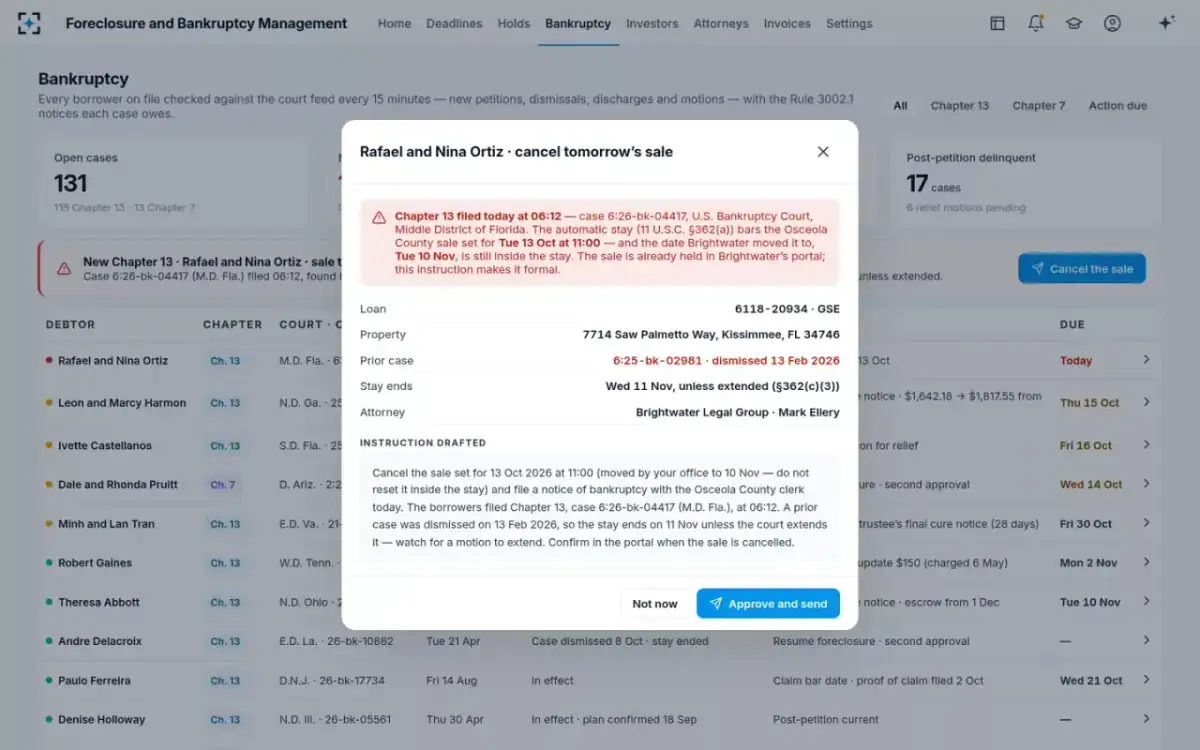
Without the prior-case data, the same petition would have produced a generic "stay in effect" and a relief motion months later, or, worse, a foreclosure resumed on day 31 without checking whether the debtor had asked to extend the stay. With it, the specialist approves one instruction and diaries one date: whether a motion to extend is filed and heard before the 30 days run out.
The rules the files are checked against are settings, versioned
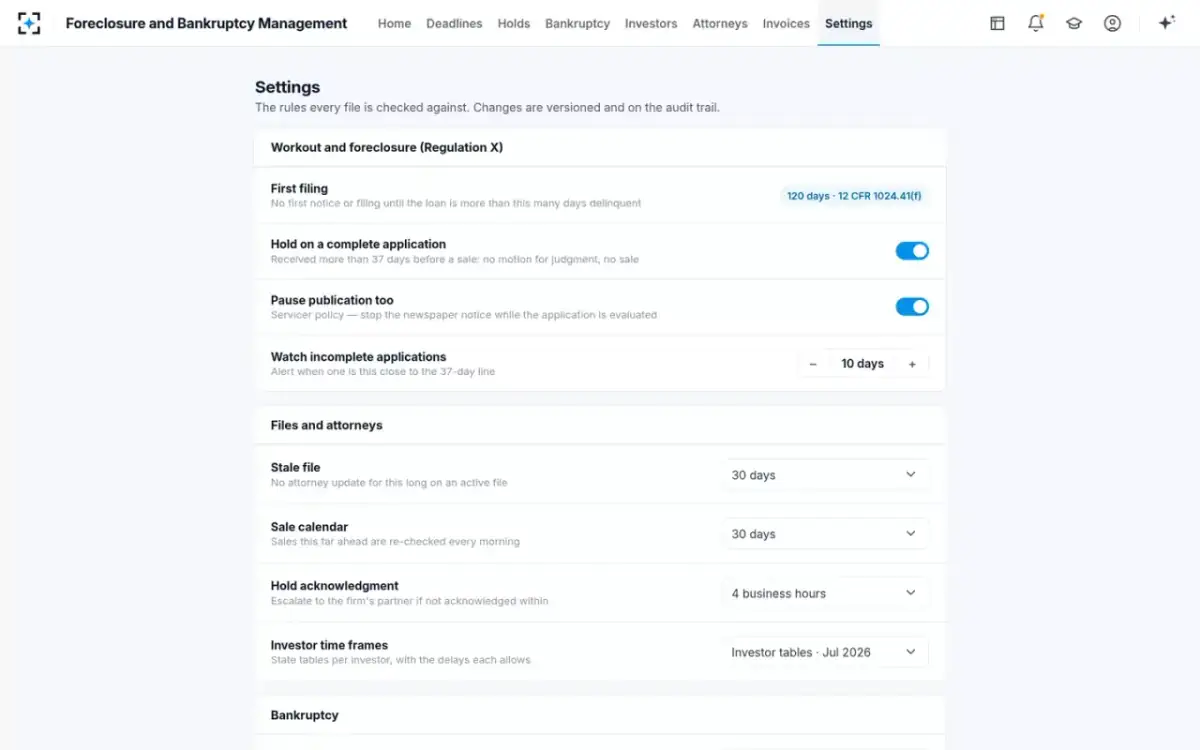
What Foreclosure and Bankruptcy Management does with these inputs, and what it leaves to counsel
The solution fits a servicer whose bankruptcy cases share files with foreclosure: it puts the stay, the plan and the Rule 3002.1 deadlines on the same timeline as the foreclosure and loss mitigation lanes, and holds a foreclosure step that lands on a stay. It never files anything with a court. It prepares notices for counsel to review and file, and a person approves every instruction.
It is not a claims-preparation service and does not reconstruct a payment history the servicer does not have; Form 410A's Part 5 still depends on the transaction data the servicer brings. It does not decide whether to seek relief from the stay or to extend it; it shows the dates and the prior cases so that counsel and the specialist can. When relief is the question, the guide to relief from stay in Chapter 13 sets out when a motion is needed at all.
Questions people ask
What is the best bankruptcy management software for a mortgage servicer?
The one that is fed completely: a court feed for every obligor, prior cases, plan terms, claim and escrow data, and fee dates. Without those inputs any product will count the wrong deadlines. Test it on your own cases, including a repeat filer and a co-borrower filing alone.
How do servicers track Chapter 13 cases?
By the stay, the proof of claim, the plan, and the Rule 3002.1 notices and responses that follow: payment change notices 21 days ahead, fee notices within 180 days, responses to status motions and to the trustee's end-of-case notice within 28 days.
What goes in a mortgage proof of claim attachment?
Official Form 410A has five parts: case and loan information, total debt, arrears as of the petition, the monthly payment, and a payment history from the first date of default. An escrow statement as of the petition goes with it when the loan has escrow.
How is escrow handled in a Chapter 13 case?
The shortage as of the petition goes into the claim, and the ongoing escrow payment is computed assuming that shortage is paid through the plan. Later escrow analyses that change the payment need a notice filed at least 21 days before the new amount is due.
Does the co-debtor stay matter to a mortgage servicer?
Yes, in Chapter 13. Section 1301 bars collection of a consumer debt from an individual liable on it with the debtor, subject to exceptions and relief. A court search that covers only the primary borrower can miss it.
How many Chapter 13 cases are filed each year?
215,490 in the year to 30 June 2026, up from 200,290 a year earlier, according to the Administrative Office of the U.S. Courts. Total bankruptcy filings rose 12.2% to 608,511.