Dual tracking foreclosure is the practice of moving a foreclosure forward while a borrower's loss mitigation application is being reviewed. Regulation X does not ban the whole practice; it bars the steps that do the damage. A servicer may not make the first foreclosure notice or filing until a loan is more than 120 days delinquent, and once a complete application arrives more than 37 days before a sale it may not move for judgment or order of sale, or conduct the sale, until the borrower has been found ineligible with appeals exhausted, has rejected every option, or has failed to perform under one (12 CFR 1024.41(f) and (g)). Most violations are not decisions to break that rule. They are handoffs that fail. Botminds' Foreclosure and Bankruptcy Management reads the loss mitigation record and the attorney's file side by side and holds a barred step the moment the two collide; this page shows, day by day, what happens when nobody does.
The method is a pre-mortem: assume the worst outcome has already happened and work backwards to find each point where it could have been stopped. The file is a fictional one from the solution's sample servicer, Copperline Loan Servicing, replayed as if it had run the old way.
The rule, the line and the harm
120days
a loan must be more than this delinquent before the first foreclosure notice or filing
37days
a complete application received more than this before a sale bars the judgment motion and the sale
$1.025M
redress and penalty in the CFPB's 2020 order against Specialized Loan Servicing for barred foreclosure steps
26,000
foreclosures the CFPB estimates its 2013 rules prevented among 2014 delinquencies
What is dual tracking, and why does the CFPB care?
Dual tracking is running the loss mitigation track and the foreclosure track at the same time on the same loan. Before 2014 it was common and largely unregulated; borrowers received modification paperwork and sale notices in the same week. The CFPB's explanation of the harm still stands in its 2024 proposal: "Dual tracking can cause substantial consumer harm to borrowers and investors alike. For example, dual tracking can result in inconsistent and confusing communications, servicing errors, and additional costs to borrowers" (FR 2024-15475).
The 2013 rules answered with two bars and a definition. The bars are the 120-day rule and the 37-day line. The definition is "complete", which includes "facially complete": the borrower has sent everything the servicer's own acknowledgment notice asked for. That definition is where this pre-mortem turns.
The 120 day foreclosure rule and its exceptions
A servicer "shall not make the first notice or filing required by applicable law for any judicial or non-judicial foreclosure process unless: (i) A borrower's mortgage loan obligation is more than 120 days delinquent; (ii) The foreclosure is based on a borrower's violation of a due-on-sale clause; or (iii) The servicer is joining the foreclosure action of a superior or subordinate lienholder" (1024.41(f)(1)). Those three are the only exceptions in the rule, and the 120-day bar applies even to small servicers.
What counts as the "first notice or filing" depends on state procedure: the earliest court filing in a judicial state, the earliest recorded or published document under a power of sale, and otherwise the first document that sets a sale date. A demand letter sent only to the borrower does not count. If a complete application arrives during those 120 days, or before the first filing, the bar extends: no first filing until the application has run its course (1024.41(f)(2)).
Can a servicer foreclose during loss mitigation?
Sometimes, and the answer turns on timing and completeness. A servicer may continue a foreclosure while an application is incomplete. After the first filing it may continue steps such as publication or mediation while a complete application is evaluated, as long as they do not produce a judgment, an order of sale or a sale. It may proceed with a sale when the complete application arrived 37 or fewer days before it, subject to investor rules. What it may not do is move for judgment or hold the sale once a timely complete application is in, until one of the three exits applies.
The exits are narrow: a written notice that the borrower is not eligible for any option, with the appeal unavailable, unrequested within its time or denied; the borrower's rejection of all options offered; or the borrower's failure to perform under an agreement (1024.41(g)(1)–(3)). A trial plan that is being paid is not an exit.
What is the 37 day rule?
The 37-day rule is shorthand for the line in 1024.41(g): a complete application received more than 37 days before a scheduled sale triggers the bar on moving for judgment and on the sale; one received 37 or fewer days before does not, under Regulation X. The day count is fixed on the date the complete application is received, and the commentary treats an application received when no sale is scheduled as received more than 90 days before any sale. How a later postponement interacts with that count is the subject of the guide to postponed sales.
The pre-mortem: a protected file that reached a sale
Imagine it is January 2027 and an examiner is reading the Whitlow file. Andre and Tamsin Whitlow, Marietta, Georgia, were 253 days delinquent on Monday 12 October 2026 with a sale set for Tuesday 1 December by the servicer's outside firm. Assume, for this exercise, that the servicer ran the file the old way, with status codes and a morning report instead of a shared timeline. The sale went ahead. Here is how.
Fifty-three days from a complete application to a barred sale, lane by lane
- Facially complete, protecteddays 0–11
- Paystub requesteddays 11–21
- Complete again, evaluation runningdays 21–53
- Late
- Helddays 3–12
- Hold released, file restarteddays 12–53
Day 0, Friday 17:40. Tomás Reyes, the loss mitigation underwriter, receives the last item on the acknowledgment notice's list and marks the application complete. It is 53 days before the sale. The borrowers are protected from this minute: the motion, the order of sale and the sale are barred.
Day 3, Monday. The status reaches the default team's morning report. A specialist emails the firm; the firm's paralegal enters a hold that afternoon. No barred step was due over the weekend, so nothing went wrong yet. But the ad copy was due Wednesday, and the hold note does not say whether publication should stop. The firm keeps the ad, which the commentary permits.
Day 11, Tuesday 20 October. Evaluating the file, Tomás finds that one paystub is for the wrong period. He requests a corrected copy, as the rule requires. The loss mitigation platform changes the status from "complete" to "missing documents". This is the moment the file is lost.
Day 12. The default team's report shows the application as incomplete. The specialist reads "incomplete" as "no protection" and releases the hold. The firm restarts. Nobody checks 1024.41(c)(2)(iv), which says a facially complete application must be treated as complete for the dual-tracking bars "until the borrower is given a reasonable opportunity to complete the application", and that if the borrower then completes it, it "shall be considered complete as of the date it first became facially complete" for purposes of (g) (1024.41(c)(2)(iv)).
Day 21, Friday 30 October. The borrowers send the corrected paystub. The application is complete, 32 days before the sale. The default team now reads it as "inside 37 days": not protected. Under the rule, the date that counts for (g) is still 9 October, 53 days out. The protection never ended.
Day 27 to day 53. Publication runs four times from 5 November. The evaluation, due within 30 days of the complete application, is still pending on 1 December. The sale is held at the courthouse at 10:00. The Whitlows had been protected for every one of those 53 days.
Each miss, matched to the rule it broke
Four handoffs failed, and only one of them was a judgment call. Each has a counterpart in the CFPB's enforcement record, which is why a pre-mortem is a fair test: these are not hypothetical failure modes.
The four misses in the pre-mortem, the rule, and the enforcement record
| Day | What happened | Rule | In the record |
|---|---|---|---|
| 0 to 3 | Hold reached counsel on the next business day, without a word on publication | Comment 38(b)(3)(iii)-1: inform counsel promptly; instruct in time | Fay (2024): up to five days from documents to hold |
| 12 | Hold released when the status changed to missing documents | 1024.41(c)(2)(iv): facially complete is treated as complete until a reasonable opportunity passes | SLS (2020): foreclosure actions barred by (f)(2) and (g) |
| 21 | Re-completion read as 32 days before the sale | 1024.41(c)(2)(iv) and (b)(3): complete as of the facially complete date | Fay (2024): violations "even after the five-day period" |
| 53 | Sale conducted while evaluation pending | 1024.41(g): no sale until an exit applies; the servicer answers for counsel | SLS (2020); Fay (2024) |
The last row is the one firms most often misread. The commentary says the servicer must instruct counsel promptly not to move for judgment, to avoid a ruling on a pending motion, and to prevent a scheduled sale, and then closes the door on blaming the firm.
"A servicer is not relieved of its obligations because foreclosure counsel's actions or inaction caused a violation."
Official commentary to 12 CFR 1024.41(g), comment 3
What did the CFPB fine servicers for dual tracking?
Two orders are directly about the 1024.41(g) bar. In May 2020 the CFPB found that Specialized Loan Servicing, then servicing about $112.69 billion of loans, had taken "prohibited foreclosure actions against certain borrowers, in violation of 12 C.F.R. § 1024.41(f)(2) and (g)" and had failed to send or timely send evaluation notices; it ordered $775,000 in redress and a $250,000 penalty (2020-BCFP-0002). In August 2024 it ordered Fay Servicing to pay $3 million in redress and a $2 million penalty for foreclosure steps taken while it decided whether applications were complete, a repeat of conduct covered by a 2017 order (2024-CFPB-0007).
The Fay order was terminated early in July 2025, and the CFPB's supervisory posture has narrowed since. That changes who is likely to look, not what the rule says: borrowers can enforce 1024.41 directly under RESPA, and investors and state regulators examine the same files. How Fay's gap translates into the evidence a file should keep is set out in the foreclosure hold guide.
How the same file runs in Foreclosure and Bankruptcy Management
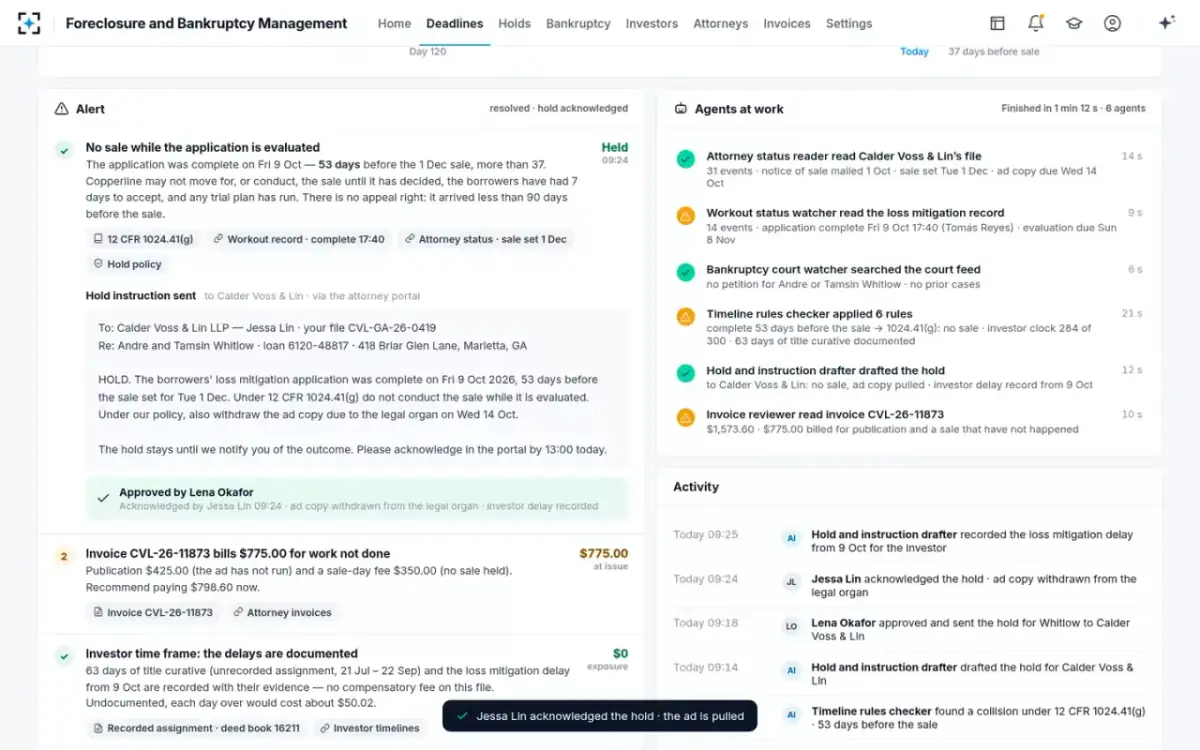
The fix for each miss is the same: the loss mitigation status and the legal steps are read together, by the rule, every time either changes. On the actual sample run, the workout status watcher saw the application turn complete on Friday evening and the colliding steps were held in the firm's portal at 06:00 on Saturday. On the replay's day 11, the change to "missing documents" would not have released anything, because the agents never release a hold; a release needs a person, and a restart needs two.
The pre-mortem's four misses, and what the shared timeline does instead
The old way, in the replay: Status waits for Monday's report; hold entered by the firm that afternoon.
On one timeline, in the sample run: Held in the firm's portal at 06:00 Saturday, with the rule cited; publication paused under the servicer's policy.
The old way, in the replay: Status change to missing documents releases the hold.
On one timeline, in the sample run: No agent may release a hold; the rules checker keeps the file protected while the borrower has a reasonable opportunity.
The old way, in the replay: Re-completion read as 32 days before the sale.
On one timeline, in the sample run: The facially complete date, 9 October, stays the date the protections were fixed.
The old way, in the replay: Sale held while evaluation pending.
On one timeline, in the sample run: Sale stays held until the evaluation outcome, the 7-day acceptance window and any trial plan decision.
Foreclosure and Bankruptcy Management puts the legal, workout, court and investor lanes on one axis
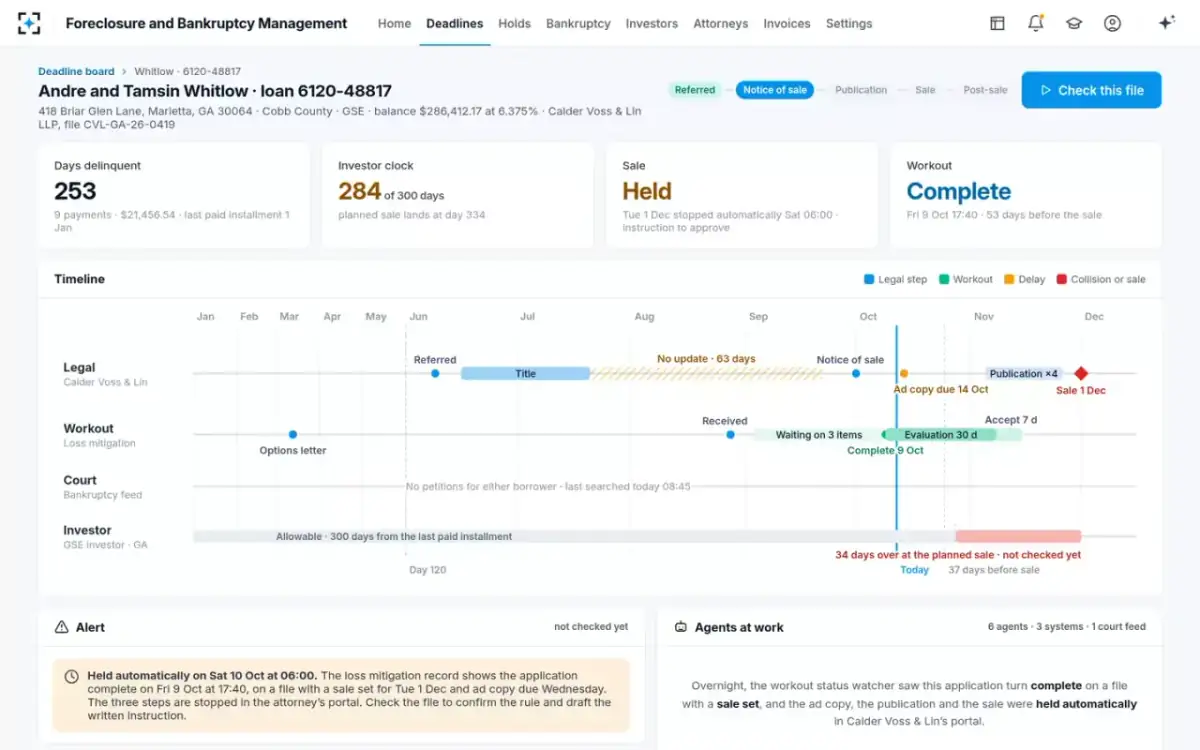
The instruction approved, the firm acknowledges, the ad is pulled
None of this replaces the underwriter's judgment or the firm's. Tomás still decides what is complete and whether a document is wrong; the firm still sets dates. What changes is that the legal file learns what the loss mitigation file knows, under the rule that governs it, without waiting for a report. The full set of people and systems involved is in the default servicing guide.
Questions people ask
What is dual tracking in foreclosure?
Pursuing foreclosure while a borrower's loss mitigation application is under review. Regulation X bars the first filing during the first 120 days of delinquency and while a complete application received before it is pending, and bars the judgment motion and sale while a complete application received more than 37 days before the sale is evaluated.
What are the exceptions to the 120-day foreclosure rule?
Only two: a foreclosure based on violation of a due-on-sale clause, and a servicer joining a foreclosure action brought by a superior or subordinate lienholder. Small servicers are bound by the 120-day rule too.
Can a servicer publish a sale notice while an application is pending?
Yes, if the first filing came before the complete application and the publication does not itself produce a judgment, order of sale or sale. Many servicers pause publication anyway as a matter of policy.
What if the application becomes incomplete again after it was complete?
If it was facially complete, the servicer must request what is missing and keep treating it as complete for the dual-tracking bars until the borrower has had a reasonable opportunity. If the borrower then completes it, it counts as complete from the facially complete date.
Is a servicer liable if its foreclosure attorney goes ahead with a barred sale?
Yes. The official commentary to 1024.41(g) says the servicer must instruct counsel promptly and "is not relieved of its obligations because foreclosure counsel's actions or inaction caused a violation." Borrowers can enforce the rule under RESPA section 6(f).