A foreclosure sale postponement does not change which loss mitigation protections a borrower has. Regulation X says that wherever a protection depends on the number of days between a complete application and a foreclosure sale, "such determination shall be made as of the date a complete loss mitigation application is received" (12 CFR 1024.41(b)(3)), and the official commentary adds that those protections "remain in effect thereafter, even if a foreclosure sale is later scheduled or rescheduled" (comment 41(b)(3)-2). An application complete 40 days before a sale set for 1 December keeps the bar on that sale if the sale moves to February; one complete 30 days before stays outside the Regulation X bar even if the sale later slips by months. Botminds' Foreclosure and Bankruptcy Management records the day count on the day the application turns complete and keeps it with the file, so a dashboard that recomputes "days to sale" from the new date cannot quietly move a borrower across the line.
Protections fixed on the day a complete application is received
| Days before the scheduled sale, at receipt | What the borrower gets under Regulation X | Rule |
|---|---|---|
| No sale scheduled | Treated as more than 90 days before any sale: everything below | Comment 41(b)(3)-1 |
| 90 days or more | Appeal of a loan modification denial within 14 days; at least 14 days to accept an offer | 1024.41(h)(1), (e)(1) |
| 45 days or more (applications) | Written acknowledgment within 5 business days, saying complete or incomplete | 1024.41(b)(2)(i) |
| More than 37 days | Evaluation for all options within 30 days; no judgment motion or sale until an exit; at least 7 days to accept (14 if 90 or more) | 1024.41(c)(1), (g), (e)(1) |
| 37 days or fewer | None of the above under Regulation X; the owner or investor may still require a review | Comment 41(g)-4; 1024.38(b)(2)(v) |
Does postponing a foreclosure sale change loss mitigation protections?
No. Protections that depend on the days between a complete application and a sale are determined once, on the date the complete application is received, and they stay in place when the sale is later scheduled or rescheduled. The rule is written to stop the sale date being used, in either direction, to change what a borrower is owed.
The protection runs both ways. A borrower whose complete application arrived 53 days before a sale does not lose the 1024.41(g) bar because the servicer moves the sale earlier, and does not gain an appeal right because the servicer moves it later past the 90-day mark. A borrower whose application arrived 30 days before a sale does not acquire the bar because the sale is postponed by two months. What the borrower can do in that case, and what the investor may require, is covered below.
The one thing a postponement does change is the calendar the protections are applied to. A bar on "conducting a foreclosure sale" applies to whatever sale is scheduled; moving the date does not lift it. The exits are the ones in 1024.41(g): ineligibility with appeals finished, rejection of all options, or failure to perform.
How is the 37 day rule measured?
Count from the date the complete application is received to the date of the sale scheduled on that day, and ask whether the gap is more than 37 days, which means 38 or more. The count uses calendar days; the five-day acknowledgment period, by contrast, excludes weekends and public holidays. If the application was facially complete earlier and is later completed within the reasonable opportunity the servicer gives, it counts as complete from the facially complete date for the purposes of the bar (1024.41(c)(2)(iv)).
One sample file, measured once
17:40
Friday 9 October 2026: the sample Whitlow application marked complete
53days
to the sale then set for Tuesday 1 December: more than 37, so the bar applies
7days
minimum time to accept an offer, because 53 is less than 90
0
appeal right, for the same reason: fewer than 90 days at receipt
For the sample file, that means a postponement of the 1 December sale to, say, 2 March changes nothing in the evaluation. The borrowers still have no appeal right under Regulation X, even though the new date is more than 90 days from receipt, and the sale stays barred until the evaluation, the seven-day acceptance window and any trial plan decision have run.
What if no foreclosure sale is scheduled?
Then the application counts as received more than 90 days before any sale, and the borrower gets every protection on the table. The commentary is direct: "If no foreclosure sale has been scheduled as of the date that a complete loss mitigation application is received, the application is considered to have been received more than 90 days before any foreclosure sale" (comment 41(b)(3)-1). For the acknowledgment notice the parallel rule treats an application received with no sale scheduled as received 45 days or more before one.
This matters in judicial states, where a case can be pending for months with no sale date. A complete application in that period carries the appeal right and the 14-day acceptance window, and if it arrives before the first filing, it bars the first filing itself under 1024.41(f)(2). A later scheduling order does not take any of that away.
What happens if a complete application arrives after the sale is postponed?
It is measured against the sale that is scheduled on the day it arrives, which is the postponed date. If the sale was moved from 13 October to 10 November and the application is complete on 1 October, the count is 40 days, more than 37, and the bar applies. If the same sale had been postponed after the application arrived, the count would have been 12 days, and the later move would not have changed it.
The same application, the same postponement, in a different order
Sale postponed before the application is complete: Tuesday 13 October
Sale postponed after the application is complete: Tuesday 13 October
Sale postponed before the application is complete: Tuesday 10 November, on 25 September
Sale postponed after the application is complete: Tuesday 10 November, on 5 October
Sale postponed before the application is complete: Thursday 1 October
Sale postponed after the application is complete: Thursday 1 October
Sale postponed before the application is complete: 40, to the 10 November sale scheduled on 1 October
Sale postponed after the application is complete: 12, to the 13 October sale scheduled on 1 October
Sale postponed before the application is complete: Bar under 1024.41(g); evaluation in 30 days; 7 days to accept
Sale postponed after the application is complete: No 1024.41(g) bar; the investor may still require a review
A second application after a postponement is a different question. A servicer must handle each new application under 1024.41 "unless the servicer has previously complied with the requirements of this section for a complete loss mitigation application submitted by the borrower and the borrower has been delinquent at all times since submitting the prior complete application" (1024.41(i)). Whether that exception applies to a first application that fell inside 37 days is a question for compliance counsel; a system should flag it rather than answer it.
FHA's 45-day and 37-day rules work the same way
FHA's own foreclosure-period rules mirror Regulation X and are also keyed to the date the request is received. "When the loss mitigation request is received 45 Days or more prior to the scheduled foreclosure sale date, the Mortgagee must notify the Borrower in writing within five business days", must decide within 30 days of a complete request, and "must not move forward with a scheduled foreclosure sale during its loss mitigation review". For a request received 37 or fewer days before the sale, "HUD does not require the Mortgagee to suspend the foreclosure sale" (HUD ML 2025-12). Between the two, a request more than 37 but fewer than 45 days out must still be reviewed within 30 days.
The structure gives a postponement the same non-effect for FHA loans as under Regulation X: the band is set by when the request arrived relative to the sale then scheduled. FHA's six-month and diligence deadlines are a separate matter; a postponement can push a file past them, which is why the delay and its cause need to be documented for the claim, as set out in the FHA cost guide.
Foreclosure sale postponement affidavits and state notice rules
How a sale is postponed is a matter of state law, and some states require a notice, announcement or affidavit recording the new date. What the statute requires matters for the new date's validity, not for the borrower's federal protections. Two examples show how much state procedure shapes a postponement. In Texas a power-of-sale foreclosure must be held "between 10 a.m. and 4 p.m. of the first Tuesday of a month", after notice "at least 21 days before the date of the sale" (Texas Property Code 51.002), so a sale that misses one first Tuesday moves by at least a month. In Florida a judicial sale is set 20 to 35 days after judgment, and "may be held more than 35 days after the date of final judgment or order if the plaintiff or plaintiff's attorney consents" (Florida Statutes 45.031).
Whatever the state requires, the servicer's file should keep three dates side by side: the sale scheduled on the day the complete application arrived, every later scheduled date with who moved it and why, and the band of protections fixed at receipt. The first and the third never change.
A sale that moves twice; the protection measured once
- Set on receipt1 Dec
- First postponement5 Jan
- Second postponement2 Feb
- More than 37, under 90 days at receipt: bar, 7-day acceptance, no appeal53 days at receipt
Why postponements cause errors, and how Foreclosure and Bankruptcy Management avoids them
Because most systems compute "days to sale" live from the current sale date, and many teams read the protection band off that number. A file moves from "52 days to sale, protected" to "88 days" after a postponement and nobody minds; a file moves from "30 days, not protected" to "60 days" and somebody reads it as protected, or the reverse after a sale is reset earlier. Neither reading is the rule.
A computed band and a stored band, after the same postponement
Band computed from today's sale date: Shows more days and, past 90, an appeal right the borrower does not have.
Band stored on the day of receipt: Shows the band fixed at receipt; no change.
Band computed from today's sale date: May drop below 37 and appear unprotected while the bar still applies.
Band stored on the day of receipt: The bar stays; any sale date inside the protection is held.
Band computed from today's sale date: Shows the new count and may hide the appeal right.
Band stored on the day of receipt: Shows "more than 90 days", per comment 41(b)(3)-1.
Band computed from today's sale date: The band on screen differs from the band in the notices sent.
Band stored on the day of receipt: The band, the receipt date and the sale then scheduled sit together.
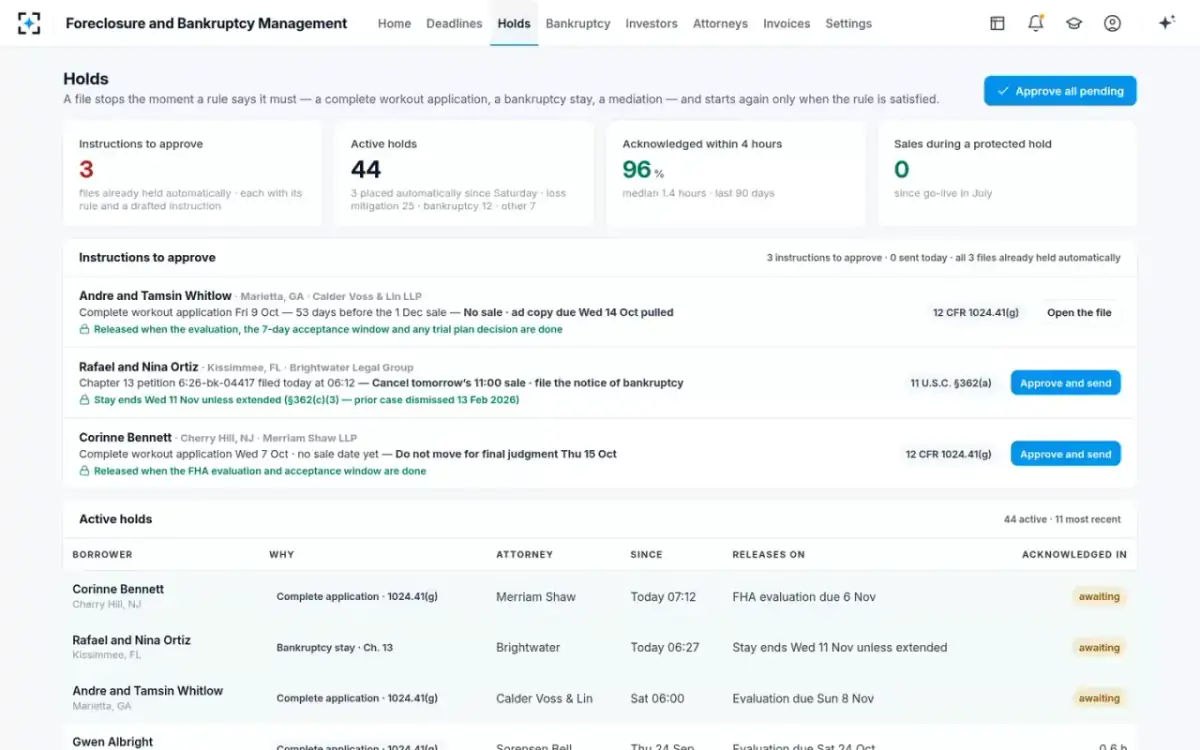
In the sample, a hold placed on a complete application stays until its release condition is met, whatever happens to the sale date; of the servicer's 44 active holds on 12 October, 25 came from loss mitigation, 12 from bankruptcy stays and 7 from other causes such as mediation.
The sample servicer's 44 active holds, by what triggered them
Active holds, Monday 12 October 2026
- Complete loss mitigation application · 57%
- Bankruptcy stay · 27%
- Other, such as mediation · 16%
Foreclosure and Bankruptcy Management keeps each hold with the rule that set it and what releases it
The line from the other side: applications that are not yet complete
The 37-day line also creates urgency before an application is complete, because a file that becomes complete on day 37 gets nothing under Regulation X. In the sample, the servicer's setting alerts the team when an incomplete application is within ten days of the line. One file, Kessler in Columbus, Ohio, had two items outstanding with a sheriff sale on 23 October, already inside 37 days; the solution showed it as one to watch, not as protected.
Every file's sale, workout status and the 37-day line on one view
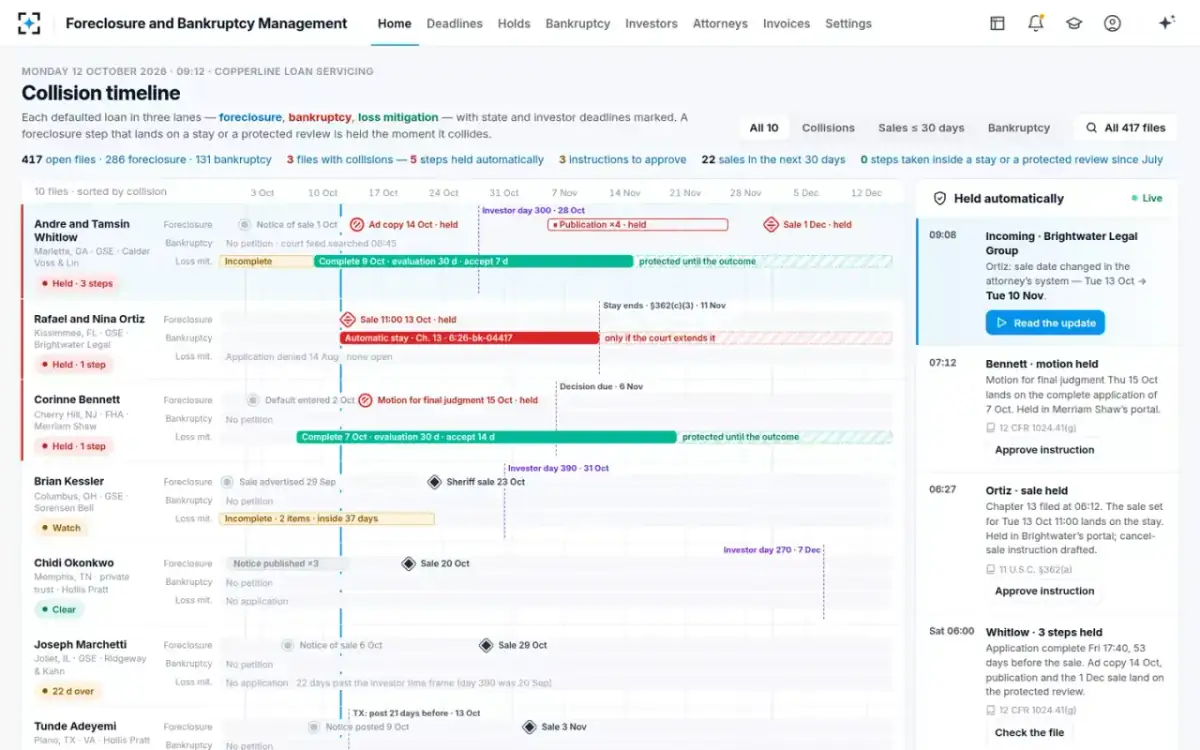
A postponement of Kessler's sale would not help the borrowers under Regulation X if the application completes before the new date is set; if the sale is postponed first, the count is made against the new date. That ordering question is the whole of this guide, and the reason the file keeps its dates rather than a single "days to sale". The handoff failures that turn this into a barred sale are walked through in the dual tracking pre-mortem.
Questions people ask
Does a foreclosure sale postponement restart the 37-day count?
No. The count is made once, on the date the complete application is received, against the sale scheduled that day. The official commentary says the resulting protections remain in effect even if the sale is later scheduled or rescheduled.
If the sale is postponed past 90 days, does the borrower get an appeal?
Not under Regulation X, if the complete application arrived fewer than 90 days before the sale then scheduled. The appeal right in 1024.41(h) depends on the date of receipt, and a later postponement does not create it.
What if no sale date was set when the application came in?
The application is treated as received more than 90 days before any sale, so the borrower has every day-count protection, including the appeal right and 14 days to accept an offer. A sale scheduled later does not remove them.
Can a servicer reschedule a sale while an application is being evaluated?
Setting a date is not barred as such, but conducting the sale is, until an exit in 1024.41(g) applies. Any new date that falls inside the protection has to be held, which is why moving a sale into a protected period is itself a warning sign.
What is a foreclosure sale postponement affidavit?
A filing or notice some states require to record a postponed trustee's sale and its new date. It is governed by state law and matters for the validity of the new sale date; it has no effect on the borrower's federal loss mitigation protections.
Does FHA measure the 37 and 45 days the same way?
Yes. HUD's rules in Mortgagee Letter 2025-12 key the review and the sale suspension to when the loss mitigation request is received relative to the scheduled sale: 45 days or more, more than 37 but fewer than 45, and 37 or fewer.