A motion for relief from stay in Chapter 13 is the mortgage creditor's request, under 11 U.S.C. 362(d), for the bankruptcy court to lift or modify the automatic stay so that a foreclosure can resume, most often because postpetition payments have stopped or the creditor's interest is not adequately protected. Before filing one, a servicer should ask a prior question: is there a stay at all? If the debtor had one case dismissed in the previous year, the stay on the new case ends on the 30th day after filing unless the court extends it; with two or more, no stay arises. Checking prior filings at intake decides whether the servicer needs a motion, a diary date or only an order confirming that no stay is in effect. Botminds' Foreclosure and Bankruptcy Management searches the court feed every 15 minutes for every borrower and co-borrower, reads prior cases on each hit, and works out when the stay ends before anyone drafts a motion.
Chapter 13 volume, and the clocks a relief motion runs on
215,490
Chapter 13 filings in the year to 30 June 2026, up from 200,290 a year earlier
Day 30
when the stay ends for a debtor with one case dismissed in the past year, unless extended
60days
after a request for relief, the stay ends for an individual debtor unless the court decides or extends
14days
an order granting relief is itself stayed, unless the court orders otherwise
What happens to the automatic stay on a repeat filing?
It depends on how many of the debtor's cases were pending in the previous year and dismissed. None: the ordinary stay applies for the life of the case. One: the stay ends on the 30th day after the new filing unless a court extends it after a hearing completed within those 30 days. Two or more: no stay goes into effect at all. The decision tree below is the check a bankruptcy desk should run on every new petition before it decides anything else.
Is there a stay, and do you need a motion? The repeat-filer check
Check first
Prior cases of this debtor pending in the past year and dismissed
Also: any recorded in-rem order on this property in the past two years (362(d)(4), (b)(20))
None
The stay arises under 362(a) and lasts for the case
To resume: a motion for relief under 362(d), for cause or no equity
One
The stay ends on day 30 after filing, under 362(c)(3)(A)
Unless: a motion to extend is heard and granted before day 30, on a showing of good faith
Then: ask for an order confirming termination under 362(j)
Two or more
No stay goes into effect, under 362(c)(4)(A)(i)
Unless: the debtor asks within 30 days and the court imposes one
Then: on request the court "shall promptly enter an order confirming that no stay is in effect"
What is 362(c)(3)?
Section 362(c)(3) is the Bankruptcy Code's rule for a debtor who files again within a year of a dismissal. If "a single or joint case of the debtor was pending within the preceding 1-year period but was dismissed", the stay "with respect to any action taken with respect to a debt or property securing such debt or with respect to any lease shall terminate with respect to the debtor on the 30th day after the filing of the later case" (11 U.S.C. 362(c)(3)(A)). A party in interest, usually the debtor, can ask to extend it, but the hearing must be completed before the 30 days run out and the movant must show the new case was filed in good faith.
The statute also tilts that showing. A case is "presumptively filed not in good faith", rebuttable only by clear and convincing evidence, where more than one prior case was pending in the year, where the prior case was dismissed after the debtor failed to file documents, provide adequate protection or perform a confirmed plan, or where nothing has changed in the debtor's affairs since the last dismissal. It is also presumed not in good faith as to a creditor that had a relief motion pending, or granted, when the earlier case was dismissed (362(c)(3)(C)). A servicer that sought relief in the last case should tell counsel so on day one.
When does the automatic stay not apply?
Beyond the two-dismissal rule, the stay does not protect a property against enforcement of a lien for two years after a court enters an in-rem order under 362(d)(4), if the order was recorded under state law; a debtor may ask for relief from that order for changed circumstances. Nor does it apply where the debtor was ineligible to file, or filed in violation of a court order barring a new case (362(b)(20), (b)(21)).
An in-rem order is the strongest tool against serial filings. The court may grant it where "the filing of the petition was part of a scheme to delay, hinder, or defraud creditors" involving a transfer of the property without consent or "multiple bankruptcy filings affecting such real property", and once recorded it binds any case "purporting to affect such real property filed not later than 2 years after the date of the entry of such order" (362(d)(4)). It follows the house, not the debtor, which is why property-level search matters as well as name search.
Does day 30 end the stay for the house too? Courts divide
The words "with respect to the debtor" have split the courts. The First Circuit, the first federal appeals court to decide the question, described it in 2018: "Some have held that § 362(c)(3)(A) terminates the stay in its entirety, allowing actions against the debtor, the debtor's property, and property of the bankruptcy estate. Others have held that it terminates the stay only in part, allowing actions against the debtor and the debtor's property to go forward, but preserving the stay as to actions against estate property." It held that "§ 362(c)(3)(A) terminates the entire stay thirty days after the filing of a second petition" (In re Smith, 1st Cir. 2018).
In a Chapter 13 case the home is usually property of the estate, so the split is not academic. In a circuit that follows the narrower reading, a foreclosure on day 31 can still be an act against estate property. The practical rule for a servicer is to ask for an order under 362(j) confirming the stay has terminated, or for relief, before resuming, and to let counsel decide which the local law requires. Software should flag day 30; it should not decide what day 30 means.
Two readings of 362(c)(3)(A), and what each means on day 31
Stay ends only as to the debtor: Stay ends on day 30
Stay ends entirely (In re Smith, 1st Cir.): Stay ends on day 30
Stay ends only as to the debtor: Stay continues; relief still needed
Stay ends entirely (In re Smith, 1st Cir.): Stay ends on day 30
Stay ends only as to the debtor: Move for relief, or confirm with counsel before acting
Stay ends entirely (In re Smith, 1st Cir.): Ask for a 362(j) confirming order, then resume with counsel
Relief from stay in Chapter 13: the grounds
The court "shall grant relief from the stay … such as by terminating, annulling, modifying, or conditioning such stay" for cause, "including the lack of adequate protection of an interest in property", or, for an act against property, where the debtor has no equity in it and it is "not necessary to an effective reorganization" (11 U.S.C. 362(d)(1), (2)). For a mortgage servicer in Chapter 13, cause is commonly argued from missed postpetition payments. The no-equity ground also requires that the property be unnecessary to an effective reorganization, a hard showing for the home a Chapter 13 plan is built around.
Relief need not be all or nothing. The statute lets the court condition or modify the stay rather than end it, for example on the debtor keeping postpetition payments current. In Chapter 13 a separate co-debtor stay protects an individual liable with the debtor on a consumer debt, and needs its own relief under section 1301(c) (11 U.S.C. 1301). A motion that names only the debtor can leave the co-borrower's stay in place.
How long does relief from stay take?
The statute sets a fast clock. Thirty days after a request, the stay ends as to the movant unless the court, after notice and a hearing, continues it pending a final hearing; a preliminary hearing must be followed by a final one within 30 more days. For an individual debtor in Chapter 7, 11 or 13, the stay ends 60 days after the request unless the court rules within that time or the period is extended by agreement or for good cause (362(e)(1), (e)(2)). Once relief is granted, the order "is stayed for 14 days after it is entered" unless the court orders otherwise (Rule 4001(a)(4)).
The relief-from-stay clock, from motion to a foreclosure that may resume
- From the motion: stay ends at day 30 unless continued30 days
- Final hearing, decision by day 6060 days
- Order stayed14 days
- Restart foreclosure within 90 days after the prohibition ends24 CFR 203.355(c)
Relief also ends the Chapter 13 notice regime for that home. Rule 3002.1's requirements "cease when an order terminating or annulling the automatic stay related to that residence becomes effective", unless the court orders otherwise (Rule 3002.1(a)). And for an FHA loan the clock restarts: where federal bankruptcy law stopped the foreclosure, the mortgagee "must recommence the foreclosure within 90 days after the expiration of the time during which foreclosure is prohibited" (24 CFR 203.355(c)(2)). The day relief becomes effective is a deadline twice over.
One sample filing, checked in 15 minutes by Foreclosure and Bankruptcy Management
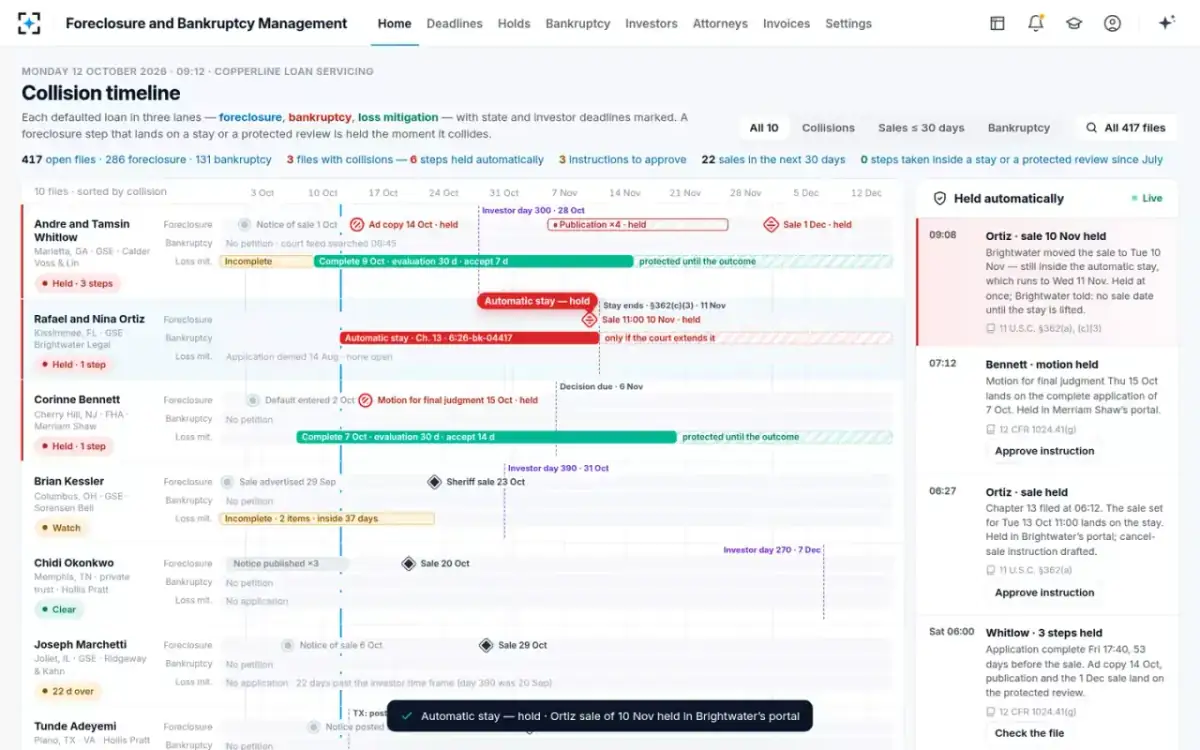
Take a fictional sample servicer, Copperline Loan Servicing, as it runs through the solution on Monday 12 October 2026. Rafael and Nina Ortiz filed Chapter 13 at 06:12 in the Middle District of Florida, with an Osceola County sale set for 11:00 the next day. The court watcher found the petition at 06:27 and, in it, a prior case dismissed on 13 February 2026: one dismissal in the year, so the stay ends on Wednesday 11 November unless the court extends it.
Foreclosure and Bankruptcy Management works out the stay's end date for a repeat filer
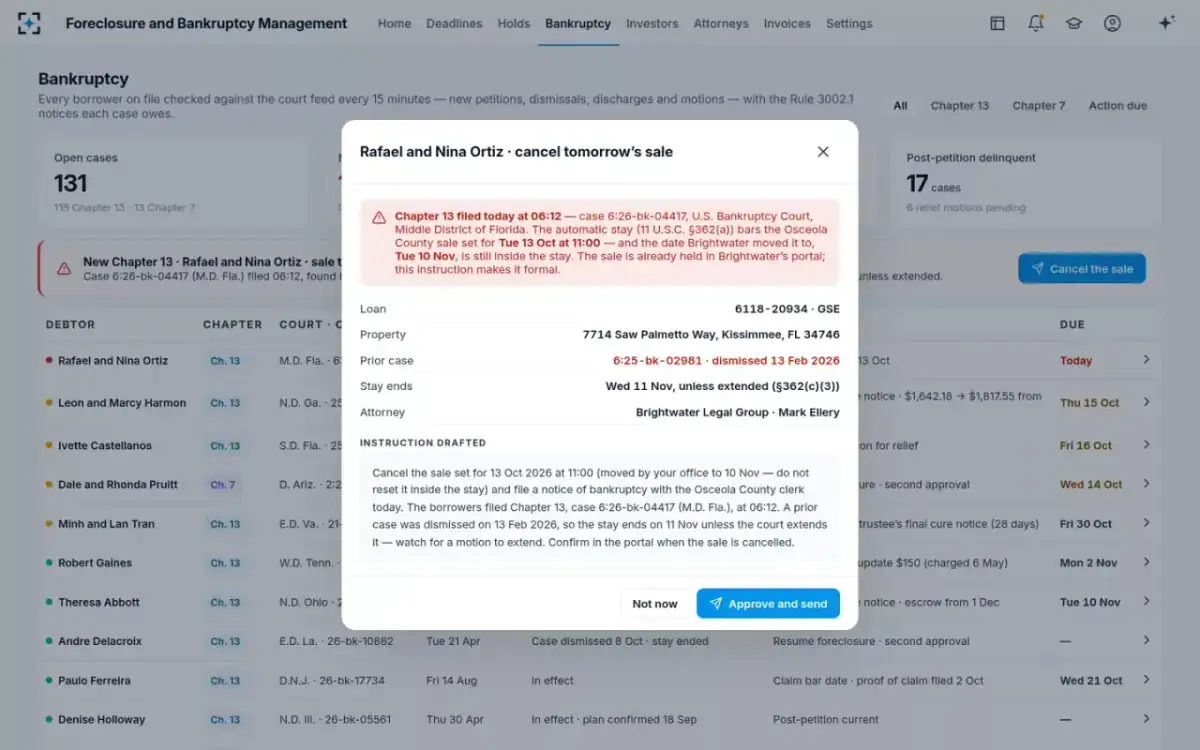
The instruction is the part that would be easy to get wrong by hand. It cancels the sale, asks the firm to file a notice of bankruptcy with the county, tells it not to reset a sale inside the stay, and asks it to watch for a motion to extend. When the firm later moved the sale to 10 November in its own system, a day before the stay's end, the date was held again at once.
The firm's new sale date lands one day inside the stay, and is held
A checklist before filing a motion for relief
Five checks, in order, decide whether a motion is needed and what it should ask for. The table sets them out with the question each answers.
Five checks before a mortgage servicer moves for relief in Chapter 13
| Check | Question it answers | If yes |
|---|---|---|
| Prior cases in the past year | Did the stay end on day 30, or never start? | Diary day 30 and watch for a motion to extend; or seek a 362(j) order confirming no stay |
| Recorded in-rem order on the property | Is the property outside any stay for two years? | Confirm with counsel; no motion may be needed |
| Co-debtors on the loan | Does a 1301 co-debtor stay also bar collection? | Ask for relief under 1301(c) as well |
| Earlier relief motion in a dismissed case | Is the new case presumed not in good faith as to you? | Tell counsel; it bears on any motion to extend |
| Postpetition payment history | Is there cause, and can you prove it? | Attach a reconciled history; consider asking for a conditional order |
The postpetition history in the last row is the same history a trustee's status motion under the amended Rule 3002.1 will test; the guide to the 2025 changes covers that motion, and what to bring to bankruptcy software covers the prior-case and co-debtor data this check depends on.
Questions people ask
What does a motion for relief from stay mean in Chapter 13?
It is a creditor's request that the bankruptcy court lift, modify or condition the automatic stay so it can act against the debtor's property, for a mortgage servicer usually to resume foreclosure. The grounds are cause, including lack of adequate protection, or no equity in a property the plan does not need.
When does the automatic stay not apply in Chapter 13?
When two or more of the debtor's cases were pending in the previous year and dismissed, no stay arises; a recorded in-rem order bars the stay as to that property for two years; and a debtor ineligible to file, or barred by court order, gets no stay against lien enforcement.
What is 362(c)(3)?
The rule that ends the automatic stay on the 30th day after a new filing when one prior case of the debtor was pending within the year and dismissed. The debtor can ask to extend it, but the hearing must finish within the 30 days and the debtor must show good faith.
How long does relief from stay take?
For an individual debtor the stay ends 60 days after the request unless the court rules first or the period is extended, and the court must hold at least a preliminary hearing within 30 days to keep the stay in place. The order granting relief is then stayed for 14 days unless the court orders otherwise.
Does a servicer still file Rule 3002.1 notices after relief from stay?
Not for that residence, unless the court orders otherwise: the rule's requirements cease when an order terminating or annulling the stay related to the residence becomes effective.
How many Chapter 13 cases were filed in the last year?
215,490 in the twelve months to 30 June 2026, up from 200,290, according to the Administrative Office of the U.S. Courts. Total filings rose 12.2% to 608,511.