In mortgage servicing, a foreclosure hold means an instruction that stops one or more steps in a foreclosure, usually the motion for judgment, the order of sale and the sale itself, because a rule requires the file to pause. The two common triggers are a borrower's complete loss mitigation application, which Regulation X protects under 12 CFR 1024.41(f)(2) and (g), and a bankruptcy petition, which stops collection and foreclosure under the automatic stay. The hold's meaning in an examination is narrower than its meaning in an operations queue: it is on time only if no barred step happened between the moment the application became complete, or the petition was filed, and the moment counsel stopped. Botminds' Foreclosure and Bankruptcy Management places the hold in the attorney's portal when the trigger appears and keeps each timestamp with its evidence, so the file can show when the servicer knew and when it stopped.
The figure below shows the pattern the CFPB found unlawful in 2024, next to a hold that starts with the trigger. Later examples use a fictional sample servicer, Copperline Loan Servicing, as it runs through the solution.
A retroactive hold leaves days in which the file is unprotected
- Arriveday 0
- Reviewing whether completeup to 5 days
- Back-dated holdhold
- Arriveday 0
- Completeness decided, hold in forceheld throughout
What does foreclosure hold mean in mortgage servicing?
A foreclosure hold is the servicer's stop on a specific foreclosure step, sent to the attorney or trustee handling the case, for a stated reason and until a stated condition is met. The phrase is servicing jargon, not a defined term in Regulation X; the regulation speaks of what a servicer "shall not" do. The hold is how a servicer turns that prohibition into an instruction someone outside the company will follow.
Several rules can require one, and they stop different steps. A complete application received before the first filing bars the first notice or filing itself. One received after the first filing but more than 37 days before a sale bars the dispositive motion and the sale. A bankruptcy petition stops nearly everything. A borrower performing under a short-term forbearance or repayment plan offered on an incomplete application is also protected.
Four common reasons for a foreclosure hold, and what each one stops
| Trigger | Rule | Steps the servicer may not take | Ends when |
|---|---|---|---|
| Complete application before the first notice or filing | 12 CFR 1024.41(f)(2) | The first notice or filing required to start foreclosure | Ineligible and appeal over, borrower rejects all options, or fails to perform |
| Complete application after first filing, more than 37 days before a sale | 12 CFR 1024.41(g) | Moving for judgment or order of sale; conducting the sale | The same three exits |
| Performing on a short-term plan offered on an incomplete application | 12 CFR 1024.41(c)(2)(iii) | First filing, judgment motion and sale | The borrower stops performing |
| Bankruptcy petition | 11 U.S.C. 362(a) | Commencing or continuing the foreclosure and acts to enforce the lien | Relief from stay, dismissal, discharge, or by law for some repeat filers |
When must a foreclosure hold be placed?
From the day the borrower submits the documents that make the application complete or facially complete, before the next barred step can happen. Regulation X fixes protections "as of the date a complete loss mitigation application is received" (1024.41(b)(3)), not the date the servicer finishes reviewing it.
Facially complete is the definition that catches most servicers. An application "shall be considered facially complete when a borrower submits all the missing documents and information as stated in the notice required under paragraph (b)(2)(i)(B) of this section, when no additional information is requested in such notice, or once the servicer is required to provide the borrower a written notice pursuant to paragraph (c)(3)(i)" (1024.41(c)(2)(iv)). If the servicer later needs more, it must still treat the application as complete for the dual-tracking bars until the borrower has had a reasonable chance to supply it.
The consequence is that the hold has to be placed on the servicer's own acknowledgment letter, not on its underwriting. Once the last item listed in that letter arrives, the borrower is protected, whatever the underwriter later finds. A workflow that waits for an underwriter to confirm completeness before stopping counsel is already late.
What did Fay Servicing do wrong?
It stopped the foreclosure only after deciding the file was complete, and dated the hold back to receipt. The CFPB's 2024 consent order describes the period from June 2017 to early 2020: "in some instances, it took Respondent up to five days to review the documents and decide whether the documents made the application complete, or facially complete, before placing a foreclosure hold. Respondent's policy was to place the foreclosure hold retroactively to the date on which it received the documents necessary to complete the Loss Mitigation Application" (2024-CFPB-0007, paragraph 14).
The order found that this "resulted in foreclosure activities that violated 12 C.F.R. § 1024.41(f)(2) or (g) during that up-to five-day period", that some violations happened even after the five days, and that Fay's policies were not reasonably designed to keep counsel's filings accurate and current. Fay paid a $2 million penalty and $3 million in redress, and had been under a 2017 order for related conduct. The CFPB terminated the 2024 order early, on 1 July 2025 (CFPB enforcement page), but the reading of the rule it applied is the regulation's own.
A hold dated back to receipt is a statement about when the servicer should have stopped. It is not evidence that it did.
Does a foreclosure hold stop publication?
Not necessarily. The official commentary lets a servicer continue steps such as publication, mediation or arbitration after the first filing, as long as they do not cause or directly result in a judgment, an order of sale or a sale (comment 41(g)-2). What the hold must stop is the dispositive motion, a ruling on one already pending, and the sale.
Many servicers pause publication anyway. A newspaper notice costs money that may end up on the borrower's account or the investor's claim, and an advertised sale is confusing to a borrower who has just been told the application is complete. In the sample, the servicer's policy pauses the ad copy too; the solution keeps that policy as its own setting, separate from the legal bar, so an examiner can see which stop came from which rule.
How to prove a foreclosure hold was timely: four timestamps
Keep four times, each with the document behind it: when the completing documents arrived, when completeness was determined, when each barred step was held with counsel, and when counsel acknowledged. The first and the third are the ones that decide compliance; the second and fourth explain the gap between them.
What a defensible hold file contains
- Receipt: the documents that completed the application, with arrival time and channel
Under 1024.41(b)(3) protections are fixed on this date. Fax, upload, mail and email each need a received-at time.
- Completeness: who decided, when, and against which notice
The acknowledgment letter's list of missing items, and the item that closed it. Facially complete counts.
- The hold: each step stopped, in counsel's system, with its time
Motion for judgment, order of sale, sale; publication if policy says so. One time per step.
- The instruction: the written text, who approved it and when
What to stop, why, until when, and the rule cited. The commentary to 1024.38 requires prompt instruction to counsel.
- Acknowledgment: when counsel confirmed and what they did
A pulled ad, a cancelled hearing, a vacated sale date, each with its time.
- Release: the condition, the evidence, and two approvals
Notice of ineligibility and appeal period, rejection, or failure to perform, and who signed the restart.
The notice of complete application helps or hurts here. Regulation X requires one within five business days of a complete application, stating "the date the servicer received the complete application" (1024.41(c)(3)(i)(B)). If the date on that letter is earlier than the hold, the servicer has written down its own exposure. The commentary's worked example shows the date moving when more documents are needed: an application complete on 1 March that needs a corrected document found on 10 March is disclosed again with the new completion date, 21 March (comment 41(c)(3)(i)-1).
Four timestamps on one sample file in Foreclosure and Bankruptcy Management
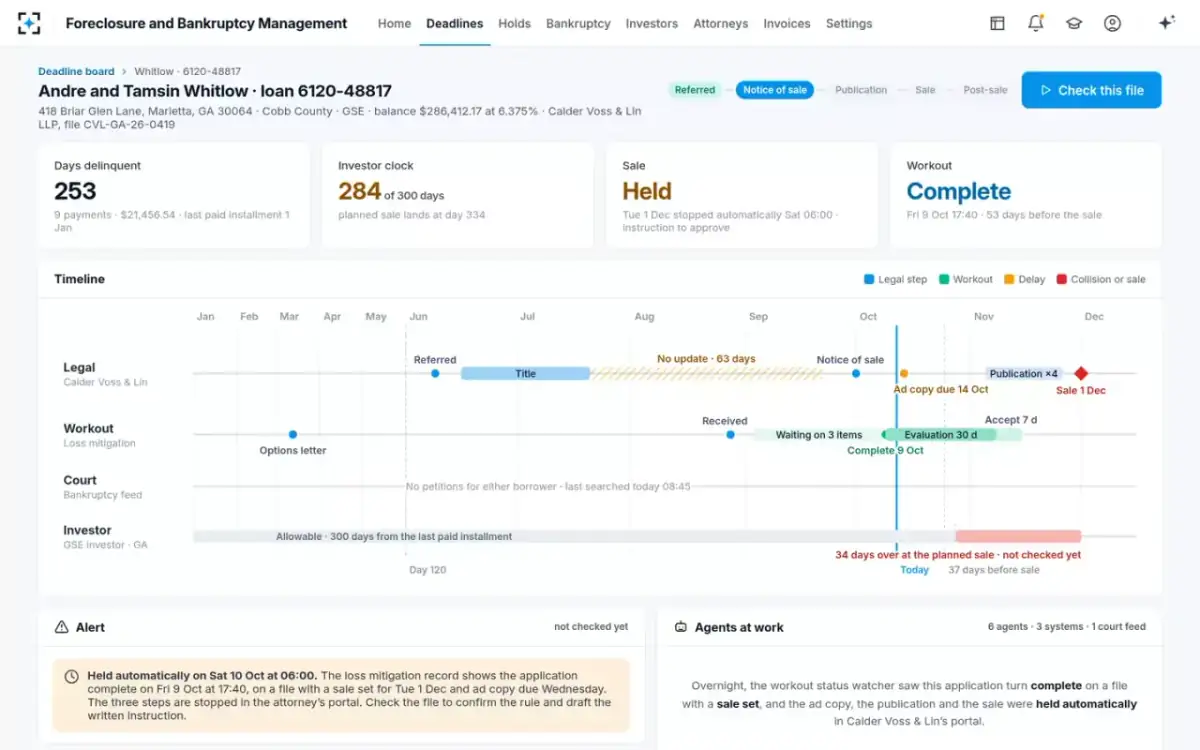
Take the sample servicer's Whitlow file. The borrowers' application was marked complete on Friday 9 October at 17:40, 53 days before a sale set for Tuesday 1 December. The ad copy was due on Wednesday 14 October. No barred step was due over the weekend, which is what made the next morning soon enough.
The sample Whitlow hold, timestamp by timestamp
17:40
Friday 9 October: application marked complete, 53 days before the 1 December sale
06:00
Saturday: ad copy, publication and sale held in the firm's portal, about 12 hours later
09:18
Monday: written instruction approved by the specialist, citing 1024.41(g)
09:24
Monday: firm acknowledges and withdraws the ad copy from the legal organ
The file shows the legal, workout, court and investor lanes on one axis
What records prove compliance with dual tracking rules?
The records that prove compliance are the ones that let an examiner rebuild the sequence without asking anyone: the loss mitigation file with received-at times, the notices sent, counsel's docket, and the instructions to counsel with their acknowledgments. Regulation X requires servicers to keep documents showing the actions taken on a loan account until a year after the loan is discharged or servicing is transferred (1024.38(c)(1)).
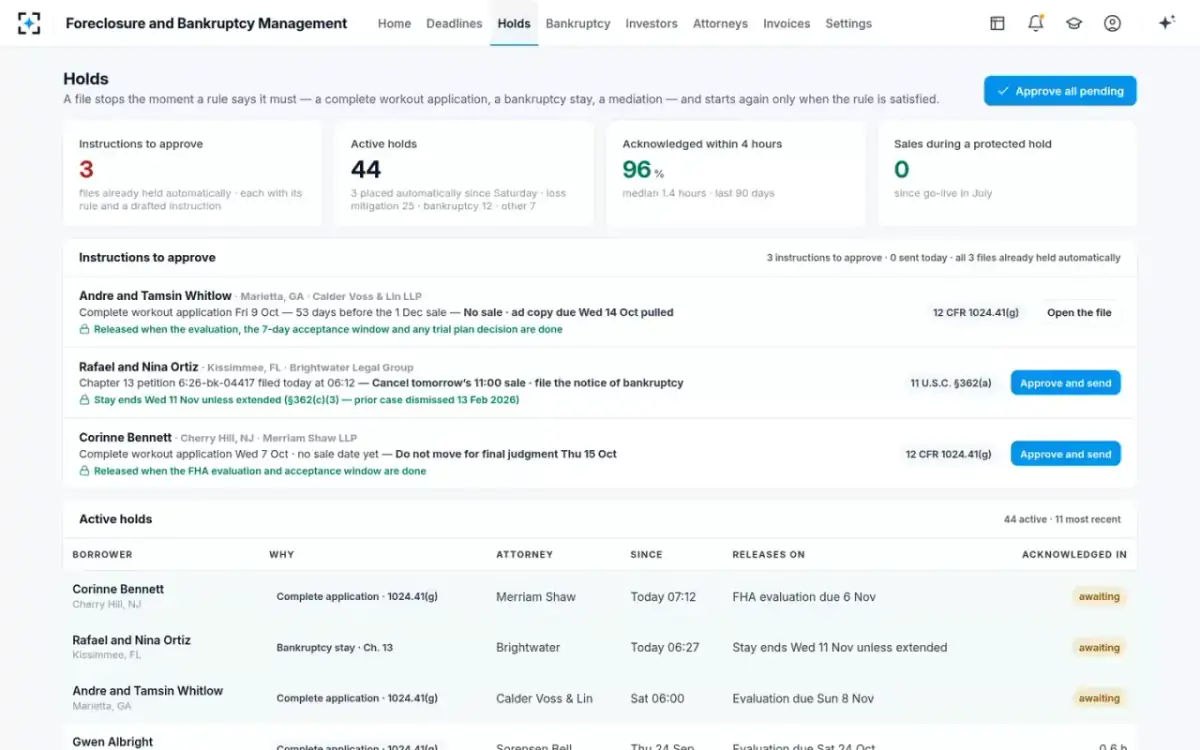
The weak point is usually the link between the two systems. Each one is internally consistent: the loss mitigation platform has a completeness date and the firm's docket has a sale date. What is missing is the proof that the first reached the second before it mattered. That is precisely the information the commentary to 1024.38(b)(3)(iii) requires to be shared, and it is why the solution writes the hold, the instruction and the acknowledgment onto the same file that holds the completeness date.
Foreclosure and Bankruptcy Management lists every active hold with its rule, start time, release and acknowledgment
How long does a foreclosure hold last?
A loss mitigation hold lasts until one of three exits in 1024.41(g) applies: the borrower has been told they are not eligible for any option and the appeal is unavailable, unrequested or denied; the borrower rejects every option; or the borrower fails to perform under an agreement. In between sit the evaluation (30 days from a complete application), the time to accept an offer and, where the application came 90 or more days before a sale, a 14-day appeal window.
A bankruptcy hold lasts as long as the stay. That can be the life of the case, until a court grants relief, or, for a debtor with a case dismissed in the previous year, 30 days unless the court extends it. The release is where most risk sits: a hold placed by a system is cheap to undo, while a hold released early can produce the very sale the rule forbids. That is why, in the solution, agents may place a hold but never release one, and a restart needs two approvers. How a later change of sale date interacts with these protections is covered in the guide to postponed sales, and a full day-by-day failure in the dual tracking pre-mortem.
Questions people ask
What is a foreclosure hold?
It is a servicer's instruction to its foreclosure attorney or trustee to stop a specific step, such as a motion for judgment or a sale, because a rule requires the file to pause. The usual triggers are a complete loss mitigation application under 12 CFR 1024.41 and a bankruptcy petition under 11 U.S.C. 362.
When does a foreclosure hold start?
It should protect the borrower from the date the complete or facially complete application is received, because Regulation X fixes protections as of that date. A hold placed after an internal review and dated back to receipt was the conduct the CFPB found unlawful at Fay Servicing.
What is a facially complete loss mitigation application?
One for which the borrower has sent every missing item listed in the servicer's acknowledgment notice, or for which that notice asked for nothing more. It is treated as complete for the dual-tracking bars even if the servicer later needs more, until the borrower has had a reasonable chance to provide it.
Does a foreclosure hold stop the newspaper notice?
Regulation X does not require it to: publication may continue if it does not directly produce a judgment, order of sale or sale. Many servicers pause it by policy to avoid charging for an ad that may not be needed.
How long must hold records be kept?
Regulation X requires servicers to keep documents showing actions taken on a loan account until one year after the loan is discharged or servicing is transferred. Investors and state law may require longer.
What happens if a sale goes ahead during a hold?
A sale barred by 1024.41(g) is a violation the borrower can enforce under RESPA section 6(f), and a sale inside a bankruptcy stay is a stay violation with damages for willful acts. Either can lead to redress for the borrower and, as at Fay, a finding that the servicer's policies were not reasonably designed.