Default servicing in US mortgage work is everything a servicer does once a borrower stops paying: early collections and live contact, loss mitigation applications and their evaluation, the foreclosure referral to outside counsel, the bankruptcy cases that interrupt it, and the investor's claim at the end. The work is hard because one loan sits in four systems at once, the attorney's portal, the loss mitigation platform, the bankruptcy tracker and the court's docket, while three clocks run on it: state foreclosure law, the investor's deadlines and Regulation X. Botminds' Foreclosure and Bankruptcy Management exists for the moment those systems disagree. It reads all four, lays each defaulted loan out as foreclosure, bankruptcy and loss mitigation lanes on one timeline, and holds any foreclosure step that lands on a stay or a protected review.
The volumes are rising again. The share of mortgages in foreclosure reached 0.67% at the end of June 2026, 19 basis points higher than a year earlier, and Chapter 13 filings passed 215,000 in a year. The examples below come from a fictional sample servicer, Copperline Loan Servicing, with 417 open default files at six law firms in 23 states, as it runs through the solution on Monday 12 October 2026.
Default servicing is growing on both the foreclosure and the bankruptcy side
0.67%
of mortgage loans in the foreclosure process, Q2 2026, up 19 basis points in a year
25,908
foreclosure starts on Fannie Mae and Freddie Mac loans in Q2 2026, up from 25,413
215,490
Chapter 13 filings in the year to 30 June 2026, up from 200,290
137,000
consumers with a new bankruptcy notation on their credit report in Q2 2026
What is default servicing in US mortgage work?
Default servicing is the part of mortgage servicing that begins with a missed payment and ends with a reinstated loan, a workout, a short sale or deed in lieu, a foreclosure sale and claim, or a discharge. It sits beside performing servicing, which collects payments, runs escrow and reports to investors, and it is the expensive part: the costs the Mortgage Bankers Association counts only for non-performing loans are "collections, loss mitigation, bankruptcy, foreclosure and post-sale" (MBA, 2025).
Most of the work is federal and investor rule-following. Regulation X sets the borrower-facing timeline: live contact by the 36th day of delinquency, written notice by the 45th, no first foreclosure notice or filing until the loan is more than 120 days delinquent, and the protections that follow a complete loss mitigation application (12 CFR 1024.41). The investor, whether FHA, VA, USDA, Fannie Mae, Freddie Mac or a private trust, adds its own deadlines and allowable fees. State law decides how the foreclosure itself runs, and the Bankruptcy Code can stop all of it on the day a petition is filed.
The Financial Stability Oversight Council put the operational point plainly: "servicing delinquent loans is more labor-intensive than servicing performing loans and requires additional personnel with expertise in addressing such loans. Processes for servicing delinquent loans also tend to be more complex, leading to additional operational risk" (FSOC, 2024). The complexity is not in any single rule. It is in the number of places a single loan's status lives.
The four desks that touch one defaulted loan
A default file passes through at least four sets of hands, and in most servicers none of them works in the others' system. The loss mitigation underwriter decides when an application is complete. The foreclosure and bankruptcy specialist manages outside counsel and the bankruptcy cases. The attorney runs the legal steps in the firm's own case system. Compliance has to prove, after the fact, when the servicer knew and when it stopped.
Four roles on one default file, and what changes when the handoffs are watched
Today
Marks an application complete late on a Friday and trusts that the decision reaches the foreclosure file before the next legal step.
With agents
The completeness decision reaches the legal file the same evening; the colliding step is held automatically and released only on the evaluation outcome.
Still theirs: Decides whether the application is complete, and what to offer
Today
Starts each morning with the sale calendar, checking three systems for the sale nobody told the attorney to stop.
With agents
Opens one timeline on which colliding steps are already held, reads the rule cited, and approves the written instruction.
Still theirs: Approves every instruction to counsel; a second person co-approves any restart
Today
Can stop only what someone tells her to stop, by email or a portal note that may arrive after the ad copy is due.
With agents
Gets the hold in the firm's own portal with the rule and the release condition, and acknowledges it on a timed standard.
Still theirs: Sets and moves legal dates; files with the court
Today
Reconstructs from email and notes when the servicer knew of a complete application or a petition, and when the step stopped.
With agents
Reads each hold with its rule, start time, release condition and the firm's acknowledgment time.
Still theirs: Tests the controls and answers the examiner
Each role is defined by the rules as much as by the org chart. Regulation X requires personnel assigned to a delinquent borrower by the 45th day, an appeal reviewed by "different personnel" from the first evaluation, and policies that let the servicer audit what its service providers do (12 CFR 1024.38(b)(3)). Outside counsel is a service provider in that sense: the servicer stays responsible for what the firm files.
Three clocks run on every default file
Every file carries three deadlines at once, set by three authorities that do not talk to each other. State law sets the floor: how much notice, how long a judicial case takes, when a sale may be held. The investor sets the ceiling: by when foreclosure must start and finish before costs stop being reimbursed. Regulation X sets the borrower's protections, which can freeze the file in the middle of either.
The three clocks on one defaulted mortgage, and who sets each
| Clock | Set by | What it controls | One example |
|---|---|---|---|
| State foreclosure law | State statute and court rules | Notice periods, judicial or power-of-sale process, sale dates, redemption | Texas: notice of sale at least 21 days before a first-Tuesday sale |
| Investor time frame | HUD, VA, USDA, the GSEs, private trusts | When foreclosure must start, how long it may take, which costs are reimbursed | FHA: loss mitigation action or first legal action within six months of default |
| Borrower protections | Regulation X (12 CFR 1024.41) | No first filing before day 121; no judgment motion or sale while a timely complete application is evaluated | Complete more than 37 days before a sale: no sale until the evaluation and its exits |
| The stay (interrupts all three) | Bankruptcy Code, 11 U.S.C. 362 | Every collection and foreclosure act stops on the petition | A repeat filer's stay can end on day 30, or never start |
The clocks pull against each other. FHA wants foreclosure started within six months of default unless a loss mitigation option was approved in time, while Regulation X bars any first filing before the 121st day of delinquency, so the window for a timely first legal action is roughly the two months between. How the investor clocks run state by state is set out in foreclosure timelines by state; what a late first legal action costs an FHA servicer is worked through in the economics of FHA's six-month clock.
What must a servicer tell foreclosure counsel?
A servicer must tell foreclosure counsel promptly when a borrower's loss mitigation application is complete, and must instruct counsel in time to avoid moving for judgment or holding a sale. That is not a best practice; it is written into the official commentary to Regulation X. A servicer's policies "must be reasonably designed to ensure that servicer personnel promptly inform service provider personnel handling foreclosure proceedings that the servicer has received a complete loss mitigation application and promptly instruct foreclosure counsel to take any step required by § 1024.41(g) sufficiently timely to avoid violating the prohibition against moving for judgment or order of sale, or conducting a foreclosure sale" (comment 38(b)(3)(iii)-1).
The rule text itself asks for the same thing in general terms: policies that "facilitate the sharing of accurate and current information regarding the status of any evaluation of a borrower's loss mitigation application and the status of any foreclosure proceeding" among servicer staff and "service provider personnel responsible for handling foreclosure proceedings" (1024.38(b)(3)(iii)). A second objective, in 1024.38(b)(1)(v), requires that foreclosure filings "reflect accurate and current information".
The cost of a slow handoff is documented. In 2024 the CFPB found that Fay Servicing had taken days to decide whether documents completed an application before placing the foreclosure hold, and that foreclosure steps in that gap broke 1024.41(f)(2) or (g). The order was terminated early in July 2025 (CFPB), but the violation it describes is the one every default operation is built to avoid; what a foreclosure hold must prove takes that case apart.
How does loss mitigation talk to foreclosure counsel today?
In most servicers it talks by status code, queue and email. The loss mitigation platform changes a status to complete; an overnight job or a person updates the default system; someone in the foreclosure team reads a report the next morning and writes to the firm; the firm's paralegal reads the note and stops the next task. Each link is reasonable. Together they take most of a business day, and longer over a weekend.
The same complete application on a Friday evening, by hand and on one timeline
Status codes and email: Underwriter marks the application complete in the loss mitigation platform.
One timeline across the four systems: Same: the underwriter's decision is the trigger, and only a person makes it.
Status codes and email: Status waits for a batch job or for Monday's report.
One timeline across the four systems: The change is read from the platform, the days to the scheduled sale are counted, and the rule is applied.
Status codes and email: Nothing moves. The attorney's portal still shows the ad copy due Wednesday.
One timeline across the four systems: The motion, the sale and, under the servicer's policy, the publication are held in the attorney's portal.
Status codes and email: The specialist finds the file on a report, checks three systems, writes to the firm.
One timeline across the four systems: The specialist reads the cited rule, approves the drafted instruction, and the firm acknowledges.
Status codes and email: Compliance rebuilds the sequence from email time stamps.
One timeline across the four systems: Each hold shows its rule, start time, release condition and acknowledgment time.
The difference is not that software is faster than people at writing emails. It is that the one thing the rule cares about, the moment the application became complete, is read where it happens rather than reported later. The underwriter still decides completeness; the attorney still sets the dates; the specialist still signs the instruction.
Bankruptcy follows the same pattern with a harder edge. The automatic stay begins when the petition is filed, not when the servicer learns of it, and a Chapter 13 filed at dawn before an 11:00 sale leaves hours, not days. In the sample, the court feed is searched every 15 minutes for every borrower and co-borrower, and a petition filed at 06:12 was found at 06:27.
Where the hours go on one colliding file
Most of the time on a collision is spent finding out and confirming, not deciding. Botminds estimates the split below for one file where a foreclosure step meets a stay or a complete application, by hand and with the solution. It is an estimate, not a measurement at any servicer.
Most of the hours on a colliding file are spent learning about it
- Learning of the petition24 h
- Matching4 h
- Drafting2 h
- Attorney acknowledges8 h
- Investor note6 h
- Invoice
- Six steps
The largest block, a day to learn that a petition was filed, is the dangerous one, because it is the block in which a sale can happen inside the stay. A willful stay violation carries "actual damages, including costs and attorneys' fees, and, in appropriate circumstances, … punitive damages" (11 U.S.C. 362(k)). The second largest, waiting for the firm to acknowledge, is the one a timed acknowledgment standard addresses directly.
Who manages foreclosure attorneys?
In most servicers a default or attorney-network manager owns the firms, usually through an agreed list of performance standards: days from referral to first legal action, how often each file must be updated, how quickly a hold is acknowledged, and how clean the invoices are. Those standards are the servicer's policy, not a regulation, but the duty behind them is regulatory: policies that let the servicer review and audit its service providers (1024.38(b)(3)(ii)).
Six firms measured on the steps they own
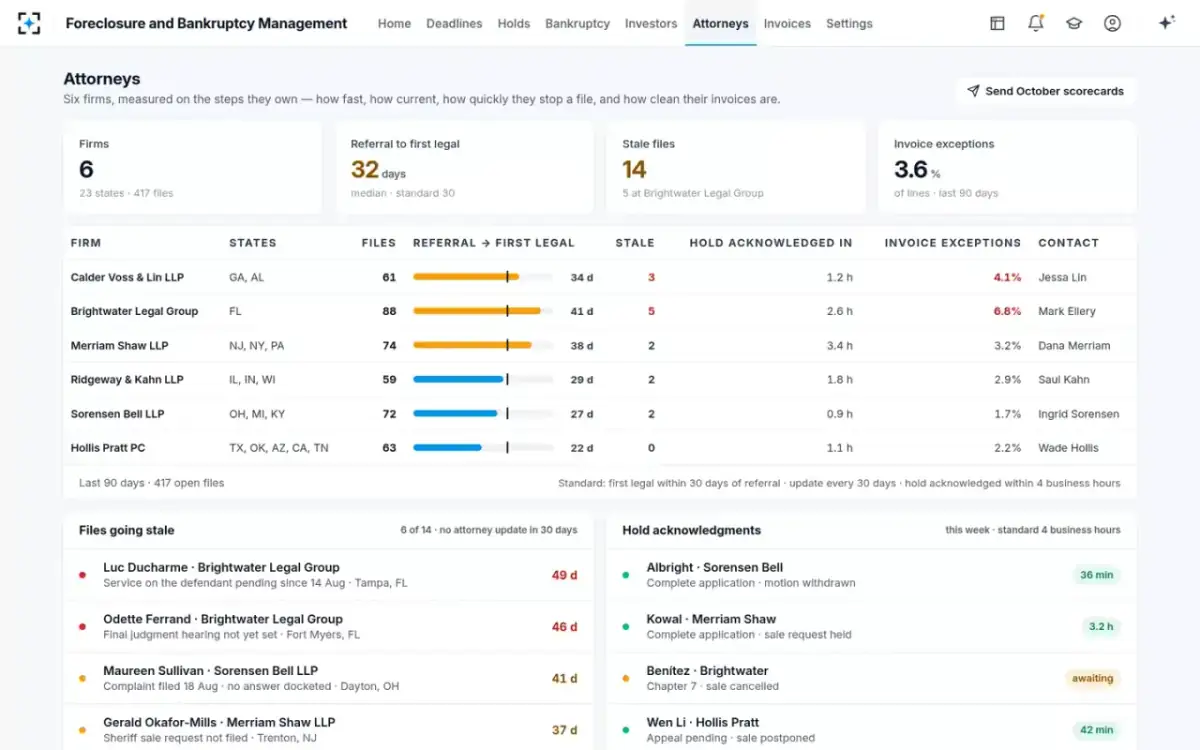
What the screen measures is deliberately narrow. A firm with a slow median from referral to first legal costs investor days; a firm with stale files is a firm whose status the servicer cannot vouch for; a slow acknowledgment is a gap in which a stopped step can still happen. Invoice exceptions matter because foreclosure costs flow into the investor's claim: in the sample, one invoice billed $425 for publication that had not run and $350 for a sale that had not been held, and $775 was held back until the work is done.
Why default servicing costs nine times as much
A non-performing loan cost $1,573 a year to service in 2024 against $176 for a performing one, according to the MBA's Servicing Operations Study, which draws on in-house servicers covering about 60% of the single-family market (MBA). The gap is labour and losses: the extra cost lines are collections, loss mitigation, bankruptcy, foreclosure and post-sale work, unreimbursed foreclosure and REO losses.
That is why the handoffs matter financially as well as legally. Every day a file waits for a status to cross from one system to another is a day of carrying cost, a day off the investor's allowable time frame, and in a bankruptcy a day in which the servicer may be acting without knowing it is stayed. FHA's clock makes that cost explicit: miss the six-month first-legal deadline and HUD computes the claim's interest only to the date the step should have happened.
Where Foreclosure and Bankruptcy Management fits, and where it does not
The solution sits between the four systems rather than replacing any of them. Six agents read the attorney portals and dockets, the loss mitigation record and the bankruptcy court feed, apply Regulation X, state rules and each investor's time frame, and hold a colliding step in the attorney's portal the moment it collides. A person approves every written instruction, and a restart after a hold needs two people.
Foreclosure and Bankruptcy Management: every defaulted loan as three lanes on one timeline
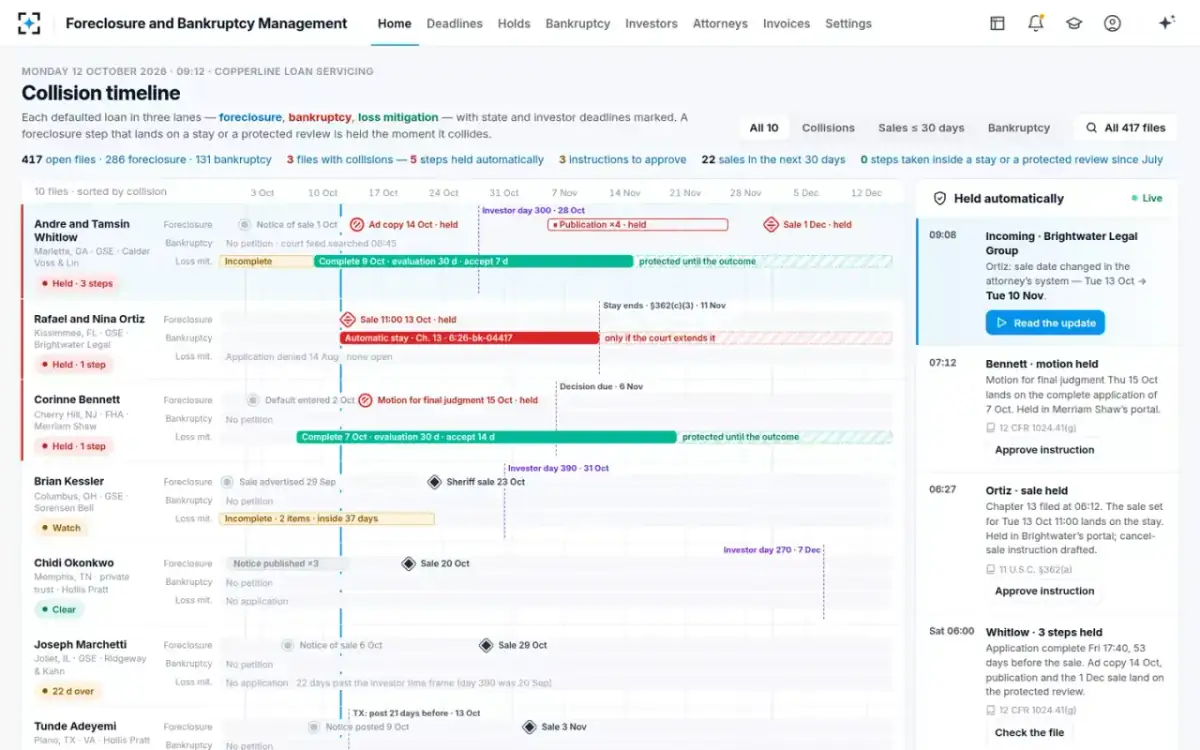
It does not decide whether an application is complete, does not move a date a court or an attorney set, does not file anything with a court and does not pay invoices. Those limits are the point: stopping is the safe direction, so the agents may stop on their own; everything else stays with the people who answer for it. A buyer's view of those limits is in what to ask of foreclosure case management software.
Questions people ask
What is default servicing?
Default servicing is the handling of mortgage loans after a missed payment: collections and borrower contact, loss mitigation, foreclosure through outside counsel, bankruptcy, and the investor claim. Regulation X governs the borrower-facing steps, the investor governs deadlines and reimbursable costs, and state law governs the foreclosure itself.
Is default servicing different from loss mitigation?
Loss mitigation is one part of default servicing: the evaluation of a borrower for options such as repayment plans, forbearance, modification, short sale or deed in lieu. Default servicing also covers foreclosure and bankruptcy, which must stop or slow while a timely complete loss mitigation application is evaluated.
What must a servicer tell foreclosure counsel?
That a complete loss mitigation application has been received, promptly, and an instruction in time to avoid moving for judgment or holding a sale. The duty is in the official commentary to 12 CFR 1024.38(b)(3)(iii), and the servicer stays responsible if counsel's action or inaction causes a violation.
Who manages foreclosure attorneys at a servicer?
Usually a default or attorney-network manager, who holds the firms to written standards on time from referral to first legal action, update frequency, hold acknowledgment and invoice accuracy. Regulation X requires policies that let the servicer review and audit service providers, which includes foreclosure counsel.
What do default servicing jobs pay?
The Bureau of Labor Statistics does not track loss mitigation or default specialist as a separate title; the work sits mostly inside loan interviewers and clerks, a group of 164,790 people with a median wage of $50,020 a year in May 2025 (BLS OEWS). Default managers and bankruptcy specialists are usually paid more, but there is no official series for them.
Why is default servicing more expensive than performing servicing?
Because it is labour-intensive and carries losses: the MBA put the 2024 cost at $1,573 a year per non-performing loan against $176 per performing loan. The difference comes from collections, loss mitigation, bankruptcy and foreclosure work, and unreimbursed foreclosure and REO losses.