Foreclosure case management software is the system a mortgage servicer uses to run its foreclosure files with outside counsel: the referral, each legal step and its date, the holds, the investor deadlines and the attorney's invoices. Most products track those things well. The question a buyer should ask is narrower and harder: when a borrower's loss mitigation application becomes complete, or a bankruptcy petition is filed, does the software stop the next foreclosure step before it happens, and can it prove when it stopped? Botminds' Foreclosure and Bankruptcy Management was built around that question. Six agents read the attorney portals, the loss mitigation record and the bankruptcy court feed, and hold a colliding step in the attorney's portal the moment it collides; a named person approves every written instruction.
This guide is for default operations leaders, compliance and IT buyers comparing systems. Where it shows the product, the files belong to a fictional sample servicer, Copperline Loan Servicing, with 417 open default files at six firms, and the times are from the solution running on that sample.
The numbers a foreclosure system is really judged on
5days
the longest gap the CFPB found at Fay Servicing between a complete application and its hold
15min
how often the sample servicer's court feed is searched for new petitions on every borrower
4hrs
the sample servicer's standard for a firm to acknowledge a hold before it escalates
1:12
for six agents to check one file in the sample: three systems read, six rules applied, a hold drafted
What is foreclosure case management software, and who is it for?
The phrase covers three different products, and a buyer should know which one is on the table. Law firms run practice systems that manage their own docket, pleadings and billing. Servicers run default management systems that hold the referral, the attorney's status and the investor deadlines. Between them sit attorney portals, through which servicers send referrals and instructions and firms post status. Foreclosure software for servicers, the subject of this guide, must work across all three, because the facts it needs live in other people's systems.
The servicer's version also carries the regulatory load. Regulation X bars the first foreclosure notice or filing until a loan is more than 120 days delinquent, and bars moving for judgment or conducting a sale while a complete application received more than 37 days before the sale is evaluated (12 CFR 1024.41(f) and (g)). A law firm's practice system has no reason to know when an application turned complete. The servicer's system has every reason, and that is the requirement most products are thinnest on.
The six feeds foreclosure software must read
A foreclosure system can only stop what it can see. In practice that means six sources, each owned by someone else, each updating on its own schedule. A product that reads three of them well and leaves the others to a nightly file will track files nicely and still miss the collision.
Six feeds, what each one tells a foreclosure system, and what goes wrong without it
| Feed | What it tells you | What goes wrong without it |
|---|---|---|
| Attorney portals and dockets | Each legal step and its date: referral, title, first legal, service, judgment, notice of sale, publication, sale | Stale files nobody notices; a sale date moved by the firm onto a stay |
| Loss mitigation system | Received, acknowledged, complete or facially complete, decided, offered, accepted | A complete application that never reaches the legal file: the dual-tracking failure |
| Bankruptcy court feed | Petitions, dismissals, discharges and motions for every borrower and co-borrower, and prior cases | A sale inside the automatic stay; a motion for relief filed when no stay existed |
| Servicing system | Payments, delinquency, escrow | Wrong day counts for the 120-day rule and investor clocks |
| Investor tables | Time frames and allowable fees by investor and state, and which delays count | Days past the time frame discovered at claim, not while they can be documented |
| Attorney invoices | Each line billed and the step it claims | Fees paid for publication or a sale that never happened |
Timing matters as much as coverage. Under Regulation X the protections attach on the date the complete application is received, and the official commentary says that if no sale is scheduled on that date the application counts as received more than 90 days before any sale (comment 41(b)(3)-1). A feed that arrives the next morning does not change the borrower's rights; it only changes whether the servicer honours them.
How to track foreclosure attorney status without a weekly call
Track the attorney's own events, not a status the servicer types in after a phone call. Every legal step has a date and a document, and the firm's portal or the court docket holds both. A good system reads each event, keeps the date and the document beside it, and flags a file when nothing has happened for longer than the servicer's stale threshold.
Every file, its next deadline and its investor clock, ranked by risk
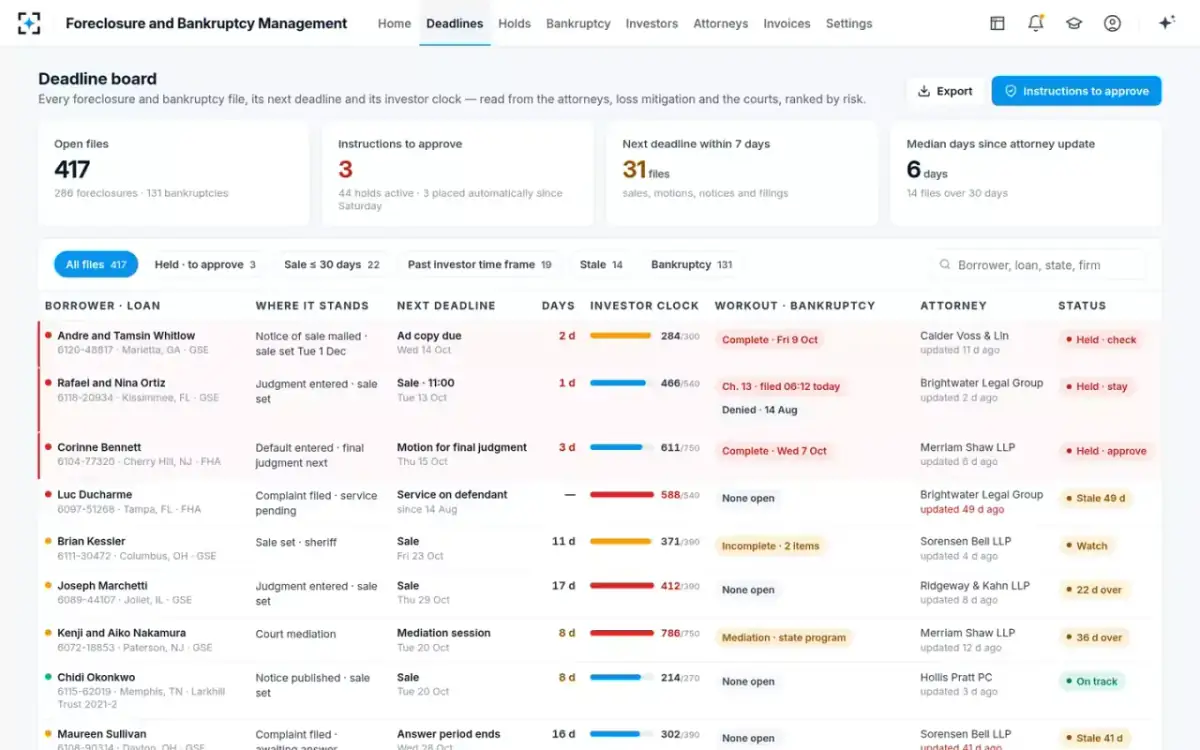
The stale flag is the one most buyers underrate. A file with no update for 49 days, like the sample's Tampa file waiting on service of process, is not just slow; the servicer cannot vouch for its status to the investor, the borrower or an examiner. A board that ranks files by the next deadline and the investor clock, rather than alphabetically, is what lets one specialist run several hundred files.
Can software stop a foreclosure sale?
Software can place a hold on the step in the attorney's portal and tell counsel why; the legal stop happens when counsel acts on it. That distinction matters because the servicer cannot hand off the duty. The commentary to Regulation X is explicit that the bar on "conducting a foreclosure sale" applies "even if a person other than the servicer administers or conducts the foreclosure sale proceedings" (comment 41(g)-5). The servicer is answerable for the sale whoever runs it.
It also matters which steps are stopped. The bar in 1024.41(g) covers the dispositive motion, the order of sale and the sale itself. The commentary allows the rest of the process to continue: "Nothing in § 1024.41(g) prevents a servicer from proceeding with the foreclosure process, including any publication, arbitration, or mediation requirements established by applicable law … so long as any such steps … do not cause or directly result in the issuance of a foreclosure judgment or order of sale, or the conduct of a foreclosure sale" (comment 41(g)-2). Many servicers pause publication anyway, to avoid charging a borrower for an ad that may not be needed; that is a policy choice, and good software keeps it as a separate setting from the legal bar.
Six agents read, check and draft; a person approves every instruction
Agent
Attorney status readerReads every portal update, docket entry and sale notice, and keeps each legal step with its date and document.
Never: Changes a date set by a court or an attorney
Agent
Workout status watcherWatches the loss mitigation record and, when an application becomes complete, counts the days to any scheduled sale.
Never: Decides whether an application is complete
Agent
Bankruptcy court watcherSearches the court feed for petitions, dismissals and motions on every borrower and co-borrower, and finds prior cases.
Never: Files anything with a court
Agent
Timeline rules checkerApplies Regulation X, state rules and the investor's time frame, names the collision and holds the colliding step at once.
Never: Releases a hold, waives a rule or sends an instruction
Agent
Hold and instruction drafterDrafts the hold, cancel-sale or resume instruction and the investor delay note.
Never: Sends without the specialist's approval
A person decides
Foreclosure and bankruptcy specialistReads the cited rule and the evidence, approves the instruction; a second person co-approves any restart.
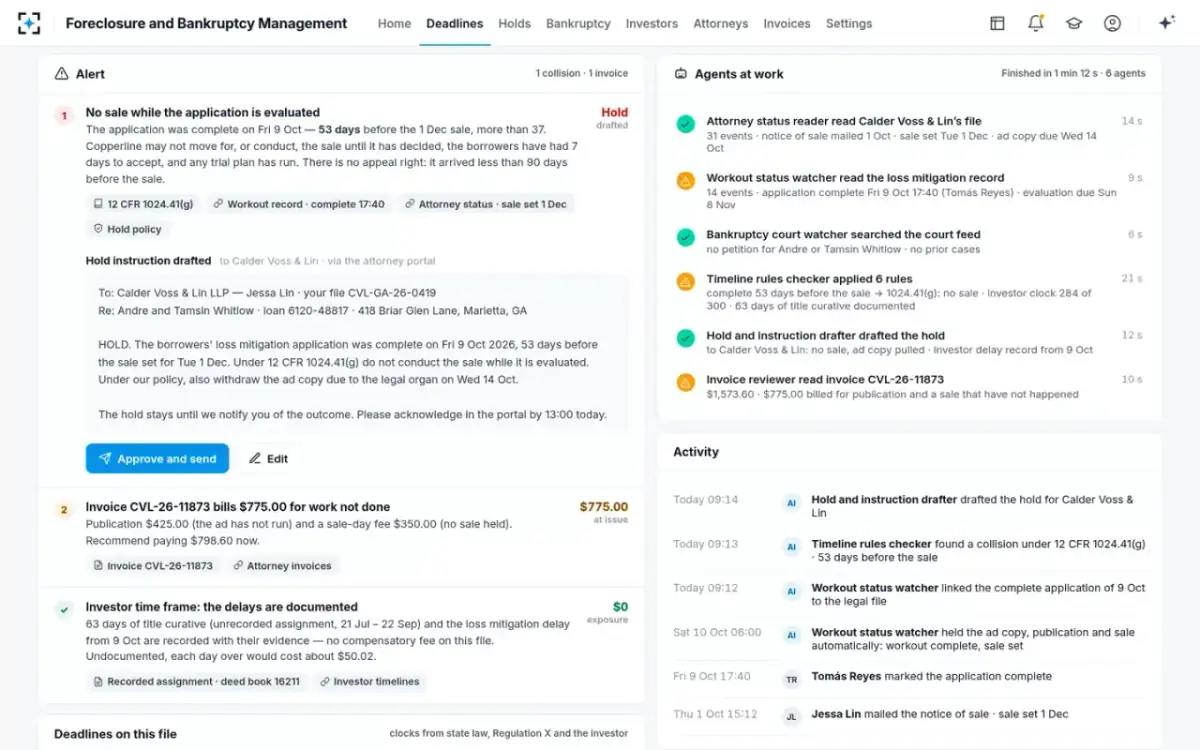
In the sample, the agents' check of the Whitlow file took 1 minute 12 seconds: 31 events in the attorney's file, 14 in the loss mitigation record, no petition in the court feed, six rules applied, and one collision named. The hold itself had already been placed automatically at 06:00 on the Saturday, about twelve hours after the application was marked complete; Monday's check produced the written instruction for a person to sign.
In Foreclosure and Bankruptcy Management, one click checks a file against three systems and six rules
How to monitor the automatic stay across a default portfolio
Search the court feed often, for every obligor, and read prior cases on every hit. The automatic stay arises on the filing of the petition (11 U.S.C. 362(a)), so a servicer is bound before it knows. A daily batch leaves a whole business day in which a sale can go ahead. Searching co-borrowers matters too: in Chapter 13 a separate co-debtor stay protects an individual who is liable on the consumer debt with the debtor.
Prior cases matter because they change the stay. With one case dismissed in the previous year, the stay on a later filing ends on the 30th day unless the court extends it; with two or more, no stay arises at all. Software that reports "bankruptcy: yes" without the prior-case history leaves the specialist to work that out by hand, under time pressure. When the stay ends on day 30, or never starts walks through the decision.
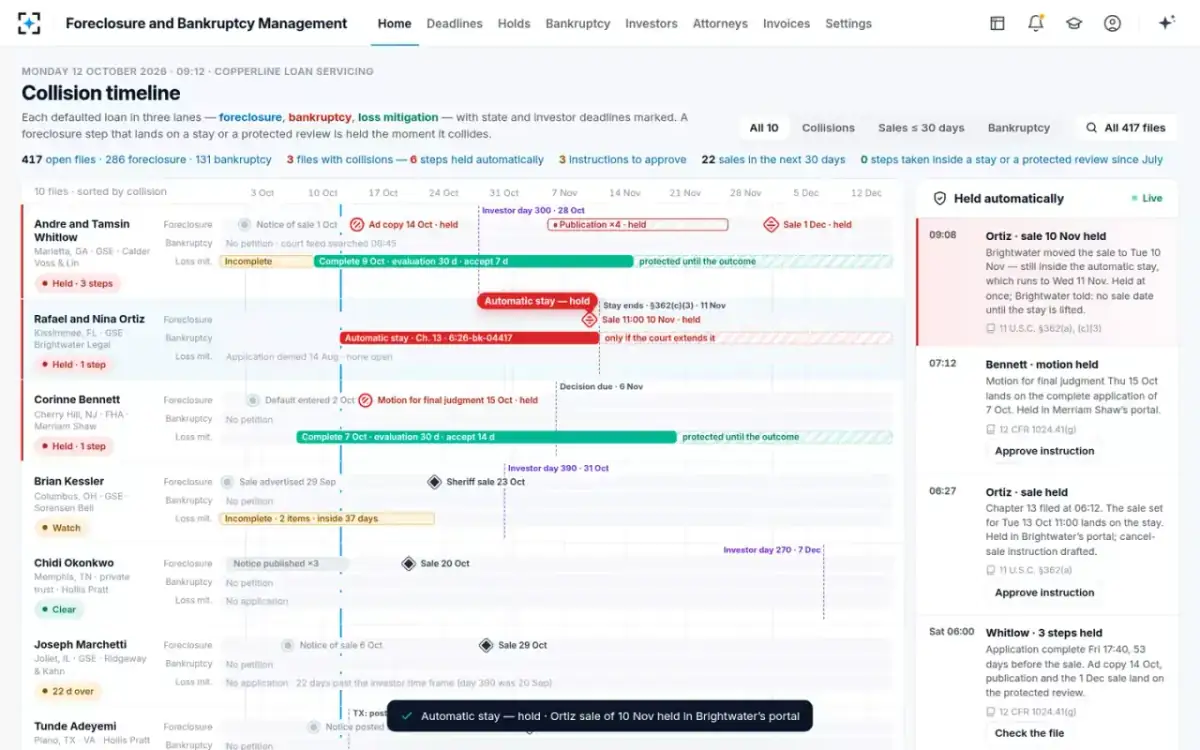
A sale moved by the attorney lands on a stay, and is held again
What should foreclosure software never do?
It should never move a date a court or an attorney set, never decide whether an application is complete, never release a hold on its own, never file with a court and never pay an invoice. The reason is asymmetry. A wrongly placed hold costs a day and a phone call. A wrongly released hold can cost a borrower a home, and the servicer the redress, penalties and remediation that follow.
What foreclosure software may do on its own, and what stays with a person
Safe to automate: Place a hold on a colliding step in the attorney's portal at once, citing the rule and the evidence.
Must stay with a named person: Release a hold, or restart a file after one (two approvers in the sample).
Safe to automate: Read every date from the firm and the court, and flag a date that lands on a stay or a protected review.
Must stay with a named person: Set or move a legal date; that is counsel's and the court's.
Safe to automate: Read the underwriter's determination and count the days to the sale.
Must stay with a named person: Decide whether an application is complete or facially complete.
Safe to automate: Draft the hold, cancel-sale or resume instruction with what to stop, why and until when.
Must stay with a named person: Approve and send it, with the meaning of the signature recorded.
Safe to automate: Prepare notices for counsel; check invoice lines against the step reached.
Must stay with a named person: File with the court; approve or pay an invoice.
How to evaluate foreclosure case management software: a buyer's checklist
Test it on your own colliding files, measure the gap from trigger to hold, and read the file an examiner would read. Demonstrations on clean data say little; every product tracks a file that never collides. The checklist below is ordered by how much each item would have changed in the enforcement cases.
Eight tests to run before you buy
- Bring five of your own colliding files
A complete application near a sale, a dawn Chapter 13, a repeat filer, a stale file and a disputed invoice. Watch what the product does with each.
- Time receipt to hold
From the minute the underwriter marks complete, or the petition is filed, to the minute the step is held in the firm's portal. Fay's gap was up to five days.
- Check what it reads, and how often
All six feeds, at what frequency; which come by live connection and which by file.
- Ask for the prior-case logic
Does it find dismissed cases in the past year and say when the stay ends, or that none arose?
- Separate the legal bar from policy
The 1024.41(g) hold should not be a switch; pausing publication should be.
- Read one hold the way an examiner would
Rule, trigger time, hold time, instruction, acknowledgment, release condition, each with its evidence.
- Find the limits in the product
Try to release a hold or move a sale date as the software. It should refuse.
- Price the investor clock
Ask how it finds days past each investor's time frame and the evidence for allowable delays.
The record-keeping test deserves its own time. Regulation X requires servicers to keep documents of actions taken on a loan account until a year after discharge or transfer, and the CFPB's 2019 assessment noted that servicers said the foreclosure restrictions were among the more costly provisions to comply with (CFPB, 2019). A system that stores the evidence as it acts is cheaper to defend than one that has to reconstruct it. The four timestamps a hold file keeps sets out what that evidence looks like.
Which servicers Foreclosure and Bankruptcy Management suits, and which it does not
It fits a servicer or subservicer with outside counsel across several states, a separate loss mitigation platform and enough bankruptcy volume that a daily check is too slow. It reads the systems the default team already runs, the attorney portal, the loss mitigation system, the court feed, the servicing system, investor tables and invoices, and does not ask any of them to change.
It is not a law firm's practice system and does not draft pleadings. It does not evaluate loss mitigation applications or decide eligibility; it reads the decision. It does not replace the servicing system of record. A small servicer, as Regulation X defines it, is exempt from most of 1024.41 but still bound by the 120-day rule and by the bar on foreclosing while a borrower performs under a loss mitigation agreement (1024.41(j)), so the value there is narrower. For Chapter 13 notices, the solution counts the deadlines under Bankruptcy Rule 3002.1 and prepares notices for counsel; what changed in that rule in December 2025 is covered in the Rule 3002.1 guide.
Questions people ask
What is the difference between foreclosure software for servicers and for attorneys?
Attorney software manages a firm's docket, pleadings and billing. Servicer software manages referrals, the firm's status, investor deadlines and, critically, the Regulation X protections that depend on the loss mitigation file. A servicer needs both views on one timeline, because the collision happens between them.
Can foreclosure software stop a sale on its own?
It can hold the step in the attorney's portal at once and tell counsel why, which is the safe direction. The servicer remains responsible for the sale even when a trustee or sheriff conducts it, so the instruction and the firm's acknowledgment still need to be on file.
How quickly should a hold reach the foreclosure attorney?
The protection runs from the day the application became complete or facially complete, so a hold should be in place before the next barred step can happen, the same day where possible. The CFPB treated a gap of up to five days at Fay Servicing as producing violations of 1024.41(f)(2) and (g).
Does a foreclosure hold have to stop publication?
No. The commentary to Regulation X lets publication, mediation and arbitration continue if they do not directly produce a judgment, order of sale or sale. Many servicers pause publication anyway as a policy, and software should keep that as a separate setting.
How often should a servicer check for new bankruptcy filings?
Often enough that a dawn filing is caught before a morning sale. The stay arises on filing, not on notice. The sample servicer in this guide searches every 15 minutes for every borrower and co-borrower; daily batches leave a business day exposed.
Is foreclosure software worth it for a small servicer?
Less often. Small servicers under Regulation X are exempt from most of the loss mitigation procedures but not from the 120-day rule or the bar on foreclosing while a borrower performs under an agreement. With few files and one firm, a disciplined calendar may be enough.