A language access plan for insurance claims is the carrier's written decision on six things: which languages it serves and on what evidence, which claim communications it offers in those languages, who interprets and how they are qualified, which text governs when a translation differs, how a customer's language preference is kept and used, and how the quality of all of it is tested. For property and casualty claims, no general US rule requires one; notice of a claim is defined by what it tells the insurer, not the language it arrives in, so a first notice in Spanish starts the same clocks as one in English. California does require a written plan of exactly this shape from health insurers, and the CFPB has published the federal government's most detailed guidance on serving customers with limited English proficiency. The operational risk sits at first notice of loss: the detail said in passing in Spanish, an injury or the other driver taken to hospital, is the one an interpreter's summary drops. Botminds' FNOL & Claims Triage Automation transcribes a first notice in the caller's language and routes on what was said.
This guide is for the claims operations leader and the compliance officer who own a carrier's first-notice line. It is general information, not legal advice for any state. Examples of the solution come from a fictional carrier, Tallowmere Mutual, with sample data; the Spanish phrases in the routing examples are our own illustrations.
The population a claims language plan is sized for
67.8M
people aged 5 and over in the US who speak a language other than English at home
22%
of the population aged 5 and over
37.6%
of them have limited English proficiency
What should a language access plan for insurance claims cover?
Six decisions, each written down with the evidence behind it. The closest regulatory model is California's rule for health insurers, which requires a Language Assistance Program "documented in a plan with comprehensive written policies and procedures" covering "assessment of insureds; provision of language assistance services; staff training; and compliance monitoring" (10 CCR §2538.3(b)). The same rule asks how "vital documents will be translated", with "standards to ensure the quality and accuracy of the written translation", and how the plan will be evaluated, "including an analysis of complaints".
That rule binds health insurers, not a property and casualty carrier's claims line. It is still the most complete template a claims leader can borrow, and its headings map onto claims work without strain: who the customers are and which languages they prefer, which claim letters are vital, how calls are interpreted, how staff are trained and how the program is checked.
Six decisions a claims language access plan writes down
- Languages served, and the evidence
Customers’ stated preferences and Census data for the states written; reassessed on a fixed cycle (three years in California’s health rule).
- Which communications, in which languages
The ones that most affect the claimant: acknowledgement, requirements list, status letters, the decision and how to appeal.
- Who interprets, and how they qualify
Bilingual staff, contracted interpreters or remote interpreting, each with demonstrated proficiency in both languages.
- Which text governs
Whether the English or the translated letter controls, and how the customer is told.
- Language preference: kept and used lawfully
Captured at first notice, carried on the claim, and never used to offer a customer less.
- Quality testing and complaints
Sampled calls and letters in each language, and complaints analysed by language.
Does an insurer have to take a claim in Spanish?
In the sense that starts the clocks, yes: a notice in Spanish is a notice. California defines notice of claim as "any written or oral notification to an insurer or its agent that reasonably apprises the insurer that the claimant wishes to make a claim" (10 CCR §2695.2(c)), and bars an insurer from requiring written notice unless the policy says so (§2695.5(f)). A clear call in Spanish reporting an accident meets that definition, and the 15-day acknowledgement and investigation clocks run from it whether or not anyone on the line understood the details.
That is the compliance point a plan has to absorb. An insurer cannot treat a Spanish call it could not fully understand as a later notice, and anything said in that call, an injury, a second vehicle, a lawyer, is knowledge the carrier had on the first day. Explicit language mandates are narrower: California's health rule requires interpretation "at no cost to LEP insureds at all points of contact", and says interpreter services "are not timely if delay results in the effective denial of the service, benefit, or right at issue" (10 CCR §2538.6). A property and casualty plan that adopts the same timeliness standard voluntarily is easier to defend than one that has no standard at all.
Choosing the languages, on documented evidence
The defensible way to choose languages is from data the carrier can show a regulator. The CFPB's 2021 statement, written for lenders and banks rather than insurers, tells institutions to rely on "documented and verifiable information (e.g., the stated language preferences of its current customers or U.S. Census Bureau demographic or language data)", and notes that "some nationwide institutions largely focus on serving Spanish-speaking consumers, while regional institutions typically align any language services with local demographics" (CFPB LEP Statement).
The same statement asks institutions to document their decisions on languages, products and services, including "any other information that allows a regulator to understand the decision-making process". For a claims line, that means a short memo per language: the share of the book's customers who asked for it, the states where it matters, the channels covered and the date of the next review. California's health rule sets the review cycle at three years (10 CCR §2538.4); a carrier entering a new state should not wait that long.
Which claim communications to offer in Spanish first
Start with the communications that carry rights, deadlines and money. The CFPB frames the test as the "activities and communications—whether verbal or written—that most significantly impact consumers". On a claim, that is the first notice itself, the acknowledgement, the list of what the carrier still needs, status letters while the claim is open, the decision with its reasons, and the notice of how to have a decision reviewed by the state department of insurance. Marketing and general policy information can follow.
Claim communications, ranked by what they carry
| Communication | What it carries | Spanish first? | Why |
|---|---|---|---|
| First notice call or form | The facts that set the desk and the reserve | Yes | An injury missed here routes the claim to the wrong desk |
| Acknowledgement | Claim number, contact, what happens next | Yes | Starts the customer’s side of the claim; usually a short template |
| Requirements list | Documents and photos the carrier needs | Yes | A misunderstood list delays proof of loss and every clock after it |
| Status letters while open | Why more time is needed, and what is missing | Yes | California requires one every 30 days until the claim is decided |
| Decision and appeal notice | Payment, denial reasons, the regulator’s address | Yes, with the governing text named | The letter most likely to be read by a lawyer or a regulator |
| Policy forms and marketing | Contract terms, offers | Later, by decision | Which text governs needs a filed-forms decision |
Interpreters, bilingual staff and machine transcription
Each route has a known failure, and the plan should name it. Bilingual staff are the strongest option when proficiency is tested; California's health rule asks for "documented and demonstrated proficiency in the source and target languages" and "a demonstrated ability to convey information accurately in both languages" (10 CCR §2538.6). Contracted interpreters add a voice between the caller and the specialist, and the record of the call becomes the interpreter's summary rather than the caller's words. Family members interpreting is the weakest route; the health rule permits it at the insured's request only after the insured is told a qualified interpreter is available at no charge, and requires that offer and the refusal to be documented.
Machine transcription is the newest route and needs testing by language and accent before it is trusted. In a Stanford study of five commercial speech recognition systems, the average word error rate was 0.35 for Black speakers and 0.19 for white speakers on matched interviews (Koenecke et al., PNAS, 2020). That study measured English dialects, not Spanish, but its lesson transfers: a system that works on one group of speakers can fail quietly on another, so a carrier should measure accuracy on its own Spanish calls, by region of origin, before routing on the transcript.
The same Spanish first notice, through interpreted intake and through bilingual intake
Interpreted, English notes: An interpreter’s summary, or the specialist’s understanding of it
Bilingual, Spanish kept: The caller’s words transcribed in Spanish, with each loss-notice value beside them
Interpreted, English notes: “Mi hijo dice que le duele el hombro” can become “son fine”
Bilingual, Spanish kept: A pain signal for a passenger; the claim routes to the injury desk
Interpreted, English notes: Caller, relative and interpreter in one voice
Bilingual, Spanish kept: Speakers separated, so the person in pain is attached to the right exposure
Interpreted, English notes: A letter in English the caller may not read
Bilingual, Spanish kept: A text from an approved Spanish template, confirmed by a person before sending
Interpreted, English notes: The adjuster reads the English notes only
Bilingual, Spanish kept: The adjuster can open the original Spanish sentence behind any value
Where a Spanish first notice loses the injury
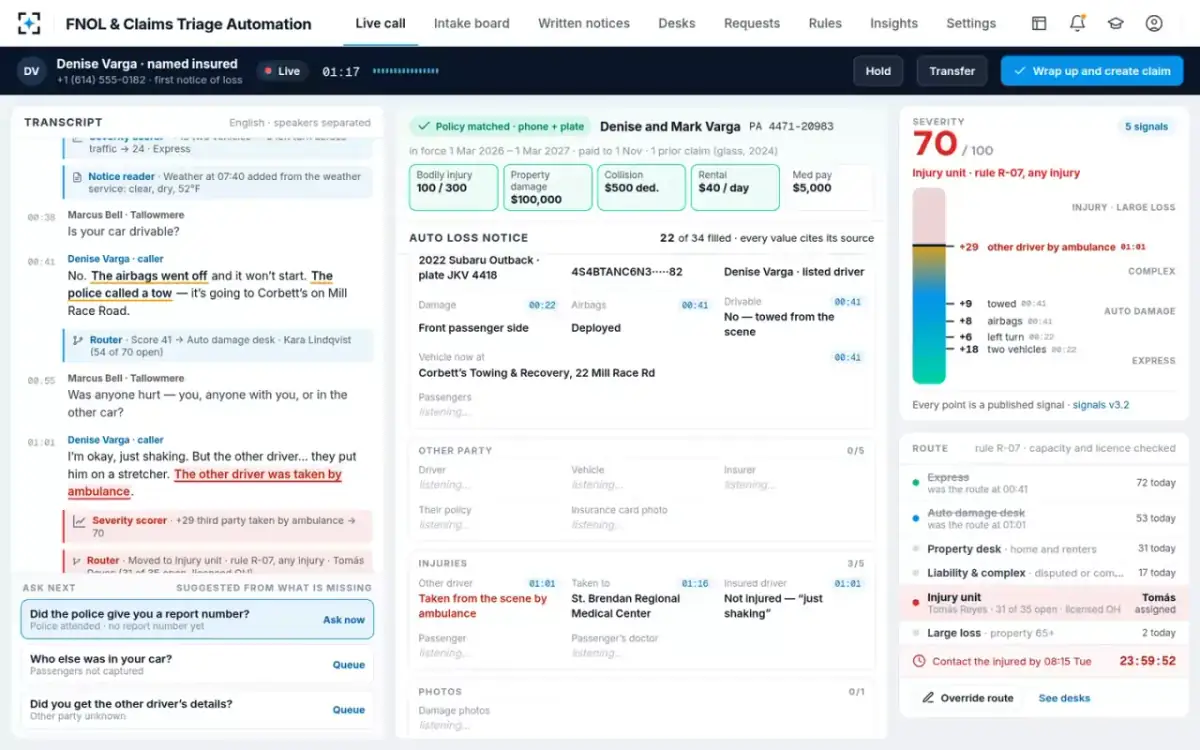
A Spanish first notice goes wrong where an English one does, in the detail said in passing, and an interpreter's summary adds one more place for that detail to drop. NHTSA's crash-report guideline treats a complaint of pain as a possible injury even with no visible wound (MMUCC, 6th edition), and a carrier's triage should apply the same rule in either language. The phrases below are our illustrations of what a bilingual rule set has to recognise, with the signal each would match at the sample carrier.
Spanish phrases a first-notice line hears, and what each should do
| What the caller says | In English | Signal it should match | Route |
|---|---|---|---|
| Al otro conductor se lo llevaron en ambulancia | They took the other driver away in an ambulance | Taken by ambulance or to hospital | Injury unit, whatever the score |
| Mi hijo dice que le duele el hombro | My son says his shoulder hurts | Our driver or passenger complains of pain | Injury unit |
| El otro señor decía que le dolía el cuello | The other man was saying his neck hurt | Third party complains of pain | Injury unit |
| Atropellaron a un ciclista | A cyclist was hit | Pedestrian or cyclist struck | Injury unit |
| Nadie salió herido | Nobody was hurt | None: a negation, not an injury | By score, as usual |
| Tengo una carta del abogado | I have a letter from the lawyer | Attorney letter | By score (+22 at the sample carrier) |
Two rows decide whether a rule set works. The negation in "Nadie salió herido" defeats keyword matching in either language, because "herido" means injured. And the third row is said about someone else, in the past tense, which is how a passing complaint by the other driver sounds. A rule that only matches "me duele", it hurts me, misses both the son and the other driver. How a carrier tests a triage rule set by planting injuries in past notices is set out in claims triage solutions.
Which text governs: translated letters and approved templates
A translation helps a customer act; the plan must say whether it binds the carrier. Public bodies that translate say so plainly. California's DMV offers a "Spanish version (PDF)" of its SR-1 accident report beside the English form, and states that "The web pages currently in English on the DMV website are the official and accurate source for the program information and services the DMV provides." Federal credit rules take the mirror approach: under Regulation B, disclosures made in another language must be available in English on request, as the CFPB's statement notes.
For a claims line, that means three controls. The transcript keeps the Spanish as said. Every outbound message comes from a template compliance has approved in Spanish, not from machine translation of the English letter, and the template names which version governs. And the claims vocabulary is fixed in a glossary: the Texas Department of Insurance publishes one in Spanish, defining "Lesiones corporales (bodily injury, BI) – Las lesiones físicas que sufre una persona" and the claimant as "La persona que presenta una reclamación de seguro" (TDI, Glosario de Terminología de Seguros de Automóvil). A customer who has read the regulator's Spanish should meet the same words in the carrier's letters.
A first notice in Spanish through FNOL & Claims Triage Automation
Agent
Call listenerTranscribes in Spanish as spoken, separating the speakers and stamping each line with the call clock.
Never: Speaks to the caller, or replaces the original words with a translation.
Agent
Notice readerFills each loss-notice field, keeping the Spanish sentence it came from beside the value.
Never: Guesses a value that was not said.
Agent
Severity scorerAdds the published signals heard in what was said, with the sentence behind each point.
Never: Decides fault.
Agent
Follow-up writerDrafts the acknowledgement and the missing-items request from the approved Spanish template.
Never: Promises coverage or payment.
A person decides
First-notice specialistConfirms the claim and the Spanish message before either is created or sent.
How should a carrier test its language access plan?
By sampling calls and letters in each language and comparing outcomes, not by counting interpreters. California's health rule requires the plan to say how it will be evaluated, "including an analysis of complaints and satisfactions surveys" (10 CCR §2538.3). For a claims line, three measures show whether the plan works: the share of Spanish first notices whose first desk was the final desk, against the same figure in English; the days from first notice to first contact with an injured party, by language; and complaints by language, read for whether the customer understood what was asked of them.
The comparison is the point. A Spanish line that routes injuries to the right desk as often as the English line is working; one that sends Spanish injury claims to the damage desk first, and corrects them days later, is failing in the way a regulator or a plaintiff's lawyer will find. The sample carrier's insights screen compares first desk against final desk over 30 days; splitting that view by language is the test.
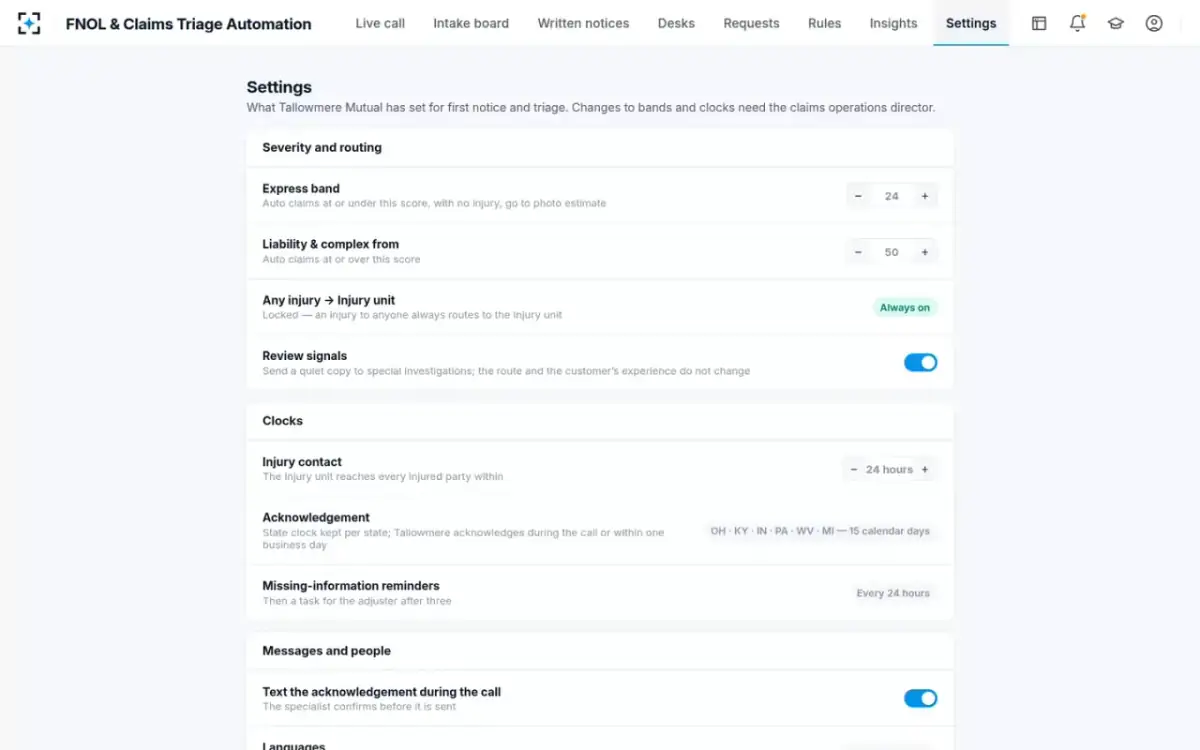
Languages are a setting, beside the clocks they serve
Where FNOL & Claims Triage Automation fits in a language access plan
The solution covers the part of a language access plan that happens on the first call and in the first messages. It transcribes in English and Spanish, keeps the caller's own sentence beside each loss-notice value, scores the published severity signals heard in either language, routes any injury to the Injury unit under a locked rule, and drafts acknowledgements and requirement requests from templates the carrier approves in each language. The specialist confirms each claim and each message before anything is created or sent. How a single call moves through those steps is traced in the claims FNOL process flow.
It does not write the plan. Which languages to serve, which letters are vital, which text governs and how interpreters qualify are decisions for the carrier's claims and compliance leaders, and the approved Spanish templates are theirs to write and sign off. Languages beyond English and Spanish need the same testing before they are switched on. And the solution measures what it hears: a carrier should test transcription accuracy on its own Spanish calls before it relies on any routing built on them.
The sentence that moved the claim, kept beside the value it set
Questions people ask
Are property and casualty insurers required to have a language access plan?
No general US rule requires one for property and casualty claims. California requires a written Language Assistance Program from health insurers under Insurance Code sections 10133.8 and 10133.9, and its structure is a usable template for a claims line.
Does a claim reported in Spanish count as notice?
Yes, where notice is defined by its content. California defines notice of claim as any written or oral notification that reasonably tells the insurer the claimant wishes to make a claim, so a clear Spanish call starts the same clocks as an English one.
What should a language access plan template include?
California's health rule lists the minimum: assessment of insureds, provision of language assistance services, staff training and compliance monitoring, plus how vital documents are translated and how interpretation quality is assured. A claims plan adds which text governs and how language preference is kept on the claim.
Can a family member interpret on an insurance claim call?
Nothing bars it on a property and casualty call, but it is the weakest route. California's health rule allows a family member or friend at the insured's request only after the insured is told a qualified interpreter is available at no charge, and requires that offer to be documented.
How accurate is speech recognition for non-native speakers?
It varies by speaker group, which is why it must be tested. A 2020 PNAS study of five commercial systems found average word error rates of 0.35 for Black speakers and 0.19 for white speakers of English. It did not test non-native or Spanish speech, so a carrier should measure its own system on its own Spanish calls.
How many people in the US have limited English proficiency?
The CFPB, citing Census Bureau data in 2021, put the number speaking a language other than English at home at 67.8 million, 22% of people aged 5 and over, and 37.6% of them as having limited English proficiency.