An FNOL call center is the part of a claims operation that takes every first notice of loss, by phone, app, web form, email or agent, identifies the policy, captures what happened and who was hurt, routes the claim to the desk that will handle it, and acknowledges it inside each state's clock. It does not decide coverage, fault or the amount; its job is the first hour, and its output is a claim on the right desk with an accurate note. The hard part is that the clocks start at notice, not when the claim reaches the right adjuster: a misrouted claim, or one waiting in a shared inbox for a supervisor to assign it, burns regulated days before anyone who can act has seen it. Botminds' FNOL & Claims Triage Automation fills the loss notice from the call or the written report, scores severity from what was said, and proposes the desk and the adjuster for a first-notice specialist to confirm.
This guide is for the head of claims intake and the claims operations director who staff and run the line. The shift below is a sample morning at a fictional carrier, Tallowmere Mutual; its people, claims and figures are sample data, not a customer's results.
One sample morning on a claims line, midnight to 08:14
186
first notices since midnight, from five channels
128
of them written: app, web form, email and agent
14min
median from first notice to the right desk
3
claims moved after routing
What does an FNOL call center do?
It turns a customer's account of a loss into a claim the carrier can act on, and puts it in front of the person who will handle it. Five tasks make up the work: identify the policyholder and confirm the policy was in force on the date of loss; capture what happened, who was involved and who was hurt; size the claim; route it to a desk and an adjuster; and tell the customer what happens next and what to send. Coverage, liability, reserves and payment belong to the adjuster.
A carrier may split the line by channel, with phone specialists on the claims number and a written-notice team reading forms, emails and agents' submissions. The split matters less than it looks. On the sample morning, 58 of 186 notices came by phone and 128 in writing, including an attorney letter about an accident the insured had not reported. Written notices carry the same clocks, the same routing rules and, as that letter shows, the same risk.
The clocks an FNOL call center runs on
The acknowledgement and first-contact clocks start at notice, and notice to an agent counts. California gives an insurer 15 calendar days from notice to acknowledge the claim, provide forms and "reasonable assistance, including but not limited to, specifying the information the claimant must provide for proof of claim", and begin any investigation (10 CCR §2695.5(e)). Ohio gives 15 days, which sending the claim forms and complete instructions also satisfies, and says "Notification of a claim given to an agent of an insurer shall be notification to the insurer" (Ohio Adm. Code 3901-1-54). Washington, under a rule effective 18 October 2026, gives 10 business days on an individual policy and 15 on a group contract (WAC 284-30-360, as amended by WSR 26-17-089).
The first-notice clocks in three states, and what the file must show
| State | Acknowledge within | If acknowledged by phone | Notice to an agent |
|---|---|---|---|
| California | 15 calendar days; forms, instructions and investigation in the same period | A dated notation in the claim file | Failure to pass it on promptly is imputed to the insurer |
| Ohio | 15 days; payment, or sending the claim forms and instructions, within the period also satisfies it | No separate notation rule in this section | Is notice to the insurer |
| Washington | 10 business days (individual), 15 (group) | A notation “describing how, when, and to whom the notice was made” | Is notice to the insurer |
The note is where call centers fail exams. California requires that "If the acknowledgement is not in writing, a notation of acknowledgement shall be made in the insurer's claim file and dated", and the NAIC's examination standards test whether "The initial contact by the regulated entity with the claimant is within the required time frame" and whether "Claim files are adequately documented" (NAIC Market Regulation Handbook, Chapter 20). A specialist who acknowledges a claim on the phone and moves to the next call has met the rule and left no proof of it. How an examiner would read the first hour is set out in why FNOL is important in claims processing.
A claims-line morning, notice by notice
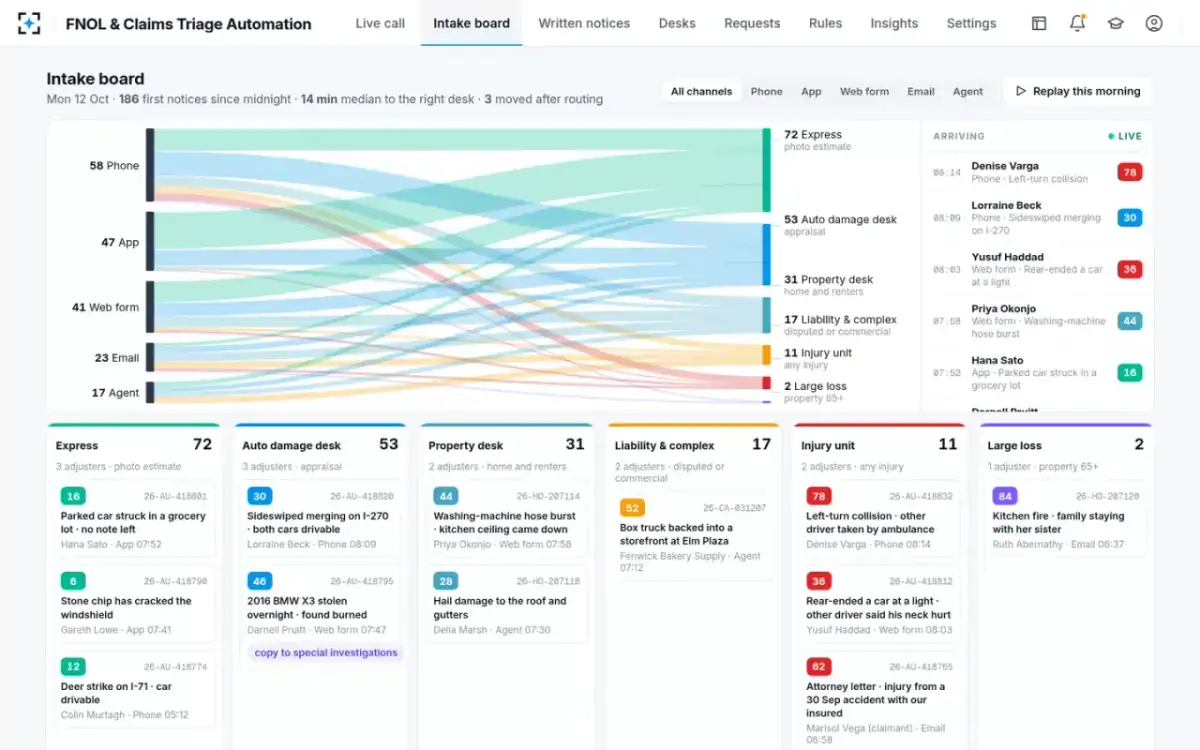
A first-notice morning is a run of very different claims, most small and a few urgent, arriving in no order across five channels. The sample board counted 58 notices by phone, 47 by app, 41 by web form, 23 by email and 17 from agents between midnight and 08:14. Twelve of them, in the order they arrived, show what one line has to sort.
Twelve first notices from one sample morning, and where each went
| Time | Channel | What came in | Score | Desk |
|---|---|---|---|---|
| 05:12 | Phone | Deer strike on I-71, car drivable | 12 | Express (photo estimate) |
| 06:37 | Kitchen fire; the family is staying with her sister | 84 | Large loss | |
| 06:58 | Attorney letter about a 30 Sep accident the insured has not reported | 62 | Injury unit | |
| 07:12 | Agent | Box truck backed into a storefront | 52 | Liability & complex |
| 07:30 | Agent | Hail damage to roof and gutters; date of loss missing | 28 | Property desk |
| 07:41 | App | Stone chip has cracked the windshield | 6 | Express |
| 07:47 | Web form | SUV stolen overnight, found burned | 46 | Auto damage, with a quiet copy to special investigations |
| 07:52 | App | Parked car struck in a grocery lot; app and web reports merged | 16 | Express |
| 07:58 | Web form | Washing-machine hose burst, kitchen ceiling came down | 44 | Property desk |
| 08:03 | Web form | Rear-ended a car at a light; the other driver said his neck hurt | 36 | Injury unit |
| 08:09 | Phone | Sideswiped merging on I-270, both cars drivable | 30 | Auto damage desk |
| 08:14 | Phone | Left-turn collision; the other driver taken by ambulance | 78 | Injury unit |
Three things decide the workload. The urgent claims are not only the high scores: a rear-end collision scoring 36 went to the Injury unit because the other driver said his neck hurt. Written notices hide work: the attorney letter at 06:58 is a claim the insured never reported, and the 07:52 app report duplicated a web form that had to be merged rather than opened twice. And each notice needs the policy, the account and a rule before it can move, which is why a line that reads its queue by hand falls behind by mid-morning.
186 first notices since midnight, five channels into six desks
Where the hours go on a first notice
Most of a first notice's elapsed time is not the call. On Botminds' estimate for one auto first notice handled by hand, the call and typing take about half an hour and the policy lookup a quarter of an hour, but the claim then waits about 16 hours in a shared inbox to be assigned, loses about 24 more when it was routed to the wrong desk and has to move, and needs a second call of about 8 hours' elapsed time to collect photos and missing details. Staffing more specialists on the phone shortens the first two; only better routing shortens the rest.
Estimated hours on one auto first notice, by hand
What should an FNOL call center measure?
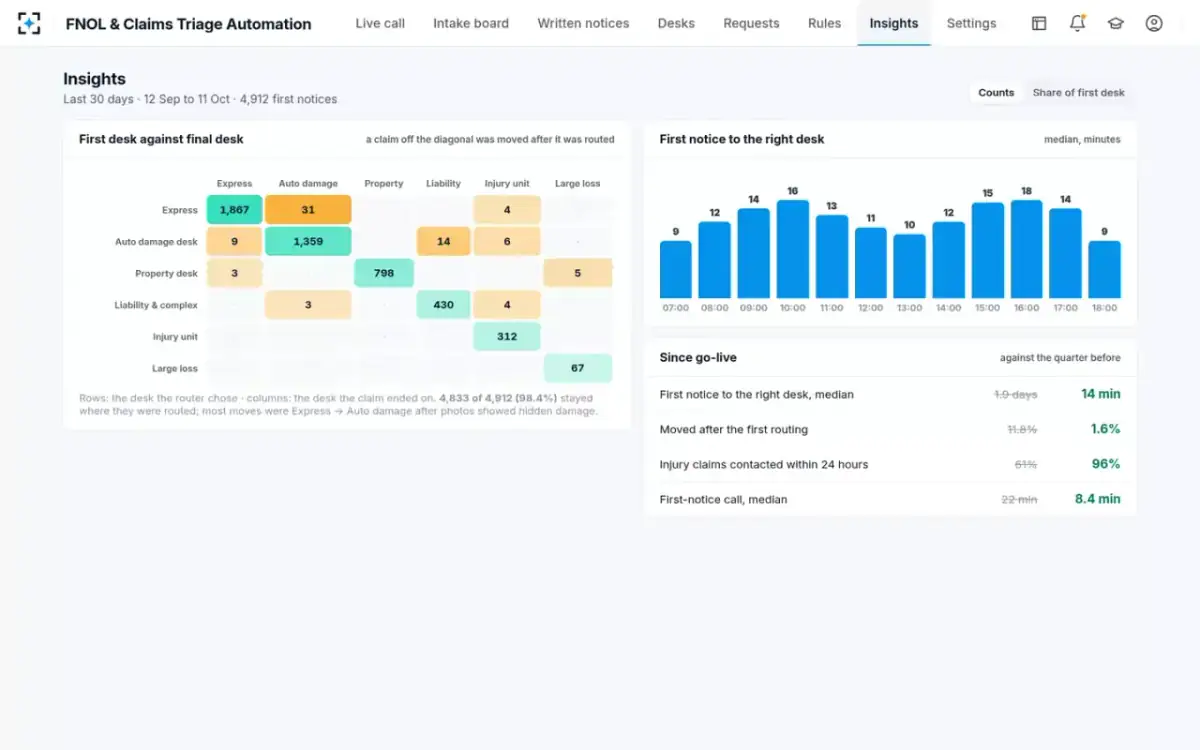
Measure whether claims reach the right desk on the first try, and how fast; average handle time comes after. A desk chosen at first notice and never changed is the outcome the line exists to produce. On the sample carrier, 4,833 of 4,912 first notices over 30 days, 98.4%, stayed on the desk the router first chose, and most of the moves were Express claims sent on to the auto damage desk after photos showed hidden damage. That table, first desk against final desk, is the single most useful view a head of intake can review each month.
Four more measures complete the picture: median minutes from first notice to the right desk, by hour of the day; the share of claims moved after routing; the share of injury claims whose injured parties were contacted within the carrier's injury clock; and first-call median handle time. On the sample carrier's figures against the quarter before go-live, the median to the right desk fell from 1.9 days to 14 minutes, moves after routing from 11.8% to 1.6%, injury contact within 24 hours rose from 61% to 96%, and the median first-notice call fell from 22 minutes to 8.4. Those are sample data on a fictional carrier, not a customer's results.
First desk against final desk: the view a head of intake reviews monthly
How should FNOL desks be capped and staffed?
Cap open files per adjuster by desk, route each new claim to the adjuster with the most room who is licensed in the loss state, and keep a named overflow for injuries. Caps differ by desk because work per claim differs: the sample carrier caps Express photo-estimate adjusters at 130 open files each, auto damage at 70, property at 60, liability and complex at 50, the Injury unit at 35 and large loss at 22. Special investigations receive quiet review copies of flagged claims without the route changing.
The caps make capacity visible during the day rather than at month end. On the sample morning the Injury unit stood at 65 of 70 open files across two adjusters, which is the moment to open an injury overflow rather than let new injury claims queue behind a full desk. A surge after a storm is the same problem at scale: the line can keep taking notices, but if the property desk is at its cap, the right answer is to add adjusters to that desk, not to route storm claims somewhere with room.
Open files against each adjuster's cap, and the states each is licensed in
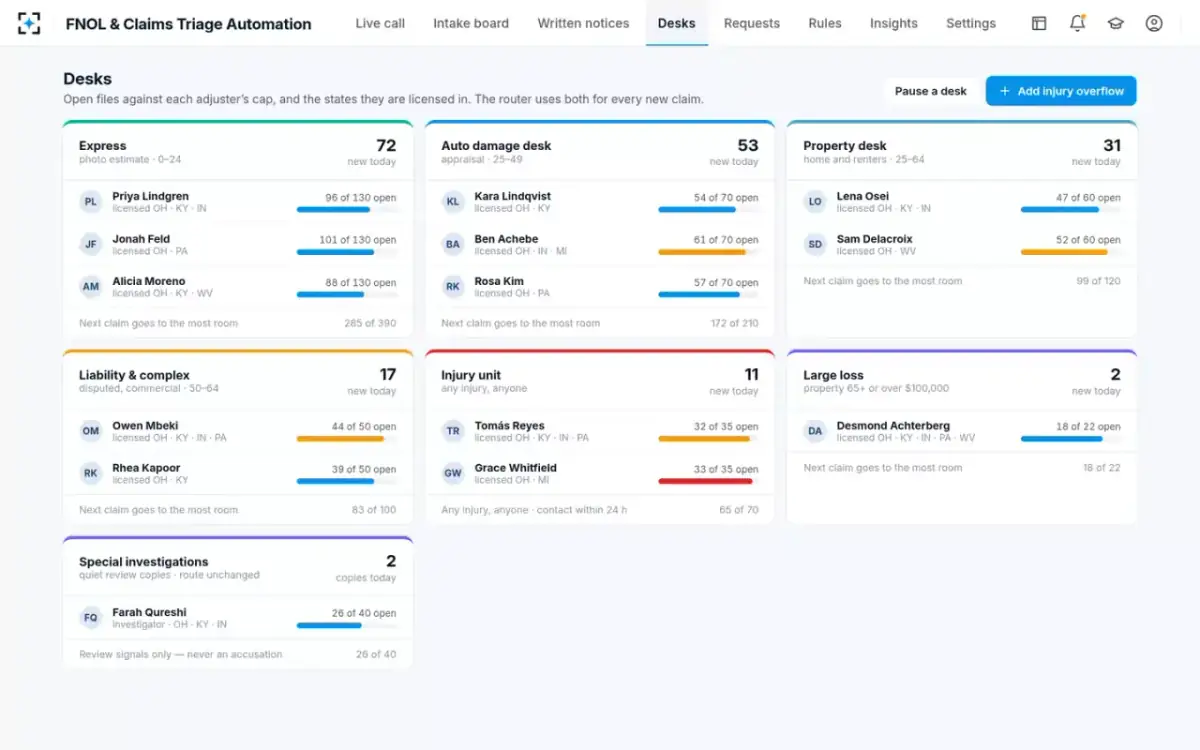
Photo estimates, and the Washington rule on routing to them
An Express or photo-estimate desk is the cheapest route for a drivable car with no injury, and Washington's amended rule limits how a carrier can push claims there. Insurers "shall not require the claimant to agree to only photo-based evaluation of damage as a condition of coverage"; when a claimant used the virtual inspection and disagrees on the amount, the insurer "must accept the claimant's request for an in-person inspection and conduct the inspection of the vehicle within five business days"; and first-party claimants must get "a clear written explanation of how applicable storage and towing fees are covered under the policy within five business days of the notification of claim" (WAC 284-30-390, as amended).
For the call center, two of those are first-notice tasks. The script must offer photo estimates as a choice, not a condition, and the towing and storage explanation has to go out in writing within five business days of the call, often before an adjuster is assigned. A carrier writing in Washington adds both to its per-state table; the sample carrier's Express band takes auto claims scoring 24 or under with no injury, and the specialist confirms the route on the call.
Who does what on one first-notice call
What moves to software is the typing, the searching and the first sorting; what stays is the listening, the questions that need judgment and the confirmation. On the sample call, which lasted 2 minutes 31 seconds, agents matched the policy in seven seconds, filled 31 of the loss notice's 34 fields from the conversation and the policy system, scored severity and proposed the desk and the adjuster. The specialist asked the suggested questions, kept the caller calm and confirmed the claim and the text to the customer. The full call is traced in the claims FNOL process flow.
Who did what on one 2-minute-31-second first-notice call
Loss-notice fields (34)
- Filled from the call by agents · 91%
- Requested by text · 9%
Decisions on the call (7)
- Proposed by agents: policy, score, desk, adjuster, text · 71%
- Made by the person: confirm claim, confirm text · 29%
Running the line: the controls a head of intake owns
A short list of controls keeps a first-notice line inside its clocks and makes its routing defensible. Each can be tested from the claim files an examiner would sample.
Seven controls for an FNOL call center
- Date the notice from the first channel it reached
An agent’s email or a web form is notice; the clock does not wait for the call back.
- Note every oral acknowledgement
Dated, and in Washington saying how, when and to whom. “Called insured” is not a note.
- Send any injury to the injury desk, whatever the score
Pain mentioned by anyone, in either car, starts the injury contact clock.
- Merge duplicates before routing
The same loss by app and web form becomes one claim, not two adjusters.
- Route on caps and licences
The adjuster with room, licensed in the loss state; overflow named in advance.
- Keep the per-state table current
Washington’s rule changed on 18 October 2026; a stale table is a wrong script.
- Review first desk against final desk monthly
Every move is a routing rule to examine, not just a claim to fix.
Where FNOL & Claims Triage Automation fits on the intake line
The solution takes the reading, typing, policy search and first sorting off the line. It transcribes the call live, fills the loss notice with the sentence behind each value, reads written notices with their attachments as they arrive, adds published severity signals into a score, routes on the carrier's rules, caps and licences, and drafts the acknowledgement and missing-items request from approved templates. Severity bands, the injury rule, the clocks per state and the reminder timing are settings; changes to bands and clocks need the claims operations director, and new signals and rules can be tried on last week's notices first. How a carrier tests a rule set before trusting it is set out in claims triage solutions.
It does not decide coverage, fault or the amount, and it never calls a claim fraudulent; special investigations get a quiet copy and the route stays unchanged. Nothing is created or sent until a person confirms it. And it does not replace the specialist's judgment on the call: the questions that change a claim, whether anyone else was in the car or what the other driver said, are still asked by a person, prompted by what the notice is missing.
Questions people ask
What is an FNOL call center?
The intake line that takes every first notice of loss, by phone and in writing, identifies the policy, captures the loss and the injuries, routes the claim to a desk and acknowledges it. It hands coverage, liability and payment to the adjuster.
How fast must an insurer acknowledge a first notice of loss?
It depends on the state: 15 calendar days in California, 15 days in Ohio, and in Washington, from 18 October 2026, 10 business days on an individual policy and 15 on a group contract. An oral acknowledgement must be noted in the claim file.
Does notice to an agent start the claim clock?
In Ohio and Washington the rules say so expressly: notification given to an agent of the insurer is notification to the insurer. California imputes an agent's failure to pass on a notice promptly to the insurer.
What is the most important FNOL metric?
The share of claims that stay on the desk first chosen, read as a matrix of first desk against final desk. On the sample carrier, 98.4% of 4,912 first notices over 30 days stayed where they were first routed.
How many first notices arrive in writing rather than by phone?
No public source measures it across carriers. On the sample carrier's morning, 128 of 186 first notices, about two in three, arrived by app, web form, email or agent rather than by phone.
Can an insurer require photo estimates at first notice?
Not in Washington: its amended rule bars requiring photo-only evaluation as a condition of coverage, and requires an in-person inspection within five business days when a claimant disputes a virtual estimate.